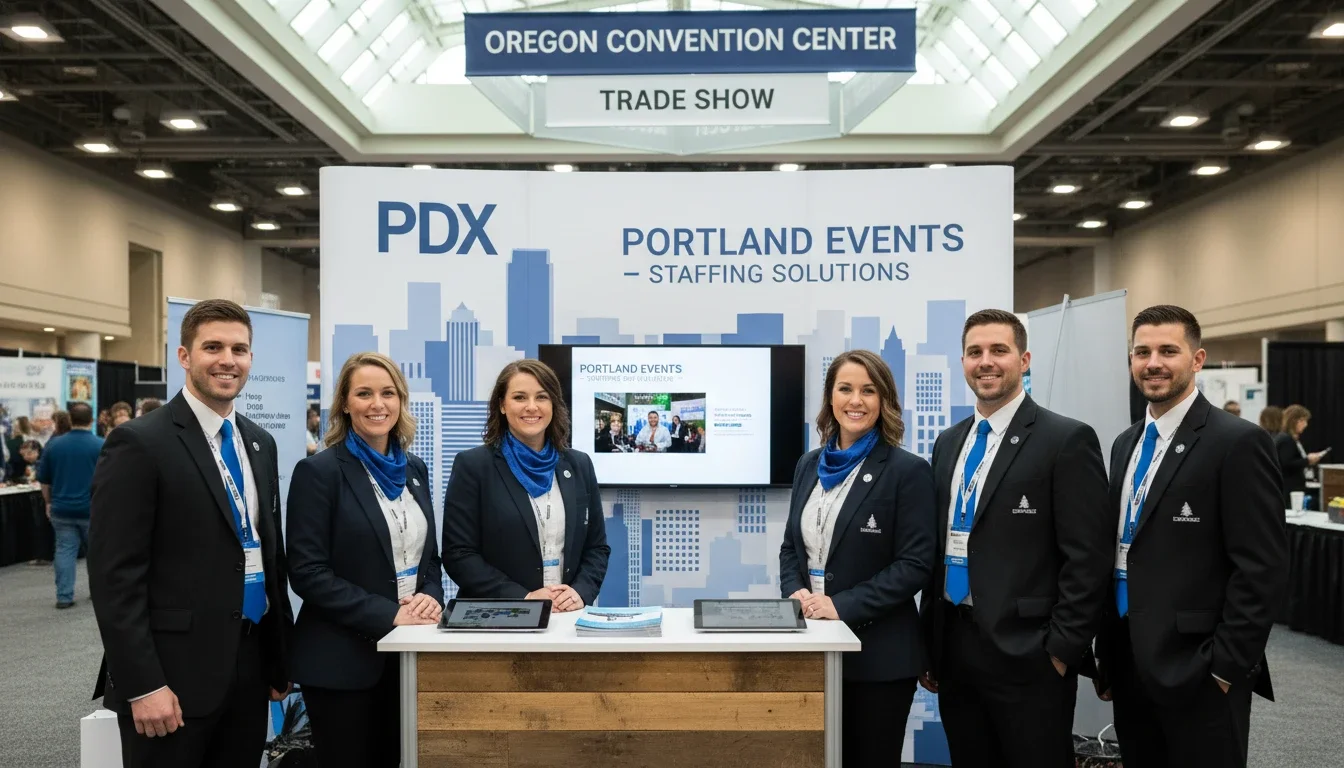
A professional event staffing team at a Portland trade show booth at the Oregon Convention Center
Portland, Oregon isn't just a city known for craft beer and Powell's Books. It's one of the Pacific Northwest's most active trade show markets, drawing thousands of exhibitors and buyers to the Oregon Convention Center and Portland Expo Center every year. Whether you're launching a product, building brand awareness, or generating leads at a convention, one thing can make or break your booth performance: the quality of your staff.
This guide covers everything you need to know about staffing a trade show in Portland — from defining roles and calculating headcount to training your team and deciding when to bring in a professional event staffing agency. If you've ever walked past an understaffed booth and watched qualified leads walk away, you know exactly why this matters.
Why Portland Is a Serious Trade Show Market
Portland punches well above its weight as a convention city. The metro area's mix of technology, outdoor recreation, food and beverage, healthcare, and sustainability-focused industries creates a steady calendar of trade shows that attract regional and national buyers alike.
Key Venues: Oregon Convention Center & Portland Expo Center
Oregon Convention Center (OCC): Located in the Lloyd District, the OCC is the largest convention center in the Pacific Northwest at nearly one million square feet, including 255,000 square feet of dedicated exhibit space, 52 meeting rooms, and two grand ballrooms. It's LEED Platinum certified and served directly by MAX light rail, making it highly accessible for attendees.
Portland Expo Center: Oregon's largest multi-purpose facility, the Portland Expo Center sits on a 53-acre campus with five exhibit halls totaling over 333,000 square feet. Conveniently located off Interstate 5 and served by MAX Yellow Line, it hosts more than 100 events annually — everything from the Northwest Food Show to automotive expos and consumer product shows. It was recently named the No. 1 mid-sized convention and event center in the United States by Trade Show Executive magazine.
Industries That Drive Portland Trade Shows
Understanding which industries show up in Portland helps you contextualize your staffing needs:
Technology & software (Salesforce, Intel, Nike — all have Pacific NW footprints)
Outdoor apparel & recreation (Farwest Show, sporting goods expos)
Food & beverage (Northwest Food Show — the largest B2B food show in the Northwest)
Healthcare & life sciences
Sustainability and green industries
Education, horticulture, and automotive
Each industry has different expectations for how booth staff look, speak, and engage. A tech startup's booth staff needs to articulate software value propositions. A craft beverage brand needs staff who can run samplings with energy and warmth. These distinctions matter when you're building your team.
Start With Strategy: What Does Your Booth Actually Need?
The single biggest mistake exhibitors make is treating staffing as an afterthought — something to figure out after the booth design is finalized and the marketing collateral is ordered. The problem with that approach is that your staff are your booth. They determine whether a passerby stops or keeps walking, whether a conversation leads to a qualified lead or a polite brush-off.
Define Your Trade Show Goals First
Your staffing plan should flow directly from your objectives. Before you can answer "how many people do I need?" you need to answer:
Are you here to generate leads, schedule demos, close sales, or build brand awareness?
Are you launching a new product that requires live demonstrations?
Do you have pre-scheduled meetings with prospects during show hours?
Are you doing product sampling or handing out swag?
What's your target number of conversations per day?
A brand awareness booth and a lead-gen booth have fundamentally different staffing requirements. The first needs high-energy greeters and crowd gatherers. The second needs trained sales reps who can qualify quickly and hand off to closers.
Booth Size & Layout Drive Your Staffing Needs
Booth footprint is one of the most reliable predictors of how many staff you need:
10x10 booth: Typically 2–3 staff. Enough for a greeter, a product specialist, and rotation coverage.
10x20 booth: Usually 3–5 staff. Add a dedicated lead capture person and a crowd gatherer.
20x20 booth: Plan for 5–8 staff minimum, more during peak hours.
Island or large format (30x30+): 8–15+ staff depending on demos, meeting areas, and show traffic.
Factor in scheduled meetings — every internal team member pulled into a 30-minute demo meeting is unavailable to staff the floor. Build that coverage into your plan.
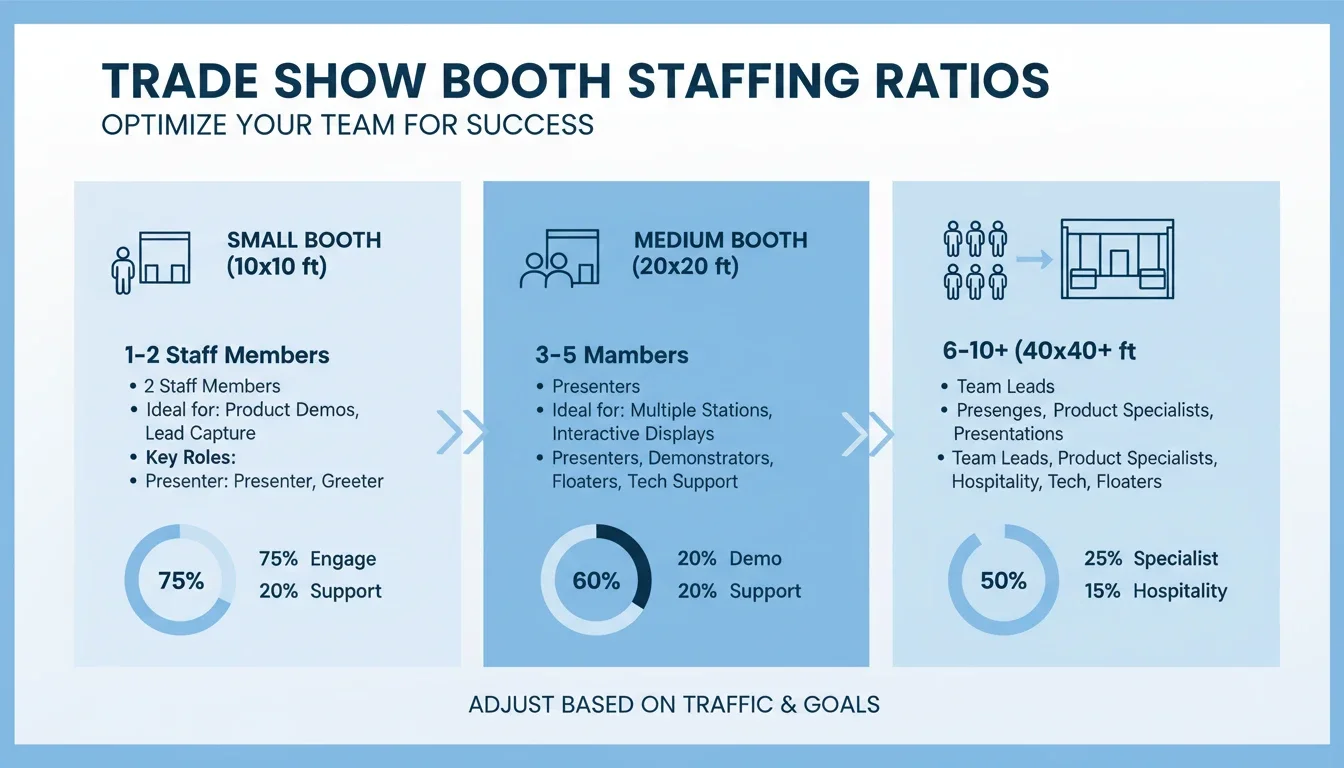
Infographic illustrating trade show booth staffing ratios by booth size
The Essential Roles for a Portland Trade Show Booth
Not everyone on your booth team should do the same job. When roles blur — when your sales closer is stuck restocking brochures or your greeter is stumbling through a product demo — the whole operation suffers. Define roles before you hire.
Greeters & Brand Ambassadors
Greeters are your first impression. They stand at the edge of the booth or in the aisle, make eye contact, and invite passersby into the space. The best greeters are warm, high-energy, and fast — they can assess a visitor's interest level in under 30 seconds and route them accordingly.
Brand ambassadors extend this role across the show floor. They represent your company's personality and can engage attendees even before they reach your booth. They're often the faces in photos and the voices doing quick-hit product explanations. This role is ideally filled by someone who genuinely enjoys people — it's hard to fake that energy across a 9-hour show day.
Key traits to look for: outgoing, high stamina, quick learners, comfortable with rejection, and physically presentable in your brand's uniform.
Product Demonstrators & Presenters
If your product or service requires a demo — software walkthroughs, physical product handling, technical explanations — you need dedicated presenters who do nothing else. Mixing demo and greeter roles kills throughput: while your presenter is deep into a 10-minute walkthrough, other attendees drift away.
Demo specialists should be technically knowledgeable, comfortable presenting to small groups and one-on-one, and able to read when an attendee is genuinely interested versus just killing time.
Lead Capture & Sales Representatives
These are your closers. Their job isn't to entertain — it's to convert qualified interest into a next step: a scheduled call, a demo booking, a signed order, or at minimum a properly captured lead with context attached.
Salespeople at trade shows need a shorter pitch than they're used to. The show floor is noisy, fast-moving, and full of competing booths. Train them on a 30-second qualifying pitch and a 2-minute value proposition. They should know when to invest in a conversation and when to politely disengage.
Crowd Gatherers
For larger booths or booths hosting demonstrations or presentations, crowd gatherers work the aisles — directing foot traffic toward your booth and building an audience. They're the ones who make an empty demo area look busy (nothing draws a crowd like a crowd).
Crowd gatherers work best in pairs, are typically high-energy performers, and may hand out promotional items or scan badges in the aisle.
Logistics & Support Staff
Every large booth needs someone managing the behind-the-scenes work: restocking brochures and swag, resetting demo stations, managing the storage area, tracking badge scans, and handling any technical issues. Keeping sales and greeter staff in front of attendees — not bent over a supply box — directly impacts your lead count.
On-Site Event Manager or Booth Captain
Someone needs to own the day. Your booth captain handles staff assignments, manages breaks, monitors booth performance in real time, liaises with show management and venue staff, and makes judgment calls when things go sideways. On multi-day shows, this person is essential.
If you're working with an event staffing agency, the agency typically provides a designated event captain who serves as the on-site point of contact for show day.
How Many Staff Do You Actually Need? A Practical Framework
The easiest way to understaff your booth is to guess. The easiest way to overstaff it is to bring everyone who seemed enthusiastic. Neither approach is a plan.
Staffing Ratios by Booth Size
| Booth Size | Recommended Staff | Key Roles | Notes |
|---|---|---|---|
| 10×10 | 2–3 | Greeter, Product Specialist | Rotation essential; one person can't run 9 hours alone |
| 10×20 | 3–5 | Greeter, Demo Specialist, Lead Capture | Add crowd gatherer if running presentations |
| 20×20 | 5–8 | Above + Booth Captain, Support Staff | Cover breaks; add overlap during peak hours |
| 30×30+ | 8–15+ | All roles, multiple greeters | Consider shift scheduling across show days |
Staffing strategy tip: For 10×10 booths, ensure staff rotations every 2–3 hours to maintain energy and engagement. For larger booths (20×20+), schedule overlapping shifts during peak traffic hours to avoid coverage gaps. A dedicated Booth Captain becomes essential for coordinating breaks and managing traffic flow at 5+ staff.
Accounting for Shifts, Breaks & Peak Hours
Trade show days are long — often 8 to 10 hours on the floor. Here's how to account for that without burning out your best people:
Rotate high-intensity roles every 60–90 minutes. Greeting and crowd gathering are exhausting. Staff performance drops noticeably after 90 minutes without a break.
Plan for lunch coverage. This is when many booths get quiet — and when understaffed teams leave their booth unattended. Schedule staggered breaks.
Know your peak hours. Most trade shows see peak traffic in the mid-morning (10am–12pm) and early afternoon (1pm–3pm). Staff your heaviest hitters during those windows.
Add 15–20% overflow capacity. Someone will call out sick. A key presenter will get pulled into an unplanned meeting. Build a buffer.
Building Your Portland Trade Show Staffing Plan
Using Internal Team Members vs. Hiring Locally
There's a common and understandable instinct to staff your Portland booth entirely with company employees. They know the product, they understand the brand, and they have skin in the game. But there are real tradeoffs:
Travel and accommodation costs: Flying four employees from your HQ to Portland for three days can easily cost $6,000–$12,000 in flights, hotels, and per diems — before any staffing fees.
Energy and fatigue: Your internal team is also attending planning meetings, managing logistics, and handling client outreach. Expecting them to also perform at peak greeter energy for nine hours a day is optimistic.
Role mismatch: Your best technical sales rep may be terrible at working an aisle. Some people are great in one-on-one conversations but have no presence in a crowd-gathering scenario.
The smarter approach for most exhibitors: bring your core team for relationship-building, demos, and high-value conversations — and supplement with trained local staff for greeting, lead scanning, crowd gathering, and support roles.
When to Work With a Portland Event Staffing Agency
Partnering with a professional event staffing agency makes sense when:
You need more booth coverage than your internal team can provide
You want to protect your highest-value employees from logistics and support roles
You're exhibiting in Portland for the first time and don't have local staff relationships
Your show requires specialized skills — bilingual staff, certified product demo specialists, or licensed bartenders for a hospitality suite
You need staff who are already familiar with the Oregon Convention Center or Portland Expo Center
A quality agency brings pre-vetted, trained professionals who show up on time, understand trade show dynamics, and can represent your brand credibly from day one — without requiring you to recruit, interview, and manage them yourself.
What to Look for in a Trade Show Staffing Agency
Not all staffing agencies are equal. When evaluating agencies for your Portland trade show, prioritize:
Pre-built local roster: An agency that recruits after you book is a liability. Look for agencies with established staff already in Portland who have been vetted, trained, and deployed before.
Rigorous vetting process: Background checks, live interviews, and reference verification should be standard — not optional.
Trade show experience: General event staffing and trade show staffing are different. Ask specifically about booth experience, lead capture tools, and show-floor etiquette.
Dedicated event captain: Someone who is accountable for the team on show day — not just an account manager who responds to emails.
Transparent pricing: No surprises. Understand what's included in the rate: training, transportation to the venue, uniform, and any agency management fees.
Flexibility and responsiveness: Trade show needs change. If an additional attendee surge hits and you need two more greeters, your agency should be able to respond.
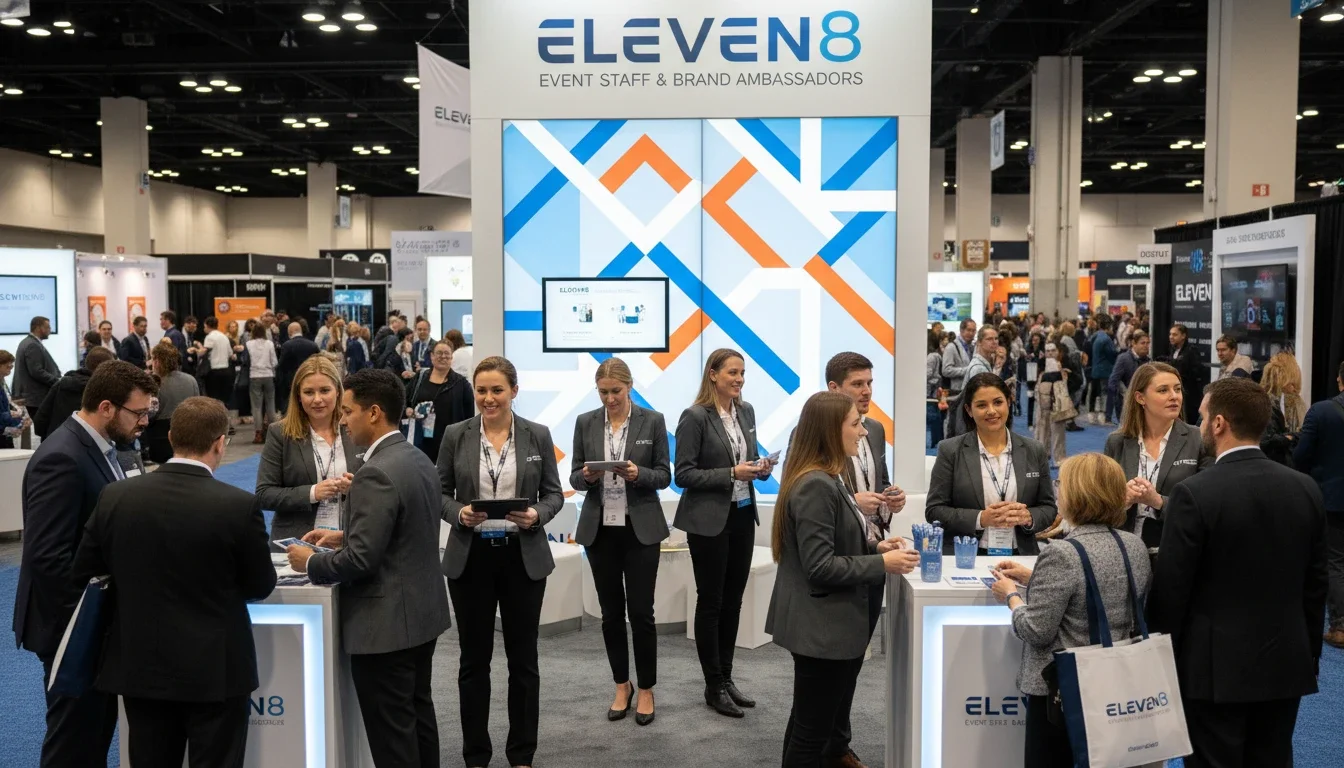
Eleven8 Event Staff brand ambassadors engaging attendees at a convention trade show booth
Training Your Trade Show Team Before the Show
Even the most experienced event staff needs a briefing specific to your brand, your product, and your goals for the show. Plan a pre-event training session — even a 60-minute virtual call — and cover the following:
Brand Briefings & Product Knowledge
What does your company do? Who does it serve? What's your elevator pitch?
What's your hero product or service for this show specifically?
What questions will attendees ask — and what are the correct answers?
What are the key objections, and how should staff handle them?
Who are the attendees at this show, and what do they care about?
Booth Etiquette & Engagement Scripts
Provide staff with a short opening line — something natural and not robotic. "Are you familiar with what we do at [Company]?" is more engaging than a product pitch. Give them a 30-second version and a 2-minute version of the core message.
Cover the basics that matter more than people realize:
No phones visible during show hours
Don't eat inside the booth
Always be standing and facing the aisle — not talking to each other
Know the nearest restroom, water fountain, and show management desk
How to handle an irate or aggressive attendee
The lead capture process — exactly how and where to log information
Shift Scheduling & Communication Protocols
Create a written schedule and share it with every team member before show day. Include:
Arrival time (30–45 minutes before doors open)
Role assignments per time block
Designated break schedule with named backfill coverage
Emergency contact for your booth captain or agency manager
End-of-day debrief time and location
Day-of Execution: Managing Your Portland Booth Team
Even the best staffing plan meets reality on show day. Here's how to stay in control.
Pre-Show Setup and Staff Briefing
Get to the Oregon Convention Center or Portland Expo Center at least 45 minutes before doors open. Use that window for:
Completing any booth setup tasks and confirming everything is operational
Running a 15-minute staff huddle covering the day's goals, talking points, and any last-minute changes
Assigning positions and confirming each person's first rotation
Testing lead capture tools — badge scanners, apps, paper forms — so there are zero surprises once the floor opens
Managing Energy and Engagement Across Long Show Days
Energy is your most perishable resource at a trade show. Protect it actively:
Rotate high-intensity roles every 60–90 minutes without exception
Keep snacks and water accessible backstage so staff don't leave the booth area unnecessarily
Do a quick mid-day check-in — 5 minutes — to recalibrate messaging based on what you're hearing from attendees
If staff energy visibly flags, rotate them to a lighter-duty task rather than leaving a tired person in the greeter position
Real-Time Adjustments on the Floor
Things rarely go exactly to plan. Be ready to adapt:
If one section of the booth is significantly busier, shift staff coverage in real time
If a particular pitch or demo is generating better responses, brief the team during a break
If the show is slower than expected, redirect crowd gatherers to be more proactive in the aisles
If you have scheduled meetings pulling key team members, confirm backup coverage is in place before those meetings start
After the Show: Staff Debrief & Lead Follow-Up
The show doesn't end when the doors close. Hold a 15-minute debrief with your full team — whether internal or agency staff — before everyone disperses. Cover:
What worked? What messaging landed best?
What didn't work? Any friction points in the booth flow?
How was the lead quality compared to expectations?
Were there any operational issues that need to be resolved before the next show day?
Capture the feedback in writing. Trade show staffing gets better every iteration — but only if you're actually learning from what happened.
On the lead side: the window for follow-up is narrow. Most lead conversion happens within 48 hours of the show. Ensure your CRM is updated with staff notes from badge scans, your sales team has prioritized leads before they leave Portland, and any follow-up emails are staged to send within 24 hours.