Hutchinson 10-Day Staffing: Avoiding Burnout on Long Activations
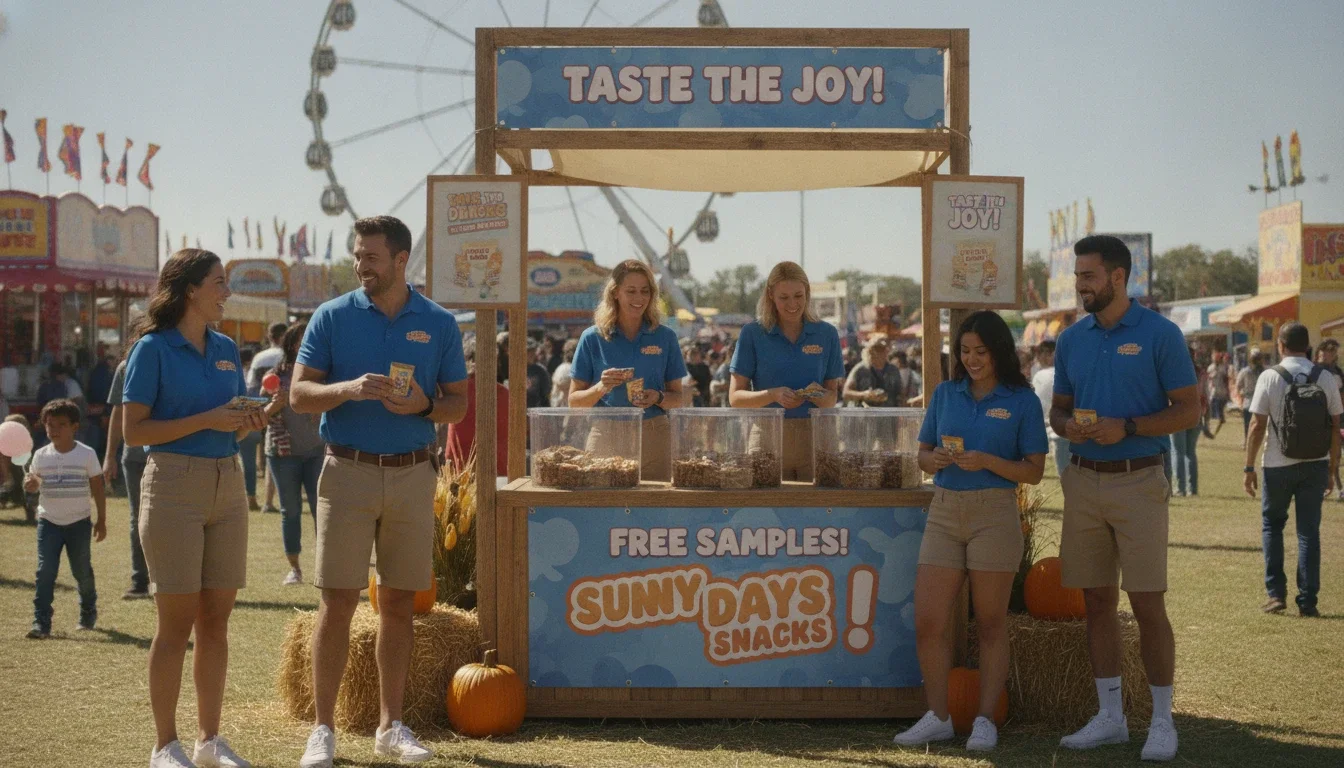
Brand ambassador team in matching branded uniforms working an outdoor activation booth at a state fair
Ten days is a long time to be on. For event staff working a state fair activation or any extended brand presence, Day 1 energy is easy — Day 8 is where activations quietly fall apart.
If you're planning a brand activation in Hutchinson, Kansas — particularly around the Kansas State Fair — you're committing to one of the Midwest's most demanding consumer engagement environments. The fair draws more than 350,000 visitors across 10 days on 280 acres of fairgrounds, and the brand opportunities are significant. So is the operational challenge.
This guide is for brand managers, experiential marketing leads, and event producers who need their staff to perform at the same level on Day 10 as they did on Day 1. We'll walk through the mechanics of burnout in long activations, practical rotation and scheduling frameworks, and the structural advantages that separate a staffing agency built for this kind of work from one that just fills seats.
Why 10-Day Activations Are a Different Beast
The Hutchinson / Kansas State Fair Landscape
The Kansas State Fair has operated out of Hutchinson since 1913, and today it stands as the largest single event in the state. Held annually beginning the Friday after Labor Day, the fair runs for 10 consecutive days and attracts attendance that consistently tops 330,000 to 350,000 visitors. The fairgrounds span 280 acres and include more than 70 buildings — hosting commercial exhibitors, agricultural displays, live entertainment, and hundreds of vendor booths side by side.
For brands with booth presence, product sampling operations, or sponsored activations, this environment offers unmatched consumer dwell time and foot traffic. Visitors aren't racing through. They're spending the day. That creates an exceptional engagement opportunity — and an equally exceptional staffing challenge.
Your team isn't working one four-hour push. They're working ten consecutive days, often in outdoor or semi-outdoor conditions, managing high-volume public interactions from morning through evening. That is a fundamentally different workload than a standard weekend activation or a three-day trade show.
What Makes Multi-Day Events Different from Single-Day Events
Single-day activations have a natural endpoint. Staff can push through discomfort knowing the finish line is hours away. Multi-day and especially 10-day events remove that psychological anchor.
The cumulative effects compound differently, too. Physical fatigue from standing, demonstrating, and engaging builds over multiple days — even with rest nights in between. Emotional labor (maintaining brand-appropriate energy, managing frustrated visitors, staying "on" for every interaction) is cognitively taxing in a way that doesn't fully reset overnight. And when one staff member's energy visibly dips, it affects the team's collective performance and brand perception.
This is why a staffing strategy for a 10-day activation cannot be copied from a one-day playbook. It needs its own architecture.
Understanding the Fatigue Curve in Long Activations
The Three-Phase Energy Arc
Experienced event operators recognize a predictable three-phase pattern in staff performance across extended activations:
Phase 1 — Launch Energy (Days 1–3)Staff arrive briefed, motivated, and fresh. Consumer interactions are sharp, brand messaging is delivered with enthusiasm, and the team's visible energy positively influences foot traffic. This phase tends to mask planning gaps — everything looks manageable because everyone is running on adrenaline and novelty.
Phase 2 — The Mid-Run Dip (Days 4–7)This is where poorly structured activations begin to fray. Physical fatigue accumulates. Staff who were scheduled too many consecutive heavy shifts start showing subtle performance degradation — slower responses, less proactive engagement, and more time spent standing passively rather than actively inviting interactions. The brand loses energy without anyone necessarily flagging it as a problem.
Phase 3 — The Closing Stretch (Days 8–10)Teams that entered Phase 2 without intervention are in survival mode by now. Teams that were managed well often experience a second-wind effect as the finish line comes into view. The difference between these two outcomes is almost entirely determined by the planning that happened before Day 1.
How Burnout Shows Up Before It Becomes a Problem
Burnout in event staff rarely announces itself clearly. More often, it shows up as:
Reduced proactivity — staff waiting to be approached rather than actively engaging visitors
Script drift — messaging becoming mechanical or inconsistent across the team
Longer break extensions — staff taking 15 minutes when they were given 10
Increased error rates — missed lead captures, incorrect product information, registration mistakes
Interpersonal friction — team tension that spills into visible dynamics in front of consumers
By the time burnout is obvious, your activation has already been underperforming for days. The goal is to prevent the conditions that allow it to develop — not to manage the consequences after the fact.
Pre-Activation Planning That Prevents Burnout Before Day 1
Staff Selection and Role Matching
The most consequential burnout-prevention decision you make happens during staff selection — before a single shift begins.
Multi-day activations require staff who have genuine experience with extended event work. Not just any brand ambassador who looks great on paper, but people who have demonstrated they can sustain performance across multiple consecutive days. This is why pre-vetted, roster-based staffing agencies have a structural advantage over platforms that recruit reactively: the performance history already exists.
Role matching matters too. A staff member who is an excellent high-energy crowd engager may struggle in a role that requires sustained precision data capture over 8 hours. Placing people in roles that align with their natural strengths reduces the cognitive effort required to perform, which directly reduces fatigue accumulation.
Briefing, Training, and Pre-Event Preparation
Under-prepared staff burn out faster. When team members arrive uncertain about their responsibilities, unsure how to handle unexpected situations, or unclear on the brand's goals, they expend additional mental energy navigating ambiguity throughout every shift. That cognitive overhead is exhausting in a way that a clear briefing simply prevents.
Effective pre-activation briefing for a 10-day event should cover:
Brand messaging and product knowledge (so staff can engage confidently without scripted reliance)
Shift structure and rotation schedule for the full 10-day window
Clear escalation paths — who to contact when something goes wrong, and who resolves it
Site orientation, including break areas, supply locations, and shift handoff protocols
Performance expectations and how the team will be evaluated throughout the run
Staff who arrive knowing all of this can spend their energy engaging — not figuring things out under pressure.
Building Your Rotation Schedule from the Start
A rotation schedule built for a 10-day activation should not look like 10 copies of the same daily schedule. It should be designed with the fatigue curve in mind.
Practically, this means:
Assigning heavier, more physically demanding roles earlier in the run when energy is highest
Building in lighter-engagement days or role variations during the mid-run dip window (Days 4–7)
Front-loading any complex consumer interactions (product demos, lead qualification conversations) to the high-energy phases
Planning partial team refreshes — introducing fresh backup staff at strategic intervals — rather than running the same crew all 10 days
Rotation Scheduling: The Core Engine of Long-Run Performance
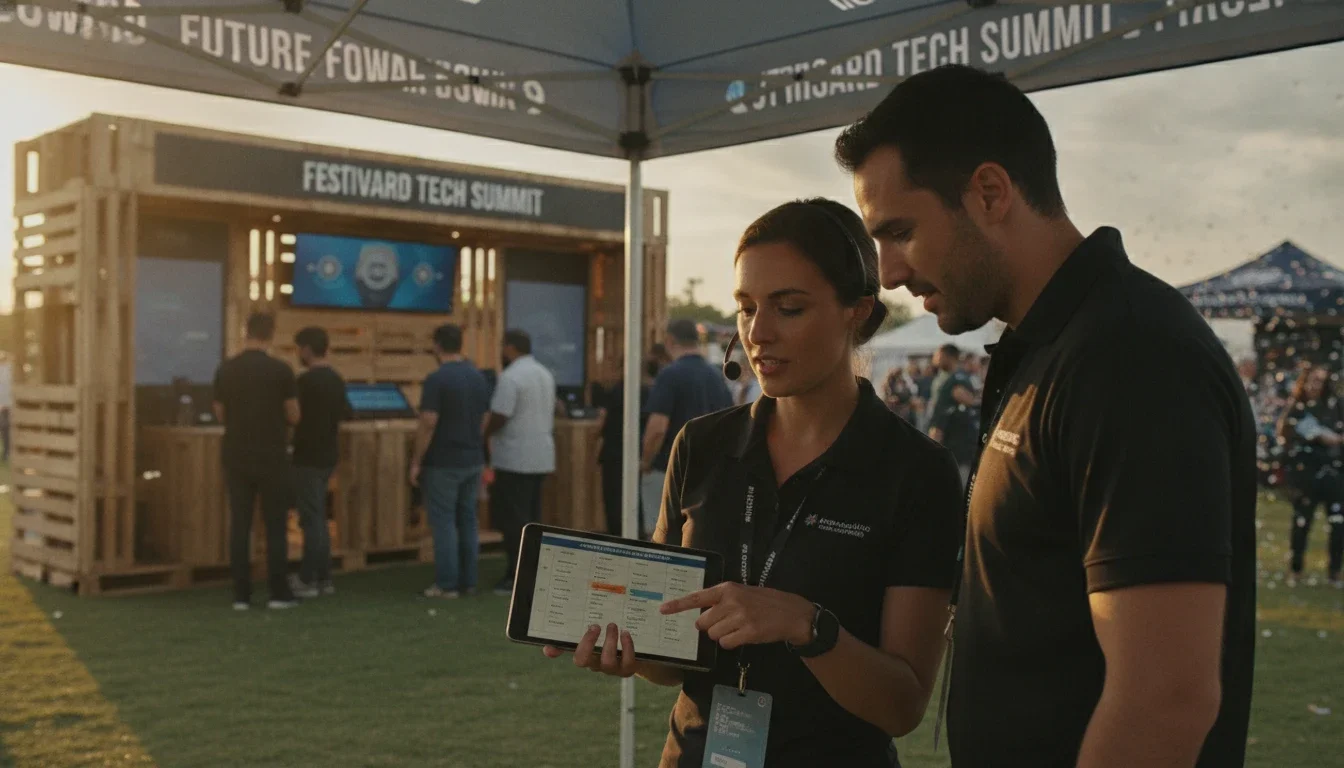
Two professional event staff reviewing a shift rotation schedule on a tablet at an outdoor activation booth
Shift Length Best Practices for Multi-Day Events
Industry best practice for sustained multi-day activations is to cap individual shifts at 8–10 hours and to avoid scheduling staff for back-to-back doubles. This applies to brand activations as much as it does to venue staff — the emotional labor demands in consumer-facing roles are equivalent.
For a 10-day fair activation with extended operating hours (say, 10 am–10 pm), this means your staffing plan almost certainly requires a split-crew model: morning and afternoon teams, or staggered rotations across the operating window. A single crew attempting to cover the full span every day will be visibly degraded by Day 5.
How to Structure A/B Team Rotations
An A/B team rotation is the most practical framework for extended fair activations. The model works as follows:
Team A covers high-traffic windows (typically late morning through early afternoon peak). Team B covers the afternoon through evening close. Key staff — your activation captain and any brand-specialist roles — work staggered shifts that overlap both teams' windows by 60–90 minutes, providing continuity and real-time knowledge transfer.
Across the 10-day window, rotate which team handles the peak-traffic shifts every 3–4 days. This distributes the high-demand workload equitably and prevents one team from carrying a disproportionate share of the activation's most intense periods.
For staffing roles that require consistent brand voice and consumer relationship continuity (sampling specialists, demo leads, or account-facing activators), keep those individuals as fixed assignments within their rotation slot rather than rotating the role itself.
Backup Coverage and the No-Show Problem
A 10-day activation creates 10 opportunities for no-shows, sudden illness, or personal emergencies to compromise your coverage. The statistical likelihood of at least one gap in a team of 10+ staff across 10 days is essentially certain without a system to address it.
Reactive replacement — scrambling to find a replacement the morning of — is not a system. It typically results in deploying an unvetted, unbriefed person into a role mid-activation, which introduces performance inconsistency and, in many cases, is worse than running short-staffed.
Proactive backup coverage means having briefed alternatives on standby before the activation starts — people who know the brand, understand the role expectations, and can step in with minimal onboarding. This is what separates a structured staffing agency deployment from a temp-agency stopgap.
On-Site Energy Management Through the 10-Day Window
The Role of the On-Site Captain
Every multi-day activation should have a designated on-site captain — an experienced team lead who serves as the real-time performance manager, escalation point, and energy anchor for the rest of the crew.
The captain's role is not just operational (managing shift handoffs, tracking coverage, liaising with venue staff). It is also cultural — setting the tone for how the team shows up each day. A strong captain runs brief daily stand-ups, acknowledges strong performances publicly, redirects energy dips before they become visible problems, and acts as the communication bridge between the activation floor and the off-site operations team.
Without a capable on-site captain, 10-day activations become a daily management challenge that falls entirely on brand-side contacts — which is a fast path to the decision-maker's own burnout.
Communication Channels That Prevent Confusion Fatigue
One of the most underestimated contributors to staff fatigue in multi-day events is communication fragmentation — the experience of receiving messages from multiple sources, on multiple platforms, with conflicting or duplicated information. When staff don't know where to look for the authoritative answer, they spend energy managing information noise instead of doing their jobs.
Effective 10-day activation communication requires a single source of truth: one channel for team updates, one person responsible for sending them, and a clear protocol for how staff should escalate questions or flag issues. This structure reduces decision fatigue and keeps the team's cognitive bandwidth available for the actual work.
Mid-Activation Check-Ins and Performance Resets
Don't wait for the post-event debrief to assess how your team is performing. Schedule a formal mid-run check-in at Day 4 or 5 — a brief team meeting (15 minutes is enough) that acknowledges what's working, addresses any friction points openly, and refreshes the team's sense of purpose around the activation's goals.
These check-ins serve as psychological reset points. They remind staff that they are seen, that their performance matters, and that there is a support structure behind them. In the research on sustained workforce performance, recognition and acknowledgment are among the most effective interventions against burnout — and they cost nothing.
How the Right Staffing Agency Prevents Burnout Structurally
Most burnout discussions focus on what individual staff members can do to cope. But the most effective burnout prevention in event staffing happens at the structural level — in the systems and practices of the agency placing the team.
Vetting and Role-Matching as a Burnout Prevention Tool
An agency that accepts every applicant and places staff based on availability is building burnout into your activation from the start. When staff are mismatched to roles — physically, temperamentally, or experientially — they expend additional energy compensating for the mismatch on every shift.
Rigorous pre-employment screening that evaluates both capability and role fit is the upstream intervention that makes everything else easier. Staff placed in roles aligned with their demonstrated strengths and prior event experience start every shift from a baseline of competence rather than effort.
What a True Backup Coverage System Looks Like
In a properly structured event staffing deployment, backup coverage is not an emergency option — it is a planned component of the activation. Every team has briefed alternates. Every role has someone who can step in without requiring an emergency orientation.
This means the backup coverage process begins during the initial briefing, not when a no-show happens at 8 am on Day 6. Alternates receive the same brand training, site orientation, and role expectations as primary staff. When they step in, the consumer experience is seamless.
Account Management Continuity Across 10 Days
One of the most practically impactful burnout prevention mechanisms for brand-side clients is having a single, dedicated account manager who owns the activation from inquiry through Day 10 debrief. This eliminates the exhausting experience of re-explaining your brand, your goals, and your operational context every time something needs attention.
A dedicated account manager also serves as the intelligence layer between the on-site team and the client — surfacing emerging issues early, communicating performance updates proactively, and making real-time operational adjustments without requiring constant client involvement. This is what off-site operations management should actually mean in practice.
What Happens When Burnout Hits Anyway — Recovery Protocols
Even well-planned activations can encounter unexpected burnout — an unusually brutal heat wave, a logistical disruption, or a personal situation that ripples through the team's morale. The question is not whether you have a perfect plan. The question is whether you have a response when things deviate from it.
Effective mid-activation recovery protocols include:
Immediate role rotation — moving a visibly fatigued staff member out of high-engagement positions and into support or logistics roles without drawing attention to the change
Deploying backup staff for targeted relief shifts rather than waiting for a formal no-show situation
A direct conversation between the activation captain and affected staff, acknowledging the difficulty without dismissing it — a 5-minute private check-in is significantly more effective than ignoring the issue
A team-level energy reset: a brief group acknowledgment of the challenge, a reminder of the activation's remaining window, and a small but visible morale gesture (team lunch, a direct thank-you from brand leadership, a small performance recognition)
The goal in a burnout recovery scenario is speed — catching the issue when it's a dip rather than a collapse, and intervening before it spreads.
Staffing Hutchinson and the Kansas State Fair with Eleven8
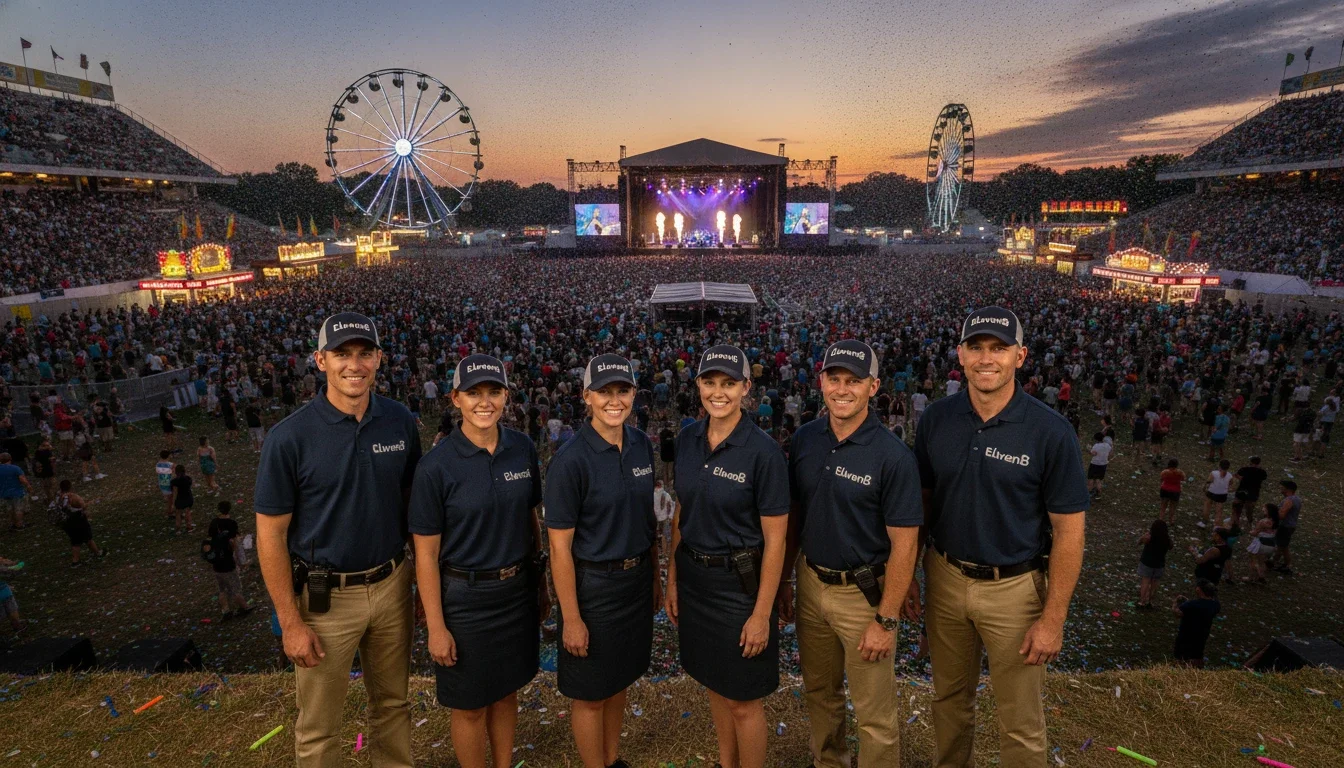
Professional Eleven8 event staff team in uniform at a large outdoor venue with fair-style crowds in the background
The Kansas State Fair represents exactly the kind of extended, high-volume, consumer-facing activation environment that demands a staffing partner — not a staffing platform.
Eleven8 Event Staff brings 35 years of event staffing experience, a pre-built roster of 24,821 active staff across 36+ U.S. markets, and an operational infrastructure designed specifically for the demands of multi-day activations. Our 101.8% fulfillment rate is not an accident — it is the result of having briefed backup coverage built into every deployment before Day 1.
For Hutchinson activations and any multi-day brand presence at regional fairs, state events, or extended experiential campaigns across the Midwest, Eleven8 provides:
Pre-vetted staff drawn from the top 3.5% of applicants
Role-matched placements based on prior event experience, not just availability
Dedicated account management from inquiry through post-event recap
Briefed backup coverage included as standard — one backup for every 8 staff
On-site captains trained on Eleven8's 11-step event process
24/7 live operations support with real-time issue escalation on every event day
Our brand ambassador and experiential staffing teams are drawn from a pre-established roster — not recruited the week of your event. When you book Eleven8, the people assigned to your activation are ready before the fair gates open.
Whether your activation runs 2 days or 10, the standards don't change. And neither does your team's performance.
Ready to staff your next multi-day activation? Request a quote from Eleven8