Minneapolis Trade Show Staffing Guide: Roles, Ratios & How to Get It Right
Minneapolis isn't just flyover country for trade shows — it's one of the Midwest's most active convention markets. The Minneapolis Convention Center alone hosts hundreds of events each year across nearly 480,000 square feet of exhibit space, drawing exhibitors and attendees from across the country. Whether you're setting up a 10x10 booth or commanding a sprawling island exhibit, the staff you deploy will determine whether your trade show investment pays off.
This guide walks through everything you need to know about staffing a trade show in Minneapolis: the roles you need, the ratios that work, how to source and train your team, and what to look for in a professional trade show staffing agency. If you're exhibiting in the Twin Cities and you want your booth to perform, this is where to start.
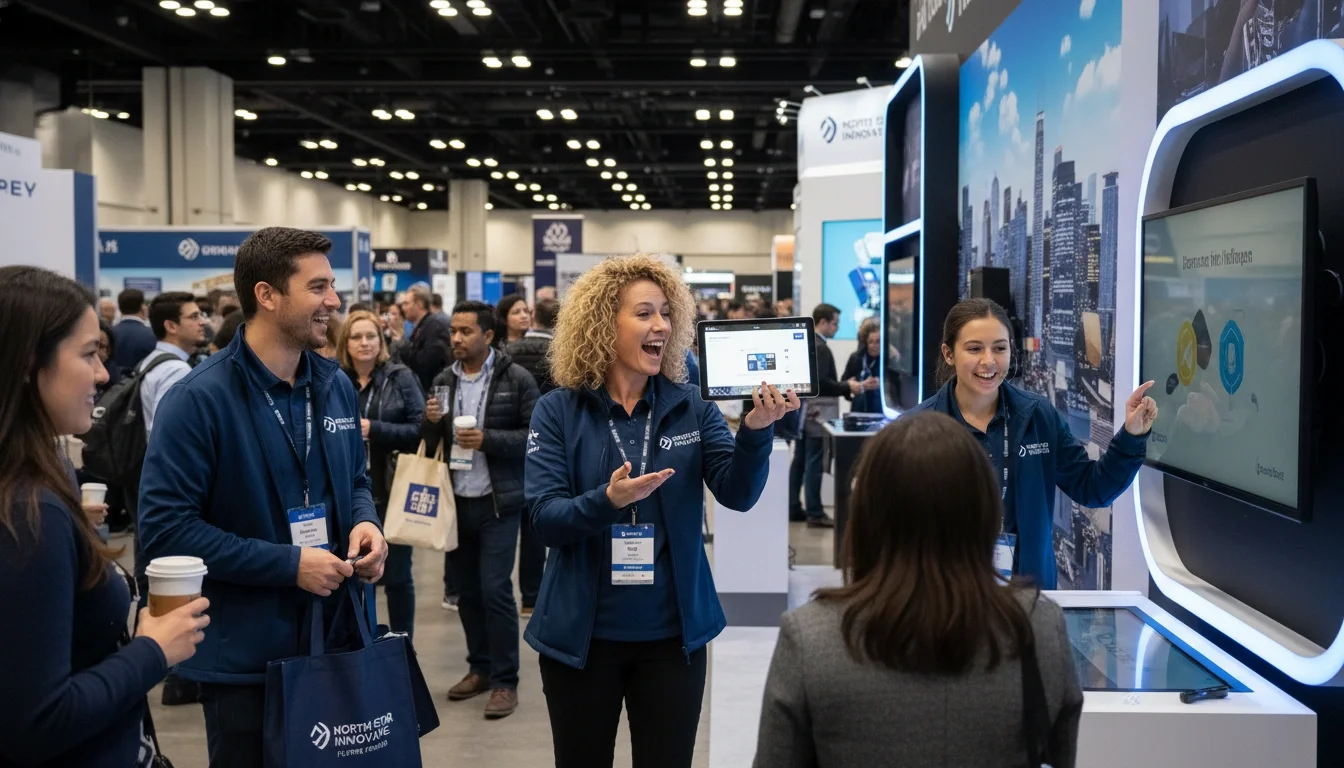
Energetic brand ambassadors engaging attendees at a busy Minneapolis trade show booth
Why Minneapolis Is a Major Trade Show Market
The Minneapolis Convention Center (MCC) is the largest in the Upper Midwest. With 475,000 square feet of exhibit space, 87 meeting rooms, and two ballrooms — all connected via climate-controlled skyways to downtown hotels and restaurants — it's built for high-volume event traffic.
Throughout the year, the MCC hosts a range of events, including major medical and pharmaceutical conferences, consumer home shows, auto expos, technology summits, and industry trade shows across various sectors, such as manufacturing, agriculture, healthcare, and more. That diversity of event types means the staffing demands in Minneapolis are equally diverse, and the competition for attendee attention on the show floor is real.
If you're exhibiting here, you need a staffing strategy that matches the scale and professionalism of the market. Walking in with undertrained or underqualified staff — or, worse, not enough of them — is one of the most common and costly mistakes exhibitors make.
Start With a Staffing Plan — Before You Do Anything Else
The single biggest staffing mistake at trade shows is reactive hiring. Waiting until two weeks before the event to consider your team means you're scrambling to find whoever is available, rather than selecting the right people to achieve your goals. A proper staffing plan starts months earlier.
Define Your Booth Goals
Before you can staff your booth effectively, you need clarity on what success looks like. Are you trying to collect qualified leads? Drive product demos? Build brand awareness in a new market? Sell directly on the floor? Each goal implies a different staffing composition. A demo-heavy booth needs presenters. A lead-generation focus needs conversationalists and lead capture specialists. A brand awareness play needs high-energy greeters and brand ambassadors working the aisle as much as the booth itself.
Know Your Booth Size and Layout
Your physical footprint shapes your staffing needs. A 10x10 inline booth has different requirements than a 20x20 peninsula or a 40x40 island. Know your layout — demo areas, meeting spaces, product display zones — before you assign roles. You'll also want to account for traffic flow. The Minneapolis Convention Center's larger halls can see dense foot traffic during peak hours, and you need enough staff to engage visitors at the front while others handle deeper conversations inside.
Build Your Planning Timeline
A general rule: begin your staffing process at least 8 to 12 weeks before the event. For larger shows, 3 to 4 months is better. Here's a baseline planning timeline:
10–12 weeks out: Define staffing needs, roles, and headcount
8–10 weeks out: Begin sourcing — whether recruiting internally or contacting a staffing agency
4–6 weeks out: Confirm your team, share event details, start brand briefings
2–3 weeks out: Conduct full staff training and dry runs
1 week out: Confirm logistics — arrival times, uniforms, contact protocols
Day of: Pre-show briefing on site, role assignments, shift schedule review
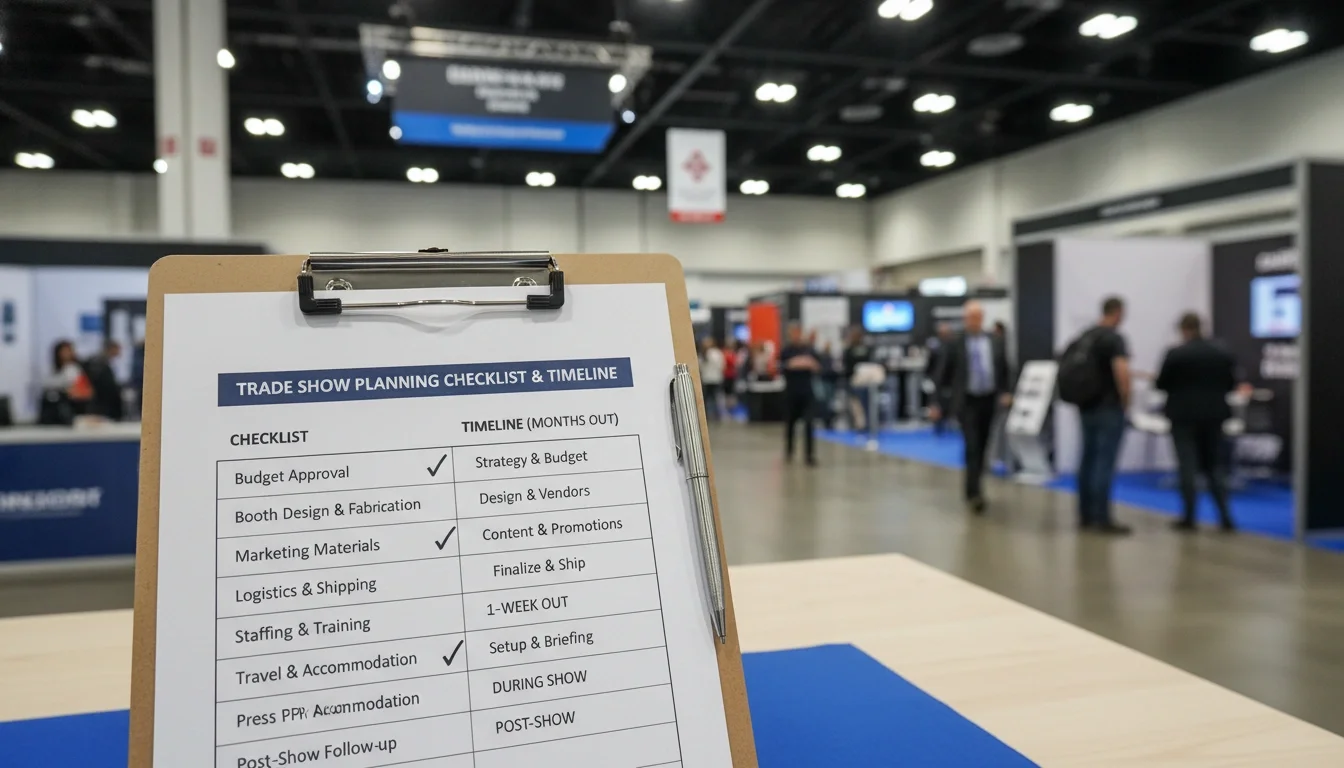
Trade show planning checklist and timeline laid out on a clipboard at an exhibition venue
The Key Trade Show Staff Roles (And What Each One Does)
Most trade show booths need a mix of roles working in concert. Understanding what each position actually does — and why you need it — helps you build a team that covers every touchpoint in the attendee journey.
Greeters and Hosts
Greeters are the first point of human contact at your booth. Their job is to welcome attendees, create an inviting atmosphere, and quickly assess who warrants a more in-depth conversation. They set the tone for every interaction that follows. At busy Minneapolis expos, a skilled greeter can dramatically increase the number of meaningful conversations your team has over the course of a day.
Brand Ambassadors
Brand ambassadors represent your company's voice and personality on the floor. Beyond the booth, they work the aisles — approaching attendees, sparking conversations, and driving traffic to your exhibit. They need to understand your brand deeply enough to speak authentically about it in casual, spontaneous interactions. At trade shows with heavy foot traffic, brand ambassadors working the perimeter of your space can double your booth's visibility.
Product Demonstrators
Demos are often the centerpiece of a trade show booth experience. Product demonstrators run live demos, keep presentations on schedule, answer technical questions, and ensure that any technology or display equipment continues to run smoothly throughout the day. They need product knowledge — either trained before the show or sourced with relevant industry experience.
Lead Capture Specialists
These are your closers. Lead capture staff are trained in consultative conversation — asking the right questions to qualify attendees, documenting contact information and buyer intent, and handing off warm prospects to your sales team for follow-up. At competitive trade shows, having dedicated lead capture personnel (rather than asking your presenters to multitask) dramatically improves the quality and quantity of leads collected.
Registration and Check-In Staff
If your exhibit includes a gated experience, product launch, VIP reception, or sponsored event space within the trade show, you'll need dedicated check-in staff to manage entry, badge scanning, and guest flow. Registration staff is also commonly deployed at conference registration desks throughout the Minneapolis Convention Center for broader event management.
Production Assistants
Trade show setups and teardowns are physically demanding, logistically complex operations. Production assistants handle the operational layer — moving materials, setting up signage, managing storage areas, and providing general support so that your core exhibiting team can focus on attendee engagement. They're also invaluable during the show itself for resupplying product samples, managing equipment, and handling logistics you didn't anticipate.
On-Site Supervisor / Staff Captain
For any trade show deployment of more than four or five people, you need a designated on-site supervisor — sometimes called a staff captain or floor manager. This person manages the team's schedule and shift rotations, handles real-time issues, communicates with your account manager or event coordinator, and keeps everyone aligned on goals throughout the day. Without clear on-site leadership, even a well-staffed booth can lose cohesion over a multi-day show.
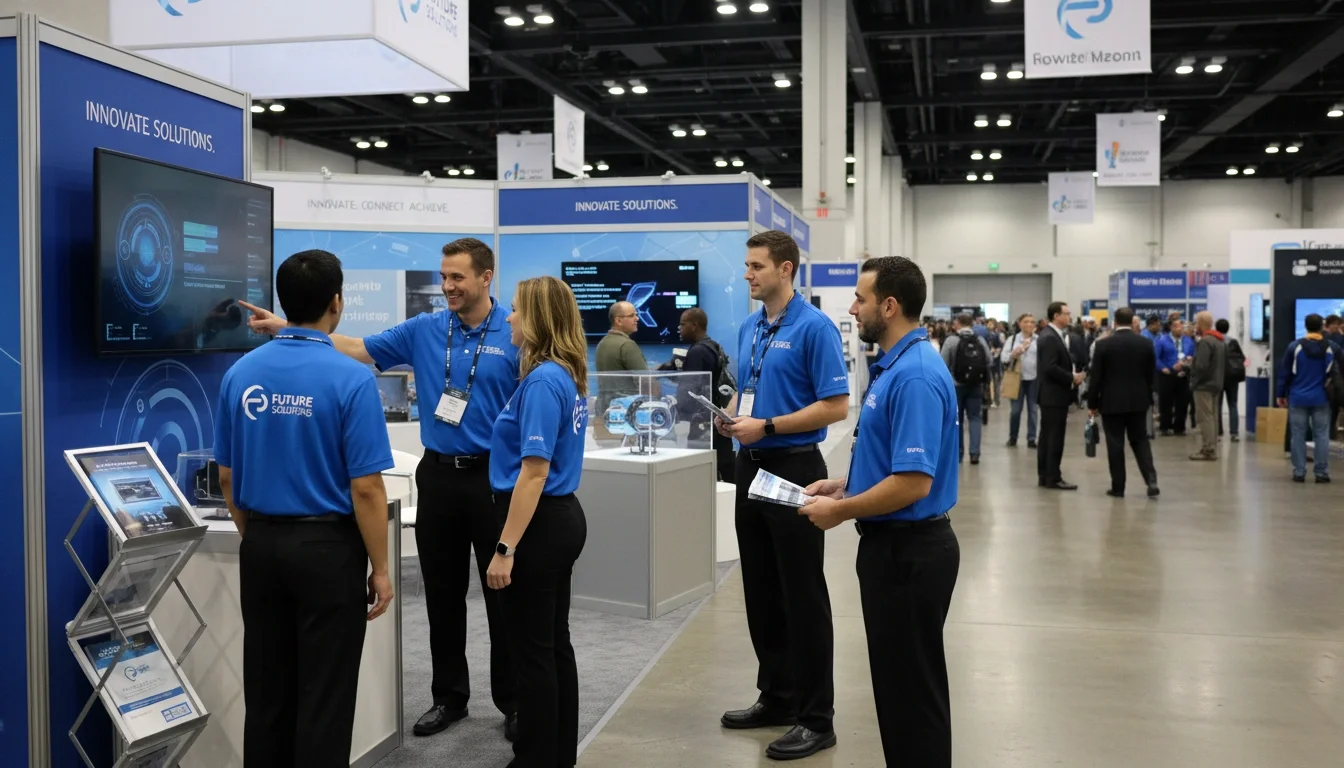
Five trade show staff members in matching branded attire working an exhibit booth at a convention center
How Many Staff Do You Need? Trade Show Staffing Ratios
One of the most common questions exhibitors have is simply: how many people do I need? The answer depends on booth size, traffic volume, and the complexity of your exhibit — but there are practical benchmarks that give you a solid starting point.
The 50 Sq Ft Rule Explained
A widely-used industry benchmark is one staff member per 50 square feet of active booth space. This accounts for the space the staff member occupies, the conversational buffer needed to engage visitors comfortably, and the natural flow of attendees through the booth. It's not an absolute rule, but it prevents the two most common errors: understaffing (leaving attendees unengaged) and overstaffing (crowding a small space and making it feel uncomfortable to enter).
Staffing Ratios by Booth Size
| Booth Configuration | Square Footage | Recommended Staff |
|---|---|---|
| Inline 10×10 Booth | 100 sq ft | 2 staff |
| Inline/Corner 10×20 Booth | 200 sq ft | 3–4 staff |
| Peninsula 20×20 Booth | 400 sq ft | 6–8 staff |
| Island 20×40 Booth | 800 sq ft | 10–14 staff |
| Large Island 30×50+ Booth | 1,500+ sq ft | 15–25+ staff |
Note: These figures reflect active floor staff. Add supervisors, production assistants, and backup staff on top of these base counts. For multi-day shows at the Minneapolis Convention Center, also account for shift rotation to keep energy levels high throughout each day.
For large shows at the MCC, where foot traffic in peak hours can be intense, leaning toward the higher end of the ratio range pays off in more conversations and more leads captured per hour.
Internal vs. External Staff: What Works at Minneapolis Trade Shows
Most exhibitors approach trade show staffing with the same team that manages their sales or marketing internally. That works — to a point. Understanding when to supplement (or replace) internal staff with professional trade show personnel is one of the most strategically important decisions you'll make.
Using Your Own Team
Your internal team has obvious advantages: product knowledge, brand familiarity, and genuine stakes in the outcome. Sales reps who know your customers, engineers who can answer deep technical questions, and executives who can close deals on the spot all have roles to play at a trade show booth.
The challenge is that trade shows are physically and emotionally demanding in ways that office work simply isn't. Standing for eight hours, engaging with hundreds of strangers, and maintaining enthusiasm through slow periods requires a particular energy profile. Your best product expert may not be your most effective booth staffer — and that's okay, as long as you plan for it.
Hiring a Trade Show Staffing Agency
A professional trade show staffing agency provides pre-vetted, experienced personnel who are accustomed to the trade show environment: high energy, quick to engage, comfortable with strangers, and trained in lead capture and brand representation. The best agencies bring staff who have worked shows in your industry and understand the rhythm and expectations of trade show floors.
When evaluating agencies for Minneapolis trade shows, look specifically for those with an established local roster. Fly-in staffing — where an agency recruits from outside the market — introduces risk in the form of higher costs, travel logistics, and staff who are unfamiliar with the venue.
Eleven8 Event Staff maintains an active nationwide roster with staff already deployed in the Minneapolis market, eliminating the fly-in risk.
The Hybrid Approach
For most exhibitors, the most effective strategy is a hybrid: your key internal people (product experts, account managers, sales leads) supported by professional external staff handling the high-volume, energy-intensive roles — greeting, lead capture, demo facilitation, and floor traffic generation. This lets your internal team do what they do best while maximizing the number of quality interactions your booth generates.
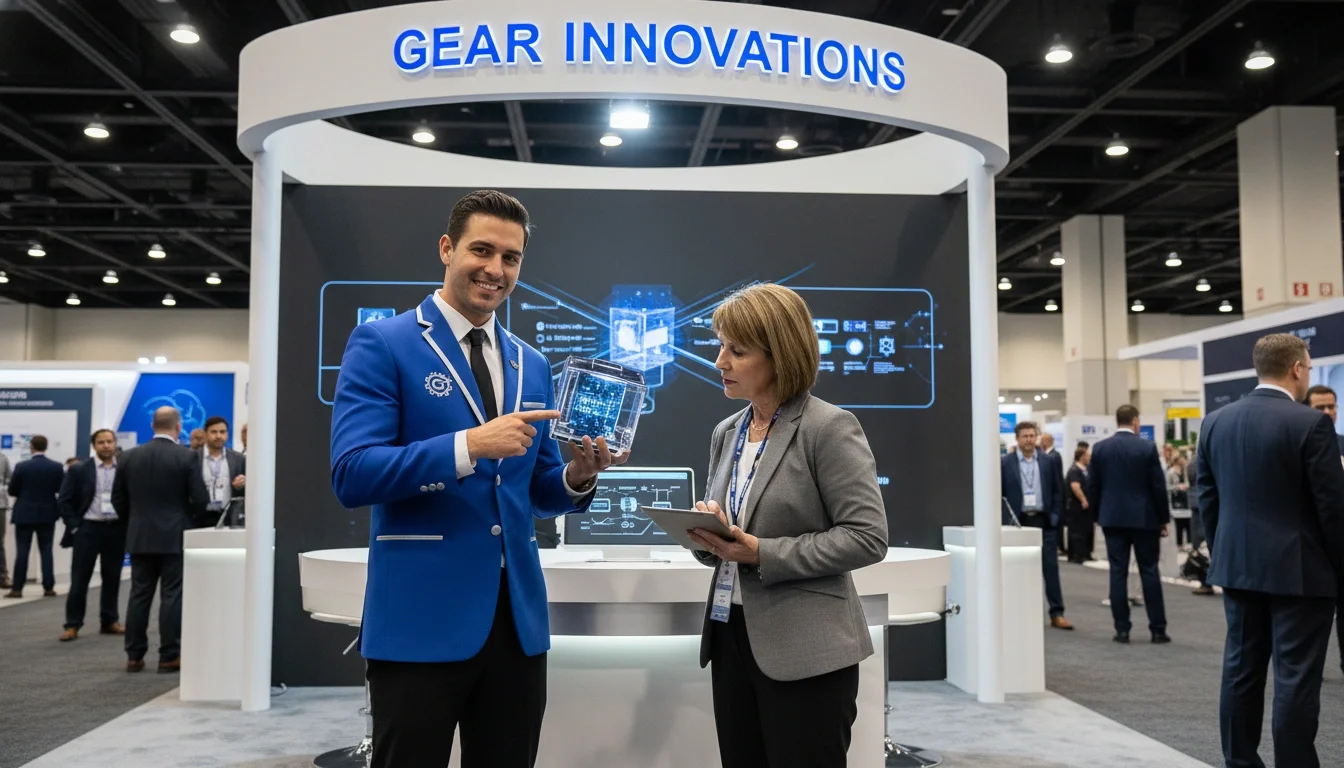
A brand ambassador in uniform engaging a trade show attendee with a product demonstration at a convention
How to Train Trade Show Staff for Maximum Results
Even the most experienced trade show personnel need event-specific preparation. Training isn't a luxury — it's the difference between staff who represent your brand confidently and staff who fumble basic questions in front of your best prospects.
Pre-Event Briefing Essentials
Every staff member — internal or external — should receive a written briefing document before the event. At a minimum, this document should cover:
Event goals and measurable success metrics for each role
Booth layout, demo areas, and storage locations
Brand guidelines: voice, tone, prohibited topics, and how to pronounce your company name
Dress code and uniform requirements (including contingency for uniform issues)
Shift schedule and break rotation
Lead capture system — how it works and how to qualify a lead
Escalation protocol: who to contact if there's a problem
Post-day debrief time and format
Brand Immersion and Product Knowledge
External staff, in particular, need dedicated brand immersion before they step on the floor. Share your website, marketing materials, product videos, and any brand guidelines in advance. For demo-heavy booths, schedule dry run sessions where staff can practice the demo flow and handle common questions.
If the show is multi-day, include a brief daily pre-show meeting — 10 to 15 minutes — to share learnings, adjust tactics, and keep energy high. Research cited by Exhibit Studios found that fewer than 30% of businesses provide any form of trade show staff training; doing it well is an immediate competitive advantage.
Lead Capture and Conversation Protocols
One of the highest-value things you can train your team on is conversation structure. Staff should know how to open interactions (not with 'Can I help you?'), how to ask qualifying questions, how to handle different attendee types (the curious browser, the serious buyer, the competitor doing recon), and how to capture lead information efficiently without making the interaction feel transactional.
Train staff on open-ended questions that generate useful information: What brings you to the show today? What does your current solution look like? What would an ideal look like for you six months from now? These questions do two things: they qualify the lead, and they make the attendee feel heard. Both outcomes are wins.
Day-Of Logistics at Minneapolis Trade Shows
Even a perfectly planned trade show staffing strategy can unravel on the day without tight logistics. The Minneapolis Convention Center's scale means setup, access, and movement through the facility all require coordination.
Scheduling and Shift Management
Multi-day shows require shift rotation to prevent fatigue. A standard model: two shifts per day (morning and afternoon), with a 30-minute overlap for handoff briefings. For single-day shows, build in mandatory 15-minute breaks every two hours — staff who skip breaks because they feel guilty underperform badly by hour six.
Post the schedule in the storage room or back area of the booth, keep a copy on your phone, and communicate any changes through a single designated channel. Ambiguity about who is on shift and when creates gaps exactly when you need coverage most.
Dress Code and Uniform Coordination
Uniformity matters on the trade show floor. When your team looks cohesive, they're instantly identifiable as your representatives and project professionalism from a distance. Coordinate attire well before the event: branded polo shirts or jackets, specific color palettes, or client-provided uniforms. Confirm sizing with external staff in advance and always have backup attire for emergencies.
Eleven8 offers flexible uniform options and regularly coordinates client-provided branded uniforms for trade show deployments.
Communication and On-Site Oversight
Designate a single point of contact for the day — either your internal event manager or the on-site supervisor from your staffing agency. All staff issues, schedule changes, and real-time decisions should route through this person, not through multiple channels.
For larger deployments, use a group messaging app to keep your team connected without disrupting floor interactions. Set expectations in advance about response times and what constitutes a message-worthy issue versus something staff can handle independently.
Eleven8 provides dedicated account managers and 24/7 event-day support as a standard part of every booking — with offsite operations management included at no additional cost.
What to Look for in a Minneapolis Trade Show Staffing Agency
Not all staffing agencies are built the same, and the difference becomes apparent on event day when you actually need your team to perform. Here's what to evaluate when choosing a trade show staffing partner for Minneapolis events.
Vetting and Hiring Standards
The quality of agency staff is entirely a function of the agency's hiring process. Ask how they vet applicants, what their acceptance rate looks like, whether staff go through background checks, and how they assess presentation skills and professional demeanor. Agencies that function as open marketplaces — anyone can sign up — produce inconsistent results. Agencies with structured, multi-step hiring processes produce staff who are genuinely prepared.
Eleven8 accepts only the top 3.5% of applicants through an 8-step process that includes application review, references, background checks, live interviews, training, and a trial shift. Of the 97,003 applicants received in the past year, only 2,476 were hired.
Fulfillment Guarantees and Backup Coverage
No-shows happen in every industry. What separates professional agencies from unreliable ones is whether they have a built-in system for handling them before you know there's a problem.
Ask specifically: Do you guarantee fulfillment? What's your process if someone calls out day of? Do you have backup staff already briefed? Generic answers like 'we'll find a replacement' are not the same as a structured backup protocol.
Eleven8 includes one briefed backup staff member for every eight deployed — at no additional charge — ensuring your event runs at full strength regardless of last-minute changes.
Local Roster vs. Fly-In Staff
Minneapolis is a substantial enough market that most reputable national agencies should have active local staff rather than recruiting or flying people in for your event. Local staff know the Minneapolis Convention Center, understand the city's professional culture, and don't carry the cost and logistical risk of travel-based deployments.
When you speak with a staffing agency, ask directly: Do you have staff currently active in the Minneapolis market? A confident 'yes' with specifics is the right answer. Hesitation or vague answers about 'sourcing' are red flags.
Eleven8 maintains an active, pre-vetted roster across 33+ markets nationwide, including the Minneapolis area — staff ready to deploy before you call, not recruited after.