Trade Show Staffing in Kansas City: Roles, Headcount & Hiring Tips
Your trade show exhibit might be flawlessly designed. Your giveaways might be irresistible. Your product might be the best thing at Bartle Hall. But if the people staffing your booth aren't engaged, prepared, and strategically deployed — none of it matters.
Trade show staffing is consistently the most underfunded and under-planned element of any exhibit strategy. Yet according to Exhibitor Magazine, 85% of an exhibitor's success hinges directly on the performance of its booth staff. That's not a minor variable — it's the defining one.
This guide walks you through everything you need to know about staffing a trade show in Kansas City: how many people you need, which roles to fill, how to train them, and when it makes sense to bring in professional event staff rather than rely on your internal team.
Whether you're exhibiting at the Kansas City Convention Center for the first time or looking to sharpen the edge of a veteran trade show program, this is the staffing playbook you need.
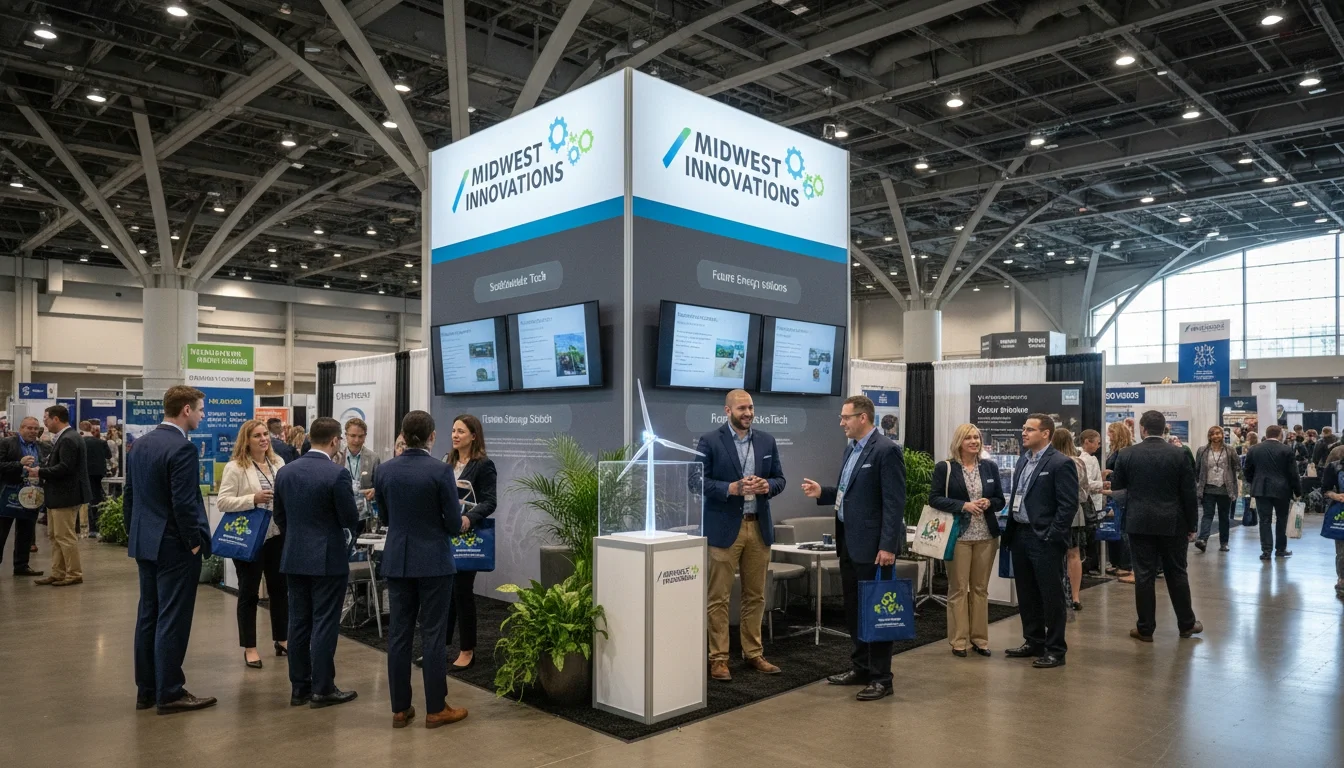
A professionally staffed trade show booth at Bartle Hall, Kansas City Convention Center
Why Trade Show Staffing Makes or Breaks Your Kansas City Exhibit
Every dollar you spend on booth design, floor space, travel, and signage is ultimately delivered through the people standing in your exhibit. They are the final mile between your brand and every qualified prospect walking the floor.
Research tells a clear story:
80% of what attendees remember most about a trade show booth is their interaction with staff — not the display or the giveaways.
Trained staffers convert qualified leads at twice the rate of untrained ones.
Only 26% of exhibitors invest in formal staff training for most of their events.
That last statistic is a competitive advantage hiding in plain sight. When your team is trained, positioned correctly, and working from a clear role structure, you pull ahead of the majority of exhibitors on the floor — regardless of booth size or budget.
In Kansas City, where conventions at Bartle Hall and the KCI Expo Center regularly draw thousands of qualified attendees, that edge compounds quickly.
Understanding Kansas City's Trade Show Landscape
Before you can plan your staffing strategy, it helps to understand the environment you're walking into. Kansas City has positioned itself as one of the Midwest's premier convention destinations, and its event calendar reflects that.
Key Venues: Bartle Hall and KCI Expo Center
The Kansas City Convention Center — known as Bartle Hall — is the city's crown jewel for large-scale events. With 388,800 square feet of column-free exhibit space across five exhibit halls, 45 meeting rooms, a 2,400-seat fine arts theater, and an arena seating over 10,700, it is one of the largest column-free convention environments in the world.
For exhibitors, this scale means real logistics: high attendee volume, multi-hall layouts, and the need for clearly assigned staff at each entry point, demo zone, and meeting area within your exhibit footprint. Understaffing a large exhibit at Bartle Hall isn't just inefficient — it's actively damaging to your brand's perception.
The KCI Expo Center near Kansas City International Airport serves as a secondary venue for regional trade shows, expos, and consumer events. Its more compact footprint makes it popular for industry-specific shows with a tighter attendee profile, where highly targeted staffing pays dividends.
Both venues are connected to robust hotel infrastructure, which matters when you're importing staff or flying in your internal team — options that a professional local staffing agency can help you avoid entirely.
Notable Trade Shows and Events in Kansas City
Kansas City hosts a wide range of industry events throughout the year. Some of the most active include:
Kansas City Boat and Fishing Show (Bartle Hall) — a regional consumer show drawing outdoor enthusiasts and exhibitors from the fishing, boating, and outdoor recreation sectors.
Kansas City Home Show (Bartle Hall) — an annual consumer show for home improvement, design, and renovation brands.
Planet Comicon Kansas City (Bartle Hall) — the region's largest pop culture and comic book event, attracting tens of thousands of attendees each spring.
Western Farm Show — a major agricultural trade event for the region.
VISION Hi-Tech Training & Expo (Overland Park Convention Center) — a professional automotive training and trade event serving the KC metro area.
Each of these events has a distinct attendee profile, which should directly influence how you select, brief, and position your booth staff.
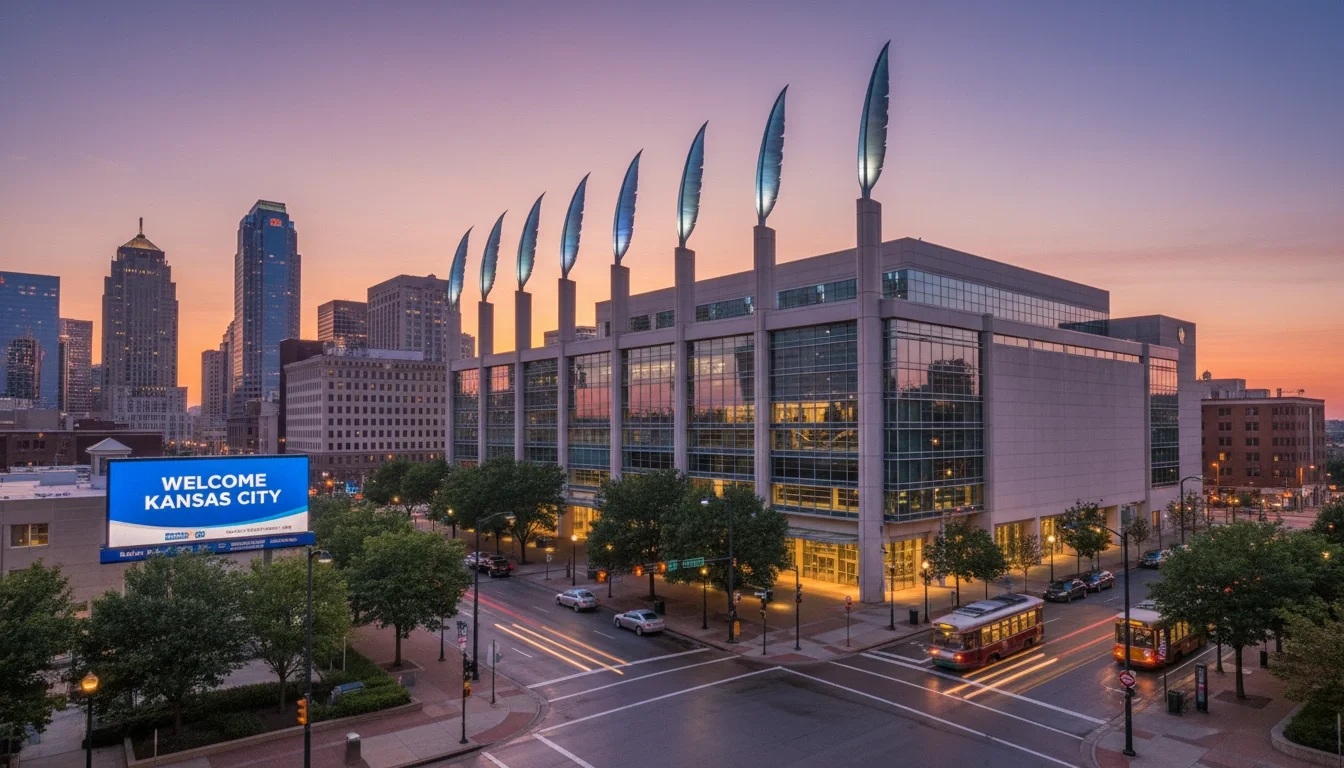
Exterior view of the Kansas City Convention Center (Bartle Hall) in downtown Kansas City
How Many Staff Do You Need for a Trade Show Booth?
This is the question most exhibitors get wrong — not because they overcomplicate the math, but because they skip it entirely and default to gut feel. Here's a framework that brings clarity.
The 50 Square Foot Rule
The most widely cited industry rule of thumb is straightforward: plan for one staff member per 50 square feet of active booth space. This accounts for enough room for each staffer to engage with visitors comfortably without crowding.
10x10 booth (100 sq ft) = 2 staff maximum
10x20 booth (200 sq ft) = 3-4 staff
20x20 booth (400 sq ft) = 6-8 staff
20x40 or larger island booth = 10+ staff depending on programming
Keep in mind that this is the maximum for comfortable coverage — not the minimum for adequate coverage. For booths with heavy demo traffic, multiple engagement zones, or meeting areas, plan toward the higher end of the range.
Calculating Interactions by Booth Size
Once you have a headcount estimate, validate it against your traffic expectations. A mid-to-large industry show at Bartle Hall typically generates 80–120 viable passers-by per hour at a 10x10 or 10x20 booth, and 150–250 per hour at a 20x20 or larger footprint.
Use this calculation to pressure-test your staffing:
Establish your total exhibiting hours (e.g., 3 days x 8 hours = 24 exhibiting hours).
Multiply by staff on duty at any given time (e.g., 3 staff x 24 hours = 72 total staff hours).
Multiply by your target interactions per hour per staffer (3–5 interactions is the industry range).
Compare against your expected traffic and lead volume goal.
If the numbers don't align, adjust your headcount — not your goals.
Staffing for Shifts and Peak Traffic Periods
Trade show days are physically and mentally demanding. Staff performance drops measurably after sustained high-engagement periods. The best teams plan for it.
Schedule breaks every 90–120 minutes for any staff member in a high-engagement role.
Rotate roles so no one person is greeting and qualifying for six consecutive hours.
Add overlap coverage during peak hours — typically the first two hours after show opening and the hour following lunch.
Always maintain at least one experienced closer or sales-qualified team member on the floor at all times.
For multi-day shows at Bartle Hall, this shift structure isn't a luxury — it's a performance management essential.
Essential Trade Show Staff Roles and Responsibilities
High-performing booths don't assign everyone to 'work the booth.' They define specific roles, match the right people to each one, and manage throughput like a system. Here are the core positions every serious trade show staffing plan should address.
Greeters and Crowd Gatherers
Greeters are your first contact — the team member who intercepts a passing attendee within 10 seconds and determines whether they're worth a deeper conversation. A great greeter is warm, energetic, and brief. Their job is not to sell; it's to qualify and route.
Crowd gatherers take this function outside the booth entirely. Stationed in the aisle, they engage attendees who might walk past without stopping, using an opening question or a promotional item to initiate contact. In high-traffic environments like the main exhibit floor at Bartle Hall, a skilled crowd gatherer can significantly increase the number of conversations your booth initiates.
Brand Ambassadors
Brand ambassadors serve as the face of your company for attendees who aren't ready for a deep sales conversation but are interested enough to engage. They handle badge scanning, distribute materials, explain product highlights at a surface level, and keep the energy of the booth positive and approachable.
This is one of the roles most commonly filled by professional temporary staff — and for good reason. A well-briefed brand ambassador from a professional agency brings immediate presence and professionalism without requiring the deep product knowledge that your internal sales team carries. It frees your experts to focus on high-value conversations.
If you're staffing a trade show in Kansas City through an agency like Eleven8 Event Staff, brand ambassadors represent the most common staffing request — and the role where professional vetting pays the most visible dividends.
(Internal link: Learn more about Eleven8's trade show and convention staffing services.)
Product Demonstrators and Presenters
If your exhibit includes a demo station, theater area, or any hands-on product experience, a dedicated demonstrator is essential. This person keeps the demo moving, maintains a repeatable rhythm, and never gets pulled into long one-on-one sales conversations that stall the flow.
Presenters operate at a higher level of public performance — delivering scripted or semi-scripted presentations to gathered groups. They should be your most polished communicators, capable of working a crowd, reading energy, and adjusting pacing on the fly.
Both roles require significant product and brand briefing before the show. Plan for dedicated preparation time, not a quick morning briefing on day one.
Lead Capture and Sales Staff
These are your closers — the team members who take a qualified prospect from 'interested' to 'next step.' Lead capture staff are skilled at reading intent signals, asking the right qualifying questions, and logging clean, actionable lead data.
A critical mistake many exhibitors make is tasking their closers with badge scanning, restocking materials, or crowd control. Protect this role. A trained closer who spends their time managing logistics instead of conversations is an expensive opportunity cost.
Many exhibitors pair their internal sales team with external brand ambassadors specifically to solve this — the ambassadors handle the front-end logistics, and the internal team focuses on advancing qualified conversations.
Exhibit Manager and Event Coordinator
For any exhibit larger than a 10x10, having a designated exhibit manager — someone responsible for logistics, staffing oversight, vendor coordination, and problem-solving — is non-negotiable. This person does not engage attendees directly. They keep the team running.
At major shows like those held at the Kansas City Convention Center, this role interfaces with venue staff, general service contractors, and your own team throughout the event. Leaving this function undefined typically results in your best salespeople getting pulled into operational firefighting.
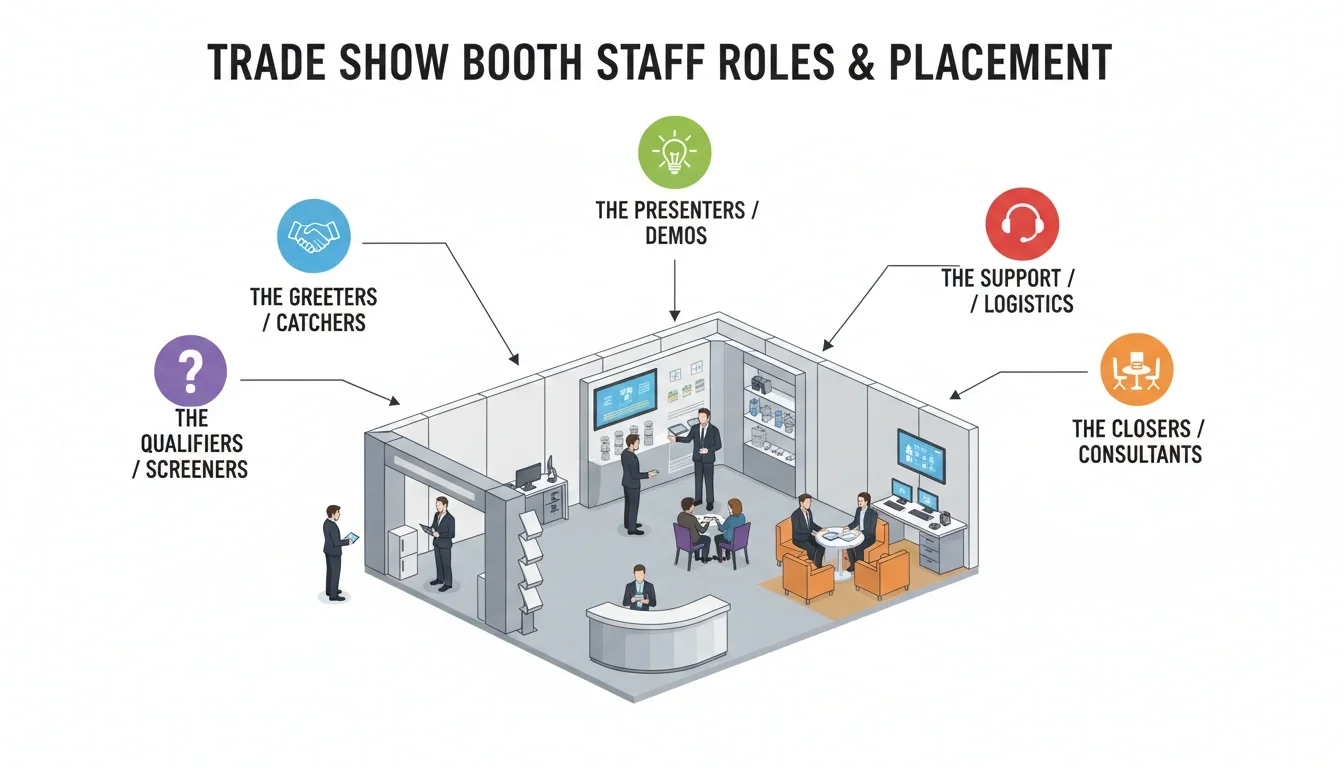
A diagram showing the five core trade show booth staff roles and their placement
Building Your Trade Show Staffing Plan: Step by Step
A staffing plan is not a headcount. It's a document that maps roles, schedules, responsibilities, and contingencies before day one. Here's how to build one that holds up on the show floor.
Define your exhibit goals for this specific show. Are you generating leads, launching a product, hosting meetings, or building brand awareness? Your goal determines your role mix.
Map your exhibit footprint. Know the square footage, demo zones, meeting areas, and storage. Plan staff positioning before the show, not after arrival.
Assign roles first, then assign people. Don't fill roles based on availability — fill them based on skills and personality fit.
Build a shift schedule. Account for breaks, peak hours, and daily team overlap. Distribute your highest-energy roles across the day, not concentrated at open.
Identify your supplemental staffing needs. Determine which roles are best filled by your internal team and which should be sourced from a local Kansas City staffing agency.
Set measurable goals per staff member. Interactions per hour, leads captured, demos delivered. Give your team a clear definition of success.
Book your staff early. For major shows at Bartle Hall, high-quality trade show staff — especially experienced brand ambassadors — book out weeks in advance. Don't leave staffing as the last item on your planning list.
Training Your Trade Show Booth Staff for Kansas City Events
The Center for Exhibition Industry Research found that booth staff training averaged just 1–2% of total trade show budgets for most exhibitors. That underinvestment shows in performance. Even a short, focused pre-show training session puts your team ahead of the majority of competing exhibitors.
Pre-Show Briefing Essentials
Every staff member — internal or temporary — should receive a briefing that covers:
Your company's core value proposition in plain language (not corporate jargon)
The two or three primary messages you want every attendee to walk away with
A qualifying question they can use to assess lead quality within the first 30 seconds of a conversation
How to use the lead retrieval system (badge scanner, app, or form)
Role assignments, shift schedule, and who to report to
Booth layout walkthrough, including demo areas, meeting zones, and supply storage
Dress code and uniform details
Rules on phone use, eating, and break procedures
For professional temporary staff sourced through an agency, a good agency will conduct their own baseline training. Your briefing supplements that foundation with brand-specific context.
On-Site Conduct and Booth Etiquette
Beyond the basics, the best booth teams operate according to clear behavioral standards:
Never stand with arms crossed or in closed body language — it signals disengagement.
Leave the booth to eat, take calls, or check email. These activities are invisible to attendees only if they happen away from the exhibit.
Wear badges at chest height or the right shoulder — the eye level of a handshake.
Greet every visitor with eye contact and an open stance within 10 seconds of entry.
Never bad-mouth competitors. Attendees notice, and it damages credibility.
At the end of every interaction, define a next step — meeting, follow-up email, demo booking. 'Nice to meet you' is not a lead.
When to Hire a Professional Event Staffing Agency in Kansas City
Some exhibitors arrive in Kansas City with a full internal team. Many more arrive knowing they need additional support — and the question becomes where to find it.
Internal Team vs. Temporary Staff: Pros and Cons
| Factor | Internal Team | Temporary Staff |
|---|---|---|
| Deep product knowledge | Yes | Requires briefing |
| Available in KC without travel cost | No | Yes (local agency) |
| Scalable on short notice | Limited | Yes (agency roster) |
| Brand ambassador roles | Possible | Ideal fit |
| Lead capture and closing | Best fit | Supplemental |
| Shift coverage and logistics | Stretched | Purpose-built |
The most effective trade show teams blend both: internal experts for product-depth conversations and relationship advancement, and professional temporary staff for greeter, ambassador, and coverage roles that don't require institutional knowledge.
Using local Kansas City staff from a reputable agency also eliminates flight, hotel, and per diem costs for additional internal headcount — a budget calculation worth running before your next KC show.
What to Look for in a Kansas City Trade Show Staffing Agency
Not every staffing agency is built for the demands of a professional trade show. Here's what distinguishes a high-quality partner:
A defined vetting process — background checks, live interviews, and documented training are non-negotiable.
Pre-built rosters of experienced trade show staff, not reactive recruiting after you book.
References from comparable events and brands in the B2B or trade show space.
A dedicated point of contact (not a call center) for day-of support.
Clear rates with no hidden fees — and transparent overage policies.
Experience at Kansas City venues, including Bartle Hall and KCI Expo Center.
Eleven8 Event Staff, for example, deploys a nationally consistent vetting process that accepts fewer than 4% of applicants, maintains rated and ready-to-deploy rosters in advance, and provides a dedicated event captain introduced 24 hours before your show. For exhibitors bringing a major trade show presence to KC, that infrastructure matters.
(Internal link: Explore Eleven8's trade show and convention staffing services nationwide.)
(Internal link: See how Eleven8 brands ambassadors work for major activations and events.)
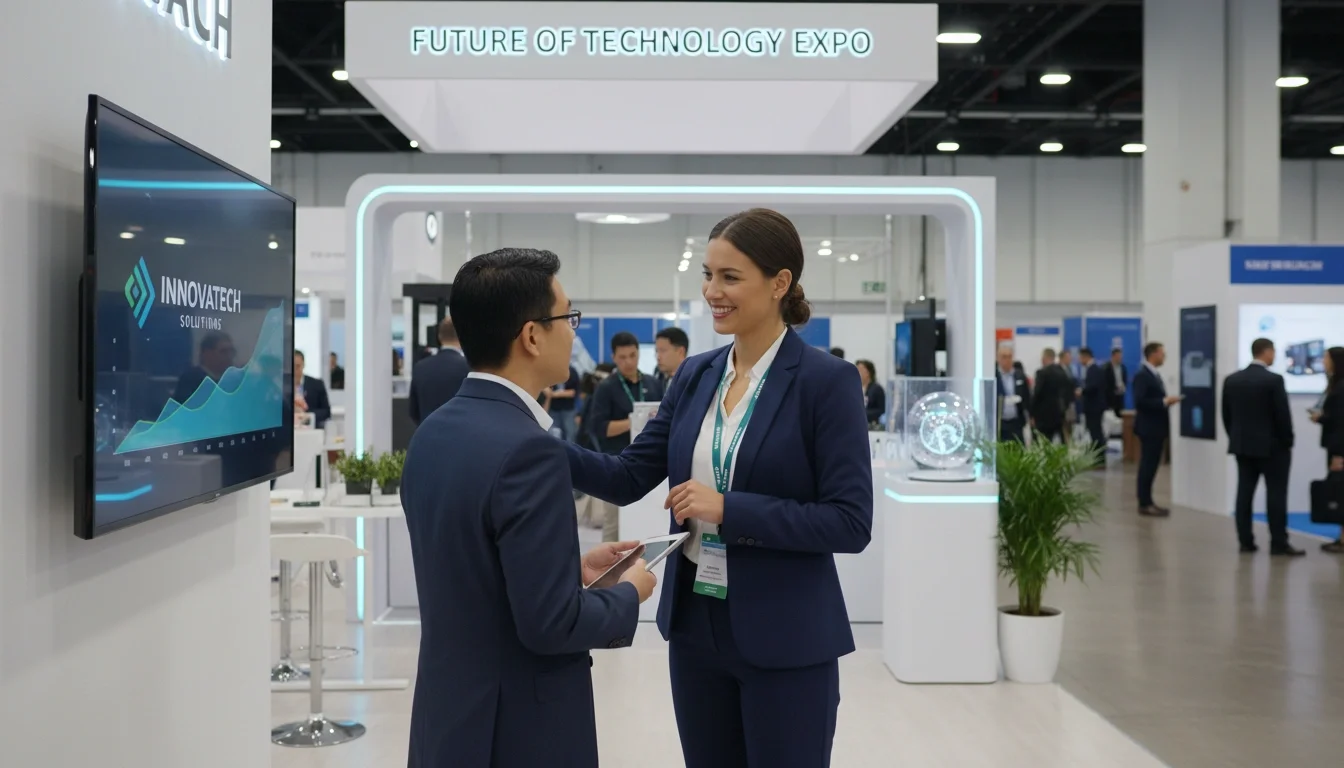
A professional trade show brand ambassador engaging with an attendee at a convention exhibit
Post-Show Staffing: Breakdown, Lead Follow-Up, and Debrief
Staffing doesn't end when the show floor closes. The hours immediately after a show are when lead data gets lost, follow-up gets delayed, and hard-won conversations turn cold.
Assign at least one team member to oversee:
Organized exhibit breakdown and inventory of all materials, samples, and equipment.
Immediate export and backup of all lead data from retrieval systems.
A brief debrief with all staff — what worked, what didn't, any incidents or notable attendee feedback.
Handoff of qualified leads to your sales or CRM team within 24 hours of show close.
For multi-day shows, a daily end-of-show debrief is even more valuable — it lets you adjust staffing, messaging, or positioning before the next morning opens.
Professional staffing agencies typically include a post-shift debrief as part of their process. When evaluating agencies for your Kansas City trade shows, confirm this is a standard deliverable, not an add-on.
Trade Show Staffing Checklist for Kansas City Exhibitors
6 Weeks Before the Show
Confirm exhibiting goals and define what a qualified lead looks like for this event
Map exhibit footprint and identify staffing zones
Calculate headcount using the 50 sq ft rule and interaction targets
Identify internal staff availability and flag coverage gaps
Request proposals from Kansas City trade show staffing agencies
Book your professional staff — availability fills fast for major Bartle Hall events
2 Weeks Before the Show
Confirm all staff assignments, roles, and shift schedules
Distribute pre-show briefing materials to all team members
Confirm uniform and dress code with all staff (internal and temporary)
Brief the lead capture process and test your lead retrieval system
Share Bartle Hall floor map and logistics details with temporary staff
Day of Show
Conduct a team walkthrough of the exhibit space before doors open
Confirm shift assignments and break schedule with all staff
Brief any temporary staff on brand messaging and qualifying questions
Designate your exhibit manager as the single point of contact for issues
Set an interaction goal for the first hour and monitor performance
Post-Show
Debrief all staff within one hour of show close
Export and back up lead data from all retrieval systems
Photograph exhibit for post-event reporting
Hand off qualified leads to sales or CRM team within 24 hours
Evaluate staffing performance for planning improvements at the next event