Walking into the Salt Palace Convention Center on the first morning of a major trade show, one thing is immediately clear: the booths that draw crowds aren't necessarily the biggest or the most visually dramatic. The ones that consistently outperform have something far more fundamental in common — the right people standing in them.
Trade show staffing is one of the most underestimated variables in exhibit ROI. You can invest six figures into a custom booth, premium flooring, and motion graphics, and still lose ground to a competitor with a pop-up display and a team that actually knows how to engage people. This guide covers exactly how to staff a trade show in Salt Lake City — from calculating how many people you need and what roles to fill, to finding the right agency, briefing your team, and connecting your staffing decisions to measurable lead outcomes.
Whether you're exhibiting at the Salt Palace, South Towne Expo Center, or a specialty venue for one of SLC's signature industry events, the principles here will help you walk away with more qualified conversations — and fewer missed opportunities.
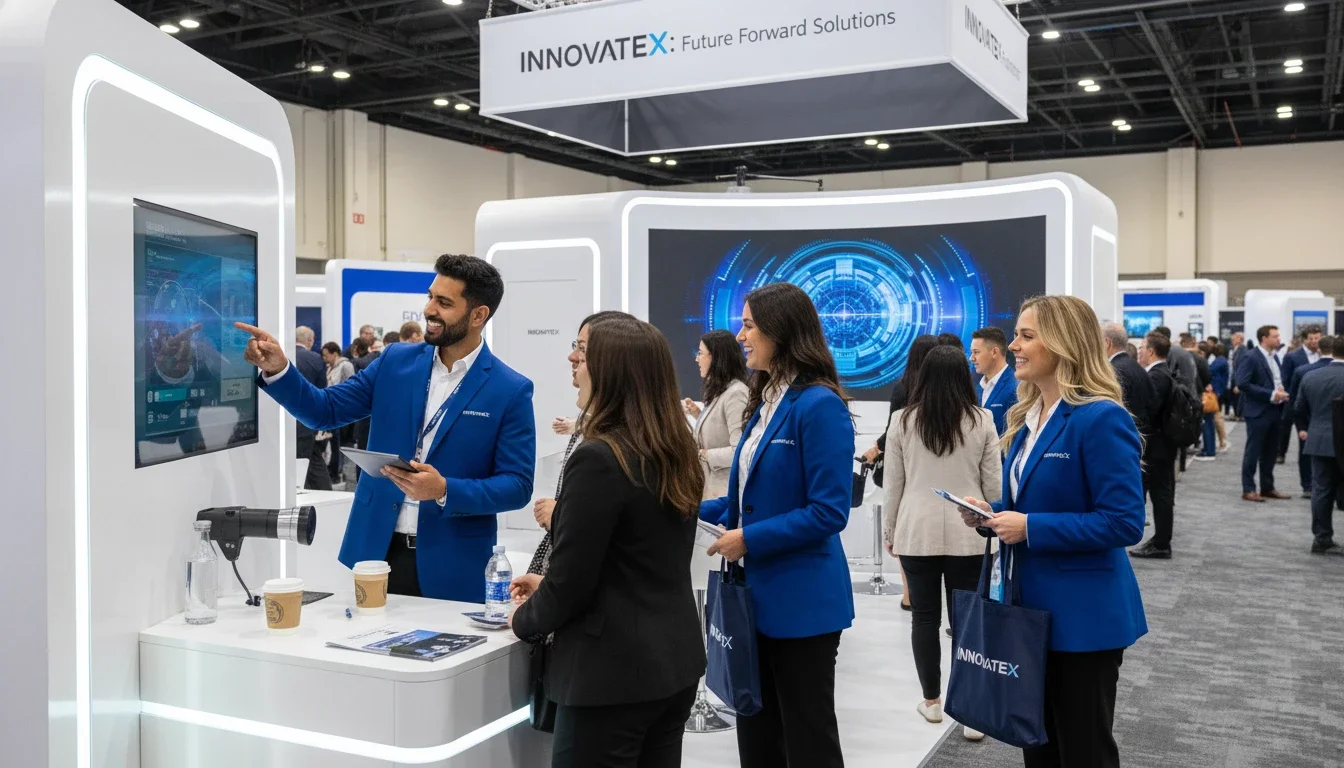
Professional brand ambassadors engaging attendees at a trade show booth
Why Trade Show Staffing Can Make or Break Your Booth
The trade show floor is a high-competition, short-window environment. Attendees have dozens of booths competing for their attention, and most will make a split-second judgment about whether your exhibit is worth stopping at based entirely on the energy and body language of the people staffing it.
Research consistently shows that face-to-face interactions remain the most effective channel for driving qualified leads at B2B events. That means your staff aren't just logistical support — they are your primary sales and brand asset during the show. Every hour an attendee doesn't get engaged at your booth is a missed conversion opportunity that no follow-up email can fully recover.
The Real Cost of Under-Staffing Your Exhibit
Under-staffing isn't just an inconvenience — it's a direct revenue leak. When your team is spread too thin, several things happen simultaneously:
Attendees approach, see no one available, and walk on
Staff fatigue sets in mid-show, and engagement quality drops
High-value prospects get caught in the same queue as browsers
Demos don't run on schedule because someone is handling registration
Your internal team burns out managing logistics instead of selling
None of these failures show up on a post-show invoice. They show up in your lead count — or rather, the absence of one.
Salt Lake City as a Trade Show Destination
Salt Lake City has quietly grown into one of the Mountain West's most active trade show markets. Its central location, strong infrastructure, and growing reputation across technology, outdoor recreation, healthcare, and retail make it a frequent stop for national exhibitors.
Key Venues to Know
Salt Palace Convention Center — Located at 100 West Temple in downtown SLC, the Salt Palace is the city's flagship convention facility, with approximately 515,000 square feet of contiguous exhibit hall space. Its downtown location puts attendees within walking distance of hotels, restaurants, and transit, making it the default choice for large-scale national trade shows and expos.
South Towne Exposition Center (Mountain America Expo Center) — Situated in Sandy at 9575 State Street, South Towne serves as the valley's primary venue for regional trade shows, home expos, consumer shows, and mid-size industry events. It's a more contained environment than the Salt Palace, with strong foot traffic and a loyal regional attendee base.
Utah Valley Convention Center — Located in Provo, this modern facility hosts regional and industry-specific gatherings drawing from the entire Wasatch Front corridor. Its proximity to Brigham Young University makes it particularly active for education and technology-adjacent events.
Grand America Hotel — For premium corporate conferences, healthcare summits, and high-profile industry events, the Grand America offers a more intimate luxury setting that demands a different caliber of hospitality staff.
Major Trade Shows and Events in Salt Lake City
Salt Lake City hosts several nationally recognized events that draw exhibitors from across the country:
Outdoor Retailer — One of the outdoor industry's most important trade shows, held annually at the Salt Palace, attracting manufacturers, retailers, and media from around the world
Silicon Slopes Tech Summit — A flagship technology and innovation conference drawing founders, investors, and enterprise tech buyers across the Mountain West
FanX Salt Lake Comic Convention — One of the largest pop culture conventions in the U.S., with strong brand activation and experiential marketing opportunities
RootsTech — The world's largest genealogy and family history conference, drawing a national and international audience to the Salt Palace
SME Annual Conference & Expo — A major engineering and manufacturing industry event
Winter Sports Market — A key gathering for winter outdoor industry stakeholders
Understanding which show you're entering matters for staffing decisions. A consumer-facing event like FanX calls for high-energy, approachable brand ambassadors. A B2B industrial show like SME demands staff with professional polish and strong lead qualification instincts.
How Many Staff Do You Need? Calculating the Right Ratio
This is the question every exhibitor asks, and the answer is less complicated than most people expect once you have a clear framework.
The 50-Square-Foot Rule
A widely used industry benchmark is one staff member per 50 square feet of active booth space. This accounts for the natural flow of attendees through your space, ensuring no visitor goes ungreeted and no demo runs without support coverage.
So a 10×10 booth (100 sq ft) generally warrants 2 staff members at minimum. A 20×20 island booth (400 sq ft) typically requires 6–8, depending on programming. A large double-decker exhibit might call for 10–15, with defined zones and role assignments.
Adjusting for Booth Type and Show Traffic
The 50-square-foot formula is a starting point, not a ceiling. Adjust upward for:
High-traffic shows where attendee volume is dense (Outdoor Retailer, FanX)
Demo-heavy programming where each interaction takes 5–10 minutes
Multi-product exhibits require staff with specialized product knowledge in each zone
Lead capture operations that run separately from engagement activities
First-day surges — many shows front-load foot traffic, and being understaffed on Day 1 is a costly mistake
Also, plan for shift coverage. A two-day show that runs 9 am–6 pm isn't staffed by people working 18-hour stretches. Build in breaks, meal rotations, and energy management — especially for staff whose primary job is standing, talking, and staying "on" for an extended period.
Trade Show Staffing Roles Explained
Not all trade show staff do the same job, and treating them as interchangeable is one of the most common exhibitor mistakes. Here's a breakdown of each core role and where they fit in your booth operation.
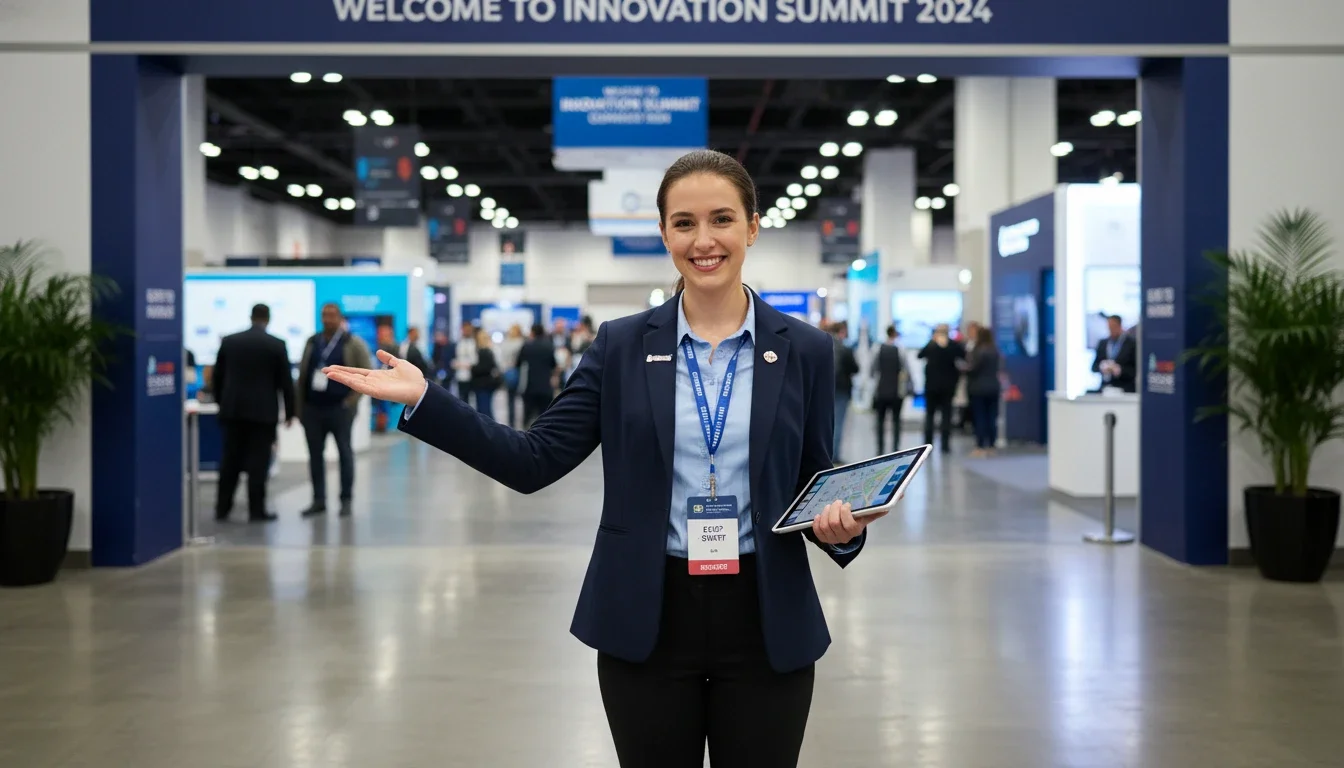
Different event staff roles at an expo — greeters, brand ambassadors, registration staff
Brand Ambassadors
Brand ambassadors are your frontline engagement team. Their job is to attract foot traffic, initiate conversations, qualify interest, and guide attendees deeper into your booth experience. The best trade show brand ambassadors balance outgoing energy with the ability to read a room — knowing when to draw someone in and when to let them browse.
They don't need to be product experts on day one, but they do need to be briefed thoroughly on your key messages, value proposition, and any scripted or semi-scripted opening lines your team uses. For SLC exhibitors working events like Silicon Slopes or Outdoor Retailer, professional, knowledgeable ambassadors are particularly important given the audience's sophistication.
Eleven8's brand ambassador services include pre-event brand briefings so every ambassador arrives informed, not improvising.
Booth Staff and Product Demonstrators
Booth staff move into deeper engagement after a brand ambassador has initiated contact. If you have a product to demo, a software platform to walk through, or technical specifications to explain, this is the role that carries those conversations. Ideally, booth staff have some relevant industry background — or at least the capacity to learn and retain product information quickly.
For complex B2B products, consider pairing one product demonstrator with two brand ambassadors: the ambassadors pull people in, and the demonstrator converts that attention into qualified conversations.
Registration and Check-In Staff
If your booth runs any kind of scheduled demo, private meeting, sweepstakes entry, or badge scan operation, dedicated check-in and registration staff make that process frictionless. Nothing kills booth energy faster than a backlog at the entry point.
Registration staff is also your first data-collection touchpoint. A professional, organized check-in experience sets the tone for everything that follows — and ensures you leave the show with clean, complete lead data.
Greeters and Hosts
Greeters serve a specific function that brand ambassadors don't always fill: pure warm welcome. At the perimeter of your space, a skilled greeter makes eye contact, offers a friendly opening, and directs attendees toward the part of your exhibit most relevant to their interests. At larger booths or those with multiple programming zones, hosts manage traffic flow and ensure every visitor gets oriented.
Think of greeters as the hospitality layer of your staffing strategy — and don't undervalue them. A warm, attentive entry experience dramatically increases dwell time.
Production Assistants
Production assistants handle the operational backbone of your booth: setup and breakdown assistance, supply management, AV support, literature restocking, and general logistics. For exhibitors who travel light or whose internal team is entirely focused on sales activity, a PA or two is what keeps the backend running without requiring your account executives to step off the floor.
PAs are also invaluable during the chaotic move-in and move-out windows that bookend every trade show — particularly at the Salt Palace, where freight and load-in schedules can be tightly managed.
Lead Capture Specialists
Not all agencies offer this as a distinct role, but for exhibitors focused on measurable ROI, a dedicated lead capture specialist — someone whose entire job is badge scanning, entering notes, and organizing contact information during the show — pays for itself quickly. When your brand ambassadors and booth staff are deep in conversations, lead data doesn't fall through the cracks.
This role pairs naturally with a post-show follow-up strategy: the cleaner your lead data, the faster and more targeted your sales team can work after the show closes.
Should You Hire Local Staff or Bring Your Own Team?
This is one of the most practical decisions an exhibitor makes, and the answer usually isn't either/or.
When Local Staffing Makes More Sense
Hiring local trade show staff in Salt Lake City has clear operational advantages:
No travel costs — No flights, hotels, per diems, or lost productivity for team members who travel
Availability for multi-day shows — Local staff can commit to all show days without conflicting obligations
Local energy — Staff who live and work in SLC often have stronger cultural familiarity with the local audience
Scalability — Need 3 brand ambassadors for Day 1 and 6 for the peak afternoon of Day 2? A staffing agency can flex that roster; your internal team cannot
For most national brands exhibiting at SLC shows, the smart model is to bring one or two internal subject matter experts for depth, and surround them with locally sourced professional staff for breadth.
How to Combine an Internal Team With External Staff
The hybrid model works well when roles are clearly divided. A typical configuration:
Internal team: Sales director, product manager, or account exec — handles high-value prospect conversations and closed-loop follow-up
External brand ambassadors: Engage the floor, qualify leads, direct traffic to the internal team
External support staff: Handle registration, demos, hospitality, and logistics
Brief everyone together before the show opens. When the external staff knows what the internal team is focused on — and the internal team trusts the external staff to hold the floor — the operation runs cleanly, and no one is wasted on work they're not equipped for.
How to Find and Vet a Trade Show Staffing Agency in Salt Lake City
The difference between a solid agency and a mediocre one isn't always visible until the morning of your show. Choosing carefully upfront protects you from the most common trade show staffing failure: no-shows and unqualified replacements.
What to Ask Before You Book
When evaluating a staffing agency for your SLC trade show, ask:
Do you maintain an existing roster in Salt Lake City, or do you recruit per event? Agencies that recruit after you book are exposed to last-minute gaps. Agencies with pre-built local rosters deploy from a vetted pool.
What does your vetting process look like? Look for background checks, live interviews, and trial shifts — not just application form reviews.
What's your fulfillment rate and backup policy? Industry standard is high 90s. Agencies that include built-in backup coverage (like one briefed backup per 8 staff) provide real protection against no-shows.
Can I see staff profiles and select my team? The ability to browse bios, photos, and experience histories before your event is a significant quality signal.
Who is my point of contact on show day? You want a named account manager who is reachable in real time — not a shared inbox.
Are your staff insured? Any reputable agency carries workers' compensation and general liability coverage, and can provide a Certificate of Insurance on request.
Eleven8's trade show staffing service addresses every item on this list, including built-in backup coverage at no additional charge and pre-event brand briefings for every staff member.
Red Flags to Watch For
Unusually low pricing with no explanation — Often signals that the agency recruits last-minute from marketplace platforms rather than a qualified roster
No clear vetting process described — "We screen our staff" is not a process
Inability to provide staff photos or profiles — If you can't see who you're getting, you're taking on unnecessary risk
No dedicated account manager — Being passed between multiple contacts is a sign of operational disorganization
Vague backup policy — "We'll do our best" is not a contingency plan
How to Brief Your Trade Show Staff for Maximum Performance
Hiring qualified staff is only half the equation. How you prepare them determines what they actually deliver on the floor.
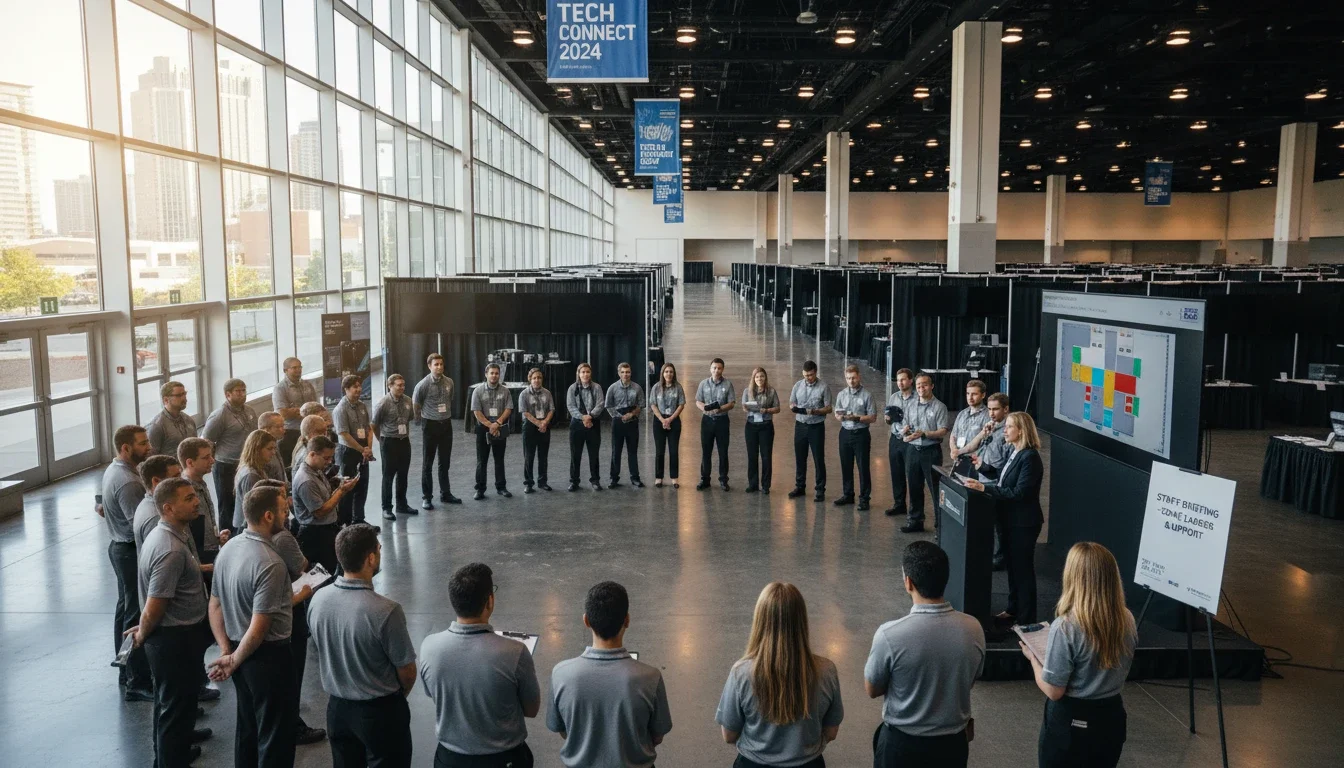
Event staffing team receiving pre-show briefing before convention floor opens
Pre-Show Briefing Essentials
A thorough pre-show brief — ideally delivered 24–48 hours before the show opens — should cover:
Brand overview: What your company does, who your target customer is, and what makes your product or service different
Key messages and talking points: The 2–3 things every attendee should walk away knowing
Role responsibilities: Who owns which zone, who handles which type of conversation, who manages lead capture
Dress code and presentation standards: Branded apparel, grooming expectations, and any show-specific guidelines
Escalation path: When and how to hand off a conversation to an internal team member
Prohibited behaviors: No phones on the floor, no eating in the booth, no sitting unless structurally required
Show logistics: Arrival time, parking, badge collection, break schedule
The more specific and operational your brief, the less you rely on individual staff judgment in the moment — and the more consistent your brand experience becomes across the entire show floor.
Setting Expectations on the Floor
Brief your staff on the energy standard, not just the task list. Trade show floors are tiring. After the first few hours, unmanaged staff tend to drift toward each other, toward their phones, or toward the back of the booth. Make clear from the start that facing outward, staying engaged, and maintaining approachability are non-negotiable throughout the show.
Designate a team lead — either from your internal staff or from the agency's on-site supervisor — who is empowered to make real-time adjustments and ensure standards are held.
Staffing for Lead Generation: Connecting Your Team to Your ROI
Your staffing model isn't separate from your lead strategy — it is your lead strategy. Every interaction your staff has is either moving someone toward a qualified conversation or losing them to the competition down the aisle.
Role of Staff in Lead Capture
Brand ambassadors should badge scan every meaningful interaction, not just the ones that convert immediately. A lot of trade show follow-up business comes from contacts who weren't ready to buy on the floor.
Booth staff should qualify leads during demos by asking structured questions — not just pitching. Knowing a prospect's timeline, budget authority, and specific use case turns a badge scan into a sales-ready lead.
Check-in staff should note the context of each entry — attendee role, company type, stated interest — rather than just collecting a badge number.
How to Track Booth Performance by Staff
Ask your agency or team lead to compile a post-show debrief that includes:
Total badge scans or lead entries by shift
Qualitative notes on which engagement approaches worked
Any recurring questions or objections from attendees (invaluable for post-show sales prep)
Attendance and punctuality report for each staff member
Agencies like Eleven8 build post-event feedback into every engagement — staff are rated after each shift, and performance data is available to the client. That kind of accountability loop matters when you're evaluating whether to bring the same team back for the next show.
Building a Backup Plan: Contingency Staffing at Salt Lake City Events
No-shows are a reality in event staffing, and planning for them is not pessimism — it's operational maturity.
At a trade show, a single no-show in a six-person team is a 17% staffing deficit. If that person was your only brand ambassador with demo experience, the impact is larger than the math suggests.
The best protection is working with an agency that builds contingency in by default. Look for:
Pre-briefed backups — Not just "we'll find someone"; a specific, named individual already briefed on your event who can deploy if needed
Same-day fulfillment capability — Can the agency fill a vacancy within 2–4 hours in the SLC market?
On-site supervisor coverage — An agency representative available throughout the event day who can respond to changes in real time
Eleven8 includes one briefed backup for every 8 staff members at no additional charge — not as a premium add-on, but as a baseline operational guarantee. At a busy show like Outdoor Retailer or Silicon Slopes, that policy has real value.
Staffing Timeline: When to Book for Salt Lake City Trade Shows
How far in advance you book has a direct effect on team quality. Here's a practical timeline framework:
| Timeframe Before Show | Action |
|---|---|
| 3–6 months out | Confirm dates, venue, and booth size. Begin agency conversations. |
| 6–10 weeks out | Finalize staffing agency selection, submit staff request with event brief. |
| 3–4 weeks out | Review staff profiles, select your team, and confirm uniforms and attire. |
| 1–2 weeks out | Deliver brand brief to agency. Schedule pre-show briefing call. |
| 48–72 hours out | Confirm all staff assignments, backup coverage, arrival times, and logistics. |
| Show morning | Team arrives 45–60 minutes early. Walk the booth, complete final briefing. |
| Post-show | Debrief with the agency. Collect lead data and performance report. |
For major SLC shows like Outdoor Retailer or FanX — both of which draw national exhibitors competing for the same staffing talent — booking 8–10 weeks out is a meaningful competitive advantage. The best staff get placed early.
Working with Eleven8 for Trade Show Staffing in Salt Lake City
Eleven8 operates an established event staffing presence in Salt Lake City — which means local staff is already on roster, already vetted, and ready to deploy before you call. The agency doesn't recruit after you book; it draws from a pre-qualified pool of professionals who've been through an 8-step screening process that accepts fewer than 3% of applicants.
For trade show exhibitors, that distinction matters. You're not hoping someone available shows up — you're selecting from people who have been background-checked, live-interviewed, and trial-shifted before they ever represent a client brand.
Every Eleven8 booking includes:
A dedicated account manager as your single point of contact
Pre-event brand briefing for every staff member
Built-in backup coverage (one briefed backup per 8 staff, at no charge)
24/7 event day support
Post-event performance reporting and staff ratings
Whether you need brand ambassadors, expo staff, check-in coordinators, or production assistants for your next Salt Lake City trade show, request a quote here — and get a staffing plan built around your booth, your brand, and your goals.