Beyond the Bots: Why Smart Event Staff Make the Difference at FIRST Robotics Competitions
Walk into a FIRST Robotics Competition regional and the energy hits you immediately. Teams of high school students in matching shirts sprint past with toolboxes. Mentors huddle around laptops. Referees walk the field. Parents and sponsors fill the bleachers. The emcee's voice fills the arena. Robots do things that, frankly, shouldn't be physically possible for students who just learned to code a PID controller six weeks ago.
It's electric.
But beneath all of that spectacle — behind every smooth match transition, every family that actually found their seat, every sponsor who got their activation handled correctly, every student who walked into pit check-in without standing in a 45-minute line — is something less visible: a skilled, professional event staff working in the background to make all of it possible.
Robotics competitions like FIRST get a lot of attention for what happens on the field. This article is about what happens off it.
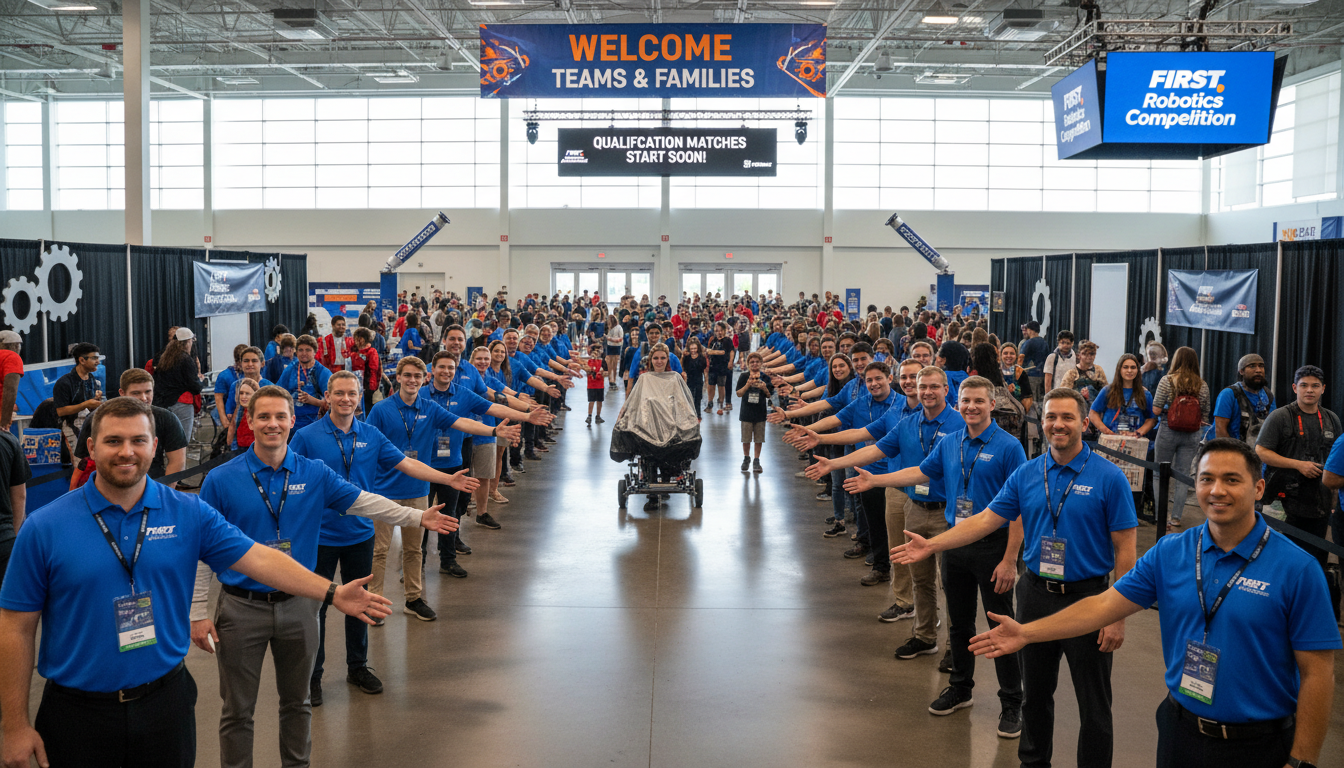
Professional event staff welcome teams and families at a large-scale FIRST Robotics regional competition
What Makes FIRST Robotics Competitions So Demanding to Run
Thousands of Attendees, Dozens of Moving Parts
A typical FIRST Robotics Competition regional event draws 30 to 80 teams, each with 25 to 40 team members, mentors, and parents. Add sponsors, media, local officials, and public spectators, and a single regional event can involve thousands of people moving through one venue across two or three days.
The FIRST Championship — held annually in Houston — scales that reality up dramatically. Over 600 FIRST Robotics Competition teams from around the globe attend the annual FIRST Championship, making it one of the largest youth STEM events in the world. The four-day Championship event requires nearly 2,000 volunteer roles to execute — and that figure doesn't include the professional hospitality and logistics staff that keep the guest experience running smoothly.
That scale is extraordinary. And it means that every person who shows up to help — whether a technical volunteer or a professional event staff member — carries real weight.
FIRST Robotics Isn't Just a Competition — It's a Multi-Day Convention
This is the thing that catches first-time event organizers off guard.
FRC events aren't like a weekend tournament where you set up a bracket and let teams play. They're full convention operations. There are pit areas where teams repair and modify robots between matches. There are sponsor booths. Judging rooms. Award ceremonies. Innovation fairs. Food service lines. Media access points. Safety zones.
These high-energy celebrations bring students, mentors, volunteers, families, and fans together in a way that mirrors the operational demands of any large corporate conference or trade show — with the added complexity of serving a predominantly youth audience.
Running it well requires two distinct categories of personnel: technical volunteers (the people certified by FIRST to manage field operations, judging, and robot inspection) and operational event staff (the professionals who manage the human experience — check-in, wayfinding, crowd flow, hospitality, and logistics).
Conflating those two categories is one of the most common mistakes FRC event planners make.
The Staffing Roles That Keep FRC Events Running Smoothly
Registration & Check-In Staff: The First Impression That Sets the Tone
Every team, mentor, and family member at an FRC event begins their experience in the same place: registration.
At a regional with 50 teams and 1,500+ attendees, that registration window gets compressed. Everyone arrives within 45 minutes of doors opening on Day 1. A slow, disorganized check-in process doesn't just frustrate people — it cascades. Delayed team check-in pushes back robot inspection. Delayed robot inspection delays the match schedule. A match schedule delay on Day 1 costs time that can't be recovered across a multi-day event.
Professional registration and check-in staff bring exactly the kind of organized, high-volume processing that FRC events demand. They've worked conventions before. They understand badge distribution, credential verification, ADA accommodation management, and how to redirect a confused family without causing a backup in the line behind them.
This is not a role that benefits from improvisation.
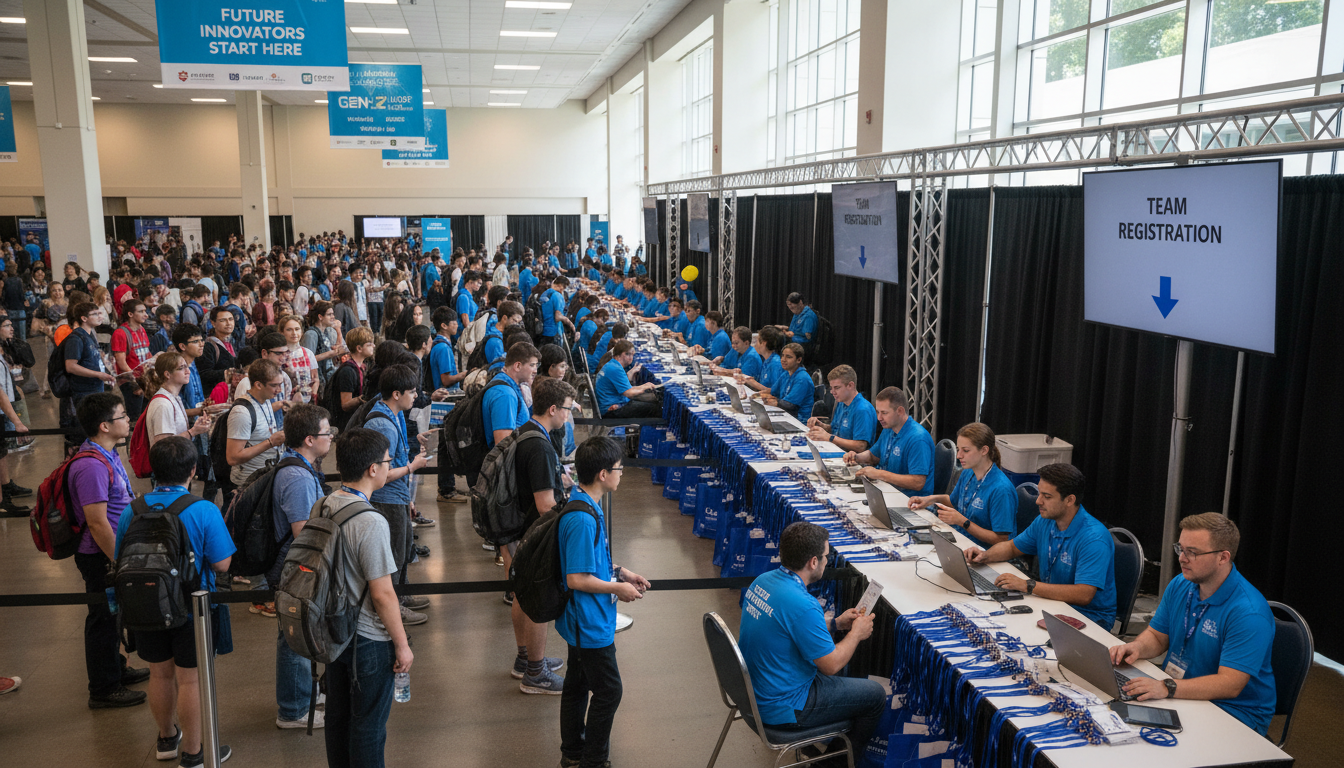
A trained check-in team processes hundreds of team registrations efficiently at a STEM convention
Ushers and Greeters: Guiding Every Attendee With Confidence
Convention venues are not intuitive. A large arena or convention center that hosts an FRC event may have pit access points, spectator seating, media areas, sponsor zones, parking structures, and food service scattered across multiple floors and wings.
Professional ushers and event greeters serve a deceptively critical function: they keep 1,500 people from all figuring out the same venue simultaneously. Positioned at key decision points — venue entrances, elevator banks, spectator entry gates, team pit access corridors — they reduce confusion before it starts.
For families attending their first FRC event, a confident, informed greeter can completely shift their first-hour experience. For sponsors and VIP guests, they're the face of the event before anyone else.
Production Assistants: The Invisible Engine Room of Every FRC Event
Production assistants at convention-scale events are responsible for a wide range of behind-the-scenes logistics: stage setup, AV support coordination, load-in and load-out, signage placement, supply runs, and the constant small-scale problem-solving that keeps multi-day events from developing friction.
FRC events have particular production complexity: field setup and breakdown, sponsor activation installation, awards ceremony staging, pit administration logistics, and the live streaming infrastructure that FIRST uses to broadcast events to remote audiences. Having trained production support staff — people who understand convention operations and work well under time pressure — directly impacts event quality.
Crowd Management Staff: Safety Without Disrupting the Energy
Safety at an FRC event isn't just about robot inspection compliance. It's about managing large crowds of students, families, and spectators through transitions — between matches, during lunch breaks, at the end of competition days, and especially during the awards ceremony when emotions run high, and exit flows can become congested.
Crowd management staff at STEM events need a specific combination of skills: the authority to redirect traffic, the communication ability to do it calmly, and the emotional intelligence to handle a situation involving minors and families without escalating tension. That combination is rare in an untrained context, and it's exactly what professional convention staffing provides.
Why Professional Event Staff Outperform Volunteer-Only Models at Scale
Volunteers Are the Heart of FIRST — But They Can't Do Everything
This point deserves to be stated clearly, because it sometimes gets lost in the enthusiasm around FIRST's volunteer culture: volunteers are indispensable to FRC events. The FIRST Technical Advisor (FTA) is a highly visible, leadership role responsible for ensuring the smooth technical operation of the competition field. Field Resetter volunteers repair and reset the playing field after each team match, playing a critical role in maintaining the pace of the event.
These are trained, certified roles that require deep familiarity with the game, the field, and FIRST's operational protocols. They cannot be replaced by professional event staff, and no one is suggesting they should be.
But FIRST's volunteer system is designed around technical and officiating functions. FIRST's own event staffing guidance is primarily addressed to Volunteer Coordinators managing technical roles. It does not address the operational hospitality layer: registration, crowd flow, sponsor support, wayfinding, or production logistics.
That layer is where professional staffing fills the gap.
The Gap Between Technical Volunteers and Guest Experience Roles
Think of it as two separate layers working in parallel.
Layer 1 — Technical Operations (Volunteer-driven):
Field Technical Advisors
Referees and scorekeepers
Robot inspectors
Judges and judge advisors
Queue managers and field supervisors
Layer 2 — Guest Experience Operations (Professionally staffed):
Registration and credential management
Spectator wayfinding and ushering
Sponsor activation support
Production and logistics assistance
Crowd management at transitions
Hospitality for VIPs and sponsors
Both layers matter. But only one of them is consistently supported by FIRST's volunteer recruitment infrastructure. The guest experience layer — the one that determines how parents, students, sponsors, and first-time attendees feel about the entire event — often relies on whoever the local planning committee can round up.
That's a risk no event organizer should accept when better options exist.
What Happens When Staffing Fails at a Large FIRST Event
It rarely makes the news, but anyone who has attended or organized a large FRC event has seen it: registration lines that stretch into the parking lot because there aren't enough hands to process credentials. Families wandering the venue with no one to ask for directions. Sponsor booths were left unattended during peak foot traffic because the volunteer assigned never showed. A crowd control gap during the awards ceremony that creates a safety issue.
None of these failures is catastrophic individually. But they accumulate. And the people who experience them — families, students in their first competition season, corporate sponsors making a significant investment — form impressions that last.
Professional convention staffing doesn't eliminate the possibility of things going wrong. It dramatically reduces it — and it provides a systematic response when things do.
Gracious Professionalism Starts Before the First Match
FIRST's guiding philosophy is "Gracious Professionalism" — the idea that fierce competition and mutual respect aren't in opposition; they're complementary. Teams are expected to help each other, compete with integrity, and treat every participant with dignity.
That philosophy is most visible on the field. But it should be present everywhere at an FRC event — including in every interaction that event staff has with attendees.
How Staff Behavior Shapes a Student's Competition Day
For many high school students, an FRC regional is one of the most emotionally intense experiences of their year. They've spent months building, testing, and rebuilding. They're competing in front of family, mentors, and peers. They're nervous, sleep-deprived, and running on adrenaline.
The event staff they interact with — the person at registration who processes their team credential without making them feel like a burden, the usher who points them to pit access with a smile, the production assistant who helps them find their gear cart — all of those interactions contribute to what the student will remember about competition day.
Staff who are rushed, disengaged, or undertrained contribute noise. Skilled, professional staff contribute signal: this event is organized, this organization cares, you belong here.
What Event Organizers Get Wrong About "Just Needing People"
There's a common assumption in amateur event planning that most front-of-house roles just need warm bodies — that the presence of a human being in a position is sufficient. Registration? Just need someone to hand out badges. Greeter? Just need someone to stand at the door.
This thinking underestimates the skill involved in high-volume, high-stakes crowd management at a multi-day convention. The difference between a good and a poor registration experience isn't whether a person is present — it's whether that person knows the venue layout, understands the event flow, can process credentials quickly under pressure, and communicate clearly with distressed or confused attendees.
That capability is built through training, experience, and selection — exactly what a professional event staffing agency provides.
What to Look for When Hiring Event Staff for a Robotics Competition
Experience with Multi-Day Convention Formats
FRC events aren't one-day activations. They're two-to-four-day operations with different audience compositions each day, different operational demands (setup day vs. competition day vs. awards day), and different physical requirements for staff.
An agency that primarily places staff at single-day product launches or brand activations may not have personnel experienced in the sustained, operationally complex environment of a multi-day convention. Look for agencies that explicitly list conference staffing, expo staffing, and trade show staffing as core competencies.
Trained, Vetted, and Backed by Backup Coverage
FIRST events don't have a lot of tolerance for no-shows. A day-of cancellation for a key check-in staff member has real operational consequences when thousands of attendees are arriving simultaneously.
Ask every prospective staffing agency two questions:
What is your fulfillment rate?
Do you include backup coverage?
A high-quality staffing partner will have a documented fulfillment rate, will staff from an existing roster rather than recruiting after you book, and will include built-in backup coverage as a standard part of their service — not an upsell.
A Staffing Partner Who Understands STEM Audience Dynamics
FIRST events have a distinctive audience composition: competitive high school students, technical mentors, corporate sponsors, public spectators, and school district officials — often all in the same building at the same time.
Staff who have only worked at cocktail parties or music festivals may find the environment surprising. Look for an agency with documented experience intech and innovation events, corporate conferences, and large-scale conventions — environments where the crowd is engaged, purposeful, and in many cases involves minors. Youth protection awareness, appropriate communication style, and the ability to remain professional in a high-energy STEM atmosphere are all relevant factors.
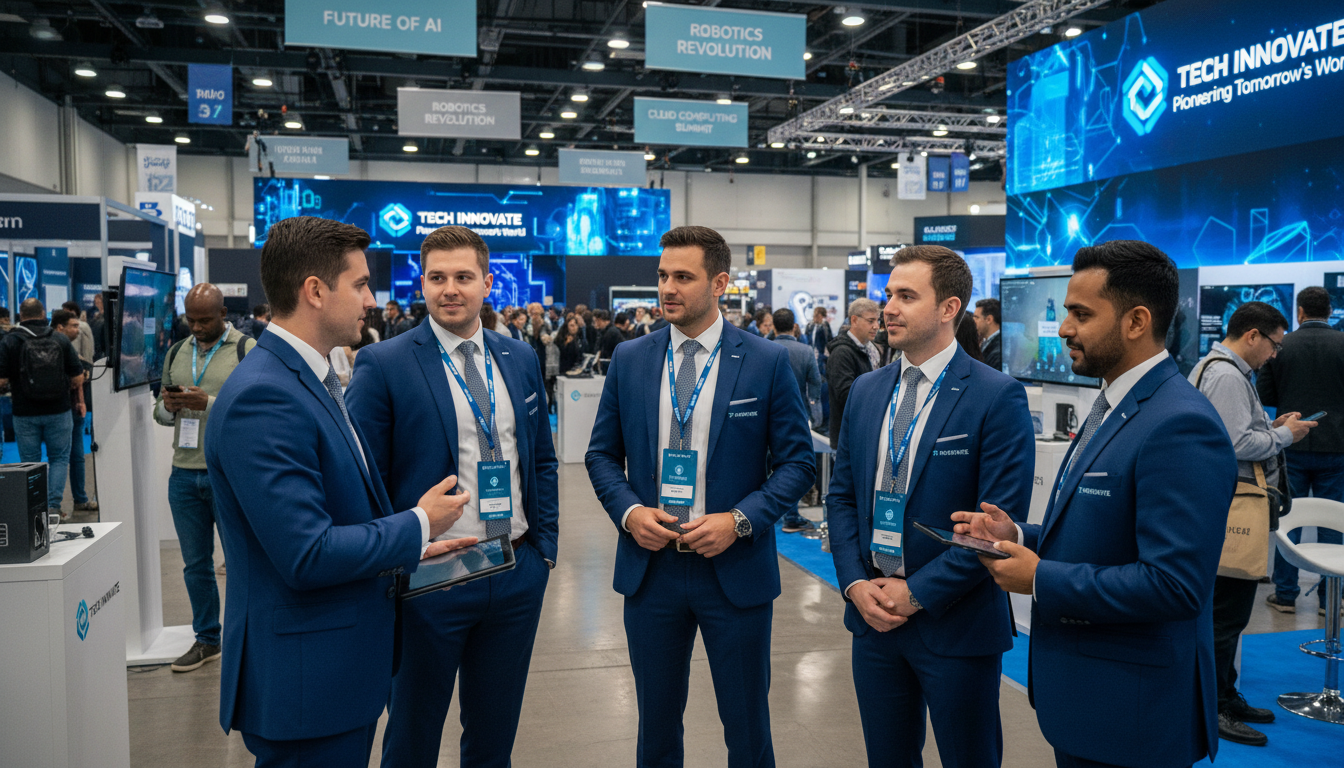
Vetted, professionally trained event staff representing a brand at a technology convention
How Eleven8 Staffs Large-Scale Conventions and Competitive Events Nationwide
Eleven8 Event Staff has spent over 35 years staffing events at every scale — from 50-person product launches to multi-day conventions drawing thousands of attendees. With more than 34,500 events staffed, a roster of 24,800+ active staff, and an industry-leading 101.8% fulfillment rate, Eleven8 brings a level of operational depth that volunteer-supplemented staffing simply cannot replicate.
Every Eleven8 staff member is selected from the top 3.5% of applicants and goes through an 8-step vetting process before being placed at any event. Backup coverage is included in every booking — one briefed backup for every eight staff. And every client gets a dedicated account manager from the first inquiry through the post-event recap.
For conventions and competitive events specifically — including STEM expos, tech conferences, and large multi-day competitions — Eleven8 deploys experienced convention staff, conference staff, trade show staff, registration staff, and production assistants who have worked comparable large-scale environments before.
With key markets in Houston — home of the FIRST Championship — as well as Los Angeles, Washington D.C., and 30+ other cities, Eleven8 can staff FRC regionals, district events, and championship-level competitions wherever they're hosted.
The bots are impressive. But it's the people behind the scenes — the ones handing out credentials at 7 a.m., directing families to their seats, supporting sponsor activations, and keeping 2,000 attendees moving smoothly through a convention center — who often determine whether the day feels polished or chaotic.
That's the difference professional event staffing makes.