17 Days at The Big E: A Staffing Plan That Survives the Marathon
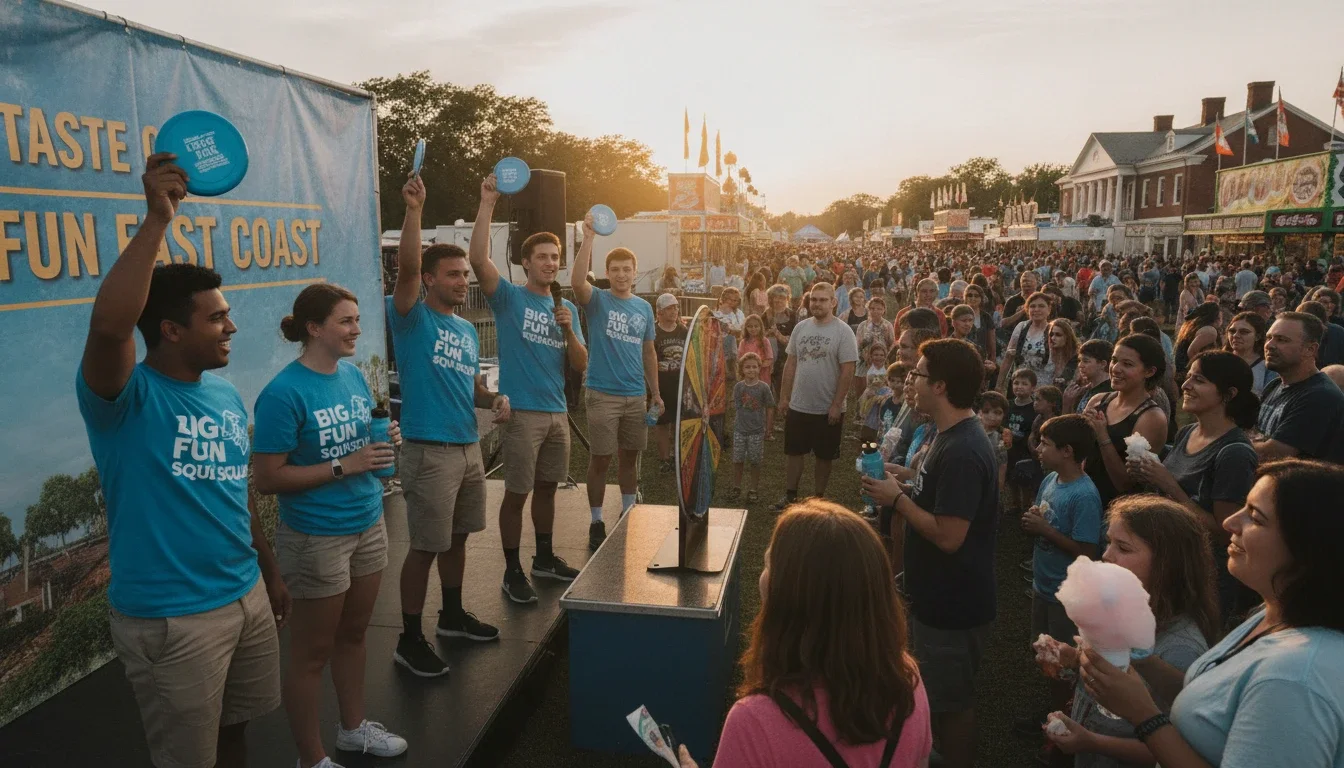
Brand activation staff at The Big E Eastern States Exposition multi-day fair
Seventeen days. One fairground. More than 1.6 million visitors.
That is what The Big E asks of every brand that shows up to activate on the Avenue of States. It is not a weekend pop-up. It is not a three-day trade show. It is a marathon — and staffing a marathon requires a completely different playbook than any other event format you have planned before.
Most brands discover this the hard way. They arrive with a solid team for opening weekend, watch performance slip through the mid-fair weekdays, and scramble to patch together coverage for the closing surge. By final Sunday, the activation is running on fumes.
This guide exists to prevent that. Whether you are planning your first Big E activation or refining a strategy that has had some rough edges, what follows is a phase-by-phase staffing framework built specifically for the Eastern States Exposition's 17-day format — the structure, the roles, the rotation logic, and the backup coverage protocols that keep your brand showing up strong every single day.
What Makes The Big E Different From Every Other Fair
Scale, Duration, and Visitor Density
The Big E is the largest fair on the East Coast and the fourth largest in North America. Held annually at the Eastern States Exposition fairgrounds in West Springfield, Massachusetts, it runs for 17 consecutive days each September, beginning on the second Friday after Labor Day. In 2024, the event drew 1,633,935 guests, broke seven daily attendance records, and set a new all-time single-day record of 178,608 visitors on its busiest day.
Those numbers are not just impressive. They are operationally significant. A single-day record of 178,608 people means your booth, activation space, or state-building exhibit will face crowd pressure that rivals major stadium events — on multiple days throughout the run.
The Three-Weekend Structure That Drives Everything
The Big E's 17-day calendar breaks naturally into three distinct phases, each with its own staffing demands:
Opening Weekend (Days 1–3): High energy, high attendance, high media visibility. First impressions are set here.
The Middle Miles (Days 4–10): Weekday attendance drops significantly compared to weekends. This is where poorly planned activations show cracks — either overstaffed and burning budget, or understaffed and delivering inconsistent experiences.
Closing Weekend Surge (Days 15–17): Attendance spikes again. Often, the busiest single weekend of the entire run. Teams that saved nothing for this phase collapse under the pressure.
Understanding this three-act structure is the foundation of every staffing decision you will make.
Why Standard Staffing Playbooks Fail at Marathon Events
The Burnout Trap
The most common mistake brands make at The Big E is treating Days 1–17 like seventeen identical single-day events. They deploy the same team, the same hours, and the same energy output every day — and wonder why enthusiasm, engagement quality, and lead capture drop off sharply by Day 6.
Event staff are not machines. Brand ambassadors who deliver high-energy, on-message interactions for nine or ten hours a day, six or seven days in a row, without scheduled recovery time, will burn out. When they burn out, your brand suffers. The visitor experience degrades, conversion rates fall, and the investment in the activation shrinks in value every day you fail to manage this.
A staffing plan built for 17 days must account for human endurance just as deliberately as it accounts for headcount.
The Weekend Surge Problem
Weekday and weekend attendance at The Big E are not the same. Weekend days — particularly the first Friday through Sunday and the final three days — drive dramatically higher foot traffic than Tuesday or Wednesday afternoons. A flat staffing model that deploys identical team sizes across all 17 days misallocates resources: overspending on low-traffic weekdays and going short on the high-traffic weekends that matter most to your KPIs.
The right answer is a dynamic staffing model with variable headcount tied to anticipated daily attendance patterns.
The Credential and Access Gap
The Eastern States Exposition is a credentialed event. Staff who have not been pre-registered and badged through the fair's exhibitor systems will not be able to access the venue — a reality that has ended more than one activation before it started. This is not a minor logistics detail. It is a hard constraint that must be planned for weeks in advance, not days.
For brand activations housed within state buildings (such as the Avenue of States buildings), staffing and credentials forms are typically due by early July — often eight to twelve weeks before the fair opens. Missing that window means starting over.
Building the Staffing Plan: A Phase-by-Phase Framework
Experiential marketing event staffing schedule planning 17-day fair activation
Phase 1 — Pre-Fair: Locking in Roles, Rosters, and Credentials (8–12 Weeks Out)
Everything that happens on Days 1–17 is determined by decisions made in the eight to twelve weeks before the gates open. This phase is operational — not creative.
Key tasks in this phase include:
Define every role you need across the full 17-day run, including weekday minimums and weekend maximums
Submit all credentials and exhibitor staffing registration paperwork to Eastern States Exposition by their published deadlines
Partner with your staffing agency to confirm roster commitments, backup staff designations, and on-site captain assignments
Create a master shift schedule that maps headcount to each day and shift — not just the weekends
Conduct brand training for all staff, including those serving as backups, before the first day
Establish communication protocols: how will staff check in, how will supervisors report issues, and who is the single point of contact on the client side?
If you are working with an experienced event staffing agency, this phase is also when your dedicated account manager becomes your most important asset. A good account manager will flag credential deadlines, help right-size your roster, and build the backup coverage plan before you ask for it.
Phase 2 — Opening Weekend: High-Energy Deployment
Days 1 through 3 set the tone for your entire 17-day run. Visitor curiosity is at its highest. Media coverage and social sharing amplify what happens on the fairgrounds during opening weekend. First impressions are made not just with individual visitors, but with the broader audience watching from home.
Staffing priorities for opening weekend:
Deploy your most experienced, highest-energy brand ambassadors for the peak hours — typically 11 AM through 8 PM
Ensure on-site supervisory coverage is present for all shifts, not just morning briefings
Run shorter shift windows (6–7 hours with intentional overlap) rather than marathon 10-hour shifts — staff need energy reserves for days 4 through 17
Capture performance data from Day 1: lead volume, engagement count, product sampling figures, and any operational friction points
Opening weekend is not the time to test your coverage plan. It is time to execute a plan that has been stress-tested in advance.
Phase 3 — The Middle Miles: Weekday Efficiency Mode
Days 4 through 10 — and specifically the Tuesday through Thursday slots within those days — represent the operational heart of your staffing challenge at The Big E. Attendance is lower. Your highest-energy staff is starting to feel the accumulated effort of consecutive days. And the temptation to coast is real.
The brands that perform best through the middle miles are the ones that were designed for this phase intentionally:
Reduce headcount on low-traffic weekdays by 20–30% relative to weekend maximums, but do not reduce quality — keep your most capable brand ambassadors on the floor even when volume is down
Use lighter weekdays for in-activation improvements: adjust booth layout, refresh product displays, debrief on messaging effectiveness
Rotate staff from weekend-heavy roles to weekday-heavy roles to distribute fatigue evenly across the team
Schedule mandatory rest days for staff working the full 17-day run — a rested ambassador on Day 12 is worth more than an exhausted one who has worked every day since Day 1
This is also where production assistant coverage pays dividends. Experienced PAs can manage the operational layer — restocking, logistics, and setup tasks — freeing your brand ambassadors to focus entirely on visitor engagement.
Phase 4 — The Second Weekend: Re-Energizing the Team
The second weekend (roughly Days 8–10) brings another attendance spike and, for many teams, a morale test. Staff have been at it for over a week. The novelty of the activation has worn off. This is the weekend when coaching matters more than cheerleading.
Effective second-weekend management includes:
A structured re-briefing on key brand messages, updated goals, and any operational adjustments made during the first week
Recognition of strong performers from the first weekend — visible appreciation keeps teams motivated
Introducing any backup staff who have not yet been deployed, bringing fresh energy to the team
Reviewing lead quality data and adjusting ambassador conversation approaches based on what has and has not converted
Phase 5 — The Final Push: Closing Weekend Surge
Days 15 through 17 are everything. Closing weekend at The Big E historically draws some of the highest single-day attendance of the entire run. It is the last chance to hit your activation targets — and it is the phase most teams underestimate because they spent down their energy and backup resources too early.
Closing weekend staffing priorities:
Return to opening-weekend headcount levels — or exceed them if attendance data supports it
Bring back your strongest brand ambassadors, ideally with a day of rest between their last mid-fair shift and closing weekend
Ensure backup staff have been briefed and are ready to deploy at two hours' notice
Plan for extended hours on the final Sunday if the activation format allows — many visitors specifically come on the last day with purchasing intent
Brands that finish The Big E strong leave with the strongest data, the most meaningful consumer connections, and the clearest picture of ROI. That finish requires intentional staffing — not improvisation.
Staff Roles at a Big E Activation (And What Each One Actually Does)
Brand Ambassadors
Brand ambassadors are the most visible layer of your activation. At The Big E, they are working in a high-distraction, high-sensory environment where they have seconds to capture visitor attention before the next attraction pulls people away. The best fair-environment ambassadors combine high energy with authentic conversational ability — they draw people in, not just in.
For a 17-day run, look for ambassadors who have multi-day festival or fair experience, not just single-event backgrounds. The skill of sustaining engagement quality across repeated shifts is different from the skill of executing one great event.
Learn more about Eleven8's brand ambassador staffing services and how they are matched to your event type and audience.
Registration and Check-In Staff
If your activation involves any form of consumer registration, sweepstakes entry, product sampling signup, or lead capture, you need dedicated check-in and registration staff who are separate from your floor ambassadors. Mixing these roles creates bottlenecks that frustrate visitors and compromise your data quality.
At a 17-day event, registration staff need to be comfortable with repetitive data entry tasks while maintaining a warm, welcoming guest experience for the thousandth visitor of the day. That takes a specific personality profile.
Production Assistants and On-Site Supervisors
Multi-week activations need operational scaffolding that single-day events do not. Production assistants handle the logistical and operational tasks — inventory management, resupply, setup and teardown, equipment management — that would otherwise eat into your brand ambassador's visitor-facing time.
On-site supervisors (often called captains in agency parlance) serve a different function: they manage staff performance in real time, handle shift handovers, escalate issues, and maintain the quality standard across every day of the run. For a 17-day activation, having a trained captain on every shift is not a luxury — it is what keeps the activation from drifting.
Specialty Roles: Retail, Demo, and Food & Beverage
If your Big E activation involves product sales, cooking demonstrations, or food and beverage service, you need staffing profiles that go beyond standard brand ambassador capabilities. Product demonstrators need hands-on product knowledge and the ability to perform live demos repeatedly under varying crowd conditions. Retail sales staff need transaction experience and brand fluency.
Eleven8 staff across all of these specialty categories — from retail sales associates and product demonstrators to bartenders and catering staff — make it possible to staff a complex, multi-format activation from a single agency partner.
Rotation Scheduling: Keeping Quality High Across 17 Days
Weekday vs. Weekend Staffing Ratios
A practical starting point for multi-day fair staffing ratios:
Peak weekend days: 100% of maximum headcount
First and last day of each weekend: 90–95% of maximum headcount
Mid-week days (Tuesday–Thursday): 60–75% of maximum headcount, with headcount concentrated in the afternoon/evening peak hours
Opening and closing Fridays: 85–90% of maximum headcount — Fridays at The Big E perform closer to weekends than weekdays
These ratios should be calibrated based on your specific activation format, product type, and historical data, if you have it. An agency partner with fair-specific experience will often have baseline attendance models to inform this.
Shift Length and Overlap Protocol
Recommended shift structure for a 17-day run:
Standard shift length: 6–7 hours (not 8–10 for ambassadors doing high-engagement work)
30-minute overlap between outgoing and incoming shifts for handover briefings
No staff member should work more than 6 consecutive days without a scheduled day off on a 17-day run
Supervisors should operate on a separate rotation from ambassadors — their cognitive load across a 17-day run is different and requires separate management
Shift overlap is not wasted time. It is where institutional knowledge about what is working, what is not, and what the crowd is responding to on a given day gets transferred. Without structured overlap, each shift starts from zero.
Mid-Event Performance Check-Ins
Schedule a formal mid-event review at the end of Day 8 or 9. This check-in should cover:
Lead volume and quality versus targets
Staff performance flags — are there individuals who need coaching, recognition, or role adjustment?
Operational issues identified during the first week
Inventory and supply status
Any adjustments needed to the staffing plan for the second half of the run
This review is the single most powerful tool for saving a struggling activation and accelerating a successful one. Brands that skip it are flying blind for the back half of the event.
Backup Coverage: The Non-Negotiable for Multi-Week Events
At a single-day event, a no-show is a problem. At The Big E, a no-show on Day 14 — when you have already burned through your informal backup options — is a crisis.
Backup coverage must be structured into your staffing plan from the beginning, not treated as a contingency to be arranged if something goes wrong. For every eight staff members in your activation, you should have at least one briefed, credentialed backup ready to deploy on short notice.
"Briefed and credentialed" is the operative phrase. A backup who has not been through brand training and has not received fair credentials in advance cannot help you when you need them. They are only useful if they are prepared before Day 1.
Eleven8 Event Staff builds backup coverage into every booking — a briefed backup for every eight staff members at no additional charge — which is particularly valuable for extended-run events like The Big E, where the probability of at least one scheduling conflict across 17 days approaches certainty.
Working With a Staffing Agency for The Big E
What to Look For
Not every event staffing agency is equipped for a 17-day fair activation. The skills required are meaningfully different from one-day event staffing. When evaluating partners, look for:
Demonstrated experience staffing multi-day or multi-week events, not just single-day activations
A roster large enough to support rotation without recycling the same tired staff every day
A dedicated account manager who oversees your activation from inquiry through post-event recap — not a general customer service team
Structured backup coverage protocols included in the booking, not added as an upgrade
Credential management experience — an agency that has navigated fair exhibitor systems and understands submission deadlines
24/7 event-day support, so operational issues at 7 PM on a Wednesday get resolved immediately, not the next morning
Questions to Ask Before You Sign
How many staff do you have available in the greater Springfield, Massachusetts / Western New England area?
What is your fulfillment rate for multi-week events specifically?
How do you handle staffing for day 12 when your first-choice ambassador calls out sick?
What does your backup coverage protocol look like, and is it included in the base quote?
How do you manage credential registration for exhibitor events with hard deadlines?
Who is my single point of contact for the full 17 days, and how do I reach them at 6 PM on a Saturday?
For brands planning a Big E activation, Eleven8 Event Staff offers a nationwide roster, a dedicated account manager model, and built-in backup coverage — with the operational depth required for a 17-day run. You can inquire about staffing for your activation here.
Final Thoughts
The Big E is one of the most demanding staffing environments in the experiential marketing calendar — and one of the most rewarding when executed well. Seventeen days of sustained, high-quality brand presence in front of over 1.6 million New England consumers is an opportunity that few other activations can match.
But it demands a staffing plan built for endurance, not just opening day. The brands that leave The Big E with strong data, meaningful connections, and a closing weekend they are proud of are the ones that planned their staffing with the same rigor they applied to their creative.
If you are planning a Big E activation and want to talk through staffing strategy, contact Eleven8 Event Staff here. Our team has the roster, the operational infrastructure, and the multi-day event experience to keep your activation running at full strength from opening Friday to closing Sunday.