17 Days at the Indiana State Fairgrounds: Staffing for the Long Run
Most event activations ask a simple question: Can you get the right staff in the right place on the right day? The Indiana State Fair asks a harder one: can you do it 15 days in a row?
Held annually in Indianapolis on the grounds at East 38th Street, the Indiana State Fair is one of the oldest and largest state fairs in the country. It draws over 850,000 visitors during its run, spread across food courts, grandstand concerts, exhibition halls, livestock pavilions, midway rides, and dozens of brand activation footprints operated by vendors and sponsors.
For brands and vendors activating at the fair, the opportunity is enormous. The audience is captive, curious, and present in massive daily numbers. But the staffing challenge is proportionally demanding. This isn’t a weekend pop‑up. It isn’t even a four‑day trade show. It’s a continuous, daily operation that runs for over two weeks — and the quality of your people on the last day carries exactly as much weight as the first.
This guide covers what multi‑day fair staffing actually requires: the roles, the planning timeline, the operational pitfalls, and the approach that keeps a brand activation strong from opening day through the final weekend.
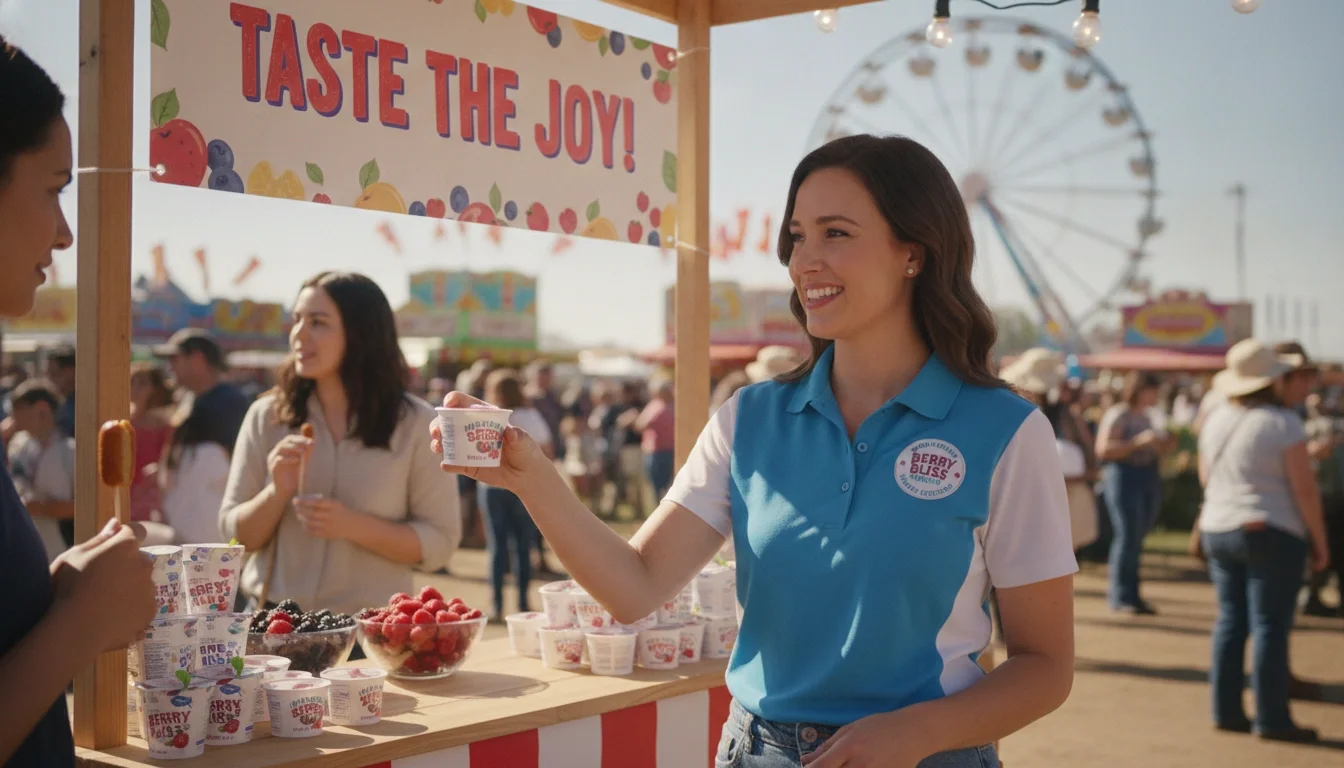
Professional brand ambassador providing product sample at state fair event
What Makes the Indiana State Fair Unlike Almost Any Other Activation
15 Days, Over 850,000 Visitors, One Chance to Get It Right
The Indiana State Fair runs for 15 operational days each August, closed only on the two Mondays within its run. The fairgrounds themselves span 214 acres and include 72 buildings, a 6,000‑seat grandstand, and a one‑mile racetrack — a campus‑scale venue that runs full programming from 8 a.m. each morning through late evening.
Attendance figures have held above 850,000 annually in recent years, drawing from across Indiana and neighboring states. The demographic mix is unusually broad: families with young children, agricultural and rural community members, entertainment‑seekers attending grandstand concerts, and food enthusiasts working through a notoriously creative food lineup. For brands, that breadth is a feature, not a complication — it represents genuine reach across income levels, age ranges, and lifestyle categories that no single‑venue activation can replicate.
But scale creates its own operational demands. A brand booth running daily for 15 days across a 214‑acre venue needs a staffing infrastructure — not just a headcount. The difference matters.
Why Brands Underestimate Multi‑Day Staffing
Single‑day and weekend activations create one set of staffing problems: sourcing qualified people quickly, ensuring they arrive and are briefed, and managing the shift. Multi‑week activations create a different and more complex set: maintaining consistent quality and brand message across many different people on many different days, managing the cumulative wear and toll of long outdoor shifts, and replacing team members who can’t cover specific days without anyone noticing the gap.
The brands that stumble at events like the Indiana State Fair typically do so not because they couldn’t staff day one — they do that well. They stumble around day seven, when the first‑week team is fatigued or unavailable, a replacement shows up without a proper briefing, and the guest experience quietly degrades. By day eleven, what was a strong activation has become an inconsistent one.
The solution isn’t hiring more people. It’s hiring the right people, building the right shift structure, and working with a staffing partner whose systems are built for sustained deployment.
The Staffing Roles That Drive Indiana State Fair Activations
The types of staff a brand or vendor needs at the Indiana State Fair depend heavily on the activation format. Here’s how the most common roles break down — and what to look for in each.
Brand Ambassadors and Sampling Teams
For consumer packaged goods, food and beverage brands, and any company running product sampling or demonstrations, brand ambassadors are the core staffing need. Their job is active engagement — stopping fairgoers, delivering a concise product message, initiating samples, and logging interactions if lead capture is part of the program.
At a 15‑day fair, sampling teams need to be energetic and engaging on day one and equally so on day thirteen. That requires selecting ambassadors who have demonstrated the stamina for sustained, high‑output guest interaction — and structuring shifts in a way that doesn’t burn them out by mid‑run. Rotating two‑person teams on alternating days, with consistent captains who maintain brand knowledge, is a model that works well in extended fair environments.
For brand activation programs at the Indiana State Fair, Indianapolis brand ambassadors are selected specifically for experiential performance — not just availability.
Food, Beverage, and Hospitality Crews
The Indiana State Fair’s food programming is one of its signature draws. Vendors operating food stalls, branded pop‑up concepts, or sponsored hospitality tents need kitchen and service staff who can handle high‑volume output in an outdoor or semi‑permanent structure — across long daily shifts, across many consecutive days.
Key roles in this category include waitstaff, bartenders and certified pourers, bar backs, line cooks, prep cooks, and bussers. Indiana’s ABCC certification requirements apply to any service involving alcohol, which means the staffing agency needs to source and verify the correct credentials ahead of deployment — not the day before.
For vendors planning a full‑service food or beverage presence, staffing should be finalized well before the fair opens. Last‑minute sourcing for culinary roles at a major 15‑day event is where quality gaps show up most visibly.
Registration and Entry Management Staff
For brands running invitation‑only experiences, sponsor lounges, or event‑within‑event programs at the fairgrounds, registration and check‑in staff serve a function that directly shapes first impressions. A smooth, organized check‑in experience sets the tone for everything that follows.
These roles require a combination of professionalism, accuracy, and genuine warmth — the ability to manage a queue efficiently without making guests feel processed. In high‑traffic outdoor environments with unpredictable arrival patterns, this means selecting staff who can work independently and stay composed under pressure.
Production Assistants and Floor Coordinators
Large brand installations at the fairgrounds typically include setup and teardown logistics, on‑site material management, and day‑to‑day operational support that doesn’t fall under a specific guest‑facing role. Production assistants fill this function — managing gear, supporting load‑in and load‑out, relaying communications between brand teams and on‑site crew, and handling the background work that keeps a complex activation running.
For activations spanning more than a week, a consistent production assistant or floor coordinator who learns the setup builds genuine operational efficiency over the run. They know where things are, what the recurring problems are, and how to solve them without escalating.
The Real Challenges of a 15‑Day Staffing Run
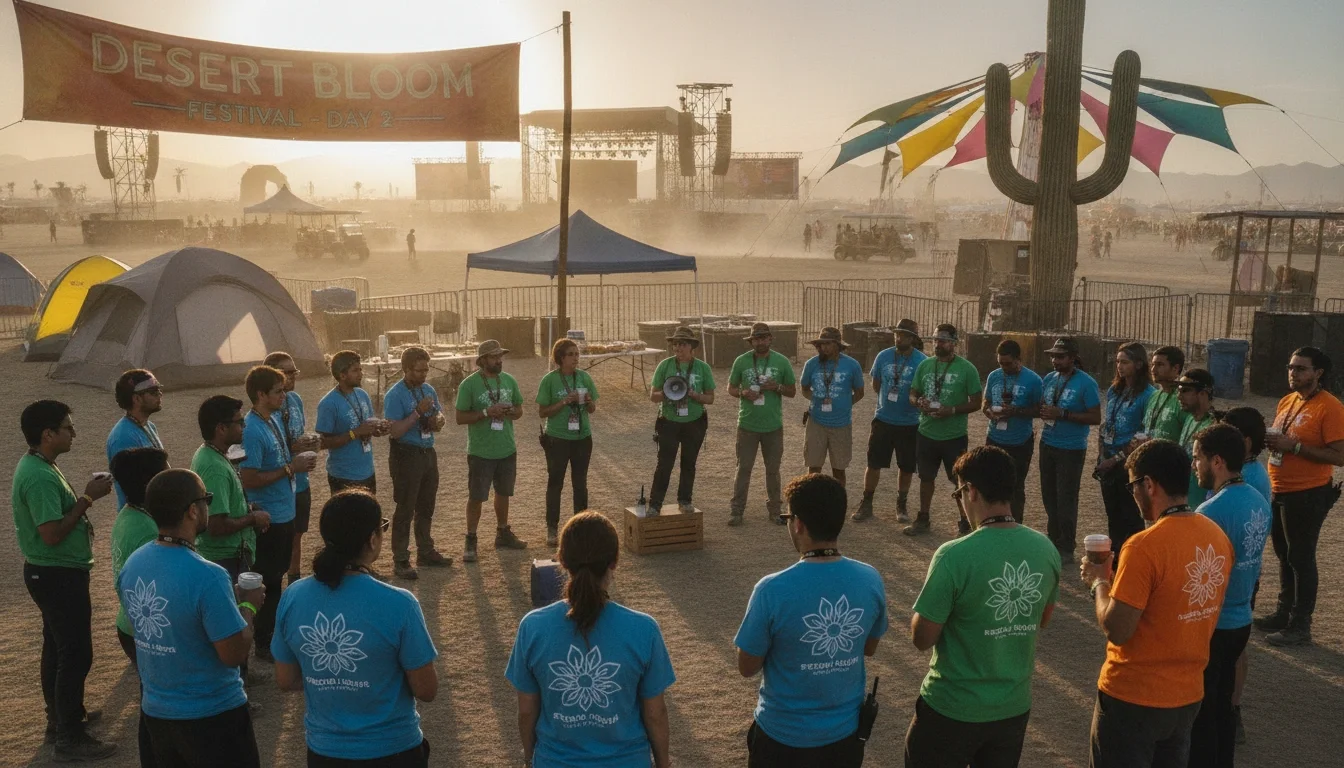
Event staffing team daily briefing at multi‑day outdoor festival
Maintaining Consistency Across Dozens of Shifts
A 15‑day fair run with a team of ten generates 150 individual staff‑day deployments — or more, depending on shift structure. Each of those deployments needs to deliver the same brand experience. A fairgoer who visits your booth on day three and returns with a friend on day nine should encounter the same energy, the same product knowledge, and the same warmth.
That consistency doesn’t happen by accident. It requires pre‑briefing materials that staff actually receive and review, a consistent captain presence across the run, a clear escalation process for on‑site issues, and a staffing partner with real accountability systems — not just promises.
Agencies built on single‑event deployment models are not naturally structured for this. An agency that excels at filling weekend shifts may have no mechanism for maintaining daily quality accountability across a two‑week run. The systems that underpin long‑run staffing quality are different, and they should be part of your evaluation criteria when selecting a partner.
Managing Fatigue Without Losing Brand Quality
Outdoor event staffing in August in Indianapolis is physically demanding. Temperatures regularly reach into the upper 80s and 90s, with humidity that makes extended standing and guest interaction taxing. Staff who are hot, tired, and on their eighth straight day of work don’t engage the same way they did on day two — and guests notice, even if they can’t articulate why.
The best agencies account for this structurally. Shift lengths at long outdoor events should be designed with recovery in mind. Rotating staff so that no single person is carrying the load for more than three to four consecutive days, building in rest days, and ensuring that high‑energy roles like sampling and ambassador positions are staffed by people with demonstrated stamina — these aren’t nice‑to‑haves. They’re the operational commitments that determine whether your activation holds quality through the final weekend.
No‑Shows and Backup Coverage in a Long‑Run Format
In a single‑day activation, one no‑show is a crisis. In a 15‑day run, no‑shows are a statistical certainty — not a possibility. Illness, family emergencies, transportation failures, scheduling conflicts: across 150 individual deployments, something will go wrong. The question is whether your staffing partner has a functional backup system or is going to scramble reactively when it does.
Eleven8’s deployment model includes one fully briefed backup for every eight staff members scheduled — at no additional charge. The backup isn’t recruited when the gap appears. They’re identified, briefed on the activation, and ready before the first day. When a gap opens at a 15‑day fair, it closes before it reaches the floor.
This is the structural distinction between staffing for a long‑run event versus staffing for a weekend. Reactive agencies can handle weekends. Sustained operations require infrastructure
How to Build a Staffing Plan for the Indiana State Fair
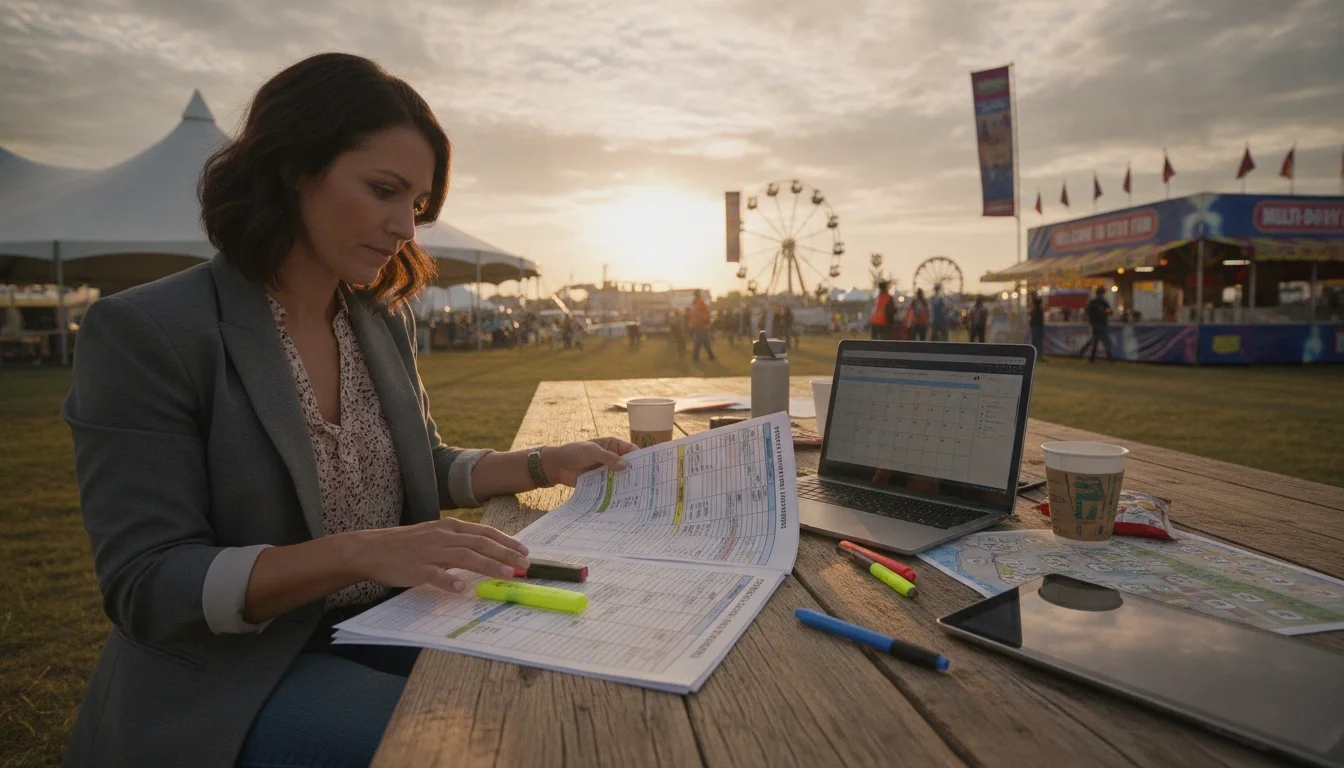
Event planner reviewing staff schedule for multi‑day state fair activation
Start the Conversation 8–10 Weeks Out
The Indiana State Fair runs in August, which means the summer event staffing calendar is already dense when fair prep begins in earnest. For a 15‑day activation, finalized contracts and confirmed staff rosters should be in place by late May or early June at the latest.
Booking early isn’t just about availability — it’s about quality of selection. When you reach out eight to ten weeks before the fair opens, you have time to review staff profiles, select your preferred team members, align on uniforms and messaging, and run a pre‑event briefing without rushing. Brands that approach staffing three weeks out get whoever is still available. Brands that plan get who they actually want.
What to Ask Any Staffing Agency Before Signing
Evaluating a staffing agency for a long‑run event requires a different set of questions than a weekend activation. Before committing to any partner for the Indiana State Fair, ask:
What is your fulfillment rate, and how is it defined? (Does it account for no‑shows, or just initial placement?)
What is your backup staffing policy for a multi‑week event? How many backups are included, and when are they briefed?
How do you maintain brand consistency across different staff members on different days?
What are your daily accountability processes — check‑in, briefings, performance review?
Have you staffed extended fair or festival runs before? Can you provide references or case studies?
Who is my dedicated contact, and are they available on event days?
An agency that can answer all of these concretely — with data, process documentation, and examples — is built for sustained deployment. An agency that gives general reassurances probably isn’t.
Shift Scheduling: Daily Deployments vs. Recurring Teams
There are two primary models for staffing a 15‑day fair run, and the right choice depends on your activation format and budget.
The first is a recurring core team that staffs the majority of days, supplemented by alternates on heavy‑volume weekend days. This model maximizes brand consistency and guest relationship continuity. The same faces become familiar over the run, build genuine enthusiasm for the product, and develop operational fluency that a rotating cast never accumulates. It works well for activations where personal engagement is the core value — sampling, demonstration, and relationship‑building.
The second is a rotating pool approach, where different qualified staff fill shifts across the run with consistent captains as the through‑line. This model provides more scheduling flexibility, reduces individual staff fatigue, and is better suited to activations where the role is more logistical than relational (registration management, production support, security).
Most large fair activations blend both: a recurring ambassador team for the guest‑facing work, rotating support staff for operational roles, and a consistent captain who ties it together across the full run.
Why Staff Continuity Is a Brand Asset, Not Just a Logistics Detail
The Cumulative Value of Familiar Faces
There’s a dimension to long‑run staffing that logistics‑focused planning tends to miss: the way familiar staff creates cumulative brand value over the course of a fair.
A fairgoer who visits a booth on day three and encounters a warm, knowledgeable ambassador forms a positive brand association. If that same person brings a neighbor on day eight and the ambassador remembers them — asks how the product worked out, engages their guest naturally — that’s a brand moment worth far more than any paid media impression. It happens only when staff continuity creates the conditions for it.
Conversely, a brand that presents a different, inconsistently briefed face every two days leaves no such impression. The activation runs. Samples get distributed. But no cumulative brand relationship builds, and the dollars spent on 15 days of fair presence don’t compound the way they could.
This is why the best experiential brands treat staff continuity as a strategic variable, not an operational convenience. Who shows up — and whether they show up consistently — determines the ceiling of what the activation can achieve.
How Eleven8 Structures Long‑Run Deployments
Eleven8 Event Staff has been operating in Indianapolis and across the Midwest for over 35 years. The Indianapolis market is a year‑round event city — cycling through the Indianapolis 500, GenCon, corporate convention season, and summer festivals — and the staffing systems Eleven8 has built are calibrated for sustained deployment, not just single‑event surges.
For extended events like the Indiana State Fair, the structure includes: a dedicated account manager assigned to the activation from initial inquiry through post‑fair recap; a briefed backup for every eight scheduled staff; daily shift reporting and performance accountability; and the ability to select your specific team from staff profiles before the event opens.
The fulfillment rate — 101.8%, meaning backup deployments have historically exceeded the original headcount — reflects a system designed so that problems resolve before they reach your activation floor.
Brands and vendors planning activations at the Indiana State Fair are encouraged to inquire early. Summer is Indianapolis’s highest‑demand staffing period, and fair‑season crew availability is confirmed on a first‑come basis. The earlier a staffing plan is in place, the stronger the team that shows up on opening day — and every day after.