Anaheim Trade Show Staffing: Roles, Ratios & How to Get It Right
Walking the floor at the Anaheim Convention Center, it becomes obvious within minutes which exhibitors came prepared. The booths drawing crowds aren't always the biggest or most expensive. They're the ones where the staff knows what they're doing — engaging visitors naturally, qualifying leads efficiently, and keeping the energy going across a full eight-hour show day.
The difference between a trade show that pays off and one that drains your budget often comes down to one thing: staffing strategy. And in a market as competitive as Anaheim — where hundreds of exhibitors compete for attention at some of the largest conventions in the country — getting your staffing right isn't optional. It's the whole game.
This guide walks you through everything you need to know about staffing a trade show in Anaheim: the roles you'll need, how many people to hire, how to find the right agency, how to brief your team, and how to manage the show floor when it counts.
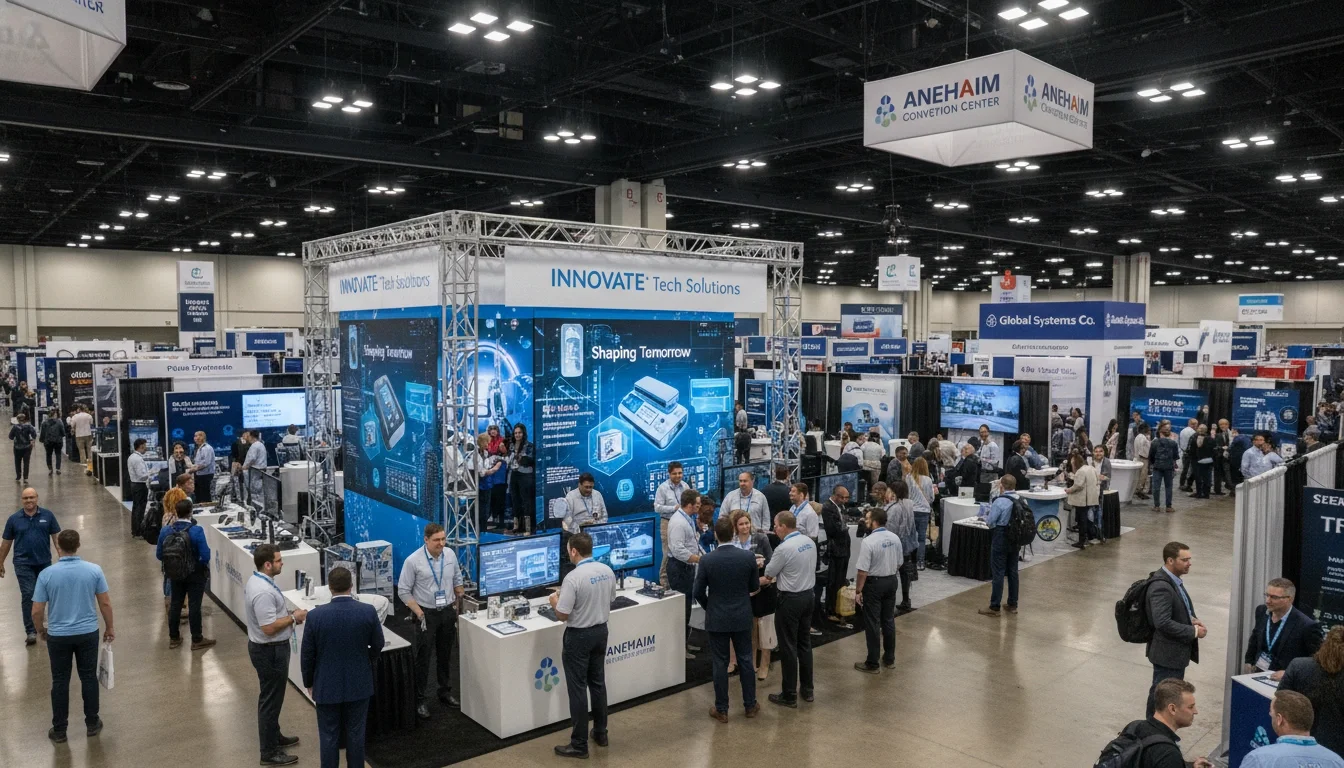
The Anaheim Convention Center hosts some of the largest trade shows in the western United States — and the most competitive booths are always the best-staffed
Why Anaheim Is One of the Most Competitive Trade Show Markets in the U.S.
Anaheim doesn't get enough credit as a trade show destination. Most people think of Las Vegas or Chicago when they think of conventions, but the Anaheim Convention Center is quietly one of the busiest and most strategically important trade show venues in the country, particularly for companies targeting the West Coast, natural products, technology, healthcare, and entertainment industries.
The combination of warm weather, easy access from LA and San Diego, a dense cluster of convention hotels, and a steady calendar of major annual shows makes Anaheim a market where exhibitors return year after year. Which also means the floor is extremely competitive.
The Anaheim Convention Center: What Exhibitors Need to Know
The Anaheim Convention Center (ACC) is the largest convention facility on the West Coast, with over 1.8 million square feet of total event space, more than 1 million square feet of exhibit hall space, 99 meeting rooms, and multiple ballrooms that can seat thousands. For exhibitors, this scale has real staffing implications — the venue is large enough that foot traffic patterns vary significantly by hall, and the show floor can run from 8 am to well into the evening depending on the event format.
Adjacent to the ACC, the Hilton Anaheim, Anaheim Marriott, and Disneyland Hotel Convention Center all host co-located events, private meetings, and overflow programming. If your show spans multiple venues or days, you may need staff deployed across more than one location.
Major Trade Shows at the Anaheim Convention Center
Understanding the calendar of shows at the ACC helps you understand the staffing competition. Some of the most prominent annual events include:
NAMM Show — the global music products and entertainment technology trade show, drawing tens of thousands of manufacturers, retailers, and media professionals each January
Natural Products Expo West — one of the world's largest trade shows for natural, organic, and better-for-you products, attracting retail buyers and distributors from around the world each spring
MD&M West — the largest medtech trade show in North America, focused on medical device design and manufacturing
VidCon — the premier conference for online video and content creators
WonderCon — one of the largest pop culture conventions in the western US
Each of these shows has a distinct attendee profile and pace. Staffing for a medical device expo requires a different approach than staffing a consumer natural products show. The right agency will understand this and match staff accordingly.
Start Here — Define Your Staffing Needs Before You Book Anyone
The most common mistake exhibitors make isn't hiring bad staff — it's hiring staff before they've defined what those people are actually supposed to do.
Before you contact a single agency or post a job listing, take an hour to get clear on two things.
What Are Your Goals for the Show?
Every staffing decision flows from your objectives. Are you primarily trying to:
Capture leads? You need staff who can qualify conversations quickly and operate lead retrieval systems efficiently.
Demo a product? You need trained product demonstrators who can run repeatable, engaging presentations all day.
Build brand awareness? Brand ambassadors with strong interpersonal skills and genuine enthusiasm are your priority.
Manage high attendee volume? Registration staff, greeters, and crowd flow managers become critical.
Support your internal sales team? You may need booth support staff who can handle initial engagement, answer questions, and hand off warm leads to your closers.
Most exhibitors need a mix of these. The key is knowing which outcomes matter most before you start building your team.
How Big Is Your Booth?
Your booth footprint directly dictates how many staff you need. A common industry rule of thumb is one staff member per 50 square feet of active floor space. That's a useful starting point, but it doesn't account for show pace, staffing rotation, or the nature of your activations.
A 10x10 booth can typically support two to three staff members effectively. A 20x20 island booth with a demo station, a lead capture area, and a greeter position might need five to eight people across a full show day. Multi-story or multi-room booths at major conventions can require 15 to 30 staff or more per day.
We'll walk through specific ratios in detail below.
The Trade Show Staff Roles You Actually Need
Not all trade show staff are the same, and most successful exhibitors use a combination of roles. Here's a breakdown of the key positions and what each one actually does.
Brand Ambassadors
Brand ambassadors are the face of your booth. They engage passing attendees, draw traffic into your space, represent your brand's energy and personality, and initiate conversations that lead to deeper engagements with your sales team. The best brand ambassadors aren't just outgoing — they're quick to qualify whether someone is worth spending time on, which means your internal team is always talking to warm prospects rather than browsing attendees.
At a show like Natural Products Expo West or NAMM, where foot traffic is relentless, having dedicated ambassadors who can work the perimeter of your booth and pull in attendees is one of the highest-ROI investments you can make.
For Anaheim specifically, Eleven8's brand ambassadors in Orange County include a deep roster of local professionals who have worked the ACC many times over.
Product Demonstrators
If you have a product that needs to be shown — not just described — you need dedicated demonstrators. These are staff (or a combination of staff and internal product experts) who can run a clean, repeatable demo, answer technical questions confidently, and keep the presentation moving even when they've done it 40 times that day.
Demonstrators need to be briefed more deeply than other staff roles. They should know your top three product benefits cold, be ready for common objections, and know when to hand a prospect off to a subject matter expert.
Registration and Check-In Staff
For trade shows where you're hosting sessions, demos with set times, or private meetings at your booth, registration and check-in staff are essential. They manage sign-in sheets or digital check-in systems, direct visitors to the right areas, and keep lines moving efficiently.
Even if you're not hosting structured sessions, a dedicated check-in person at a high-traffic booth dramatically improves visitor flow and makes the experience feel organized and professional.
Check-in staff for Orange County events is one of the most-requested roles for Anaheim convention exhibitors, particularly at multi-day shows where attendee management becomes complex.
Lead Capture Specialists
Lead capture is often treated as an afterthought — someone on the team has the badge scanner and uses it when they remember. That's a significant missed opportunity.
Dedicated lead capture specialists are staff members whose primary job is to scan badges, collect business cards, and qualify leads using a defined system. They're fast, consistent, and trained to note context about each interaction so your sales team has something useful to work with after the show.
At a busy show like MD&M West or NAMM, a good lead capture specialist can add dozens of qualified contacts per day to your pipeline.
Event Captains and Floor Supervisors
For larger booths or multi-day shows, an event captain is the on-site manager who keeps everything running. They coordinate staff rotations, handle issues in real time, serve as the point of contact for your account manager, and ensure every staff member knows their role and stays on task throughout the show.
Many exhibitors underestimate how important this role is until they've run a large booth without one. Having a single point of accountability on the floor is what separates smooth execution from constant chaos.
Eleven8's trade show staff for Orange County includes trained event captains available for every booking — and every event comes with a briefed backup for every eight staff deployed.
Greeters and Booth Hosts/Hostesses
Greeters are the first human contact most attendees have with your brand. They welcome visitors, offer literature, direct traffic, and create the initial impression that determines whether someone stays or keeps walking. For luxury brands, pharmaceutical companies, or any exhibitor where brand perception matters, a polished greeter is non-negotiable.
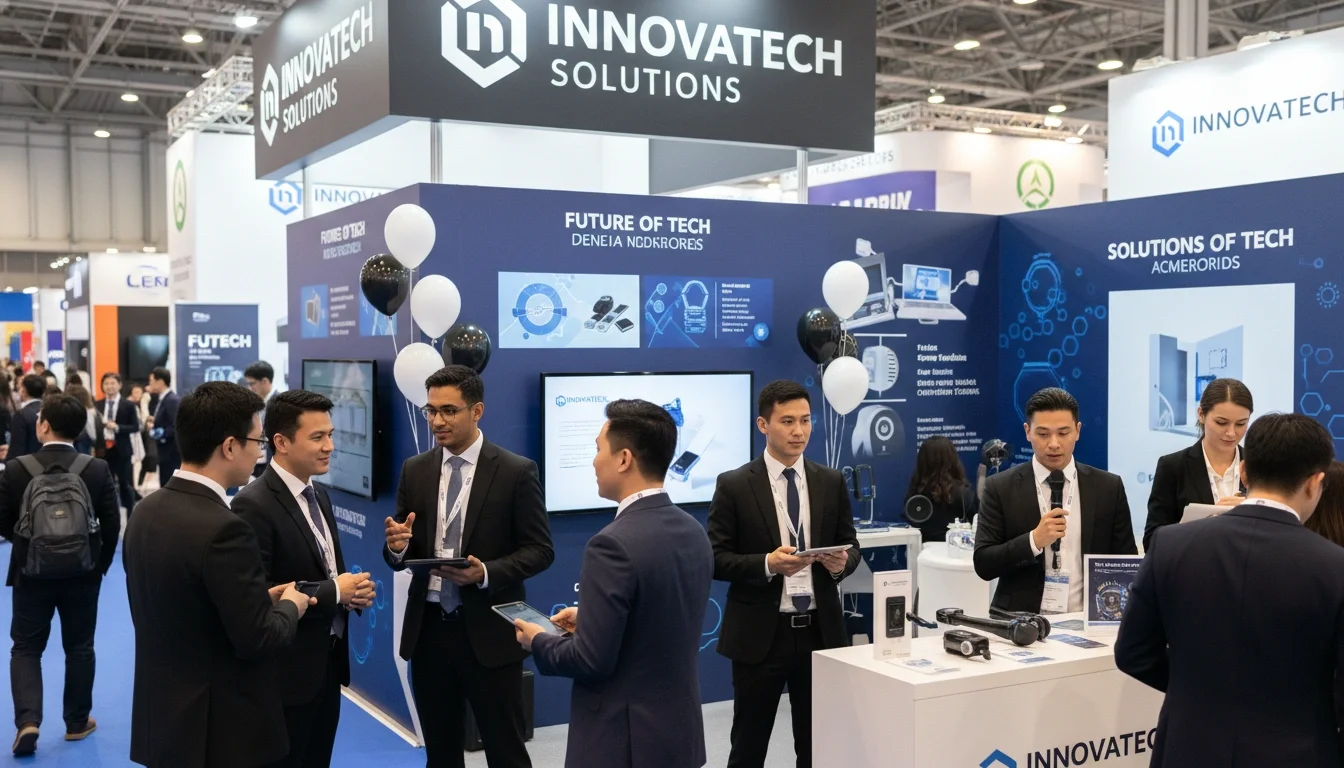
Professional trade show staff engage attendees at a busy expo booth — combining brand ambassador energy with lead capture discipline
How Many Staff Do You Need? (Staffing Ratios Explained)
Staffing too light is the single most costly mistake exhibitors make. You've paid for the booth space, the display, the travel, and the collateral — and then you're understaffed on the show floor and miss 40% of your potential conversations.
Here are practical staffing benchmarks by booth size:
| Booth Size | Recommended Staff | Notes |
|---|---|---|
| 10x10 booth (100 sq ft) | 2–3 staff | One greeter/ambassador and one lead capture person is the minimum for a busy show. Add a third if running demos. |
| 10x20 or 20x10 booth (200 sq ft) | 3–4 staff | Enough for an ambassador, a demonstrator, and a lead capture specialist, with one floating. |
| 20x20 booth (400 sq ft) | 4–6 staff | Consider adding an event captain to manage the floor. |
| 30x30 to 40x40 booths (900–1,600 sq ft) | 6–10 staff minimum | Multiple demonstration areas, dedicated lead capture, greeter positions, and a captain. |
| Island booths and large custom builds (1,600+ sq ft) | 10–20+ staff per show day | Often deployed in overlapping shifts across multi-day events. |
Keep in mind that most shows run 8–10-hour days, and no one performs well at a trade show for 10 hours straight. Build in shift rotations, especially for ambassador and demonstrator roles, where energy is everything. A good rule is to plan for 30-minute breaks every two hours for high-engagement roles.
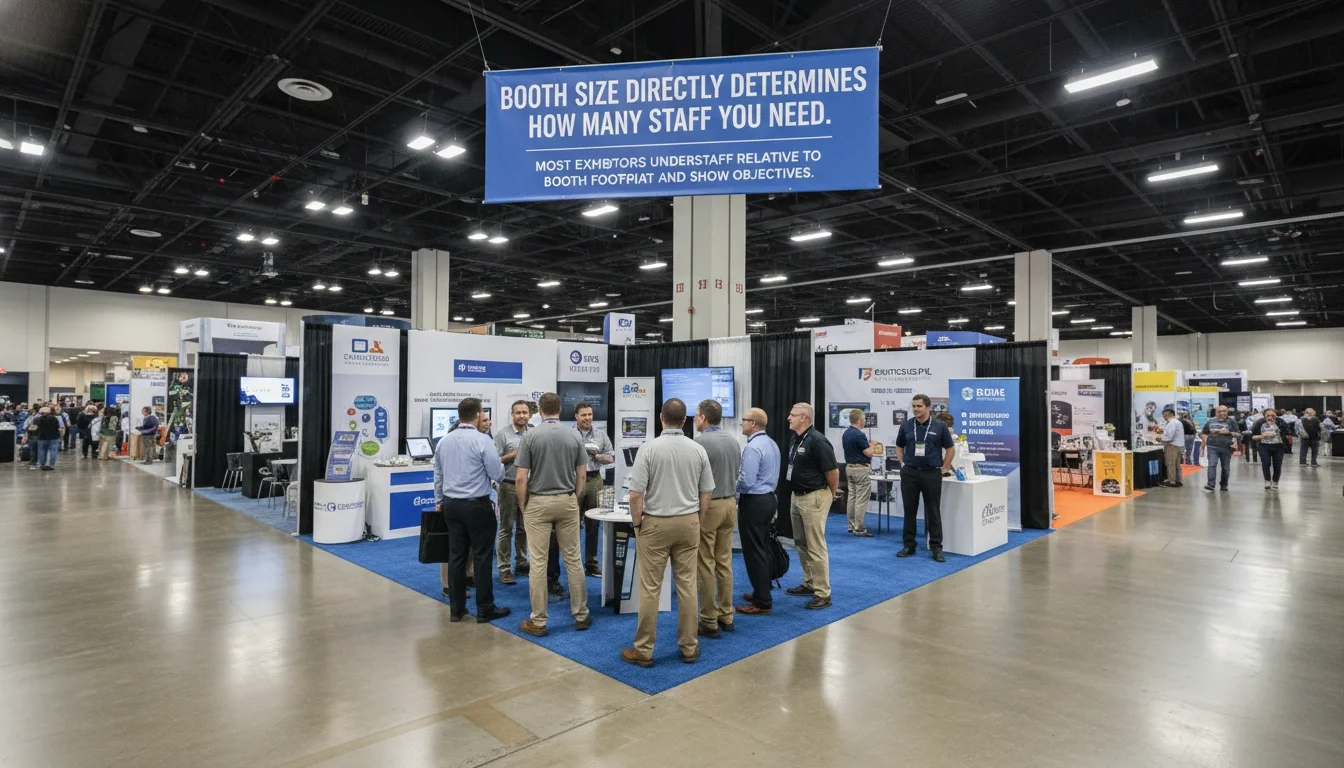
Booth size directly determines how many staff you need — most exhibitors understaff relative to their booth footprint and show objectives
In-House vs. Staffing Agency: Which Is Right for Your Anaheim Show?
This is the question every exhibitor faces, and the answer depends on your situation.
When Your Internal Team Is Enough
If your show is small (10x10 or 10x20), your internal team knows the product deeply, and you only need one or two people on the floor, your own employees may be the right call. Internal staff bring genuine product knowledge and can handle complex questions without preparation.
The challenge is energy and endurance. Trade shows are physically and mentally exhausting, and employees who are also managing post-show follow-ups, responding to emails, and processing their regular workload often hit a wall by day two.
When to Hire a Local Staffing Agency
Hiring a local Anaheim trade show staffing agency makes sense in the following situations:
Your booth is staffed by 4+ people. Managing a larger team is a full-time job on the show floor, and a professional agency handles scheduling, backup coverage, and day-of coordination so you don't have to.
You need high-energy brand ambassadors. Professional booth staff is selected and trained specifically for the demands of trade show floors. They don't have the off-site job distractions your employees do.
Your show is multi-day. Managing rotation, fatigue, and show-day logistics across two or three days becomes exponentially more complex. An experienced agency has systems for this.
You're new to the Anaheim market. Local agencies have staff who know the ACC's layout, understand credentialing procedures, and have worked the specific shows you're exhibiting at.
You need backup coverage. No-shows happen. A professional agency with a built-in backup system ensures your booth is never understaffed.
How to Choose a Trade Show Staffing Agency in Anaheim
Not all staffing agencies are equal, and the event staffing market has a significant quality range. Here's how to evaluate your options.
Questions to Ask Before You Book
Before committing to any agency for your Anaheim trade show, ask:
Do you have staff who have worked at the Anaheim Convention Center specifically? Local experience matters. Staff who know the ACC's loading protocols, credentialing requirements, and floor layout start the show day ahead of those who don't.
What is your fulfillment rate? Any agency should be able to give you a concrete number. A fulfillment rate below 95% is a red flag.
What backup coverage do you provide? If a staff member doesn't show up, what happens? Understand the answer before you're in that situation.
Can I see staff profiles before I approve my team? Professional agencies give you visibility into who will represent your brand. If an agency can't show you bios, photos, or prior event experience, that's a gap.
How do you brief staff on client brands? Staff who show up without knowing anything about your product are worse than no staff at all. Ask specifically how the agency prepares its people.
Do you carry liability insurance and workers' comp? This is non-negotiable in California. Ask for a Certificate of Insurance.
Red Flags to Watch For
Vague pricing with no line items
No dedicated account manager (you'll be passed around)
No verification process for staff (open marketplace signups, no interviews)
Inability to provide references from trade show clients specifically
Briefing Your Trade Show Staff: The Most Overlooked Step
The pre-show brief is where good trade show staffing separates from great trade show staffing. Most exhibitors spend thousands on booth design and almost nothing on preparing the people who will be standing in it for eight hours.
What to Include in a Staff Brief
A complete staff brief for a trade show should cover:
Brand overview: What does your company do, and who is your target customer? Keep it to three to four sentences — staff needs the quick version.
Key messages: What are the two or three things you want every visitor to walk away knowing about your product?
Booth layout and flow: Where are the different stations? What's the intended path for a visitor moving through your space?
Role assignments: Who is doing what, where, and when? Every staff member should know their specific position and rotation schedule before the show opens.
Lead capture protocol: How is lead information being collected? What qualifies as a warm lead versus a cold contact? What should staff note after each conversation?
Escalation process: When should a staff member bring in an internal product expert or sales rep? What's the handoff process?
Common questions and answers: Prepare staff for the five questions they'll get asked most. If there are things they shouldn't answer, tell them now.
Dress code and appearance standards: Confirm uniform requirements, grooming standards, and any specific brand guidelines.
Logistics: Badge pickup time, load-in location, parking, and check-in procedure with the event captain.
A good brief doesn't need to be a 20-page document. A clean one-pager distributed at least 48 hours before show day is more effective than a long document handed out in the parking lot at 7:30 am.
Run a Pre-Show Walkthrough
If at all possible, arrange a walkthrough of the booth before the show opens. This gives staff the chance to physically orient themselves to the space, understand where everything is, and practice the flow of a visitor interaction. Even a 20-minute walkthrough the morning of the show dramatically improves day-one performance.
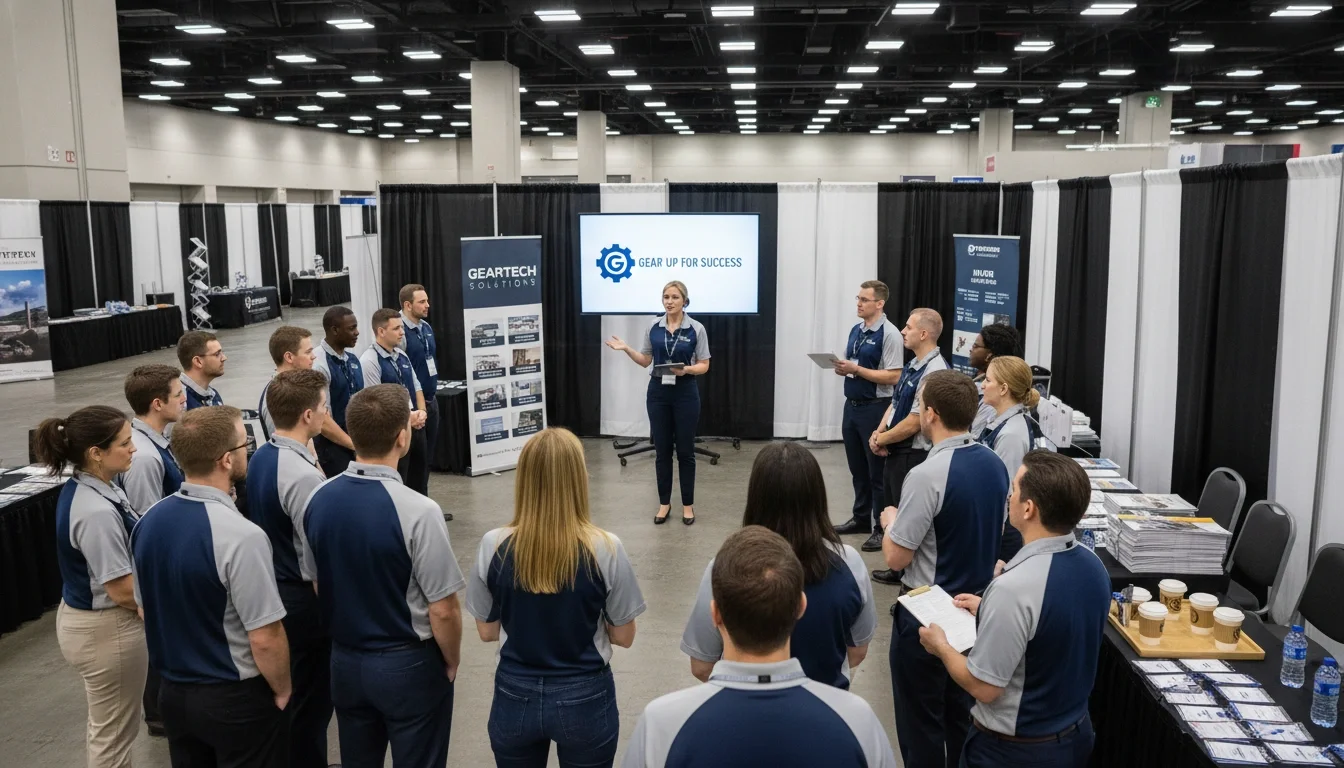
A pre-show briefing gives trade show staff the context they need to represent your brand confidently from the first minute the floor opens
Managing Staff on Show Day
Once the floor opens, your job shifts from planning to managing. Here's how to keep your team operating at full strength for the entire show.
Shift Scheduling and Rotation
Map out your shift schedule before show day — don't improvise it on the floor. For multi-day shows, stagger start times to keep staff fresh. For high-energy roles like brand ambassadors, build in 20–30 minute breaks every two hours. If you're running a 9 am to 6 pm show day, a typical rotation for a four-person booth might look like:
8:30 am: Full team arrives for walkthrough and briefing
9:00 am: Show opens — two ambassadors on the floor, one demonstrator active, one lead capture
11:00 am: First rotation, one ambassador takes a break
1:00 pm: Lunch rotation in shifts — no position should be empty
3:00 pm: Afternoon rotation — bring back energy, swap demonstrators
5:00 pm–6:00 pm: Wind-down — shift to lead capture focus as floor pace slows
Your event captain manages this in real time, so you don't have to.
Real-Time Communication Protocols
Establish a simple communication system before the show opens. A group text thread or a channel in a messaging app works fine for most booths. Define who staff should contact if they have an issue — the event captain first, then the agency's on-call manager.
Professional agencies like Eleven8 provide 24/7 event day support, meaning any operational issue can be escalated immediately rather than waiting hours for a response.
Handling No-Shows and Coverage Gaps
No-shows are the nightmare scenario, and they happen even with the best agencies. The difference between a manageable situation and a disaster is whether your agency has a backup system in place before show day begins.
Ask any agency you're considering: Do you have briefed backups ready before the event? A strong agency doesn't just scramble to fill gaps reactively — they have replacement staff briefed and on standby as a standard part of every booking.
Anaheim Convention Center: Logistics Your Staff Agency Needs to Know
The Anaheim Convention Center has specific operational requirements that affect your staffing logistics. If your agency hasn't worked with the ACC before, brief them carefully on these points — or choose an agency with direct ACC experience.
Credentialing and Badge Requirements
The ACC and most major shows hosted there require advance credentialing for staff. This typically means submitting a staff list 48–72 hours before the event, with names and sometimes photo IDs, and completing a venue-specific orientation briefing for multi-day shows. Your agency should be prepared to handle this as a standard part of its process.
Confirm with your show's exhibitor services team what credentials are required for non-exhibitor staff (i.e., staffing agency employees) versus exhibitor booth staff. Some shows have specific badge categories and access restrictions.
Load-In and Load-Out Protocols
The ACC has defined load-in and load-out windows, and these vary by show. Staff arriving early to help with setup must have the correct access credentials for the setup period, which is typically different from show floor credentials. Confirm these details with your exhibitor services contact well in advance and pass them to your agency.
Parking and Transportation for Staff
Anaheim parking is manageable, but it can add meaningful cost at busy shows. The ACC has adjacent parking structures, and many hotels within walking distance also offer event parking. Confirm your agency's transportation policy: are staff responsible for their own transportation, or does the agency coordinate this? For large teams arriving early, coordinating a single point of arrival often reduces show-morning confusion.
Post-Show Debrief: Turning Staffing Into a Competitive Advantage
Most exhibitors pack up their booth and immediately start thinking about their lead list. But the post-show debrief with your staffing agency is an often-missed opportunity to significantly improve your next show.
A strong post-show debrief covers:
What worked: Which staff roles performed best? What engagement tactics drove the most leads?
What didn't work: Were there coverage gaps? Timing issues? Roles that were over- or under-staffed?
Lead quality: Did the lead capture system work? Were notes useful, or did they need to be more specific?
Staff feedback: What did your team observe about attendee behavior, competitor booths, and show floor dynamics?
Recommendations for next time: A good agency should be able to tell you what changes would improve performance at your next Anaheim show.
If you're exhibiting at the same show year after year, building a preferred staff team — people who know your brand, your booth, and your goals — is one of the most underrated competitive advantages in trade show marketing. Eleven8 allows clients to select preferred staff members and build dedicated teams for recurring events.
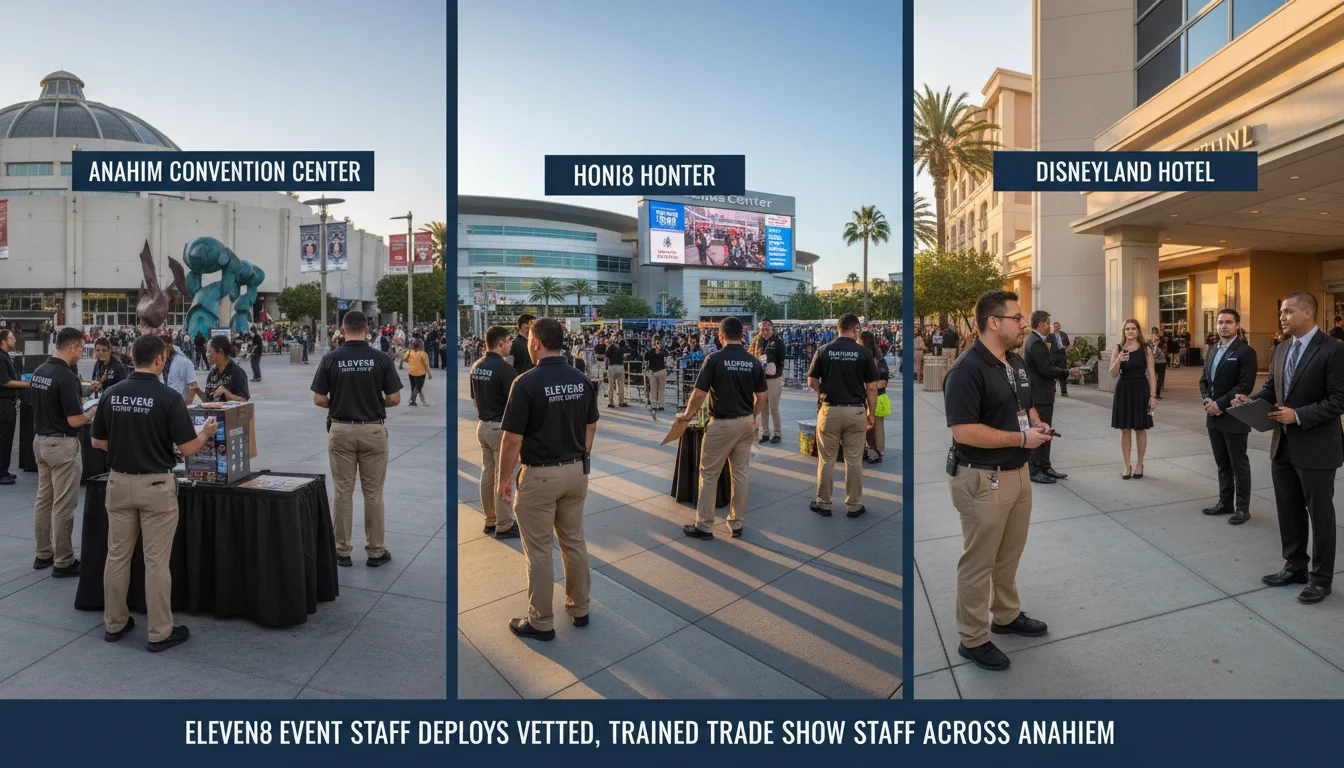
Eleven8 Event Staff deploys vetted, trained trade show staff across Anaheim's major convention venues — including the Anaheim Convention Center, Honda Center, and Disneyland Hotel
Ready to Staff Your Next Anaheim Trade Show?
Staffing a trade show well isn't complicated — but it does require the right preparation, the right roles, and the right agency. Anaheim's convention market moves fast, and the best staff for the most popular shows books out weeks in advance.
Whether you're exhibiting at Natural Products Expo West, the NAMM Show, MD&M West, VidCon, or any other event at the Anaheim Convention Center, Eleven8 Event Staff has the local roster, the operational systems, and the trade show experience to staff your booth at the level your brand deserves.
Explore Eleven8's Orange County trade show staffing services or request a quote to get your team in place before the show floor opens.