Event Staffing Costs in Pittsburgh: What to Expect & How to Budget
Event staff costs in Pittsburgh typically range from $22 to $75 per hour, depending on the role, experience level, and event requirements. Servers and registration staff generally cost $22-$32 per hour, bartenders run $28-$40 per hour, while specialized roles like event captains and AV technicians can reach $50-$75 per hour. These rates position Pittsburgh as a competitive mid-tier market, offering 15-25% lower costs than major metros like New York or Los Angeles while maintaining access to highly qualified professionals.
Understanding event staffing costs involves more than just hourly rates. The final price for your Pittsburgh event depends on factors including event type, venue requirements, booking timeline, staff quality standards, and hidden fees like service charges and minimum hour requirements. Whether you're planning a corporate conference at the David L. Lawrence Convention Center, a wedding reception in the Strip District, or a brand activation in South Side, having a clear picture of staffing costs helps you build a realistic budget and avoid unwelcome surprises.
This comprehensive guide breaks down everything you need to know about event staffing costs in Pittsburgh, from role-specific pricing to quality considerations that impact your investment.
Pittsburgh Event Staff Pricing Overview
Average Hourly Rates by Role
The table below provides current market rates for event staff in Pittsburgh based on industry standards and local market conditions. Note that these are base hourly rates before agency fees, minimum hour requirements, or specialized certifications.
| Role | Hourly Rate Range | Typical Minimum Hours | Common Event Types |
|---|---|---|---|
| Servers/Waitstaff | $22–$32 | 4–5 hours | Weddings, galas, corporate dinners |
| Bartenders | $28–$40 | 4–5 hours | Receptions, parties, networking events |
| Brand Ambassadors | $25–$45 | 4–6 hours | Trade shows, product launches, promotions |
| Event Captains/Supervisors | $35–$55 | 5–6 hours | Large events, multi-day conferences |
| Registration/Check-in Staff | $20–$28 | 4–6 hours | Conferences, conventions, seminars |
| Setup/Breakdown Crew | $20–$30 | 3–4 hours | All event types |
| Promotional Models | $30–$50 | 4–6 hours | Brand activations, experiential marketing |
| Convention Floor Staff | $22–$35 | 6–8 hours | Trade shows, expos |
| ★ Specialty Roles (AV, Tech) | $50–$75 | 4–6 hours | Corporate events, production-heavy shows |
These rates reflect W-2 employment through professional agencies, which includes insurance coverage, payroll tax compliance, and professional vetting. Independent contractors or 1099 workers may quote lower hourly rates, but this typically shifts insurance liability and compliance responsibilities to you as the event host.
How Pittsburgh Compares to Other Markets
Pittsburgh occupies a strategic position as a mid-tier event market, delivering substantial cost advantages over coastal cities while maintaining a robust talent pool and professional infrastructure. Here's how Pittsburgh stacks up against other major markets:
Tier 1 Markets (NYC, Los Angeles, San Francisco): Event staff in these cities typically cost 25-40% more than Pittsburgh. A server who costs $25/hour in Pittsburgh might run $35-40/hour in Manhattan. The cost difference stems from higher wages, increased cost of living, stricter labor regulations, and more competitive demand for event talent.
Tier 1.5 Markets (Chicago, Boston, Seattle): These markets run 15-25% higher than Pittsburgh. Chicago's union presence, particularly at venues like McCormick Place, can significantly increase costs. Pittsburgh offers comparable professional quality at notably better rates.
Comparable Markets (Denver, Nashville, Austin): These cities offer similar pricing to Pittsburgh, generally within 5-10% either direction. Market dynamics, local cost of living, and seasonal demand create minor variations, but overall competitiveness remains strong.
Regional/Secondary Markets: Smaller Pennsylvania markets and neighboring regions may show slightly lower baseline rates, but they often lack the depth of experienced professional staff available in Pittsburgh. For events requiring skilled brand ambassadors, trained convention staff, or polished corporate representatives, Pittsburgh delivers better value through its established talent pool.
The Pittsburgh advantage becomes even clearer when you consider what you're getting for the investment. The city's multiple universities, strong hospitality sector, and growing event industry create a workforce that understands professional service standards. You're not sacrificing quality for cost savings; you're accessing experienced professionals at fair market rates.
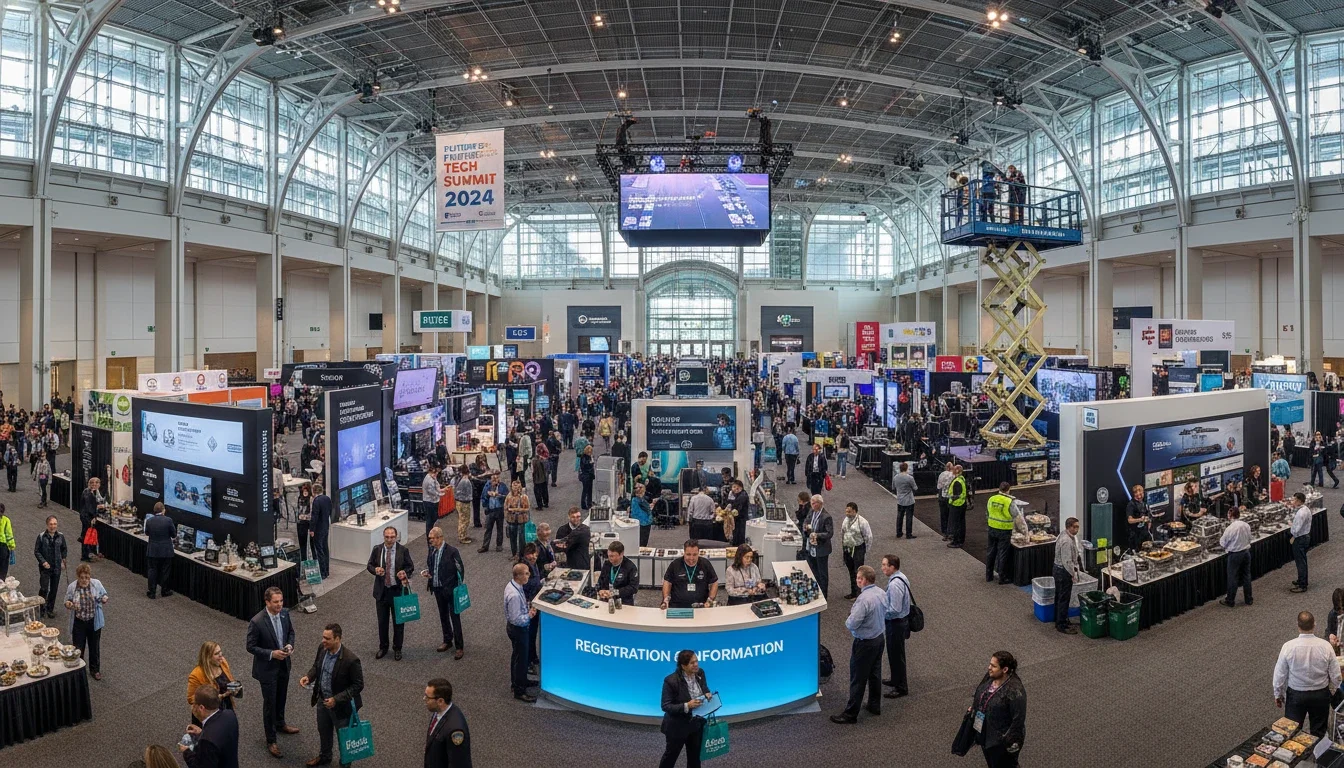
Pittsburgh's David L. Lawrence Convention Center hosts major trade shows requiring diverse staffing roles
Factors That Influence Event Staffing Costs in Pittsburgh
While hourly rates provide a baseline, the final cost to staff your event depends on several interconnected factors. Understanding these variables helps you budget accurately and make informed decisions about where to allocate resources.
Event Type and Complexity
The nature of your event fundamentally shapes staffing requirements and associated costs. Different event formats demand different skill sets, staff-to-guest ratios, and preparation levels.
Corporate Events and Trade Shows require professional staff who can represent brands with polish and expertise. A three-day tech conference at the David L. Lawrence Convention Center needs registration staff who can handle high-volume check-ins, floor staff familiar with crowd management, and hospitality teams capable of maintaining energy across long days. These events typically require staff with previous convention experience, which commands premium rates within the role's range.
Weddings and Private Celebrations emphasize seamless service and attention to detail. Servers need to understand formal dining protocols, timing between courses, and how to anticipate guest needs without being intrusive. Bartenders should know classic cocktails and wine service. The emotional significance of these events makes reliability and professionalism worth the investment in vetted, experienced staff.
Brand Activations and Promotional Events require outgoing personalities who can engage strangers, embody brand values, and maintain high energy throughout shifts. Staff need quick thinking and improvisational skills to handle unexpected situations while staying on-message. These specialized skills place brand ambassadors and promotional models toward the higher end of their rate ranges.
Multi-Day Festivals and Conventions present unique staffing dynamics. While the per-day rate may be slightly lower due to volume, total costs increase with the extended commitment. Staff consistency across multiple days maintains guest experience quality and reduces training time, making it worth securing the same team throughout your event.
Venue Considerations
Where you hold your event significantly impacts staffing costs through logistics, accessibility, and venue-specific requirements.
David L. Lawrence Convention Center represents Pittsburgh's premier large-format venue. Its downtown location, professional infrastructure, and frequent high-profile events mean staff familiar with the space command competitive rates. However, the venue's efficiency and amenities can reduce other logistical costs, creating overall value. Parking for staff can be a consideration, though the venue's central location with public transit access helps mitigate this.
Hotel and Resort Venues (Omni William Penn, Renaissance Pittsburgh, Fairmont) often have preferred vendor relationships or specific requirements for outside staff. Some properties require staff to use certain entrances or follow particular protocols. Understanding these expectations upfront prevents surprises. Hotel events benefit from built-in infrastructure but may have stricter compliance requirements.
Unique Pittsburgh Venues throughout the Strip District, South Side, Lawrenceville, and North Shore offer character but may present logistical challenges. Loading access, kitchen facilities, and parking vary widely. Some of Pittsburgh's most distinctive spaces—converted warehouses, historic buildings, riverfront locations—require additional planning time and may increase costs for setup and breakdown.
Union vs. Non-Union Venues matters less in Pittsburgh than in cities like Chicago or New York, but some major venues and hotels have union considerations that affect certain technical roles. Most event staff roles in Pittsburgh operate in a non-union environment, keeping costs more predictable.
Suburban and Neighborhood Venues across surrounding areas like Mount Lebanon, Cranberry, or Sewickley may involve modest travel fees when staff must drive 20-30 minutes from the city center. However, these fees are typically minimal compared to major metropolitan areas.
Timing and Seasonality
When you hold your event directly impacts both availability and pricing. Pittsburgh's event calendar follows predictable patterns that savvy planners can leverage.
Peak Wedding Season (May-October) sees the highest demand for servers, bartenders, and event staff. Saturday evenings during June, September, and October are particularly competitive. Booking premium staff during these windows requires 8-12 weeks advance notice, and rates may increase 10-15% during peak weekends.
Convention Season (Spring and Fall) brings corporate events and trade shows to downtown venues. March-May and September-November see concentrated convention activity. If your corporate event coincides with major shows at the David L. Lawrence Convention Center, plan accordingly as the best staff get booked quickly.
Holiday Events (November-December) command premium rates, particularly Thanksgiving week and the two weeks before Christmas. Holiday party demand increases costs 15-25% above standard rates. Staff working New Year's Eve typically receive the highest premiums. If holiday timing is essential, extend your booking timeline to three months out.
Off-Peak Advantages (January-March) present cost-saving opportunities. Winter months outside the holiday rush offer better availability and potentially negotiated rates. If your event has flexibility, these months deliver the best value.
Last-Minute Booking Premiums come into play when you need staff within two weeks. Rush requests can increase costs 20-40% above standard rates. Emergency same-day or next-day staffing may be possible but could double your normal expense. The premium reflects the challenges of rearranging schedules and the limited available staff pool on short notice.
Multi-Day Event Discounts work in your favor. Agencies prefer booking staff for consecutive days rather than single-day commitments. A three-day conference might cost 10-15% less per day than three separate single-day events would total.
Staff Quality and Vetting
Not all event staff are created equal, and pricing often reflects the level of vetting, training, and professionalism you receive. This is where understanding true value becomes critical.
Background-Checked vs. Unchecked Staff makes a significant difference for corporate events, venues with sensitive areas, or any event involving minors. Professional agencies include background checks in their service fees. Independent contractors who skip this step may quote lower rates but create liability exposure. Pennsylvania-specific clearances (particularly for certain educational or youth-focused events) add small administrative costs but provide essential protection.
Trained vs. Untrained Personnel impacts guest experience directly. Agencies that invest in pre-event briefings, service training, and brand-specific orientation charge appropriately for this value. A trained server knows how to work a buffet line efficiently, handle dietary restrictions, and maintain service flow. Untrained help may cost less per hour but can compromise your event's success in ways that far exceed the hourly savings.
W-2 Employees vs. 1099 Contractors represents a fundamental distinction. Professional staffing agencies employ their staff as W-2 employees, meaning the agency handles payroll taxes, workers' compensation, and unemployment insurance. This structure costs more per hour but eliminates significant administrative burden and legal liability from you. Hiring independent contractors as 1099 workers shifts these responsibilities to you and potentially exposes you to misclassification penalties if the IRS determines the relationship should have been employer-employee.
Insurance and Liability Coverage protects all parties. Reputable agencies carry general liability insurance (typically $1-2 million coverage) and workers' compensation insurance. This coverage is built into service fees. If a staff member is injured during your event or accidentally causes property damage, proper insurance handles the situation. Uninsured staff or agencies that can't provide certificates of insurance create enormous financial risk that far outweighs any hourly rate savings.
Agency vs. Individual Freelancers isn't necessarily a quality distinction, but it is a structure distinction. Established agencies offer replacement guarantees, backup systems, and management oversight. If an individual freelancer has a personal emergency the morning of your event, you're scrambling for replacement. An agency with deep bench strength can deploy a replacement from their roster.
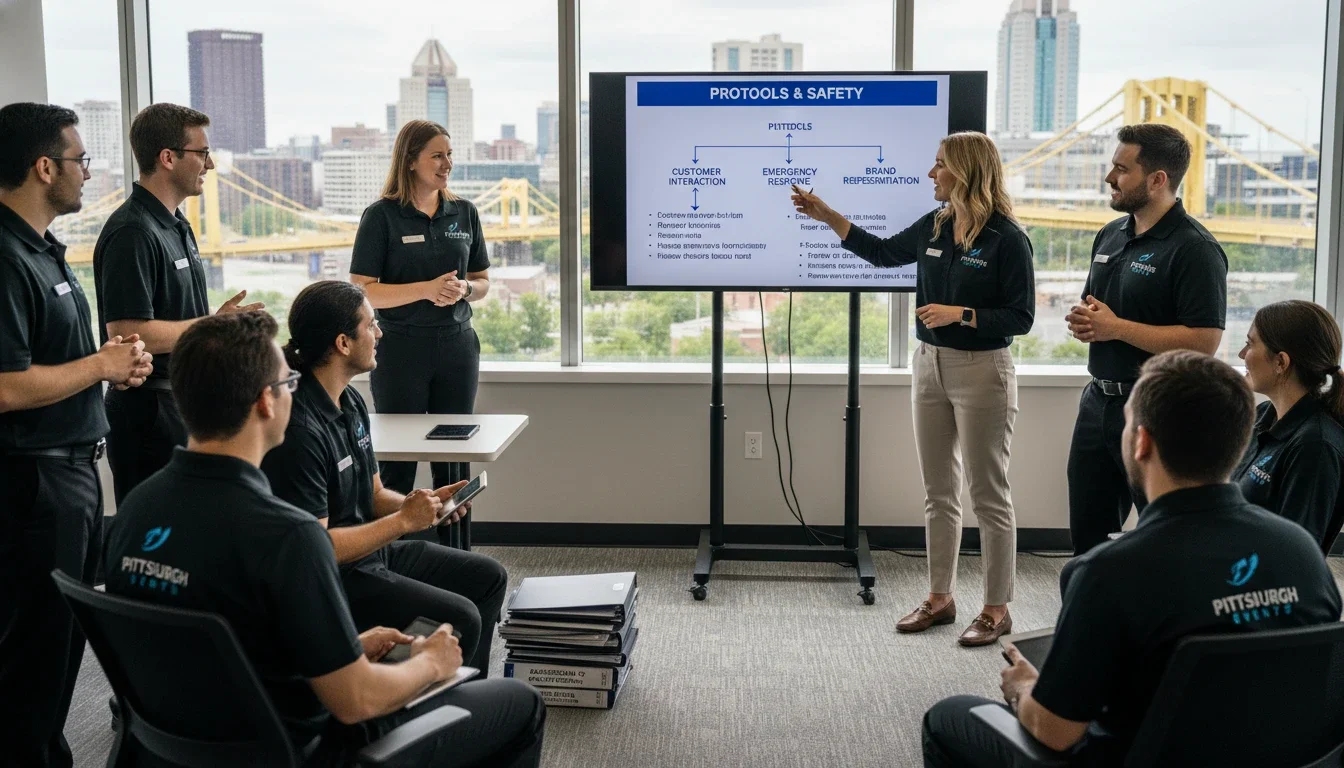
Professional event staff undergo extensive training and background checks before representing brands at Pittsburgh events
Cost Breakdown by Event Type
Understanding your specific event type helps estimate accurate staffing costs. Here's how different event formats translate to real numbers.
Corporate Events and Conferences
Corporate events demand professional staff who can represent your company and manage business-critical interactions. A typical 200-person corporate conference at the David L. Lawrence Convention Center might require:
Registration Staff (2): Handle check-in, distribute materials, manage questions. Running 8 hours at $25/hour each = $400
Floor Support Staff (4): Direct attendees, assist with breakout rooms, manage logistics. Running 8 hours at $28/hour each = $896
Hospitality Staff (6): Manage coffee stations, lunch service, refreshment breaks. Running 8 hours at $26/hour each = $1,248
Event Captain (1): Coordinate all staff, troubleshoot issues, serve as point of contact. Running 9 hours at $45/hour = $405
Setup/Breakdown Crew (3): Two hours setup, two hours breakdown at $25/hour each = $300
Subtotal: $3,249 Agency Fee (20%): $650 Total Conference Staffing Cost: $3,899
This breaks down to approximately $19.50 per attendee for a full day of professional staff support. Corporate events justify investing in the higher end of rate ranges because staff directly represent your brand to clients, partners, or employees.
For more information on how professional event staffing elevates corporate events, see our guide to event staffing services nationwide.
Weddings and Private Celebrations
Weddings represent one of the most popular reasons people hire event staff in Pittsburgh. These celebrations benefit enormously from professional help that allows hosts to enjoy their own event. A typical 150-guest wedding reception requiring six hours of service might include:
Servers (6): Assuming a 1:25 guest-to-server ratio for plated dinner service. Running 6 hours at $27/hour each = $972
Bartenders (2): Two full bars at opposite ends of the venue. Running 6 hours at $32/hour each = $384
Event Captain (1): Oversee service flow, timing, and coordination with other vendors. Running 6.5 hours at $42/hour = $273
Setup Staff (2): Two hours pre-event setup at $24/hour each = $96
Breakdown Staff (2): One hour post-event cleanup at $24/hour each = $48
Subtotal: $1,773 Agency Fee (20%): $355 Total Wedding Staffing Cost: $2,128
At roughly $14 per guest, professional staffing for a wedding represents a worthwhile investment. The alternative—asking friends and family to serve their own celebration or hoping untrained volunteers can execute complex dinner service—typically creates more stress than savings.
Trade Shows and Conventions
Trade show staffing differs from other event types through its focus on brand representation and lead generation. Staff quality directly impacts your event ROI. A three-day presence at a major Pittsburgh trade show might require:
Booth Staff (4): Engage attendees, qualify leads, demonstrate products. Running 8 hours per day for 3 days at $35/hour each = $3,360
Registration/Check-in Staff (2): Manage scanning, credentialing, information desk. Running 8 hours per day for 3 days at $26/hour each = $1,248
Floor Supervisor (1): Coordinate breaks, handle logistics, manage booth appearance. Running 8 hours per day for 3 days at $48/hour = $1,152
Subtotal: $5,760 Agency Fee (20%): $1,152 Total Trade Show Staffing Cost: $6,912
This represents $2,304 per day for professional trade show presence. While this investment seems substantial, consider that booth staff generate leads worth thousands in potential revenue. The difference between enthusiastic, trained brand ambassadors and disengaged temporary help often determines whether your booth ROI justifies the exhibition expense.
Learn more about how to maximize trade show staffing value in our Chicago event staff guide, which covers strategies applicable to any major convention market.
Brand Activations and Promotional Events
Brand activations prioritize engagement and memorable experiences. A weekend product sampling activation at a Pittsburgh retail location or outdoor festival might require:
Brand Ambassadors (4): Approach potential customers, distribute samples, collect data. Running 6 hours per day for 2 days at $32/hour each = $1,536
Setup/Breakdown (2): Two hours each day for setup and breakdown at $25/hour each = $200
On-Site Supervisor (1): Photography, social media, logistics management. Running 7 hours per day for 2 days at $45/hour = $630
Subtotal: $2,366 Agency Fee (20%): $473 Total Activation Staffing Cost: $2,839
Brand activations represent some of the most skilled event staffing work. Staff must embody your brand personality, think on their feet, handle rejection gracefully, and maintain energy throughout long shifts in varied conditions. The hourly rate for premium brand ambassadors reflects these specialized skills.
Hidden Costs and Additional Fees to Consider
The quoted hourly rate represents only part of your total staffing expense. Understanding the full cost structure prevents budget surprises and helps you compare proposals accurately.
Service Fees and Administrative Charges
Professional event staffing agencies typically add service fees ranging from 18-25% on top of base staff wages. If you see a quote for "$30/hour per bartender" with a separate "20% service fee," your actual cost is $36 per hour per bartender.
What do service fees cover? Quite a bit, actually. This administrative layer handles payroll processing and tax withholding, workers' compensation insurance premiums, general liability insurance, comprehensive background checks and screening, training programs and pre-event briefings, scheduling and shift management systems, replacement staff coordination for no-shows, and client account management.
Some agencies build these costs directly into their quoted rates rather than listing them separately. A quote of "$36/hour all-in" may actually represent better value than "$28/hour plus 25% service fee" even though the second option sounds cheaper initially. Always compare the total cost per hour including all fees.
Minimum Hours and Overtime
Very few events actually need staff for just an hour or two, but understanding minimum hour policies prevents miscalculations when estimating costs.
Most agencies require 4-5 hour minimums per staff member. If your cocktail reception only runs three hours, you're still paying for four or five. This policy protects staff from insufficient income for the time commitment of showing up, and it protects agencies from operational losses on very short shifts.
Overtime considerations follow Pennsylvania labor law. For W-2 employees, overtime pay (1.5× the regular rate) kicks in after 40 hours per week or, for daily overtime calculations, sometimes after 8 hours in a single shift depending on how the staffing contract is structured. For a long event day, factor in how overtime might impact your total cost.
Break time also matters. Labor law requires breaks for shifts over certain lengths. Professional agencies schedule breaks into your event, but you still pay staff during their breaks. A six-hour shift includes paid break time, not six continuous hours of active work.
Travel, Parking, and Logistics
Pittsburgh's geography creates minor logistical considerations that can add small costs to your overall budget.
Downtown events present parking challenges. If staff must pay for parking or use meters, agencies may add a small parking reimbursement (typically $10-20 per staff member per day). Some downtown venues offer loading zone access that eliminates this issue. The David L. Lawrence Convention Center, for example, has excellent loading access that makes this a non-issue.
Suburban venue travel fees apply when events take place significantly outside Pittsburgh proper. A venue in Cranberry Township or Peters Township might incur a modest travel fee ($15-25 per staff member) to account for 30-45 minute drives each way. Compare this to major metropolitan markets where travel fees can reach $50-100 per person for outer suburbs.
Load-in and load-out time requires staff to arrive before the event starts and stay after it ends. For an event running 6:00 PM to 10:00 PM, staff typically arrive by 5:00 PM and don't leave until 10:30-11:00 PM. Make sure your quote accounts for actual time needed, not just event duration.
Equipment and Uniforms
Professional appearance matters, and how staff dress impacts equipment costs.
Standard attire like black pants and white shirts typically doesn't incur extra charges—this is considered basic professional dress that staff own. However, branded uniforms with your company logo or specific themed costumes may add costs. Custom shirts, hats, or jackets might run $15-35 per staff member. You generally keep these items after the event.
Communication equipment such as two-way radios becomes necessary for large venues or multi-area events. Radios help captains coordinate staff, respond to issues, and maintain timing. Radio rental might cost $10-15 per unit per day. For a six-person team, add $60-90 to your budget.
Special equipment varies by event type. Sampling events need table setups, serving tools, and coolers. Bar events might require speed pourers, garnish kits, or specialty glassware. Most basics are included, but unique needs should be discussed during the quote process.
Cancellation and Rescheduling Policies
Events get cancelled or postponed. Understanding policies before signing protects both parties.
Typical notice requirements follow a sliding scale. Cancelling 30+ days before your event might result in no penalty or just loss of your deposit. Cancelling 15-30 days out typically forfeits 25-50% of the total. Cancelling 7-14 days out might cost 50-75%. Cancelling within one week of the event often means paying the full amount since staff have blocked that time and declined other work.
Weather contingencies for outdoor events warrant special discussion. If your outdoor festival gets rained out, what happens to staffing costs? Some contracts include force majeure clauses that allow reschedules without penalty. Others require payment regardless since staff were available and ready to work. Clarify this before signing.
Rescheduling usually offers more flexibility than cancellation. If you need to move your event from Saturday to the following Saturday, most agencies accommodate this if the staff are available on the new date. Moving dates might incur small administrative fees but typically avoids large penalties.
Sample Event Staffing Budgets for Pittsburgh
Seeing complete budget examples helps contextualize the individual cost components discussed above. These scenarios represent typical Pittsburgh events with realistic staffing needs and current market pricing.
100-Person Corporate Dinner at a Downtown Hotel
Event Details: Plated three-course dinner with bar service, networking reception beforehand Venue: Renaissance Pittsburgh Hotel Duration: 5 hours (2-hour reception, 2-hour dinner, 1-hour after-dinner networking)
Staffing Plan:
4 Servers at $28/hour × 5 hours = $560
2 Bartenders at $34/hour × 5 hours = $340
1 Event Captain at $45/hour × 6 hours (includes setup supervision) = $270
2 Setup Staff at $24/hour × 1 hour = $48
Subtotal: $1,218 Service Fee (20%): $244 Grand Total: $1,462 Cost Per Attendee: $14.62
This budget delivers professional service allowing your guests to focus on relationship building rather than self-service. The event captain ensures timing flows smoothly and handles any unexpected issues without you leaving your guests' side.
300-Person Trade Show at David L. Lawrence Convention Center
Event Details: Three-day industry conference with booth presence Venue: David L. Lawrence Convention Center Duration: 8 hours per day, three consecutive days
Staffing Plan:
6 Booth Staff at $36/hour × 8 hours × 3 days = $5,184
2 Registration Staff at $26/hour × 8 hours × 3 days = $1,248
1 Floor Supervisor at $50/hour × 8 hours × 3 days = $1,200
Subtotal: $7,632 Service Fee (20%): $1,526 Grand Total: $9,158 Cost Per Show Day: $3,053
Trade shows justify premium staffing because booth staff directly impact lead generation and brand perception. The difference between engaged, knowledgeable brand ambassadors and indifferent temporary help often determines whether your booth achieves its ROI goals. For this size activation, staffing represents approximately 15-20% of total show costs when you factor in booth design, shipping, hotels, and related expenses.
150-Guest Wedding Reception at a Strip District Venue
Event Details: Cocktail hour followed by plated dinner and dancing Venue: Unique Strip District warehouse space Duration: 6 hours total
Staffing Plan:
6 Servers at $27/hour × 6 hours = $972
2 Bartenders at $32/hour × 6 hours = $384
1 Event Captain at $42/hour × 6 hours = $252
2 Setup Staff at $24/hour × 2 hours = $96
2 Breakdown Staff at $24/hour × 1.5 hours = $72
Subtotal: $1,776 Service Fee (20%): $355 Grand Total: $2,131 Cost Per Guest: $14.21
Wedding staffing delivers peace of mind that service flows smoothly while you enjoy your celebration. The event captain coordinates timing with your DJ and photographer, ensures courses come out properly, and handles any hiccups without involving the wedding couple. For most weddings, professional staff are worth every dollar when you consider the alternative of managing service yourself during your reception.
500-Person Festival at a Pittsburgh Park
Event Details: All-day outdoor music and food festival Venue: South Side Riverfront Park Duration: 10 hours
Staffing Plan:
8 Festival Staff (gates, information, vendor coordination) at $24/hour × 10 hours = $1,920
2 VIP Area Hosts at $30/hour × 10 hours = $600
3 Supervisors at $45/hour × 11 hours (includes setup/breakdown) = $1,485
4 Setup Staff at $25/hour × 2 hours = $200
4 Breakdown Staff at $25/hour × 2 hours = $200
Subtotal: $4,405 Service Fee (20%): $881 Grand Total: $5,286 Cost Per Attendee: $10.57
Festival staffing focuses on crowd management, information delivery, and keeping operations running smoothly across a large footprint. The relatively low per-attendee cost reflects that festival staff handle general operations rather than intensive individual guest service.
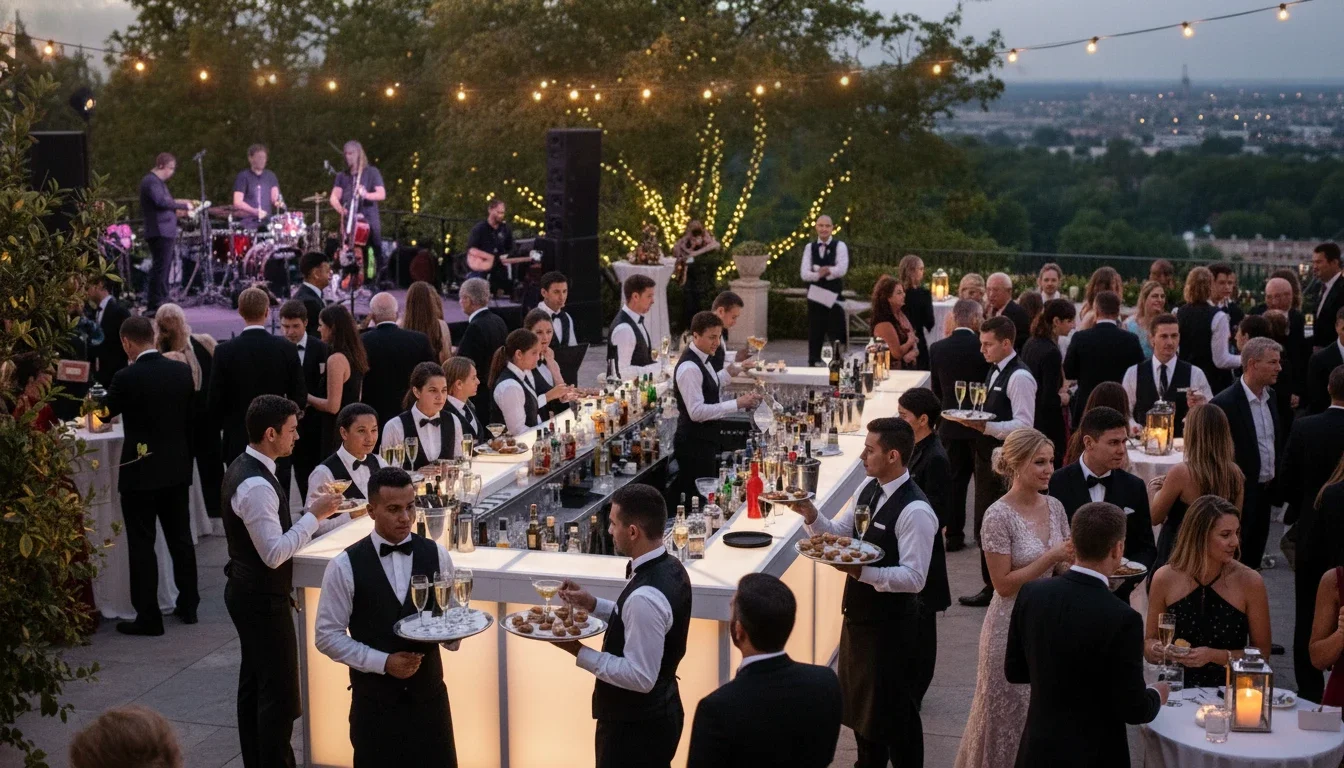
Properly staffed events ensure guests receive excellent service without overwhelming your budget
How to Maximize Value When Hiring Event Staff
Smart planning helps you get the most value from your staffing investment without cutting corners on quality. These strategies optimize your budget while maintaining the professional service your event deserves.
Book Early to Secure Better Rates
Advance booking delivers multiple benefits beyond just cost savings. Planning six to eight weeks ahead of your event gives you first access to agencies' best staff. The most experienced, professional event workers maintain busy schedules and get booked quickly, especially during peak season.
Early booking also avoids rush fees. The 20-40% premium that last-minute bookings incur adds up quickly across a full team. For a 10-person staff, rush fees could add $500-800 to your total cost—money that delivers no additional value.
Peak season timing magnifies the importance of advance booking. If your event falls during May-October (wedding season) or coincides with major conventions at the David L. Lawrence Convention Center, extend your booking timeline to 10-12 weeks. The most competitive dates sell out months ahead.
Last-minute flexibility has its price. While professional agencies do their best to accommodate rush requests, availability becomes unpredictable as you get closer to your event date. You might not get your first choice of staff roles or experience levels. If possible, lock in your team early and eliminate this uncertainty.
Optimize Staff-to-Guest Ratios
More staff doesn't always equal better service. Finding the right balance prevents both under-staffing (which creates poor guest experience) and over-staffing (which wastes budget).
Standard ratios by event type provide useful starting points. For plated dinner service, one server per 15-20 guests works well. Buffet service needs fewer servers, typically one per 25-30 guests. Cocktail receptions with heavy hors d'oeuvres might require one server per 20-25 guests. Bartenders generally handle 75-100 guests per bar station for basic service, or 50-75 for craft cocktail programs.
Trade show booth staffing depends on foot traffic and engagement goals. One brand ambassador per 75-100 square feet of booth space ensures continuous visitor engagement without crowding. High-traffic moments like show openings might benefit from additional staff during peak hours only rather than full-day commitments.
Multi-skilled staff delivers efficiency. A server who can also handle bar backup during busy moments provides flexibility. Brand ambassadors comfortable with registration duties can float between roles as needed. When requesting quotes, ask about staff capabilities beyond their primary role.
Staggered timing reduces unnecessary costs. Your event might need six servers during dinner but only three during dessert and dancing. Some agencies allow split shifts where additional staff work only during peak hours. This approach requires careful coordination but can save 15-20% on total staffing costs for events with distinct high-demand and low-demand periods.
Choose the Right Service Level for Your Event
Not every event requires premium staffing at the top of the rate range. Matching service level to your actual needs optimizes budget without sacrificing guest experience.
High-stakes events justify premium investment. Corporate events hosting important clients, awards ceremonies, fundraisers where attendees paid significant ticket prices, product launches representing major brand investments, and executive retreats demand staff at the higher end of experience and rate ranges. The stakes are too high for anything less than polished professionals.
Appropriate budget-friendly options exist for different event types. Casual company picnics, internal team celebrations, community festivals, and similar relaxed gatherings can often succeed with newer staff who charge toward the lower end of the range. These events still benefit from professional vetting and agency management but don't require the same level of formal service expertise.
Key quality indicators that matter for any budget level include reliable background checks, professional training and pre-event briefings, responsive agency communication, backup staff guarantees, and proper insurance coverage. These fundamentals shouldn't be sacrificed regardless of where your event falls on the formality spectrum.
For guidance on how professional agencies maintain quality across different service levels, learn about Eleven8's staffing process and standards.
Negotiate Multi-Event or Multi-Day Discounts
If you host events regularly or need staff for consecutive days, volume pricing creates significant savings opportunities.
Multi-day event pricing often includes 10-15% discounts on the per-day rate. A three-day conference might cost $3,000 per day in staffing rather than $3,500 if each day were booked separately. The savings stem from reduced administrative overhead and guaranteed consecutive work for staff.
Recurring event partnerships work well for organizations hosting monthly networking events, quarterly conferences, or weekly programs. Agencies value reliable clients and often extend preferred pricing. Building a relationship with a staffing partner also means they understand your standards and preferences, reducing onboarding time for each new event.
Annual contract structures benefit organizations with predictable event calendars. Universities hosting multiple alumni events, corporations with regular training sessions, and associations running annual conferences can negotiate framework agreements covering multiple events throughout the year. These contracts might lock in rates and guarantee priority staffing.
Be realistic about commitment. Only negotiate multi-event discounts if you're confident about your event schedule. Agencies invest in these relationships, and cancelling multiple events creates challenges for all parties.
Understand What's Included Before Signing
Comparing proposals requires understanding what each agency includes in their pricing. Not all quotes cover the same services.
Insurance coverage should be verified for every proposal. Request certificates showing general liability coverage (minimum $1 million, preferably $2 million) and workers' compensation coverage. If an agency hesitates to provide insurance certificates, this is a major red flag.
Training and preparation vary significantly between agencies. Some conduct detailed pre-event briefings where staff learn your event's specific needs, your organization's background, and any special protocols. Others provide minimal instruction. Ask specifically about pre-event preparation during the quote process.
Backup staff guarantees protect you from no-shows. Professional agencies maintain deep rosters and can deploy replacement staff if someone has an emergency. Agencies working with small, thin staffing pools may not be able to guarantee replacements. This distinction matters enormously at 7:00 AM the day of your event when a staff member calls in sick.
Payment terms and refund policies should be crystal clear. When is deposit due? When is final payment due? What cancellation terms apply? Get these details in writing before signing.
Hidden fees need explicit discussion. Does the quote include parking? Travel for suburban venues? Uniform costs? Equipment rental? Having a comprehensive list of what's included versus what costs extra prevents unwelcome surprises.
For Pennsylvania-specific labor law information relevant to event staffing, see Pennsylvania Department of Labor & Industry resources.
Quality Indicators: What to Look For in a Pittsburgh Event Staffing Agency
Price alone shouldn't drive your hiring decision. The right agency delivers value through professionalism, reliability, and systems that protect your event's success. These quality indicators help you identify agencies worth your investment.
Vetting and Background Checks
Professional event staff work in homes, corporate spaces, and around valuable equipment. Proper vetting protects all parties and demonstrates an agency's commitment to quality.
Standard screening practices for reputable agencies include comprehensive employment verification confirming prior event and hospitality experience, reference checks with previous employers or clients, identity verification through official documentation, and criminal background checks appropriate for the event setting.
Pennsylvania-specific clearances become relevant for certain events. If your event involves minors, some venues or organizations require Pennsylvania Child Abuse History Clearance, Pennsylvania State Police Criminal Record Check, and FBI Fingerprint Clearance. While not all events require these clearances, agencies that understand when they're necessary demonstrate thorough knowledge of compliance requirements.
References and work history verification separates professionals from inexperienced workers. Agencies that invest time confirming staff backgrounds deliver better performance because they're selecting based on proven capability rather than just availability.
Drug testing policies vary by agency. Some high-end staffing companies include pre-employment drug screening. While not universal in the event staffing industry, it's another indicator of thoroughness worth asking about for sensitive events.
Training and Preparation
How agencies prepare staff before your event directly impacts service quality. The best companies don't just send warm bodies; they send professionals who understand their role in your event's success.
Pre-event briefings should cover your event's specific needs, key information about your organization or brand, contact protocols and chain of command, timing and schedule details, venue layout and facility information, and any special guest considerations.
Industry-specific training demonstrates an agency's investment in professional development. Staff working corporate conferences should understand business etiquette and professional behavior. Brand ambassadors need training in engagement techniques and brand messaging. Wedding staff benefit from formal service training and understanding of ceremony/reception flow.
Brand representation standards matter particularly for corporate events and brand activations. Staff need to understand that they're representing your brand, not just completing tasks. This mindset shift requires training and agency culture that emphasizes professional representation.
Ongoing development for experienced staff shows an agency's commitment to continuous improvement. The best agencies don't just train once; they provide regular updates, share best practices, and cultivate professional growth among their team members.
Insurance and Compliance
Proper insurance and legal compliance are non-negotiable. Cutting corners in this area creates financial risk that far exceeds any cost savings.
General liability coverage protects against third-party claims for bodily injury or property damage. If a staff member accidentally damages venue property or a guest is injured due to staff actions, general liability insurance handles the claim. Request certificates showing minimum $1 million coverage, though $2 million is preferable for larger events.
Workers' compensation insurance covers staff members' medical costs and lost wages if they're injured during your event. Pennsylvania law requires workers' compensation for most employment relationships. If staff are truly W-2 employees of the agency, the agency's workers' comp policy covers them. If you hire independent contractors directly, you may be liable for their injuries despite the independent contractor classification.
W-2 vs. 1099 classification carries significant implications. The IRS has strict criteria for determining whether workers are employees or independent contractors. Misclassification creates liability for unpaid payroll taxes, penalties, and potential legal claims. Professional agencies employ staff as W-2 employees, handling all payroll obligations properly. Individuals who call themselves "independent contractors" may actually meet the IRS definition of employees, creating potential liability for you as the hiring party.
For IRS guidance on proper worker classification, seeIndependent Contractor (Self-Employed) or Employee?
Compliance with labor laws includes proper overtime calculation, required break periods, anti-discrimination policies, and safe working conditions. Agencies that operate compliantly build these costs into their rates. Suspiciously low pricing often indicates shortcuts on compliance that create risk.
Replacement and Backup Systems
No-shows happen. Medical emergencies occur. Cars break down. How an agency handles unexpected absences determines whether these situations become your problem or theirs.
No-show policies from professional agencies guarantee replacement staff or don't charge for the missing person. If you're expecting 10 staff members and only 9 show up, the agency either deploys a replacement immediately or reduces your bill. You should never pay for staff who don't appear.
Same-day replacement capabilities depend on roster depth. Agencies with 50-100 vetted staff in their Pittsburgh pool can usually deploy replacements quickly. Smaller operations may struggle to cover last-minute gaps. This distinction becomes critical during your event.
Emergency contact procedures should provide you with direct access to management during your event. If an issue arises that on-site staff can't resolve, you need immediate backup. Agencies should provide emergency contact numbers and guarantee response within minutes, not hours.
Backup for backup matters for large events. If your event requires 20 staff members, ask what happens if two or three can't make it. Does the agency have sufficient depth to still staff your event fully? Understanding these contingencies provides peace of mind.
Client Reviews and Portfolio
Past performance indicates future results. Agencies with strong track records of successful Pittsburgh events earn their reputation through consistent delivery.
Pittsburgh-specific experience demonstrates knowledge of local venues, understanding of Pittsburgh market expectations, familiarity with area logistics, and established relationships with Pittsburgh vendors.
Venue familiarity particularly matters for complex spaces. Has the agency staffed events at David L. Lawrence Convention Center? Do they know the loading procedures at your chosen venue? Have they worked with your other vendors before? Previous experience at your specific venue or with your other suppliers reduces coordination friction.
Industry recognition through awards, certifications, or professional association membership indicates commitment to the event industry. Look for membership in organizations like the International Live Events Association or similar professional bodies.
Reference checking beyond online reviews provides deeper insight. Ask agencies for references from recent clients whose events resembled yours in size, type, or venue. Direct conversations with past clients reveal information you won't find in public reviews.

Professional staffing agencies maintain detailed training programs and quality standards to ensure consistent, excellent service
Pittsburgh Market Advantages for Event Staffing
Pittsburgh offers unique advantages for event planning, particularly around staffing costs and quality. Understanding these regional benefits helps you leverage your Pittsburgh location.
Competitive Pricing Without Sacrificing Quality
Mid-tier market economics create a sweet spot where professional quality meets fair pricing. Pittsburgh doesn't carry the cost inflation of New York, Los Angeles, or San Francisco, yet it delivers comparable professional standards due to its robust hospitality industry and educated workforce.
The cost-of-living differential translates directly to labor rates. Housing, transportation, and general expenses cost significantly less in Pittsburgh than in major coastal cities. This allows agencies to pay competitive wages to attract quality staff while charging clients rates that remain affordable. A brand ambassador earning good money in Pittsburgh might need 30-40% more to maintain the same lifestyle in San Francisco—and that cost difference would pass to you as the client.
Established hospitality infrastructure means Pittsburgh has professional venues, experienced catering companies, skilled event planners, and deep staffing pools. You're not pioneering event services in an underdeveloped market; you're accessing mature event industry resources at favorable pricing.
Quality staff availability remains strong despite the favorable pricing. Pittsburgh's multiple major universities create a steady pipeline of educated, articulate, professional young people who work in the event industry. The city's service and hospitality sectors employ thousands of experienced professionals. This combination ensures agencies can recruit and maintain high-caliber teams.
Strong Talent Pool
Pittsburgh's workforce characteristics create excellent conditions for event staffing agencies and their clients.
University presence matters enormously. Carnegie Mellon University, University of Pittsburgh, Duquesne University, Chatham University, Point Park University, and others produce graduates who often remain in the region. Many students work in event roles during school, building experience that transitions into professional event careers. This creates a reliable talent pipeline of educated, professional, personable staff.
Arts and entertainment workforce in Pittsburgh includes actors, musicians, dancers, and other performers who often supplement their artistic careers with event work. These individuals bring natural stage presence, confidence with audiences, and comfort in dynamic environments—all valuable traits for event staff.
Hospitality industry presence throughout Pittsburgh's restaurant, hotel, and service sectors means experienced servers, bartenders, and customer service professionals populate the region. Agencies recruit from this experienced base, not just entry-level workers.
Professional diversity allows agencies to match staff backgrounds to specific event needs. Tech conferences benefit from staff who understand technology. Healthcare events pair well with staff having medical or pharmaceutical knowledge. Arts events succeed with culturally engaged staff. Pittsburgh's diverse economy supports this matching process.
Accessible Venues and Logistics
Pittsburgh's geography and infrastructure create operational advantages that reduce event complexity and cost.
Centralized downtown district concentrates major venues, hotels, restaurants, and services within a compact, navigable area. The David L. Lawrence Convention Center, multiple downtown hotels, the Cultural District theaters, and numerous unique event spaces sit within easy reach. This concentration simplifies logistics, reduces travel time between venues, and creates efficiency.
Major convention infrastructure including the David L. Lawrence Convention Center, Allegheny County fairgrounds, and numerous hotel conference facilities positions Pittsburgh as a legitimate mid-major convention market. The city regularly hosts industry conferences, trade shows, and corporate events, which maintains a sophisticated ecosystem of event services.
Growing event industry continues to expand. New venues open, existing spaces renovate, and the market for corporate events, brand activations, and experiential marketing grows. This growth creates opportunities for staff and agencies while maintaining competitive pricing through healthy market dynamics.
Transportation accessibility includes Pittsburgh International Airport serving the region, downtown light rail and bus systems, reasonable highway access, and manageable traffic patterns compared to larger metros. These factors make Pittsburgh events logistically simpler for both attendees and staff.
When to Hire an Event Staffing Agency vs. Independent Contractors
Choosing between an established agency and independent contractors involves weighing structure, security, and cost against each other. The right choice depends on your event's specific needs and risk tolerance.
Benefits of Working with Agencies
Professional agencies deliver systems and infrastructure that individual contractors can't match. Understanding these advantages helps justify agency fees.
Vetted, trained professionals come standard through agency relationships. You're not gambling on an unknown person's capabilities; you're accessing a roster of staff who've been screened, trained, and proven through multiple events. This vetting reduces risk significantly.
Replacement guarantees protect you from no-shows. If an individual contractor doesn't appear, you're scrambling at the last minute or doing without that role. When an agency staff member can't make it, the agency deploys a replacement from their bench. This guarantee alone justifies agency premiums for many event hosts.
Insurance protection comes built into agency relationships. The agency's general liability and workers' compensation insurance covers staff activities. This protection eliminates major financial exposure that exists when you hire individuals directly.
Streamlined payroll and administration means you receive one invoice covering all staff rather than processing payment for multiple individuals, handling tax documentation, tracking hours, and managing disputes. For events with 10+ staff members, administrative savings become significant.
Quality control systems ensure consistent service. Agencies can deploy supervisors, provide performance feedback, and maintain standards across all staff. Individual contractors operate independently without this oversight layer.
When Independent Contractors Make Sense
Despite agency advantages, some situations favor working with individuals directly. Recognizing these scenarios helps you make appropriate choices.
Very small events involving just one or two staff members for a few hours create minimal complexity. A small birthday party needing one bartender for three hours might reasonably hire an experienced individual you know personally. The administrative and insurance concerns remain but at smaller scale.
Established personal relationships change the risk equation. If you've worked with a particular bartender for five years through multiple successful events, the familiarity reduces uncertainty. You know their reliability, skill level, and professionalism from direct experience.
Non-traditional event types that fall outside typical agency offerings might require specialized independent professionals. Highly specific technical roles, niche expertise, or unique skill sets sometimes exist in the independent contractor space rather than through agencies.
Budget constraints occasionally force difficult choices. If your budget absolutely cannot accommodate agency fees, working with carefully selected independent contractors at least provides some support versus trying to host your event completely alone. This should be a last resort rather than a first choice, but it acknowledges real-world budget limitations.
Red Flags to Avoid
Whether working with agencies or independent contractors, certain warning signs indicate problems you should avoid.
Suspiciously low pricing that significantly undercuts market rates usually indicates something missing from the service. No insurance coverage, no background checks, inexperienced staff, or improper worker classification often explains prices that seem too good to be true. Remember that professional event staffing includes substantial infrastructure that costs money to maintain.
No insurance verification or inability to provide certificates of insurance represents major exposure. Never hire staff—agency or independent—without confirming proper insurance coverage. Request certificates showing general liability and workers' compensation coverage before signing agreements.
Lack of vetting process means you have no idea who will show up at your event. Professional agencies can tell you about each staff member's experience, background check results, and previous event performance. Operations that skip vetting send whoever is available, regardless of suitability.
Poor communication during the booking process predicts poor communication during your event. If an agency doesn't return calls promptly, answer questions clearly, or provide detailed information during sales conversations, expect similar problems when you need support during your event.
Unclear contracts without detailed terms for services, pricing, cancellation, no-shows, and dispute resolution create vulnerability. Every agreement should clearly state what's included, what costs extra, and how problems get resolved. Verbal agreements or vague written terms spell trouble.
How to Get an Accurate Quote for Your Pittsburgh Event
Obtaining accurate quotes requires providing agencies with complete information and asking the right questions. Preparation makes the process efficient and ensures proposals address your actual needs.
Information Agencies Need
The more details you provide upfront, the more accurate your initial quote will be. Comprehensive information prevents the back-and-forth that delays booking.
Event date, time, and duration should include your event's actual start and end times plus any setup or breakdown time you need covered. If your reception runs 7:00 PM to midnight, specify whether that includes one-hour setup before and half-hour breakdown after, or whether those times represent when you need staff present.
Guest count helps agencies recommend appropriate staff numbers. An estimate is fine if you're booking well in advance, but provide your best projection. Round to the nearest 25 for larger events (175, 200, 225 rather than 187, 216).
Event type and format affect staffing needs significantly. "Corporate event" could mean anything from a sit-down dinner to a trade show booth to a networking reception. Describe your event's format, meal service style, bar service approach, and activity flow.
Venue location and requirements matter because different spaces present different logistical considerations. Name your venue if you've selected one. If you're still choosing, list your top options. Mention any known venue requirements like specific entrances for vendors, parking situations, or unusual load-in procedures.
Specific role needs should detail what you want staff to do. Don't assume agencies will automatically know whether your "servers" need to do passed hors d'oeuvres versus plated service or buffet setup. Spell out duties, responsibilities, and any specialized skills required.
Setup and breakdown requirements often get overlooked in initial planning. Think through what needs to happen before your first guest arrives and after the last guest leaves. Who places name cards? Who clears and boxes up leftover supplies? These tasks require staff time that should be included in quotes.
Questions to Ask During Consultations
Beyond providing information, asking strategic questions during the quote process reveals important details about how agencies operate.
"What's included in the quoted price?" should generate a comprehensive answer listing base wages, service fees, insurance, travel if applicable, standard uniforms, and any other bundled items. This question flushes out hidden costs before signing.
"What are the payment terms?" clarifies when deposit is due, when final payment is due, what payment methods are accepted, and whether payment plans are available for larger events. Understanding financial expectations prevents surprises.
"What is your cancellation policy?" should receive a clear answer with specific timeframes and percentage penalties. Get this in writing so you know exactly what you're agreeing to.
"How do you handle no-shows or performance issues?" reveals whether the agency guarantees replacement staff, how quickly they can deploy backups, what recourse you have if staff perform poorly, and how they handle problems during your event.
"Can I meet or speak with staff beforehand?" Some agencies introduce you to your event captain or lead staff member a few days before your event. This meeting builds comfort and allows you to communicate special requirements directly.
"What happens if I need to add staff last-minute?" Understanding flexibility for scope increases helps you plan. Can you add staff with 48 hours notice? One week? What premium applies to late additions?
"Do you provide on-site supervision?" For larger events, knowing whether a supervisor will be present and what their role entails helps set expectations. Supervisors coordinate staff, handle issues, and serve as your single point of contact during the event.
Comparing Multiple Quotes
Getting proposals from three agencies provides useful comparison data. Evaluating these quotes requires looking beyond bottom-line prices.
Apples-to-apples comparison means ensuring all quotes cover the same scope. If Agency A quotes 6 servers for 5 hours while Agency B quotes 5 servers for 4 hours, you're not comparing equivalent proposals. Standardize the scope before comparing prices.
Understanding price variations between agencies requires examining what each includes. Agency A's higher price might include uniforms, parking, and on-site supervision that Agency B charges extra for. Calculate the true total cost for each proposal including all fees and likely additional charges.
Service level differences matter beyond just price. Agencies with deeper experience, more thorough vetting, and better backup systems deliver more value even at higher rates. Consider reliability and professionalism alongside cost.
References and past work should factor into your decision. The lowest-priced agency might lack experience with your event type or venue. Paying 10-15% more for proven expertise in your specific scenario often represents better value than gambling on the cheapest option.
Communication quality during the quote process indicates how the relationship will unfold. The agency that responds quickly, asks insightful questions, provides detailed proposals, and makes you feel heard during sales will likely deliver superior service during your event.
Planning Your Pittsburgh Event Staffing Budget
Professional event staff represent an investment in your event's success rather than just another line item expense. The difference between well-staffed events and under-staffed disasters often determines whether guests remember your event positively or negatively—and whether you achieve your event's objectives.
Pittsburgh's position as a mid-tier market creates opportunities to access high-quality event staff at rates significantly better than major coastal cities while still drawing from a strong professional talent pool. The city's universities, hospitality industry, and growing event market maintain healthy competition and abundant qualified staff.
Understanding the full scope of event staffing costs—from base hourly rates and service fees to hidden charges like minimums, overtime, and logistics—positions you to budget accurately and avoid surprises. The examples and frameworks provided here give you tools to estimate your specific event's staffing needs and compare proposals intelligently.
Quality matters tremendously in event staffing. While it's tempting to choose the lowest-priced option, professional agencies earn their rates through comprehensive vetting, proper insurance, training programs, backup systems, and reliable service delivery. These systems protect your event and ensure guests receive the professional service they expect.
Planning ahead, optimizing staff ratios, choosing appropriate service levels, and building relationships with quality agencies maximize value without cutting corners. Pittsburgh's event staffing market offers excellent options for every event type and budget level.
Whether you're planning a 50-person board retreat, 150-guest wedding, 300-person trade show, or 500-person festival, investing in professional event staff allows you to focus on your event's goals rather than managing service details. That focus makes the difference between events that merely happen and events that succeed.
For professional event staffing in Pittsburgh backed by comprehensive vetting, training systems, and nationwide expertise, explore Eleven8's event staffing services. Our team brings the same quality standards that serve clients in Los Angeles, New York, Chicago, and Atlanta to every Pittsburgh event we staff.