Hoosier Hospitality: What Makes Indiana Fairgoers Different to Staff
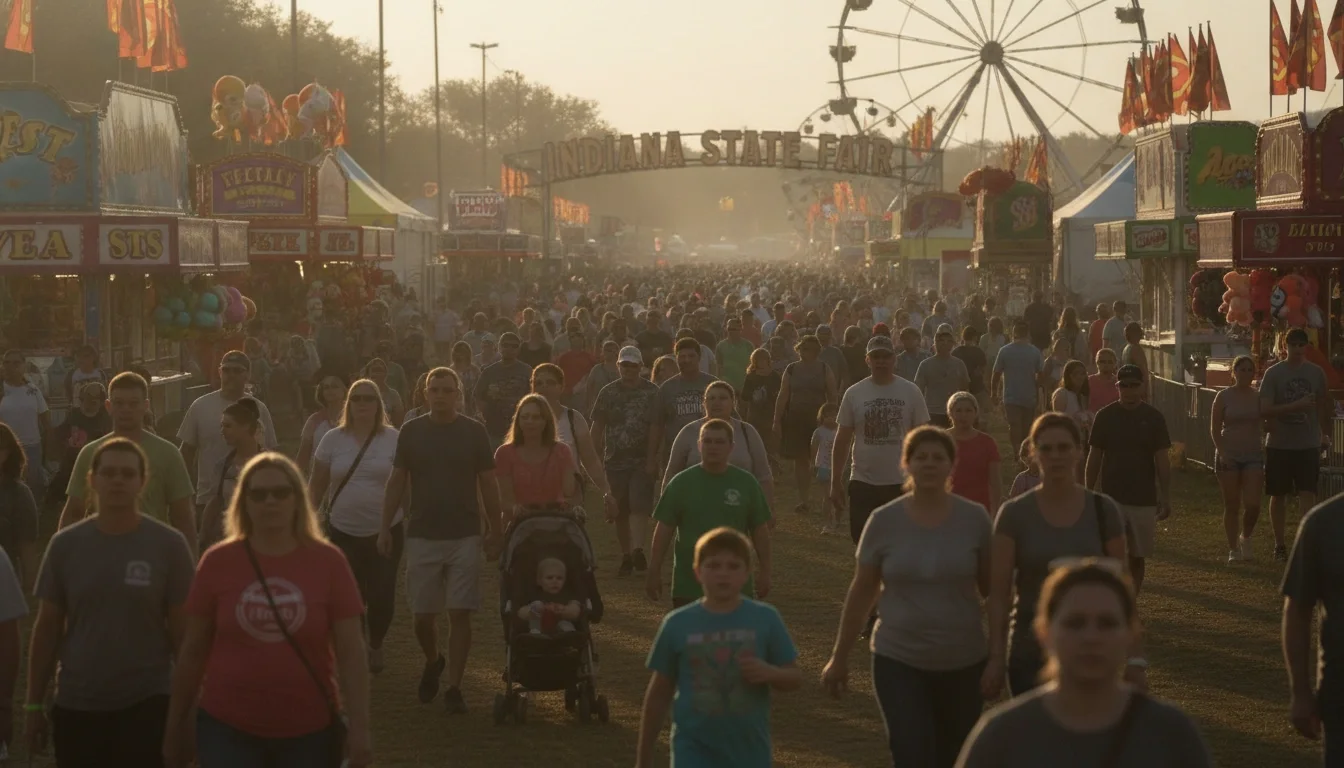
A sea of Indiana fairgoers moving through the Indiana State Fair grounds, warm summer light, families and multi-generational groups visible
Not Every Crowd Is the Same — And Indiana Proves It
There's a reason experienced event staffers talk about Indiana differently. Walk a brand activation booth at a fair in Miami or New York and you're dealing with a crowd that moves fast, makes quick decisions, and rarely lingers unless you're offering something immediately compelling. Show up at the Indiana State Fair and something different happens.
People stop. They ask questions — real ones, not deflection tactics. They bring their grandparents and their toddlers. They've been coming to this fair for decades, in some families for generations. They have opinions about the food and strong feelings about which exhibits are worth the walk. And when they engage with your staff, they're watching closely — not for polish, but for authenticity.
Understanding this distinction isn't just useful cultural trivia. For any brand running an activation, a product sampling campaign, or a sponsored experience at an Indiana fair, it has direct operational implications. The staffing profile that works in a high-turnover urban environment can actively underperform here — and the teams that understand Hoosier culture in advance consistently outperform those that don't.
What Is Hoosier Hospitality?
Rooted in Community, Not Performance
Hoosier Hospitality isn't a marketing slogan — it's a documented, deeply practiced cultural trait rooted in Indiana's history. The state's early agricultural communities depended on mutual support to survive harsh growing seasons and geographic isolation. That foundation created a culture of genuine neighborliness: you helped your neighbors because they'd help you, and because it was simply the right thing to do.
Indiana consistently ranks among the friendliest states in America, and residents don't describe that warmth as performative — it's described as an expression of the Golden Rule. As David Letterman, a native Hoosier, has put it, it's the way people are supposed to be. That orientation toward others is baked into daily life: people hold doors, say hello to strangers, give directions without hesitation, and extend goodwill toward people they've never met.
This matters for staffing because it sets an expectation. When Indiana fairgoers show up, they're bringing that same spirit with them. They expect the people they encounter — including your event staff — to meet them with genuine engagement. When staff do, the result is extended conversations, real interest in your product or brand, and highly positive brand recall. When staff don't, the gap between expectation and reality is noticed.
Friendly but Not Effortless — What Hoosier Warmth Actually Looks Like
One nuance worth noting: Hoosier hospitality is warm, but it's not naive. Indiana culture tends to be reserved at first, particularly with visitors who come across as loud, dismissive, or trying too hard. The warmth is genuine, but it's earned. Fairgoers are polite and patient, but they're also perceptive. They'll spot a scripted pitch from twenty feet away, and they won't reward it.
The most effective event staff in this market are the ones who treat fairgoers as neighbors rather than conversion targets. That's a specific mindset shift — one that needs to be articulated in pre-event briefings, not assumed.
The Indiana State Fair — A Staffing Context Unlike Any Other
Scale, Duration, and Audience Diversity
The Indiana State Fair is one of the largest in the country by attendance. The 2025 edition drew nearly 855,000 visitors across 15 days — a figure that held nearly flat despite six days of 90-degree-plus heat. That sustained attendance isn't just impressive; it tells you something about the commitment of the audience. These aren't casual drop-ins.
The fair runs across three weekends in August. Attendance shifts meaningfully by day — weekday crowds skew toward older attendees, retirees, and dedicated fairgoers; weekend crowds bring families, younger adults, and larger groups. Staffing teams that treat every day the same will consistently misallocate energy and engagement style. The sharpest teams adjust in real time.
Events at the fair include agricultural competitions (over 50,000 entries submitted by 10,000+ Hoosiers in 2025), live concerts on the Hoosier Lottery Free Stage, culinary demonstrations, midway rides, and a dense schedule of ticketed and free programming that keeps fairgoers on-grounds for extended periods. Brand activations sit within this larger ecosystem — not as the main event, but as part of the experience.
The Community-Event Mindset That Separates Hoosier Crowds
What distinguishes Indiana State Fair attendance from most large events is the proportion of attendees who treat it as a community ritual rather than consumer entertainment. Many families have multi-generational fair traditions. Agricultural exhibitors bring children who've raised livestock for competition. Local vendors have been on the grounds for decades. The sense that the fair belongs to everyone who comes — not to the brands, the sponsors, or the organizers — is palpable.
For event staff, this translates into a specific relational dynamic: the fairgoer is on their turf. They know where things are, they have expectations about how the space should feel, and they're attuned to whether a brand presence adds to or detracts from their fair experience. Staff who lean into that — who show genuine curiosity about the fair, who acknowledge what makes it special — will land significantly better than those who treat it as an interchangeable activation venue.
6 Distinct Ways Indiana Fairgoers Behave Differently
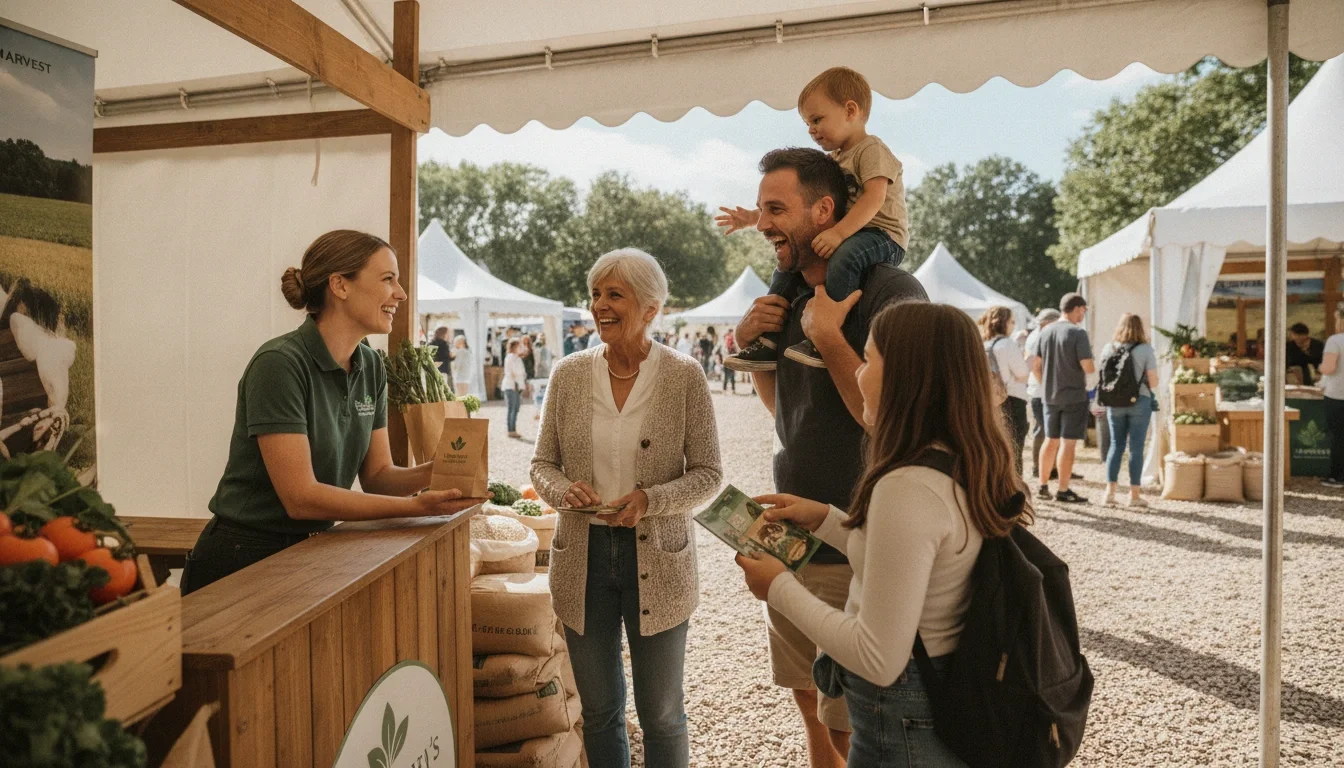
A brand ambassador at an outdoor fair booth is having a genuine conversation with a multi-generational family group
1. They Respond to Genuine Engagement, Not Sales Energy
High-pressure, high-energy promotional tactics are a particularly poor fit for Hoosier audiences. The same brand ambassador approach that works in Times Square activation — loud, fast, attention-grabbing — often reads as inauthentic to Indiana fairgoers who've grown up in a culture that values quiet sincerity over performance.
Staff should be trained to open with curiosity rather than pitch: ask questions about what brought the fairgoer over, show interest in their day at the fair, and earn the conversation rather than demand it. Dwell time at your activation increases meaningfully when the engagement feels real.
2. They Linger — And That's an Opportunity
Unlike urban event environments where foot traffic moves in brief windows, Indiana State Fair crowds often have all day and no particular rush to be anywhere. Fairgoers who become genuinely engaged with an activation will spend five, ten, even fifteen minutes — not because they've been corralled, but because they're enjoying the interaction.
This changes the staffing calculus. You need enough staff to handle extended interactions without creating visible wait times at adjacent stations. It also means that a single high-quality engagement can result in far more genuine brand exposure than rapid-fire interactions with a high-turnover crowd. Depth over breadth is consistently the right approach here.
3. They're Multi-Generational Crowds With Layered Needs
A significant proportion of Indiana State Fair attendance comes in family groups that span three or more generations. Grandparents, parents, and young children often attend together, which means a single engagement point may need to serve three different people with three different levels of interest and different communication needs.
Staff need to be versatile communicators. The same person who can explain a product clearly to a 70-year-old needs to be able to make it engaging for a ten-year-old. Brand ambassador teams should include staff who are comfortable across age ranges — a capability that deserves explicit discussion in pre-event briefings.
4. They Know the Fair Better Than Your Staff Does
A recurring dynamic at Indiana fairs: fairgoers who've been coming for years will know the grounds, the vendors, and the events better than the staff you've deployed. They may arrive at your activation knowing exactly what you're offering, or they may ask staff questions about fair logistics that your team can't answer.
The fix is simple but often skipped: provide staff with fair maps, event schedules, and a brief orientation to the key programming so they can be genuinely helpful, not just brand-present. Being able to point someone toward the closest restroom or tell them when the headliner goes on isn't your activation's job — but staff who can do it build immediate goodwill that pays dividends in engagement quality.
5. They're Skeptical of Inauthenticity
Hoosier audiences have a well-developed radar for insincerity. This is a culture that places a high value on honesty and directness. Staff who appear scripted, visibly disengaged, or performing enthusiasm they don't feel will be noticed — and quietly walked past. There's no hostile response; the Midwestern equivalent of rejection is simply moving on without comment.
The implication for brand ambassador selection: personality fit matters as much as presentation. Staff who are genuinely curious about people, comfortable in unscripted conversation, and able to find real interest in what they're promoting will outperform technically polished staff who are going through the motions. Indiana audiences reward real.
6. They Appreciate Directness and Practical Communication
Midwestern communication culture tends toward clarity and practicality. Indiana fairgoers don't need elaborate setups or lengthy brand narratives before they understand what you're offering. Clear, honest communication — here's what this is, here's who it's for, here's how to get it — lands better than layered marketing language.
This has a useful operational corollary: when there are logistics to communicate (wait times, sampling limits, age requirements), saying them clearly and warmly is better than softening them into ambiguity. Fairgoers appreciate being treated as capable adults. Staff who communicate directly earn respect and, often, patience.
What This Means for Your Staffing Strategy
Tone-Matching Is Everything
The cultural traits above aren't random observations — they point toward a specific staffing profile. For Indiana fair activations, you want staff who are warm without being performative, knowledgeable without being condescending, and energetic without being overwhelming. That's a specific blend, and it needs to be communicated clearly before event day.
Tone-matching also applies at the management level. On-site captains should understand that corrective guidance between fairgoer interactions needs to be discreet and calm — loud corrections, visible frustration, or obvious tension within the staff team will register with nearby fairgoers and undercut the brand experience.
Staff Briefings Should Include Cultural Context, Not Just Operational Logistics
Most pre-event briefings cover uniform standards, station assignments, break schedules, and product knowledge. For Indiana fair activations, add fifteen minutes on the audience. Who are these fairgoers? What do they value? What do they notice? What's the fair's role in their community?
Staff who understand the cultural context of what they're walking into engage differently from day one. They ask better questions, they read situations more accurately, and they're less likely to default to a generic activation script that doesn't land.
Consistency Across the Run Matters More Here Than in Most Markets
A multi-day fair creates a specific challenge: repeat fairgoers. Unlike single-day events, a meaningful proportion of Indiana State Fair attendees come back more than once across the 15-day run. Staff who were warm and engaged on day two will be remembered on day nine. Staff who are visibly fatigued or disengaged by mid-run leave a different impression.
Managing energy and performance consistency over a multi-day run requires structured rotation, adequate staffing depth so no individual is overextended, and an account management structure that can identify quality drift before it compounds.
Why Backup Coverage Is Non-Negotiable at Multi-Day Fairs
In single-day activations, a no-show is a crisis. In a 15-day activation, staff turnover over the run is statistically predictable — illness, personal conflicts, and scheduling issues will arise. Operating without briefed backups means scrambling reactively, which results in gaps in coverage at exactly the moments when consistency matters most.
A proper backup protocol — where a replacement is pre-briefed on brand standards, station assignments, and cultural context — is the difference between a run that holds its quality and one that degrades by the second week.
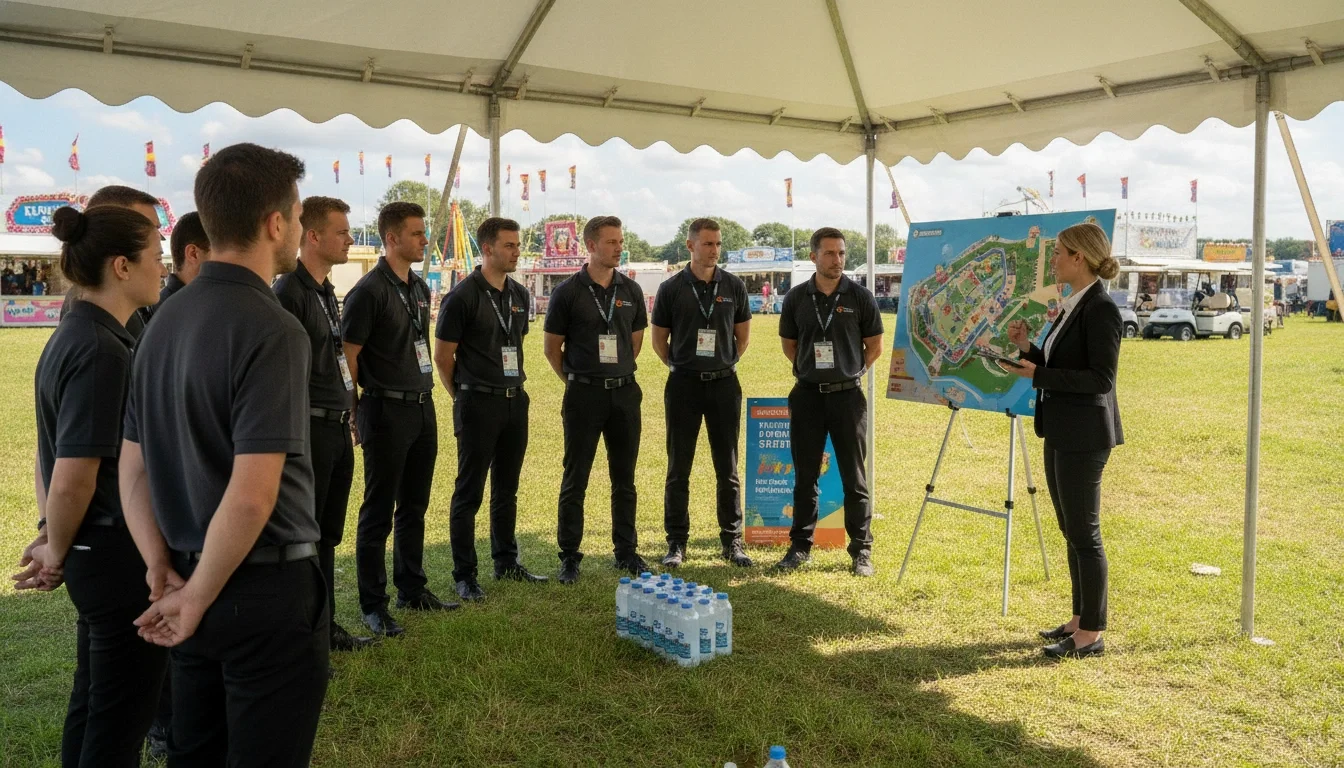
A professional event staffing team receiving a pre-event briefing in an outdoor fair setting, engaged and attentive
Staff Roles Most Impacted by Hoosier Audience Dynamics
Brand Ambassadors
Brand ambassadors are the primary point of contact between your activation and Hoosier fairgoers — and the role where cultural fit has the greatest impact on outcomes. For Indiana fair deployments, ambassador selection should weigh conversational naturalness and genuine curiosity highly. Ambassadors who can find real interest in an extended conversation, who can move between age groups without awkwardness, and who respond to follow-up questions with confidence rather than script-recall will produce significantly better engagement metrics over a multi-day run.
Ambassador briefings should cover the fair's cultural significance in the state, key programming details for the days they'll be on-site, and explicit tone guidance around the authenticity-over-performance principle that defines effective Hoosier engagement.
Greeters and Wayfinding Staff
At a fair the size of Indiana's, greeters and wayfinding staff are often the first touchpoint fairgoers have with a brand's presence on the grounds. The quality of that first contact shapes the likelihood of secondary engagement. Warm, unhurried, and genuinely helpful greeters — who can orient attendees to both the activation and the broader fair grounds — build the goodwill that converts passersby into participants.
This is a role where Midwestern communication norms are a direct advantage: clear, practical directional guidance delivered without pretension or hustle is exactly what fairgoers respond to.
Crowd Management Teams
At a fair drawing nearly 855,000 visitors across 15 days, effective crowd management isn't optional — it's structural. Indiana fairgoers are patient and cooperative, but they expect that patience to be respected. Lines that are poorly managed, unclear, or apparently unmonitored will generate quite frustration that compounds over time.
Crowd management staff who communicate proactively — giving honest estimates, acknowledging wait times, and thanking fairgoers for their patience — perform well in this market. The Midwestern appreciation for directness means that telling someone honestly 'it'll be about ten minutes' earns more goodwill than vague reassurance. For information on crowd management services, visit Eleven8's dedicated crowd control page.
Sampling and Demonstration Staff
The product sampling environment at Indiana fairs is highly favorable for brands that approach it correctly. Fairgoers who stop for a sample are genuinely interested — they're not in a rush, they're open to conversation, and they often bring others over when they find something they like. Word-of-mouth within fair crowds is immediate and organic.
Sampling staff should be trained not just on the product, but on handling extended curiosity: questions about ingredients, sourcing, availability, and brand story are common and represent genuine engagement. The ability to answer them confidently and conversationally — without referring the question elsewhere — closes the loop on a high-quality fairgoer interaction.
Eleven8's Indianapolis Staffing Approach
Local Market Knowledge in Central Indiana
Eleven8 Event Staff has built an active roster in Indianapolis with experience across the Indiana Convention Center, Lucas Oil Stadium, Gainbridge Fieldhouse, and the broader Central Indiana event landscape. That local market knowledge shapes how we build and brief teams for Indiana-specific activations — including fair staffing that draws on this region's distinct audience culture.
Our Indianapolis team understands that Midwestern audiences reward genuine engagement and penalize inauthenticity. We incorporate that understanding into every staff briefing, regardless of whether the event is a downtown corporate conference or a 15-day state fair run.
How We Brief Teams for Indiana Audiences
Every Eleven8 deployment follows our 11-step event staffing process, which includes pre-event briefings that are customized to the specific audience, event type, and activation goals. For Indiana fair activations, that means explicit cultural preparation — not just logistics.
Staff assigned to Indiana activations receive orientation on Hoosier communication norms, the multi-generational fairgoer profile, and the expectations that Indiana audiences bring to brand interactions. They also receive fair-specific logistics (map, schedule, venue orientation) so they can be genuinely helpful to fairgoers from the first hour of day one.
With a fulfillment rate of 101.8% — maintained through built-in backup coverage — and a staff selection process that admits fewer than 1 in 30 applicants, our team is built for the consistency that multi-day fair activations demand.
To explore our Indianapolis event staffing services and request a quote for your next Indiana activation, visit Eleven8's Indianapolis event staff page.