Formula 1 has exploded across the United States. What was once a single-race presence at Circuit of the Americas has expanded into three marquee events spanning Miami, Austin, and Las Vegas. Together, these races draw over 1.2 million spectators and generate billions in economic impact. For brands, this represents an unprecedented opportunity to activate at the intersection of luxury, performance, and global culture.
But here's what separates successful Formula 1 activations from expensive disappointments: staffing. The premium audiences, compressed timelines, complex credential requirements, and high-stakes visibility of F1 events demand specialized event staffing expertise. A brand activation that looks perfect on paper can collapse under poor execution, inadequate team size, or staff unfamiliar with the unique demands of motorsport events.
This guide provides a comprehensive framework for staffing brand activations across all three US Formula 1 Grand Prix events. Whether you're planning a single-race activation or coordinating a multi-market campaign spanning Miami, Austin, and Las Vegas, you'll learn how to calculate staffing requirements, navigate venue-specific logistics, build resilient teams, and deliver consistent brand experiences across different markets.
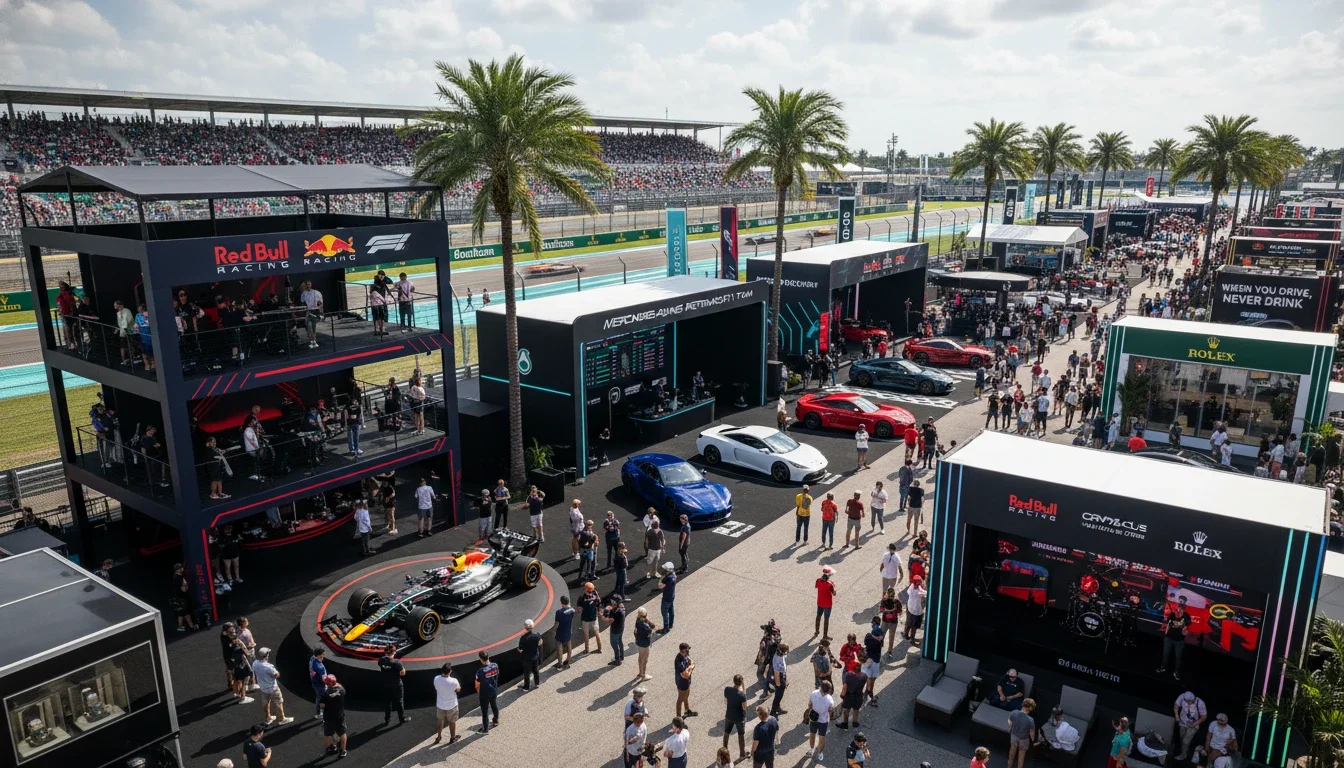
Brand activation zones at Miami International Autodrome during Formula 1 race weekend
Why Formula 1 Staffing Requires Specialized Expertise
The Unique Demands of F1 Brand Activations
Formula 1 events operate at a different intensity level than typical sporting events or trade shows. Race weekends compress three days of programming into an environment where global media attention, celebrity presence, and affluent attendees create heightened expectations for every brand touchpoint.
Your event staff aren't just managing booth traffic or serving drinks. They're representing your brand to an audience that includes C-suite executives, international media, influencers, and passionate motorsport enthusiasts who notice details. A single poorly trained brand ambassador or understaffed hospitality area can undermine months of planning and six-figure activation budgets.
The credential and access systems at Formula 1 events add another layer of complexity. Unlike open convention floors, F1 venues segment access by zone, with paddock areas, pit lanes, hospitality suites, and fan zones each requiring specific credentials. Your staffing plan must account for these restrictions, ensuring team members have proper access to their assigned areas weeks before race weekend.
Time compression is another critical factor. While a multi-day trade show might build gradually, Formula 1 activations face surges during practice sessions, qualifying, and the main race. Your team needs to handle quiet periods without burning budget on idle staff, then scale up instantly when crowds arrive. This requires sophisticated shift planning and team leads who can make real-time adjustments.
Multi-Race Coordination Challenges
Brands activating at multiple US Grand Prix events face coordination challenges that single-race activations avoid. The Miami Grand Prix typically occurs in May, the United States Grand Prix in Austin runs in October, and the Las Vegas Grand Prix happens in November. This six-month span across three distinct markets creates unique staffing considerations.
Local labor markets vary dramatically between Miami, Austin, and Las Vegas. Miami offers a diverse, bilingual workforce experienced with international events and hospitality but faces seasonal competition from cruise ship operations and spring festivals. Austin's labor market combines university students with a professional events community, though October timing coincides with Austin City Limits Music Festival. Las Vegas maintains the deepest pool of experienced event and hospitality staff in the country, but Formula 1 race week competes with conventions, residencies, and casino operations for talent.
Staff availability across multiple markets presents another challenge. Using the same traveling team across all three races ensures brand consistency and accumulated experience but creates travel logistics and cost considerations. Hiring separate local teams for each market reduces travel expenses and provides local market knowledge but requires multiple recruitment cycles, training sessions, and quality control systems.
Understanding the Three US Formula 1 Grand Prix Events
Miami Grand Prix at Miami International Autodrome
The Formula 1 Crypto.com Miami Grand Prix, first held in 2022, has rapidly become the longest-contracted event on the F1 calendar through 2041. The race takes place at the Miami International Autodrome, a purpose-built circuit at Hard Rock Stadium in Miami Gardens. Recent editions have drawn over 270,000 attendees across race weekend.
The Miami activation environment blends South Florida glamour with motorsport intensity. The venue features multiple distinct activation zones including the Paddock Club for ultra-premium hospitality, the Campus area with general admission access, the Beach Club offering coastal atmosphere, and the Marina providing waterfront hospitality. Off-track, brands activate across Miami Beach, Wynwood, the Design District, and Brickell.
Miami's May timing positions the race as the unofficial start of summer in South Florida, bringing warm weather and occasional afternoon thunderstorms that smart activation planners build contingencies around. The market attracts a highly international audience with strong Latin American representation, making bilingual staff capabilities valuable for many activations.
For staffing purposes, Miami presents both opportunities and challenges. The market offers experienced hospitality and event professionals familiar with high-end service expectations, but May timing creates competition with other major South Florida events. Smart brands begin Miami GP staffing recruitment 4-5 months in advance to secure top talent before availability tightens.
United States Grand Prix at Circuit of the Americas (Austin)
The United States Grand Prix at Circuit of the Americas (COTA) in Austin has anchored Formula 1's American presence since 2012. COTA is a purpose-built facility designed specifically for Formula 1, offering world-class infrastructure and clear sightlines. Recent races have exceeded 440,000 attendees across three-day weekends, making it one of the highest-attended events on the F1 calendar.
Circuit of the Americas provides expansive activation real estate with distinct zones including the Grand Plaza, Turn 1 complex, and amphitheater areas. The venue sits on Austin's outskirts near the airport, creating a campus environment where brands control more activation footprint than typical street circuits allow. However, the semi-rural location means most attendees drive or use shuttle systems rather than walk, affecting foot traffic patterns.
Austin's October timing brings ideal weather for outdoor activations, with moderate temperatures and low precipitation probability. The city's culture of live music, food, and creative expression means F1 race weekend competes for attention with numerous off-track events, concerts, and pop-ups across downtown Austin. Many brands execute dual strategies with trackside presence at COTA and separate activations in downtown Austin's entertainment districts.
The Austin labor market benefits from the University of Texas and a robust events industry built around South by Southwest, Austin City Limits, and year-round live music programming. However, October timing creates direct competition with ACL Music Festival, which has historically overlapped with or immediately preceded F1 race weekend. Brands should begin COTA staffing recruitment 5-6 months in advance and be prepared to offer competitive rates during this peak period.
Las Vegas Grand Prix at Las Vegas Strip Circuit
The Formula 1 Heineken Las Vegas Grand Prix debuted in 2023 as the newest addition to the US F1 calendar and instantly became one of the sport's marquee events. The 3.8-mile circuit runs directly through the Las Vegas Strip, creating a unique street circuit that integrates iconic casino resorts and entertainment venues into the race experience. The inaugural event drew over 300,000 attendees and has been contracted through the 2030s.
Las Vegas transforms Formula 1 into a week-long spectacle rather than a weekend event. The Strip circuit means brand activations can integrate with casino properties, restaurants, nightclubs, and entertainment venues in ways impossible at traditional racing circuits. Key activation zones include the Grand Prix Plaza (permanent facility with year-round activation potential), casino resort properties along the circuit, the Las Vegas Convention Center area, and the Fremont Street district.
November timing positions Las Vegas as the season finale or near-finale, bringing championship drama and end-of-year celebration energy. Weather is generally favorable, though occasional wind and cool evening temperatures require consideration. The market's 24/7 operation means race weekend activations compete for attention with residencies, conventions, sporting events, and the baseline Las Vegas entertainment ecosystem.
Las Vegas offers the deepest and most experienced event staffing pool of the three US Grand Prix markets. The city's hospitality, casino, convention, and entertainment industries create a workforce accustomed to premium service, high-pressure environments, and last-minute changes. However, November brings convention season competition, and Formula 1 week itself creates such demand that staffing rates typically increase 15-25% above baseline. Brands should secure Las Vegas F1 staffing 6-8 months in advance despite the deep talent pool.
Comparing the Three US Grand Prix Markets
| Factor | Miami GP | Austin (COTA) GP | Las Vegas GP |
|---|---|---|---|
| Timing | May | October | November |
| Venue Type | Stadium circuit | Purpose-built track | Street circuit |
| Attendance | 270,000+ | 440,000+ | 300,000+ |
| Primary Audience | International, Latin American influence | Domestic, music festival crossover | Global luxury, entertainment-focused |
| Key Activation Zones | Paddock Club, Campus, Beach Club, Miami Beach off-track | Grand Plaza, Turn 1, downtown Austin | Strip properties, Grand Prix Plaza, Convention Center |
| Labor Pool Depth | Strong hospitality, competitive May market | Good events workforce, ACL competition | Deepest pool, highest competition |
| Advance Booking | 4–5 months | 5–6 months | 6–8 months |
| Staff Cost Premium | 10–15% vs baseline | 15–20% vs baseline | 15–25% vs baseline |
| Bilingual Staff Value | High (Spanish essential for many roles) | Moderate | Moderate |
Staffing strategy note: Each F1 race requires distinct staffing approaches. Miami demands Spanish-speaking brand ambassadors; Austin's October timing competes with ACL Festival for labor; Las Vegas commands the highest premiums and longest lead times due to its night-race format and luxury demands. Book agency staff 6–8 months in advance for Vegas, 4–6 months for Miami and Austin.
Essential Staffing Roles for Formula 1 Brand Activations
Brand Ambassadors and Product Specialists
Brand ambassadors serve as the face and voice of your activation, engaging directly with attendees to communicate brand messaging, explain product features, and create memorable interactions. At Formula 1 events, brand ambassadors must combine product knowledge with the ability to read premium audiences and adjust their approach accordingly.
Effective F1 brand ambassadors possess several specific qualities beyond standard event staff capabilities. They understand motorsport culture enough to connect with passionate fans while remaining approachable to casual attendees. They maintain energy and enthusiasm during long days that often span 10-12 hours across practice, qualifying, and race sessions. Most importantly, they represent your brand with the polish and professionalism that F1's premium environment demands.
Staffing ratios for brand ambassadors typically run 1 ambassador per 75-100 anticipated visitors per hour for standard engagement activations. Product demonstration or sampling activations with higher interaction requirements may need 1 ambassador per 50-60 visitors per hour. VIP or invitation-only activations can operate at leaner ratios of 1 ambassador per 100-125 visitors given the more controlled environment.
Product specialists represent a step up from general brand ambassadors, bringing deep technical knowledge about your offering. At F1 activations featuring automotive technology, premium consumer electronics, or performance products, specialists who can discuss specifications, answer detailed questions, and provide expert demonstrations create significantly higher engagement quality. Budget 1-2 specialists per activation area, supported by general brand ambassadors for broader crowd engagement.
VIP Hospitality Staff
VIP hospitality represents a critical component of most Formula 1 brand activations, given the sport's premium positioning and the prevalence of corporate hospitality suites, invitation-only lounges, and exclusive viewing areas. Hospitality staff at F1 events must meet elevated service standards consistent with luxury hotel and fine dining expectations.
Bartenders and servers working Formula 1 activations need specific qualifications. Previous experience in upscale restaurants, luxury hotels, or premium event settings is essential. Many F1 hospitality environments serve craft cocktails, premium spirits, and wine selections that require knowledge beyond standard beer-and-wine service. In Nevada (Las Vegas) and some other jurisdictions, staff must hold current alcohol service certifications.
Staffing ratios for F1 hospitality depend on service style and guest count. Full-service seated meals require 1 server per 12-15 guests for attentive service. Standing receptions with passed hors d'oeuvres typically need 1 server per 25-30 guests. Bar service ratios run 1 bartender per 50-75 guests for cocktail bars, or 1 bartender per 100+ guests for simple beer and wine service.
Suite coordinators manage the overall guest experience within dedicated hospitality spaces, handling guest list verification, coordinating with catering teams, managing audiovisual needs, and serving as the point of escalation for any service issues. Sophisticated multi-suite operations should allocate 1 coordinator per 2-3 suites, while single large suites may require a dedicated coordinator.
Registration and Guest Management Teams
Registration and guest management staff create the crucial first impression for any ticketed or invitation-based activation. At Formula 1 events where credentials, wristbands, or specific access permissions control entry, these teams must balance efficiency with warmth while managing security protocols.
Check-in coordinators verify guest lists, distribute credentials or wristbands, explain activation amenities, and direct guests to appropriate areas. Formula 1 activations should staff check-in at ratios designed to prevent queue formation during peak arrival times. For activations expecting 200-400 guests with concentrated arrival periods, allocate 2-3 check-in positions. Larger activations serving 500+ guests may require 4-6 check-in positions to prevent bottlenecks.
Credential specialists handle the more complex aspects of F1 access management, including verifying proper identification, managing waitlists, and coordinating with venue security on credential issues. At activations requiring official F1 venue credentials in addition to brand-specific access, having dedicated credential specialists (separate from general check-in) prevents delays and confusion.
Queue management becomes critical during peak times at popular activations. Dedicated queue managers keep lines organized, set arrival expectations, and provide engagement to waiting guests. The presence of queue management staff transforms a frustration point into a brand touchpoint. Allocate 1 queue manager per 75-100 people in queue during anticipated peak periods.
Promotional Models and Street Teams
Promotional models serve as high-energy, high-visibility brand representatives ideal for photo opportunities, merchandise distribution, and attracting attention in crowded fan zones or along activation perimeters. At Formula 1 events, promotional models help brands cut through the visual noise of competing activations.
Effective F1 promotional models combine physical presence with genuine personality and professionalism. They engage fans naturally rather than robotically repeating scripts, handle photographer requests gracefully, and maintain energy even during slower periods. Previous experience with automotive brands, sporting events, or luxury activations provides valuable context.
Street teams operate as mobile brand representatives who work activation perimeters, nearby areas, or off-track locations to drive traffic to main activation spaces, distribute promotional materials, or create brand presence in high-traffic zones. Formula 1 race weekends feature significant foot traffic between venues, parking areas, and entertainment districts, creating opportunities for strategic street team placement.
Staffing for promotional models and street teams typically runs 2-4 models per primary photo opportunity or sampling station, with additional roving team members as budget and objectives allow. Street teams work most effectively in pairs or groups of 3-4, providing mutual support and creating more visible brand presence than solo representatives.
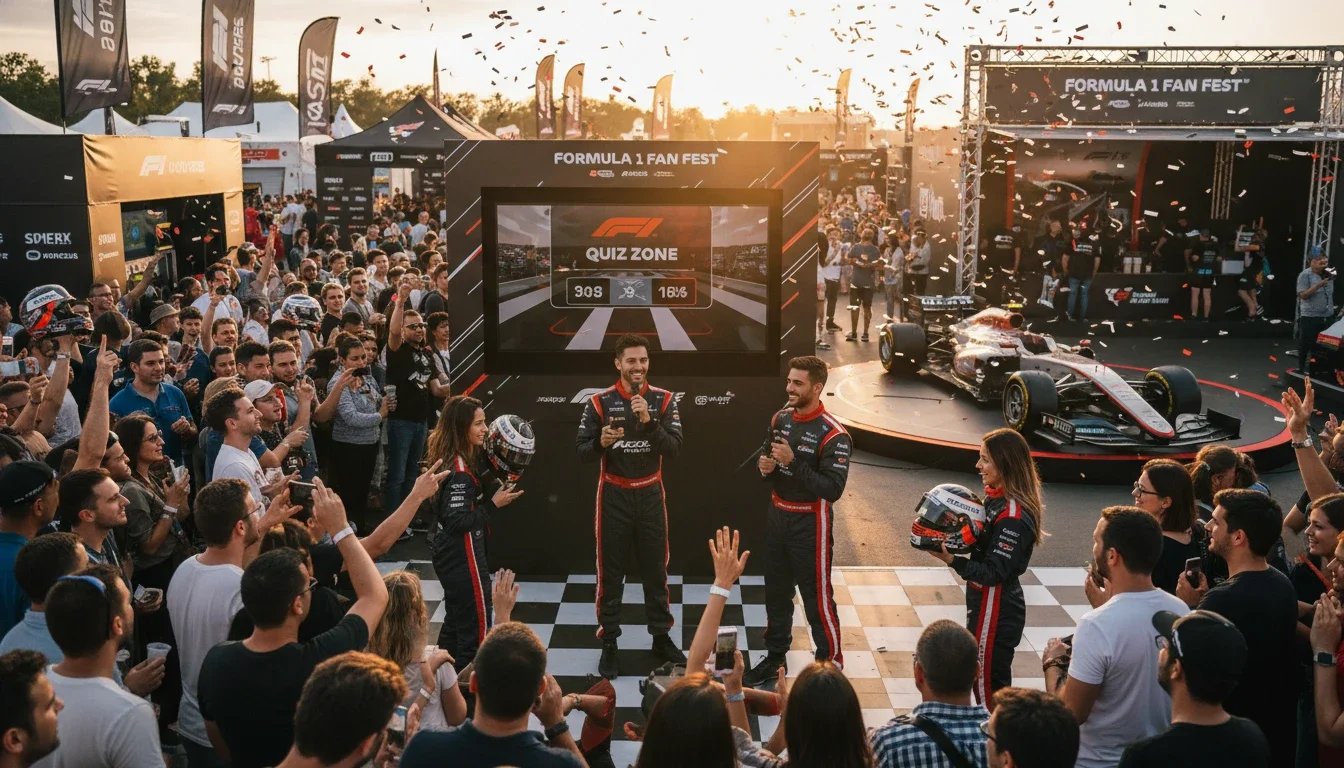
Brand ambassadors engaging fans at Formula 1 fan zone activation
Event Coordinators and Team Leads
Every Formula 1 brand activation beyond minimal scale requires designated team leads who manage on-site operations, coordinate with venue staff, handle real-time problem-solving, and serve as communication hubs between brand representatives and activation staff.
Team leads should come from your most experienced, capable event professionals. They arrive before general staff to conduct site walkthroughs, verify setup completion, and address any last-minute issues. During operational hours, they monitor team performance, manage break rotations, handle staff questions, and coordinate with venue operations on logistics. After shifts, they debrief teams and prepare reports for brand stakeholders.
The general guideline calls for 1 team lead per 8-12 event staff members. Activations with multiple distinct zones or complex operations may require team leads for each area. Very large activations spanning 50+ total staff members should include a senior coordinator who oversees multiple team leads and serves as the single point of contact for brand decision-makers.
Event coordinators working Formula 1 activations need specific capabilities beyond general event experience. They must understand F1 credential systems, communicate effectively with venue security and operations teams, think quickly when weather or crowd surges create unexpected challenges, and maintain composure when celebrities, athletes, or executives appear at the activation.
Calculating Your Staffing Requirements
Staffing Ratios by Activation Type
Determining the right team size for your Formula 1 brand activation requires considering multiple factors including activation footprint, expected attendance, engagement complexity, and service level goals. The ratios provided here represent industry benchmarks refined through hundreds of major sporting events and brand activations.
Product Sampling and Distribution Activations: These activations hand out samples, branded merchandise, or promotional items with relatively brief interactions. Staff needs scale to throughput capacity.
1 brand ambassador per 75-100 anticipated visitors per hour
Additional 1-2 staff members dedicated to inventory management and restocking
1 team lead per 8-10 brand ambassadors
Interactive Experience Activations: These involve longer engagement periods as guests participate in demonstrations, virtual reality experiences, photo opportunities, or educational content.
1 experience operator per station or experience unit
1-2 queue managers for popular experiences with wait times
1 brand ambassador per 50-60 anticipated visitors per hour for pre/post experience engagement
1 team lead per activation zone
VIP Hospitality Suites: Full-service premium hospitality with food, beverage, and guest services.
1 server per 12-15 guests for seated service
1 bartender per 50-75 guests for full cocktail service
1 suite coordinator per 75-100 guests
1 check-in coordinator per 200-300 expected guests during peak arrival
Additional event staff for coat check, valet coordination, or concierge services as needed
Trade Show Style Booths: Static displays with branded spaces for conversations, lead collection, or product information.
2-4 brand ambassadors per 10x10 booth space minimum
Add 1-2 brand ambassadors per additional 100 square feet
1 product specialist for technical products
1 team lead for booths with 6+ total staff
Pop-Up Retail or Merchandise Sales: Activations involving product sales transactions.
1 cashier/sales associate per register
2-3 floor staff for merchandise zones up to 500 square feet
Add 1 floor staff per additional 200 square feet
1-2 stock/inventory coordinators
1 team lead per 8-10 total retail staff
Off-Track Activations: Brand activations at nearby restaurants, hotels, entertainment venues, or street locations.
Base staffing same as activation type, but add 10-15% for coordination complexity
Consider additional team lead if off-track location is significant distance from primary activation
Space and Capacity Considerations
Physical footprint and expected crowd density significantly impact staffing requirements. A 400-square-foot activation in a high-traffic fan zone faces different demands than a 2,000-square-foot hospitality suite in a controlled-access area.
For open activations in fan zones or public areas, calculate expected visitors using venue foot traffic data when available. Miami International Autodrome fan zones see peak crowds of 50,000-70,000 during race day. Circuit of the Americas fan zones can exceed 100,000 on race day. Las Vegas Strip activations may encounter 200,000+ pedestrians during prime evening hours on race night. Your activation won't engage everyone passing by, but understanding total traffic helps estimate realistic interaction volumes.
Booth or activation footprint constraints also determine maximum staff capacity before you create crowding rather than solving it. A 10x20 booth space can physically accommodate 6-8 staff members at once, but only 4-5 while maintaining comfortable guest access. Larger activations with 1,000+ square feet of space can deploy teams of 15-20 without space constraints becoming the limiting factor.
Peak hour planning separates functional activations from overwhelmed ones. Formula 1 race days concentrate crowd flow during specific windows: pre-race (2 hours before start), post-qualifying sessions, and immediately post-race. Your staffing plan should account for these surges, either through shift overlaps that double coverage during peaks or strategic break scheduling that keeps maximum staff present when crowds hit.
Duration and Shift Planning
Formula 1 race weekends span three days (Friday practice, Saturday qualifying, Sunday race) though many activations operate Thursday through Sunday to capture early arrivals and post-race celebration. Daily operating hours vary by activation location and strategy, ranging from 8-hour race day coverage to 12-14 hour daily operations for activations capturing both daytime track action and evening entertainment.
Individual staff shift length should balance adequate coverage with performance and compliance considerations. Eight-hour shifts represent the industry standard for event work, providing full-day coverage without excessive fatigue. Some activations use 10-hour shifts to reduce staffing needs, but this requires careful break scheduling and may trigger overtime obligations depending on state labor law.
Staff rotation and break scheduling at Formula 1 events must account for both labor law compliance and operational continuity. Most jurisdictions require 10-15 minute paid breaks for every 4 hours worked and 30-minute unpaid meal breaks for shifts exceeding 6 hours. Your team lead should maintain a break rotation that never leaves positions unstaffed during operating hours.
Multi-day events create additional considerations. Using the same staff across all race weekend days ensures experienced teams but requires competitive daily rates and potentially increases no-show risk by day three. Some brands split teams, running A and B crews on alternating days to manage costs and maintain staff freshness. This approach works well for sampling or simpler activations but creates training and consistency challenges for complex operations.
Multi-Race Staffing Strategies
Option 1: Local Market Hiring for Each Race
Local market hiring means recruiting and deploying separate teams in Miami, Austin, and Las Vegas tailored to each specific Grand Prix. This approach offers distinct advantages for brands activating at multiple US Formula 1 events.
Cost efficiency ranks as the primary advantage of local hiring. Eliminating travel expenses, hotel accommodations, and per diem allowances for 10-40 staff members across three cities creates substantial savings. A brand ambassador earning $35/hour for an eight-hour shift costs $280 in direct wages, but adding roundtrip airfare ($400-600), three nights hotel ($450-750), and per diem ($150-300) can triple total cost per person. Multiply across your full team and multi-race campaigns, and local hiring may save $50,000-150,000 compared to traveling teams.
Local market knowledge provides another benefit. Miami staff understand the city's bilingual dynamics, traffic patterns, and cultural nuances that help them connect with diverse attendees. Austin teams know the city's music and creative culture that permeates F1 weekend. Las Vegas staff operate comfortably in the high-service-standard environment that casinos and entertainment venues demand.
However, local market hiring creates challenges that require active management. Training and brand consistency across three different teams demands standardized materials, procedures, and quality control. You'll conduct three separate training sessions, verify understanding three times, and potentially encounter three different interpretations of brand guidelines unless you build robust systems.
Quality variance represents another risk. Your Miami team might include several exceptional brand ambassadors who elevate the activation, while one or two weak performers in Austin create service gaps. With traveling teams, you identify and address performance issues once, then carry forward your best people. With local hiring, you're recruiting and evaluating anew for each market.
Successful local hiring at Formula 1 events requires partnering with experienced staffing agencies who maintain quality talent pools in multiple markets or building direct relationships with event professionals in Miami, Austin, and Las Vegas. The staffing partner should provide detailed training, conduct quality assurance checks, and maintain consistent standards across all three activations.
Option 2: Traveling Core Team + Local Support
Hybrid staffing models combine a traveling core team of key personnel with local market support staff for each Formula 1 event. This approach balances cost management with consistency and accumulated expertise.
The traveling core typically includes team leads, product specialists, complex role operators (bartenders for signature cocktail programs, experience technicians), and top-performing brand ambassadors from previous activations. This core team might represent 25-40% of total headcount. Local support staff fill general brand ambassador, registration, queue management, and basic hospitality roles.
This model delivers several strategic advantages. Your core team accumulates F1-specific knowledge across races, understanding what works, common challenges, and how to maximize impact. They build relationships with your brand team, understand guidelines deeply, and provide continuity. Meanwhile, local support staff bring market knowledge and cost efficiency for roles that don't require specialized expertise.
Operationally, the hybrid model works best when core and local team responsibilities are clearly defined. Core team members should handle guest-facing roles requiring product expertise, manage complex stations, supervise local support staff, and serve as escalation points. Local support handles volume roles like registration check-in, sampling distribution, queue management, and general guest services.
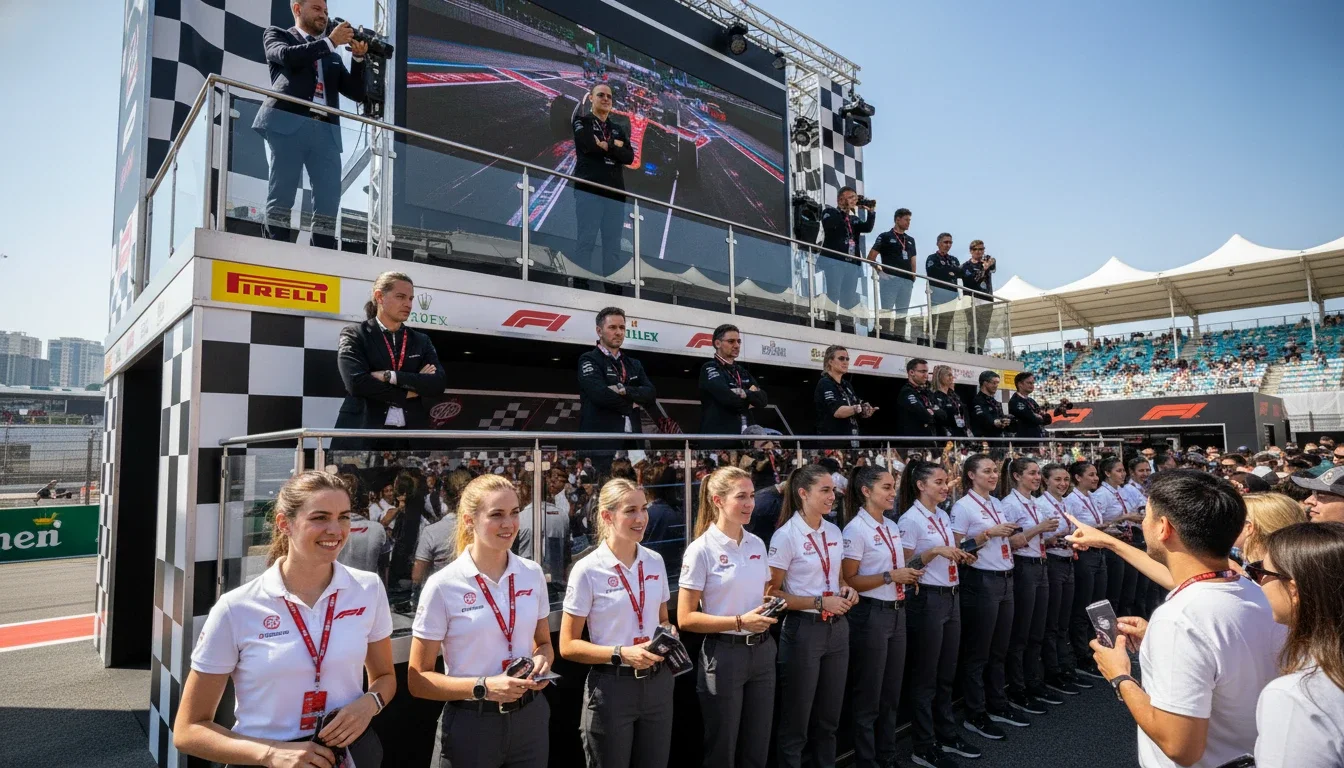
Multi-tiered event staff team at Formula 1 activation with supervisors and brand ambassadors
Cost analysis for hybrid models requires calculating both direct wages and travel expenses for core team members across three markets. A core team of 12 people traveling to Miami, Austin, and Las Vegas adds approximately $45,000-75,000 in airfare, hotels, and per diem across all three races. However, this investment buys consistency, leadership, and the accumulated expertise that can measurably improve activation performance by the third race.
Logistically, traveling core teams need advance planning for credential applications (which require staff names 6-8 weeks before events), travel coordination during busy race weekends when hotels sell out, and clear communication protocols between traveling and local team members who meet for the first time on-site.
Option 3: National Staffing Partner Coordination
Working with a single nationwide event staffing agency to coordinate all three Formula 1 Grand Prix activations represents the most streamlined approach for brands prioritizing consistency, simplified vendor management, and expertise-driven execution.
National agencies with multi-market capability, such as Eleven8 Event Staff, maintain vetted talent pools across major US cities including Miami, Austin, and Las Vegas. This infrastructure enables standardized recruitment, training, and quality control while still leveraging local market knowledge through each city's staff roster.
The primary advantage lies in simplified vendor management. Instead of negotiating separate agreements with three different local agencies, vetting their capabilities, and coordinating between multiple contacts, you work with a single partner who manages all logistics. This reduces administrative burden, ensures consistent contract terms, and provides unified reporting across all three races.
Quality assurance becomes more reliable when one agency owns outcomes across all three markets. If staffing shortfalls or performance issues occur in Miami, your agency partner has direct accountability and motivation to prevent recurrence in Austin and Las Vegas. The learning curve compresses as the agency refines its approach to your brand's specific needs across successive activations.
National staffing partners also provide more sophisticated risk mitigation. Their larger talent pools enable backup staffing if illness, no-shows, or last-minute scope changes affect headcount. Their cross-market relationships allow flexible resource deployment—for example, flying exceptional Miami performers to Las Vegas if local recruitment faces challenges.
However, national agency partnerships typically command premium pricing compared to direct local hiring. Agencies build margins into their rates to cover recruitment, vetting, training, insurance, and coordination overhead. For a 30-person team across three F1 races, total agency costs might run 20-35% higher than theoretically achievable through direct local hiring.
This premium buys meaningful value for brands that lack internal event operations expertise or staff bandwidth to manage recruitment and training across three markets. The ROI calculation should consider not just price differential but the cost of poor execution, the value of your team's time, and the risk mitigation that experienced agencies provide.
When evaluating potential national staffing partners for Formula 1 activations, prioritize agencies demonstrating proven F1 or major motorsport experience, the ability to deploy teams in all three US GP markets, comprehensive insurance coverage, established training programs, and 24/7 race weekend support.
Planning Timeline: 12 Months to Race Week
9-12 Months Before Race Week
Strategic planning for Formula 1 brand activations should begin nearly a year before race weekend. This timeline might seem excessive for a three-day event, but F1's credential requirements, limited vendor rosters, and competitive landscape demand early action.
During this initial phase, define your multi-race staffing strategy using the frameworks outlined earlier. Will you hire locally for each market, deploy a traveling core team, or partner with a national agency? This decision drives subsequent planning activities and budget allocation.
If pursuing the national agency route, begin vetting potential partners. Request proposals that demonstrate F1-specific experience, confirm availability in all three target markets, and outline their approach to multi-race consistency. Quality agencies book major sporting events 6-12 months in advance, so early engagement increases selection options.
For brands handling recruitment directly, this phase involves identifying potential team leads in each market. Team leads require more extensive vetting than general staff given their operational responsibility. Starting with team lead recruitment enables those individuals to participate in subsequent planning and training development.
Initial headcount estimates should emerge from this phase based on activation footprint, expected attendance, and engagement model. These estimates will be refined, but establishing planning ranges enables preliminary budget development and ensures adequate scope in vendor agreements.
6-9 Months Before Race Week
Six to nine months before Formula 1 race weekends, staffing moves from strategy to execution. This phase centers on formalizing relationships, developing detailed role definitions, and initiating recruitment for specialized positions.
Staffing agreements should be finalized during this window. Whether contracting with national agencies or local market partners, formalized agreements should specify headcount ranges, role categories, hourly rates, overtime provisions, cancellation terms, insurance requirements, and payment schedules. For brands working directly with freelance staff, individual contractor agreements should be templated and ready for execution.
Role definitions and job descriptions must provide enough detail for effective recruitment and training. Generic "brand ambassador" descriptions fail at Formula 1 events. Instead, specify "F1 brand ambassador—VIP hospitality suite" with requirements like "previous luxury hotel or fine dining service experience, knowledge of craft cocktails and wine service, comfortable engaging C-level executives and celebrities." Detailed descriptions improve recruitment quality and set clear performance expectations.
Training curriculum development belongs in this phase. What brand knowledge must staff demonstrate? What F1 protocols and venue rules will they follow? How should they handle common scenarios like media requests, credential questions, or difficult guests? Documenting training content now enables consistency across multiple markets and creates resources for team leads to reference.
For roles requiring official F1 venue credentials, the application process often begins 6-8 weeks before events. Credential applications require staff names, roles, zones needed, and sometimes background check information. Brands should work with their agency partners or venue contacts to understand credential timelines and requirements specific to each Grand Prix.
3-6 Months Before Race Week
The three-to-six-month window before Formula 1 race weekends represents the primary recruitment and selection phase for most activation teams. Quality talent books quickly for major events, making this timeline essential rather than merely recommended.
Active recruitment should launch during this period. Agencies begin circulating role descriptions to their talent pools, conducting interviews, and making preliminary selections. Brands hiring directly should post roles, screen candidates, conduct interviews, and make offers. For Formula 1 events, emphasize previous experience with premium hospitality, luxury brands, automotive events, or major sporting events in your selection criteria.
Pre-event training sessions should be scheduled and conducted 2-4 weeks before each race. Training for Formula 1 activations should cover brand background and key messaging, product knowledge for all items featured in the activation, F1-specific protocols and etiquette, venue layout and credential zones, uniform and appearance standards, emergency procedures and escalation protocols, and customer service scenarios specific to premium audiences.
Virtual training works effectively for knowledge transfer content, while in-person sessions before race weekends allow hands-on practice, team building, and logistics coordination. Hybrid models combining virtual brand/product training with in-person race week briefings balance efficiency with effectiveness.
Credential applications must be submitted during this window for most Formula 1 venues. Brands should collect all required information from staff who need venue credentials, submit applications through proper channels, and follow up to ensure approval. Credential denials or delays can undermine activations if discovered during race week.
1-3 Months Before Race Week
Final confirmation and detailed preparation dominate the one-to-three-month pre-race period. By this phase, major decisions are locked, and focus shifts to execution details and contingency planning.
Final headcount confirmation should occur 4-6 weeks before race weekends. Review your initial staffing estimates against updated activation designs, expected attendance, and experience from previous races (if applicable). Make final adjustments to team size, shift schedules, and role allocation.
Uniform and materials coordination becomes critical during this window. Custom branded apparel for staff requires 4-6 week lead times for design, production, and delivery. Standard uniform pieces (black pants, white shirts) should be specified and communicated to staff with adequate time for procurement. Some brands provide all uniform pieces; others specify standards and require staff to provide their own. Either approach works if clearly communicated.
Materials for activations—product samples, promotional items, branded collateral, signage, props—should be inventoried and staged for shipping to each venue. Build 10-15% overage into sample quantities to account for damage, higher-than-expected traffic, or last-minute requests.
Detailed briefing documents should be finalized and distributed to all staff 2-3 weeks before race weekends. Briefing documents should include activation objectives and brand messaging, detailed schedule with report times and locations, venue maps with credential zones highlighted, uniform requirements and inspection standards, contact information for team leads and brand representatives, FAQs addressing common questions, and emergency protocols.
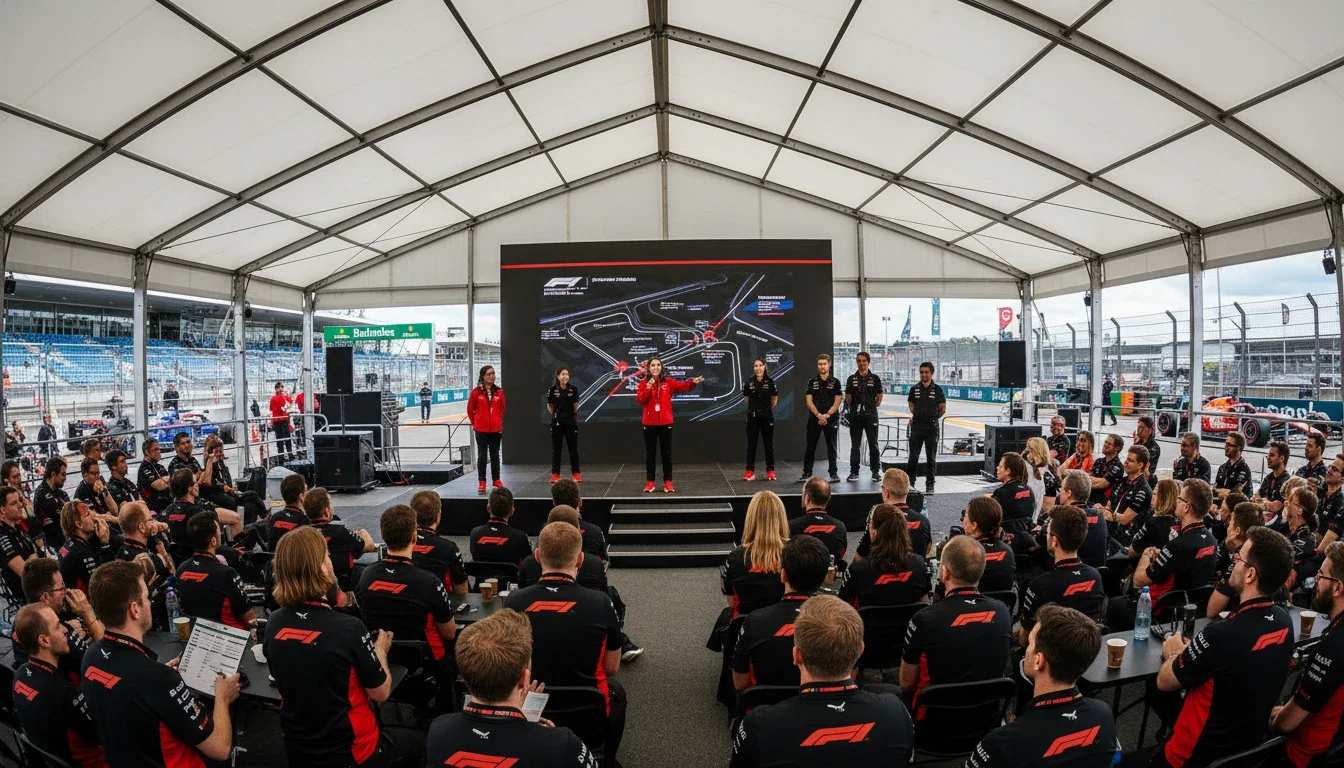
Event staff briefing session before Formula 1 Grand Prix activation
Race Week Execution
Race week transforms months of planning into live execution. The quality of your preparation determines how smoothly operations flow, but even meticulously planned activations require active management and real-time problem-solving.
Pre-event walkthroughs should occur before general staff arrival, ideally the day before activation launch. Team leads, brand representatives, and key personnel walk the physical space, verify setup completion, test equipment, review logistics, and identify any last-minute issues. This walkthrough provides the final opportunity to address problems before crowds arrive.
Daily check-ins and briefings become routine during race weekends. Morning briefings before each shift review the day's schedule, address any overnight changes, reinforce key messages, and energize teams. Mid-day check-ins allow team leads to gauge performance, identify issues, and make real-time adjustments to break schedules or position assignments. Evening debriefs capture lessons learned while they're fresh.
Real-time adjustments separate competent activations from exceptional ones. Weather changes, unexpected celebrity appearances, crowd surges, credential issues, staff illnesses—all require quick thinking and decisive action. Empower team leads with authority to make operational decisions without lengthy approval chains. Establish clear escalation protocols so significant issues reach appropriate decision-makers quickly.
Communication systems must function reliably during race weekends. Many brands use group messaging apps, walkie-talkies, or radio systems to coordinate across large activation footprints. Ensure all team leads and key staff have reliable communication tools and know how to use them before operations begin.
Attendance and time tracking requires attention even during busy race weekends. Accurate records prevent payment disputes, support labor law compliance, and provide data for post-event analysis. Many brands use simple mobile check-in systems where staff photograph a QR code when arriving and departing.
Post-Event Activities
Post-event activities often receive inadequate attention as teams celebrate successful execution or pivot to next projects, but systematic debriefs and reporting add value that compounds across multiple races.
Immediate debriefs should occur within 24-48 hours of activation conclusion while memories remain fresh. Gather team leads, key brand representatives, and selected staff for structured discussions covering what worked well, what fell short, specific incidents requiring attention, and recommendations for future events. Document these debriefs thoroughly.
Performance evaluations for staff inform future hiring decisions. Which team members exceeded expectations? Who would you not hire again? Which individuals should be considered for team lead roles at future events? Capturing these assessments immediately prevents relying on faulty memory when planning the next Formula 1 activation months later.
Data collection and reporting provide accountability and inform optimization. Compile metrics including total staff hours worked, total visitors engaged, leads or registrations collected, samples distributed, hospitality guests served, and any activation-specific KPIs. Compare actual staffing needs versus planning estimates to refine future calculations.
Financial reconciliation ensures accurate payment processing and budget tracking. Verify all staff hours worked, calculate payments including any overtime, review agency invoices against agreed rates, and process payments according to contract terms. Delays in payment harm your reputation and make recruiting more difficult for subsequent events.
Planning for next race begins immediately if you're activating at multiple Formula 1 events. Miami debrief insights inform Austin planning. Austin learnings optimize Las Vegas execution. This continuous improvement cycle transforms adequate activations into exceptional brand experiences by the third race.
Venue-Specific Logistics and Considerations
Miami International Autodrome Logistics
Miami International Autodrome's location at Hard Rock Stadium in Miami Gardens creates a campus environment with distinct access considerations. The venue sits roughly 15 miles north of downtown Miami and Miami Beach, where many brands execute off-track activations.
Access routes and parking for staff working Miami F1 activations require advance planning. The stadium offers dedicated staff parking, but access requires obtaining parking credentials weeks before the event. Many staff members use rideshare services, but race weekend brings surge pricing and limited driver availability. Smart brands coordinate staff transportation through shuttles or shared vehicles, especially for team members arriving from off-track activation sites.
Credential zones at Miami International Autodrome include general admission areas, Paddock Club, premium hospitality zones, and restricted team areas. Your staffing plan should clearly map which credentials each team member needs based on their assigned zones. Credential application deadlines typically fall 6-8 weeks before race weekend.
Local labor market considerations include Miami's strongly bilingual environment. Brands activating at Miami F1 should prioritize Spanish-speaking capabilities in staff recruitment, especially for public-facing brand ambassador roles. Miami's hospitality and events industry provides experienced professionals, but May timing creates competition with cruise line operations, spring festivals, and corporate events.
Weather contingencies matter in Miami. May brings warm temperatures (80-90°F) and afternoon thunderstorm potential. Outdoor activations need shade, hydration stations for staff, and rapid response plans if storms force temporary shutdowns. Indoor or covered activation spaces provide more predictable environments.
Circuit of the Americas (Austin) Logistics
Circuit of the Americas' purpose-built facility offers excellent infrastructure but sits approximately 15 miles southeast of downtown Austin. The campus layout spreads activation zones across significant distances, requiring staff to understand venue geography and allow adequate time for zone changes.
Access routes to COTA primarily rely on personal vehicles, though race weekend brings dedicated shuttle services from downtown Austin. Staff parking is available but requires advance coordination. The rural location means limited rideshare availability, making reliable transportation critical. Brands should confirm how staff will reach the venue and whether any transportation support is needed.
Austin staffing market considerations include competition with Austin City Limits Music Festival, which has historically occurred during F1 race weekend in October. This overlap tightens labor markets and increases rates for premium talent. Beginning recruitment 5-6 months in advance mitigates availability challenges.
Downtown Austin activations complement COTA presence for many brands. Austin's Sixth Street entertainment district, Rainey Street bar scene, and Warehouse District provide high-traffic locations for pop-ups, experiential activations, or hospitality events. Off-track activations in Austin allow brands to capture attendees during Thursday arrival, Friday evening after practice, and Sunday post-race celebrations.
October weather in Austin generally provides ideal activation conditions. Average high temperatures reach mid-80s°F with low humidity and minimal precipitation probability. Outdoor activations face few weather risks compared to Miami or winter events.
Las Vegas Strip Circuit Logistics
Las Vegas Strip Circuit's integration with casino resorts and entertainment venues creates unique logistics that differ fundamentally from traditional racing circuits. Brand activations can occur within casino properties, along the Strip pedestrian corridors, at the Las Vegas Convention Center, or at the permanent Grand Prix Plaza facility.
Strip road closures during race weekend dramatically affect access and traffic patterns. The circuit closes sections of Las Vegas Boulevard and surrounding streets during practice, qualifying, and race sessions. Staff working activations along the circuit must understand closure schedules and plan arrival before restricted access begins. Transportation during race weekend requires patience and flexibility.
Credential types and access in Las Vegas blend traditional F1 venue credentials with casino property access and city permit requirements. Activations on Strip sidewalks may require city permits. Casino resort activations need property approval and adherence to resort policies. Grand Prix Plaza credentials provide access to the permanent facility. Brands must coordinate multiple credential types depending on activation locations.
Las Vegas labor market provides the deepest pool of experienced hospitality and events professionals of the three US Grand Prix markets. However, November brings convention season competition, and Formula 1 week itself creates extraordinary demand. Staffing rates typically increase 15-25% above baseline during F1 week. Booking 6-8 months in advance secures talent before availability tightens.
November weather in Las Vegas brings comfortable daytime temperatures (60-70°F) but cooler evenings once the sun sets. Evening and night activations should provide staff with layers or light jackets. Occasional wind can affect outdoor setups but rarely disrupts operations.
Credentials, Access, and Compliance
Understanding F1 Credential Requirements
Formula 1 credential systems control access to different venue zones based on operational necessity and commercial rights. Understanding these systems prevents activation disruptions and ensures staff can perform their assigned roles.
Credential types vary by venue but generally include paddock credentials (restricted team areas), hospitality credentials (premium suites and lounges), media credentials (press areas and photo positions), and general admission credentials (fan zones and public areas). Each activation zone requires appropriate credentials for staff working within it.
Application timelines for F1 credentials typically require submissions 6-8 weeks before race weekends. Applications request staff names, roles, companies, zones needed, and sometimes supporting documentation. Late applications face rejection or delayed processing that can jeopardize activations.
Who qualifies for credentials depends on legitimate operational need. Staff directly involved in activation execution generally qualify. Personal assistants, observers, or guests typically don't. Venue organizers scrutinize credential requests to prevent abuse, so applications should justify why each person needs access.
Credential pickup procedures vary by venue. Some distribute credentials during race week at designated locations. Others mail credentials in advance. Brands should understand pickup logistics and communicate clearly with staff about when and where to collect credentials before their shifts begin.
Background Checks and Compliance
Background check requirements for Formula 1 event staff vary by venue, client requirements, and activation type. Understanding applicable standards ensures compliance and prevents last-minute disqualifications.
Standard background screening for major events typically includes criminal history checks at county and federal levels, sex offender registry searches, and social security number verification. Some venues or clients require additional screening like motor vehicle records checks (if driving is involved) or credit checks (for financial roles).
Market-specific regulations add complexity. Nevada requires gaming work cards for certain casino property activations. Some jurisdictions mandate specific safety training for staff working in particular environments. Brands should clarify all applicable requirements early in planning and factor screening time into recruitment schedules.
Insurance and liability considerations include general liability coverage protecting against third-party bodily injury or property damage claims, workers' compensation insurance covering staff medical costs and lost wages if injured while working, and liquor liability insurance if serving alcohol. Most Formula 1 venues require minimum coverage amounts verified before activations begin.
Brands working through professional staffing agencies generally benefit from the agency's master insurance policies. Direct hiring models require brands to secure appropriate coverage independently or verify that independent contractors carry their own policies.
Training and Brand Guidelines
Training requirements for Formula 1 event staff span brand-specific content, venue protocols, and safety procedures. Comprehensive training correlates directly with activation quality and risk mitigation.
F1 protocol training should cover credential usage and display requirements, restricted zone awareness and access rules, interaction protocols if encountering drivers or team members, media interaction guidelines (typically "no comment" unless specifically authorized), and photo/video policies in different venue zones.
Brand-specific requirements vary widely. Luxury brands often mandate appearance standards beyond typical event dress codes. Technology companies might require staff to complete product certification programs. Beverage brands serving alcohol need responsible service training and compliance with local laws.
Safety and emergency procedures round out training requirements. Staff should know emergency evacuation routes from activation locations, medical emergency protocols including location of first aid stations, incident reporting procedures for accidents or conflicts, severe weather responses, and escalation chains for different scenario types.
Training delivery can combine virtual sessions for knowledge transfer with in-person briefings immediately before race weekends for logistics review and team building. Hybrid approaches balance efficiency with effectiveness, especially for multi-race campaigns where core content remains consistent but venue-specific details change.
Budget Considerations for Multi-Race Staffing
Cost Factors by Market
Formula 1 staffing costs vary significantly across Miami, Austin, and Las Vegas based on local labor markets, cost of living, and event demand dynamics. Understanding these variations enables accurate budget forecasting for multi-race activations.
Base hourly rates for brand ambassadors typically range from $30-45/hour in Miami, $28-40/hour in Austin, and $35-50/hour in Las Vegas. These rates reflect standard event staffing during non-peak periods. Specialized roles command premiums: experienced bartenders earn $40-60/hour, product specialists might reach $50-70/hour, and team leads can command $60-85/hour depending on responsibility level.
Premium pricing during Formula 1 race weeks adds 10-25% to baseline rates across all three markets. Miami GP staffing typically sees 10-15% premiums given strong year-round event activity. Austin rates increase 15-20% during F1 weekend due to ACL Music Festival competition. Las Vegas experiences the steepest increases at 15-25% as F1 week stacks atop convention season demand.
Travel and accommodation costs affect traveling team budgets. Roundtrip airfare to Miami, Austin, or Las Vegas from major origin cities averages $400-600 per person. Hotel accommodations during race weekends range from $200-400 per night for standard properties to $500+ for locations near venues. Per diem for meals and incidentals typically adds $75-150 per person per day.
For a traveling core team of 15 people across all three F1 races, total travel costs approximate $65,000-95,000 when including airfare, three nights accommodation per race, and per diem. This substantial investment should be weighed against the consistency and expertise benefits discussed in multi-race strategy sections.
Hidden Costs to Plan For
Budget planning for Formula 1 staffing should account for several cost categories beyond base hourly wages that catch unprepared brands off-guard.
Credential fees may apply depending on venue and credential types. Some F1 venues charge per-credential fees for certain access levels. These fees might range from $50-250 per credential. For a 30-person team, credential costs could add $1,500-7,500 to total activation budgets.
Training time represents real costs even if not always budgeted as such. Pre-event training sessions lasting 2-4 hours should be compensated at standard hourly rates. For a 40-person team attending a 3-hour training at average $35/hour, training costs reach $4,200. Virtual training reduces or eliminates venue and travel costs but still incurs labor costs for staff time.
Uniform and materials costs vary based on brand standards. Custom branded apparel for 30 staff members might cost $50-150 per person ($1,500-4,500 total). Even brands requiring staff to provide their own standard uniforms should budget for inspection, accessories, or replacement pieces.
Contingency staffing reserves prevent activation failures when unexpected absences occur. Smart brands contract with agencies for 10-15% backup capacity, paying either retainer fees or simply maintaining on-call access to qualified replacements. Backup staffing might add 5-10% to total labor budgets but provides essential insurance.
Agency fees and markups apply when working with staffing partners. Agencies typically mark up base labor costs by 30-60% to cover recruitment, vetting, training, insurance, coordination, and profit margin. An agency quoting $45/hour for brand ambassadors might be paying those individuals $30-35/hour. While markup percentages appear substantial, they reflect real services provided and eliminate costs brands would otherwise incur directly.
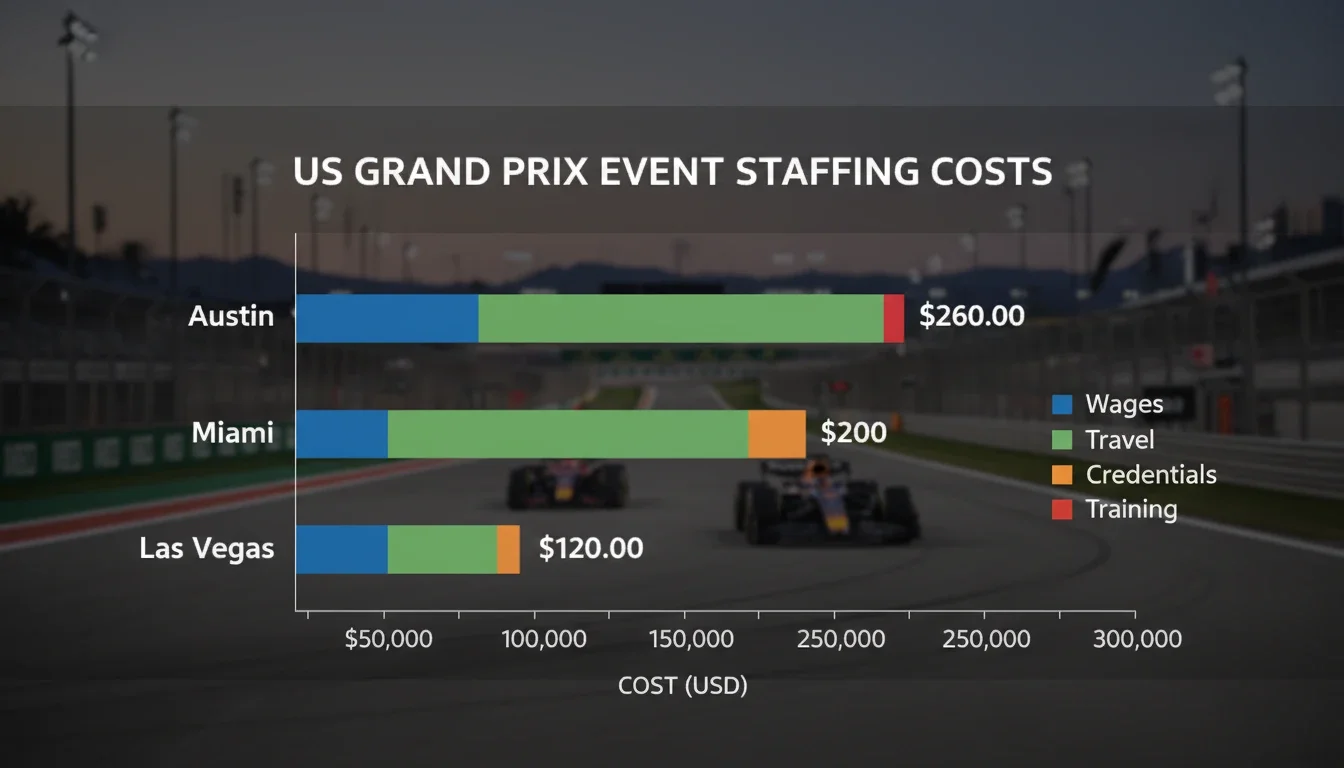
Bar chart comparing event staffing costs including wages, travel, credentials, and training across three US Grand Prix locations
Building Your Staffing Budget
Comprehensive staffing budget development for multi-race Formula 1 activations should follow a systematic framework that captures all cost categories.
Start with headcount and hours. Calculate total staff needed by role using ratios provided earlier in this guide. Multiply by hours per shift and number of shifts across race weekend. For example: 20 brand ambassadors × 10 hours per day × 3 days = 600 total brand ambassador hours.
Apply appropriate rates to each role category. Brand ambassadors at $40/hour average across three markets = $24,000 for 600 hours. Repeat for all roles: team leads, hospitality staff, specialists, coordinators.
Add premium multipliers for race week. If baseline calculations yield $80,000 total labor cost, applying an average 17.5% race week premium brings total to $94,000.
Layer in travel costs if using traveling teams. Calculate airfare, accommodations, and per diem for applicable staff members. For 15 traveling team members across three races: approximately $75,000-100,000.
Include credential fees based on venue requirements and team size. Budget $100-200 per person as a conservative estimate: $3,000-6,000 for a 30-person team.
Budget training time at standard hourly rates. Three-hour training for 30 people at $35/hour average = $3,150.
Add uniform and materials costs. Custom branded apparel averages $75-100 per person: $2,250-3,000 for 30 people.
Build in contingency reserves of 10-15% of total labor costs. This buffer addresses unforeseen overtime, additional headcount needs, or other labor-related adjustments.
Factor in agency fees if working with staffing partners. Add 30-50% to base labor calculations to approximate all-in agency costs.
Example total budget for multi-race F1 activation (30 total staff, 15 traveling core team):
Base labor (all roles, all races): $95,000
Race week premiums: +$16,625
Travel (15 people, 3 races): $85,000
Credentials: $4,500
Training: $3,500
Uniforms: $2,750
Contingency (10%): $20,738
Total: $228,113
This budget supports a mid-scale activation across all three US Grand Prix events. Larger or more complex activations will scale upward; leaner programs can reduce costs through local-only hiring and reduced headcount.
Quality Control and Performance Management
Pre-Event Preparation Standards
Quality control for Formula 1 event staff begins well before race weekends through rigorous preparation and verification processes.
Training completion verification ensures all staff meet knowledge standards before deployment. This might include written assessments testing brand and product knowledge, scenario-based evaluations where staff demonstrate proper responses to common situations, or certification programs for technical roles. Documented training completion creates accountability and identifies individuals needing additional preparation.
Brand knowledge testing can use simple quizzes covering key messaging points, product features, and common guest questions. Passing scores (typically 80-90%) should be required before staff receive credentials or shift assignments. This standard signals expectations and prevents underprepared individuals from representing your brand.
Appearance and uniform inspection occurs before staff access activation zones. Team leads should verify that all staff meet grooming standards, uniforms are clean and properly fitted, required accessories are present, and name tags or credentials are correctly displayed. This initial inspection sets tone and prevents appearance issues from undermining premium brand positioning.
Role-specific readiness varies by position but might include bar staff demonstrating cocktail recipes, product specialists explaining technical features accurately, or registration coordinators demonstrating check-in procedures. Hands-on verification exceeds theoretical knowledge assessment.
During-Event Management
Active performance management during Formula 1 race weekends ensures consistent quality and enables rapid course correction when issues emerge.
Team lead oversight represents the primary quality control mechanism during operations. Effective team leads circulate continuously, observe staff interactions, provide real-time coaching, recognize strong performance, and address deficiencies immediately. They balance supportive guidance with clear standards enforcement.
Real-time performance monitoring can include direct observation of guest interactions, guest feedback collection through brief intercepts or comment cards, mystery guest evaluations where designated individuals assess service quality, and photo/video documentation of activation in action.
Issue escalation protocols ensure problems receive appropriate attention without overwhelming team leads. Minor issues (uniform adjustments, simple questions, standard guest requests) should be resolved by front-line staff. Moderate issues (difficult guests, operational hiccups, supply shortages) escalate to team leads. Significant issues (safety concerns, media incidents, celebrity interactions, major operational failures) escalate to designated brand representatives.
Performance recognition during events boosts morale and reinforces desired behaviors. Simple acknowledgment of exceptional service, team lead shout-outs during briefings, or small rewards (gift cards, branded merchandise) for outstanding performance motivate staff and set standards for the full team.
Metrics and Reporting
Quantifiable measurement transforms event staffing from necessary expense into strategic investment by demonstrating value and informing optimization.
Interaction counts track volume of guest engagements. Simple tally systems where brand ambassadors count conversations, samples distributed, or demonstrations provided yield baseline metrics. More sophisticated tracking uses digital tools where staff log interactions via mobile apps. Target minimum interaction rates per staff hour provide performance benchmarks.
Lead generation tracking applies to activations with business development objectives. Staff should collect contact information, scan badges, or log qualified prospects using standardized criteria. Lead quality matters more than volume, so define qualification standards before events and measure conversion rates in post-event follow-up.
Guest satisfaction measurement can use brief intercept surveys where guests rate their activation experience, post-event email surveys to attendees who registered, social media monitoring for mentions and sentiment, or net promoter score questions incorporated into digital interactions.
Post-event debriefs should follow structured formats covering quantitative metrics (hours worked, interactions logged, leads collected, issues resolved), qualitative observations (what worked well, what needs improvement, specific incidents), and actionable recommendations for future events. Documented debriefs enable longitudinal improvement across multiple Formula 1 activations.
Staff performance evaluations inform future hiring decisions. Which team members exceeded expectations and should be prioritized for future events? Who performed adequately? Who should not be rehired? Capture these assessments immediately while performance is fresh in memory.
Contingency Planning and Risk Mitigation
Common Staffing Challenges at F1 Events
Formula 1 brand activations face predictable challenges that risk-aware planners prepare for in advance.
Last-minute cancellations occur despite best efforts. Staff call in sick, encounter family emergencies, or occasionally simply fail to appear. Planning should assume 5-10% no-show/cancellation rates for large teams. Backup staffing pools mitigate this risk.
Credential delays or denials can jeopardize operations if staff can't access assigned zones. Common causes include missed application deadlines, incomplete documentation, background check issues, or administrative errors. Submitting credentials well in advance and following up on status reduces risk. Backup staff with approved credentials provide insurance.
Weather disruptions affect outdoor activations. Miami brings thunderstorm potential. Las Vegas occasionally experiences high winds. While these events rarely force complete shutdowns, they create periods requiring adjusted operations. Covered contingency spaces, flexibility in programming, and clear weather monitoring protocols help teams adapt.
Unexpected crowd surges can overwhelm activations sized for predicted attendance. Viral social media posts, celebrity appearances, or simply inaccurate estimates create situations where demand exceeds capacity. Elastic staffing agreements with agencies providing rapid reinforcements offer solutions. Alternative activation formats (such as timed entry) can regulate flow.
Building Resilient Teams
Operational resilience comes from systematic preparation and resource redundancy, not hoping problems won't occur.
Backup staffing pools should be established before race weekends. Work with staffing agency partners to maintain on-call qualified individuals ready to deploy within 2-4 hours if needed. While backup staff command premium rates (often 25-50% above standard), their availability prevents catastrophic activation failures.
Cross-training strategies create internal flexibility. Train registration staff to handle sampling roles. Ensure multiple team members can operate interactive experiences. Cross-training enables rapid position shifts when absence or surges create imbalances.
Emergency communication plans define how teams receive critical updates and relay urgent information. Group messaging apps (WhatsApp, Slack) work well for non-urgent coordination. For emergencies, designated phone trees ensure rapid, reliable contact. All staff should know who to contact and how for different scenario types.
Decision-making authority must be clearly defined. Team leads need authority to make operational adjustments without awaiting approval. However, parameters should specify what decisions they can make independently versus situations requiring escalation. Clear authority prevents both paralysis and unauthorized actions.
Working with Professional Staffing Agencies
What to Look for in an F1 Staffing Partner
Selecting the right event staffing partner for Formula 1 activations significantly impacts execution quality, risk management, and overall experience.
Multi-market capability represents an essential requirement for brands activating at multiple US Grand Prix events. Agencies should maintain talent pools in Miami, Austin, and Las Vegas with demonstrated ability to deploy quality teams in each market. Request case studies or references from previous multi-city sporting or entertainment events.
F1-specific experience separates general event agencies from true motorsport specialists. Agencies with Formula 1 track records understand credential systems, premium service expectations, compressed timelines, and venue-specific logistics. They've solved the problems first-time F1 activations encounter and can proactively prevent issues.
Quality vetting processes ensure agencies deliver talent that meets your standards. Inquire about recruitment criteria, interview processes, background screening, and acceptance rates. Agencies claiming to accept only top 3-5% of applicants (like Eleven8's 3.5% acceptance standard) demonstrate commitment to quality over volume.
24/7 support availability during race weekends provides essential insurance. Issues don't respect business hours. Agencies should provide dedicated contacts reachable at any time during F1 operations. Ask specifically about after-hours support protocols and response time commitments.
Comprehensive insurance coverage protects against liability. Verify that agencies carry general liability insurance ($1-2 million minimum), workers' compensation coverage in all relevant states, and appropriate umbrella policies. Request certificates of insurance naming your organization as additional insured.
Key Questions to Ask Potential Partners
Thorough vetting requires asking specific questions that reveal capabilities, experience, and operational approaches:
What Formula 1 or major motorsport events have you previously staffed? Request specific examples with scope, team sizes, and client references.
How do you maintain quality standards across multiple markets? Understanding their multi-market coordination processes reveals operational maturity.
What is your staff recruitment and vetting process? Learn about screening criteria, interview approaches, and acceptance rates to gauge quality focus.
What percentage of your staff have previous Formula 1 or premium sporting event experience? High percentages reduce training requirements and operational risk.
How far in advance should we book your services for Formula 1 events? This reveals demand for their services and appropriate planning timelines.
What training do you provide to staff before deployment? Comprehensive training programs indicate professional operations.
What backup staffing capacity do you maintain? Understanding their contingency resources reveals risk management sophistication.
What reporting do you provide during and after events? Detailed reporting enables performance tracking and continuous improvement.
How do you handle credential applications and management? F1-specific credential knowledge is essential.
What are your payment terms and cancellation policies? Understanding financial terms prevents surprises.
Can you provide references from previous Formula 1 or comparable events? Direct reference conversations reveal true capability beyond marketing claims.
What distinguishes your agency from competitors? This open-ended question reveals how they position themselves and what they prioritize.
How Eleven8 Supports Formula 1 Brand Activations
Eleven8 Event Staff brings over 30 years of major event experience and nationwide reach to Formula 1 brand activations across Miami, Austin, and Las Vegas. The company's track record includes staffing for Olympic events, Super Bowl activations, major convention floors, and premium sporting venues including SoFi Stadium.
The agency's selective recruitment process accepts only the top 3.5% of applicants, ensuring brands work with proven professionals rather than general labor pools. This high selectivity combines with market-specific expertise in Los Angeles, Las Vegas, Miami, Austin, and other major US markets where Formula 1 activations occur.
Eleven8 provides comprehensive services spanning brand ambassadors and promotional models, VIP hospitality staff including bartenders and servers, event coordination and team lead services, registration and guest management teams, and specialized roles from product specialists to celebrity handlers.
The company's multi-market infrastructure enables single-point coordination across all three US Grand Prix events, standardizing quality while leveraging local market knowledge. Brands benefit from simplified vendor management, consistent training and standards, unified reporting, and accumulated Formula 1 expertise that compounds across races.
Round-the-clock availability during race weekends provides essential support when unexpected challenges emerge. Eleven8's team remains reachable 24/7 throughout event operations, enabling rapid response to staffing issues, last-minute scope changes, or operational questions.
For brands planning Formula 1 brand activations in Miami, Austin, Las Vegas, or all three markets, Eleven8 offers proven capability, nationwide reach, and the premium service standards that motorsport's pinnacle demands. Contact Eleven8 at hello@elev8.la or visitelev8.la to discuss your Formula 1 staffing needs.
Case Study: Coordinating Multi-Race F1 Activations
Planning Phase
A premium automotive technology brand planned experiential activations at all three 2024 US Formula 1 Grand Prix events to showcase new driver assistance features. The activation strategy centered on interactive driving simulators where guests experienced the technology firsthand, supported by brand ambassadors explaining features and collecting qualified leads.
Initial planning began 10 months before the Miami Grand Prix, with the brand partnering with a national event staffing agency experienced in automotive and motorsport events. Early planning enabled comprehensive role definition, detailed training curriculum development, and advance credential applications for all three venues.
The staffing strategy employed a hybrid model with 12 traveling core team members (2 team leads, 4 simulator technicians, 6 lead brand ambassadors) supplemented by local brand ambassadors and hospitality staff in each market. This approach balanced consistency from the experienced core team with cost efficiency from local hiring for volume roles.
Total team size varied by market based on activation footprint and expected traffic: Miami deployed 35 total staff, Austin required 42 given higher attendance, and Las Vegas utilized 38 staff across Strip activations and convention center presence.
Execution Across Three Markets
Miami Grand Prix activation in May launched the campaign with an off-track location in Wynwood near the Design District. The activation attracted strong traffic from affluent, design-conscious attendees exploring Miami during race week. Bilingual staff capabilities proved essential, with approximately 40% of interactions conducted in Spanish.
A mid-activation challenge emerged when one simulator experienced technical issues. The traveling technician team quickly diagnosed and resolved the problem, but the incident highlighted the value of specialized technical staff who could troubleshoot under pressure. Local brand ambassadors lacked the expertise to address the issue independently.
Austin activation in October operated both at Circuit of the Americas and a downtown location on Rainey Street. The dual-location strategy captured both trackside attendees and downtown entertainment crowds. October timing and Austin's outdoor culture enabled extended operating hours and strong evening traffic.
Coordination between the traveling core team (who worked both locations) and local support staff (who covered single shifts at one location) required clear communication and detailed briefing materials. The two team leads divided responsibilities between COTA and downtown, maintaining quality across both sites.
Las Vegas activation in November represented the campaign's culmination, with lessons learned from Miami and Austin informing optimization. The activation occupied a premier Strip location near major casino properties, benefiting from extraordinary foot traffic during F1 week.
Las Vegas staffing faced the tightest labor market of the three races despite the city's deep talent pool. Race week competition drove 20% rate premiums, but the investment secured experienced hospitality professionals who enhanced guest experience significantly. The activation's proximity to high-end casino operations meant many staff brought luxury service backgrounds exceeding typical event standards.
Results and Key Learnings
Across all three Formula 1 Grand Prix activations, the campaign generated 12,847 total guest interactions, collected 3,216 qualified leads, and achieved 87% guest satisfaction ratings from post-interaction surveys. The traveling core team model delivered 23% higher guest satisfaction in Las Vegas compared to Miami, demonstrating how accumulated expertise improved performance.
Key learnings from the multi-race campaign:
Start earlier than seems necessary. Credential applications, specialized staff recruitment, and training development all benefit from extended timelines. The 10-month advance planning enabled smooth execution.
Invest in core team travel despite costs. The consistency, expertise accumulation, and technical capability of the traveling core team justified travel expenses. Simulator technical issues in Miami would have created major disruption without specialist technicians present.
Local market staffing requires robust systems. Training materials, briefing documents, and quality standards must be exceptionally clear when working with new team members at each race. What traveling teams learn through osmosis must be explicitly communicated to local staff.
Market characteristics dramatically differ. Miami's bilingual requirements, Austin's music festival competition, and Las Vegas's premium service expectations each demanded market-specific adjustments. Generic one-size-fits-all approaches underperform.
Credential management is mission-critical. Early submission prevented issues, but the complexity of coordinating credentials for 35-42 staff members across three venues required dedicated attention. Assign specific responsibility for credential tracking.
Budget 15-25% contingency. Despite careful planning, unexpected costs emerged including rush uniform shipping, premium overtime rates during unexpected crowd surges, and last-minute credential fees. Financial flexibility prevented compromises.
The brand has committed to expanded Formula 1 activations in 2025, planning presence at Miami, Austin, Las Vegas, and potentially international races, demonstrating the program's success and the value of the systematic approach to multi-race staffing.
Conclusion
Staffing brand activations across all three US Formula 1 Grand Prix events represents a significant operational undertaking that rewards systematic planning, market-specific expertise, and attention to execution details. The compressed intensity of race weekends, premium audience expectations, and complex credential systems demand specialized approaches beyond typical event staffing.
Success requires early action—beginning planning 9-12 months before race weekends, securing staffing partnerships 6-8 months in advance, and completing recruitment and training well before credential deadlines. The multi-race coordination strategies outlined in this guide—local market hiring, traveling core teams, or national agency partnerships—each offer distinct advantages depending on brand priorities and resources.
Understanding the unique characteristics of Miami International Autodrome, Circuit of the Americas in Austin, and Las Vegas Strip Circuit enables market-specific optimization. Miami's bilingual dynamics, Austin's music festival culture, and Las Vegas's premium hospitality expectations each require tailored approaches that generic strategies miss.
Working with experienced event staffing partners like Eleven8 Event Staff provides access to vetted talent pools, proven Formula 1 expertise, and the operational infrastructure that multi-market activations demand. The investment in quality staffing pays dividends through consistent brand representation, professional guest experiences, and the performance metrics that justify activation ROI.
Formula 1's explosive growth in the United States creates unprecedented opportunities for brands to activate at the intersection of luxury, performance, and global culture. The brands that capitalize on this opportunity are those who recognize that exceptional staffing transforms good ideas into exceptional executions. Your activation concept, creative production, and media investment all depend on the event staff who bring everything to life during race weekends.
Ready to staff your Formula 1 brand activations across Miami, Austin, and Las Vegas? Contact Eleven8 Event Staff at hello@elev8.la or visit elev8.la to discuss your multi-race staffing strategy.