Indoor January Activations: Why the PA Farm Show Beats Summer Fairs for Some Brands
Most brand activation calendars look exactly the same. Summer state fairs. Outdoor music festivals. Fall tailgates. And then a quiet stretch from January through March, where brands go dark and wait for warmer weather.
That gap is an opportunity — and the Pennsylvania Farm Show in Harrisburg is one of the most underutilized brand activation venues in the eastern United States.
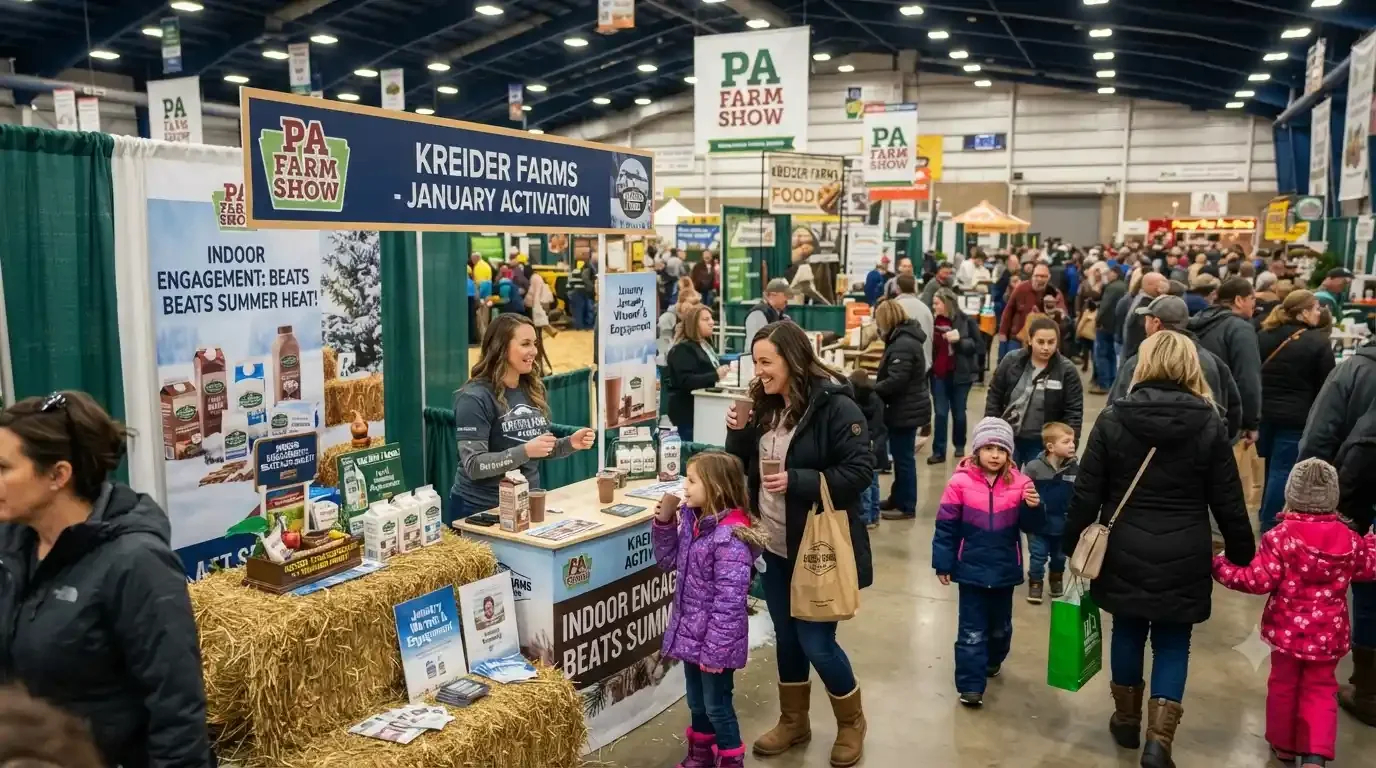
Every January, more than half a million people walk through the doors of the PA Farm Show Complex & Expo Center. They come for the butter sculpture, the farm animals, the food court, and the competitions. They stay for hours. They come back the next day. And unlike a summer fair, they are not distracted by the heat, the mud, the noise, or a dozen competing activations happening fifty yards away.
For brands that sell food products, agricultural equipment, family goods, outdoor gear, nutrition, or lifestyle products — and for any brand looking to reach Pennsylvania's working and farming communities — the PA Farm Show deserves serious consideration alongside, or even ahead of, the summer outdoor circuit.
This article breaks down exactly why indoor January events like the PA Farm Show offer a distinct strategic advantage for certain brands, how the activation experience differs from summer fairs in ways that matter, and what it takes to staff and execute an indoor fair activation effectively.
Why the PA Farm Show Beats Summer Fairs for Some Brands
What Is the Pennsylvania Farm Show?
The Largest Indoor Agricultural Expo in the United States
The Pennsylvania Farm Show has been running continuously for over a century, making it one of the oldest and most established agricultural events in the country. Held every January at the PA Farm Show Complex & Expo Center at 2300 North Cameron Street in Harrisburg, the event runs for eight full days and draws an attendance that consistently exceeds 500,000 visitors.
The complex itself spans more than one million square feet under a single roof — making it the largest indoor agricultural exposition in the United States. That scale matters for brands. This is not a regional county fair inside a converted barn. It is a purpose-built facility capable of hosting thousands of animals, hundreds of commercial exhibitors, live cooking demonstrations, competitive events, and large consumer attractions simultaneously.
General admission is free, which dramatically lowers the barrier to entry for attendees and contributes directly to the show's massive foot traffic.
Who Attends — and Why It Matters for Brands
The PA Farm Show audience is a deliberate mix of Pennsylvania's agricultural community, rural and suburban families, urban food enthusiasts, and curious day-trippers from Philadelphia, Pittsburgh, and the mid-Atlantic region. The show attracts everyone from fourth-generation farmers comparing equipment to first-time visitors drawn in by social media coverage of the famous milkshake stand and butter sculpture.
More than 250 commercial exhibitors participate each year, sharing floor space with agricultural organizations, state agencies, and educational exhibits. That means the commercial exhibitor environment is competitive but curated — attendees expect to engage with brands and discover products. The buying mindset is present.
From a demographic standpoint, PA Farm Show audiences index strongly for household decision-makers, rural and suburban homeowners, food-conscious consumers, and community-engaged adults — profiles that map well to a broad range of brand categories.
The Indoor Advantage — What Changes When You Move the Activation Inside
No Weather Variables. No Tent Fees. No Wilting Brand Staff.
Outdoor brand activations carry a long list of operational risks that indoor events simply do not. Rain contingency plans. Heat management for staff and sampling product. Generator costs for lighting and power. Canopy and tent rental. Permits for outdoor structures. And the very real possibility that a weather event turns a high-investment activation into a logistical disaster.
At an indoor event like the PA Farm Show, those variables disappear. The facility is climate-controlled. Your brand displays functions exactly as designed. Your product samples arrive and stay in the condition you intended. And your brand ambassadors show up energized — not exhausted from managing in the heat before the first attendee even walks by.
That operational simplicity often goes unquantified in brand activation planning, but it represents real cost and risk reduction.
Dwell Time Is Higher Indoors
Research consistently shows that attendees who spend more time at an activation are more likely to retain brand messaging and take post-event action. Dwell time — the amount of time an individual spends in proximity to your brand experience — is one of the most predictive metrics for activation effectiveness.
Indoor events drive higher dwell time for a straightforward reason: attendees are not competing with outdoor discomforts. At a summer outdoor fair, the combination of heat, direct sunlight, and physical fatigue encourages fast movement between shaded rest stops. At an indoor event in January, the environment is comfortable, contained, and designed to be experienced at a slower pace. Visitors browse. They compare. They return to the booths they found interesting. They bring their whole family because there is genuinely something for everyone to see.
The PA Farm Show, with its eight-day run and full programming slate, attracts significant numbers of repeat visitors — people who come back multiple times over the course of the week. For brands with a physical exhibit presence, this creates repeat exposure opportunities that a single-day summer fair simply cannot match.
A Captive Audience with Nowhere to Rush
The psychology of an indoor agricultural show attendance is fundamentally different from that of an outdoor festival. Attendees at the PA Farm Show have made an intentional trip to Harrisburg. They have parked, entered a massive facility, and are there with the expectation of spending several hours. They are not passing through on the way somewhere else.
That intentionality makes them more receptive to brand engagement. They will stop at a demonstration. They will try a sample. They will talk to a brand ambassador. The staff-led interaction model — where trained personnel initiate conversations, guide product experiences, and collect lead information — performs exceptionally well in this environment precisely because attendees are open to it.
Why January Is Actually a Strategic Window for Brand Activations
Less Brand Competition in the Activation Calendar
The experiential marketing calendar crowds dramatically in spring and summer. Coachella. State fairs across the country. Music festivals. Outdoor sports events. Pride events. Food and wine festivals. Every brand with an outdoor activation budget is competing for attention at roughly the same time of year.
January is different. The post-holiday lull clears the calendar of most competing activations, which means brands that do show up in January earn a disproportionate share of audience attention. At indoor events like the PA Farm Show, commercial exhibitors are specifically chosen for relevance to the audience — so there are hundreds of exhibitors competing, but the total activation noise is significantly lower than a summer festival environment where everyone is vying for the same walking-by eyeballs.
Post-Holiday Audiences Are Receptive and Refreshed
There is a meaningful psychological shift in consumer behavior in January. The holiday spending season is behind them. New Year's resolutions are active. People are thinking about food quality, home improvement, outdoor living, and what they want for the year ahead. That mindset aligns naturally with the product categories that perform well at agricultural fairs — food and beverage, agriculture-adjacent products, family goods, and lifestyle brands.
Consumers who attend a January event have deliberately chosen to get out of the house and engage with their community during what is otherwise a month of low social activity. That choice signals openness and engagement that marketers should not underestimate.
Budget Efficiency Early in the Fiscal Year
Many brand marketing budgets are reset in January. Activating early in the fiscal year allows brands to establish market presence, gather consumer feedback, and calibrate sampling and messaging before peak season — when the same reach costs significantly more to achieve. The PA Farm Show's free admission also means exhibitors are not sharing foot traffic costs with steep entry fees that might suppress overall attendance.
PA Farm Show vs. Summer State Fairs — The Brand Activation Comparison
Audience Profile and Consumer Mindset
Summer state fair audiences are large, diverse, and often in a festive, fast-moving mindset. They are at the fair for entertainment — rides, concerts, fried food — and brand activations compete with those primary motivations. The audience is broad but distracted.
PA Farm Show audiences come specifically for the agricultural and food programming. They are community-focused, family-oriented, and intentionally seeking out exhibits and demonstrations. That specificity is a feature, not a limitation, for brands whose products align with the audience's interests.
Engagement Conditions: Indoors vs. Outdoors
The contrast in physical conditions shapes everything about how a brand activation runs. Outdoor summer fairs require defensive planning — shade structures, hydration for staff, contingency plans for rain, power solutions, and continuous vigilance over product integrity in high heat. Indoor events allow offensive planning — all energy goes into optimizing the brand experience itself rather than managing environmental variables.
Staff performance is also directly affected. Brand ambassadors and product demonstrators working an eight-hour shift outdoors in summer heat face real physical challenges that affect their energy, engagement quality, and consistency. Indoors in January, those challenges largely disappear, and the quality of every consumer interaction reflects that.
Foot Traffic Quality Over Quantity
The largest summer state fairs in the US can draw a million or more visitors. The PA Farm Show draws approximately half that. But raw attendance numbers do not tell the full activation story. Engagement rate, dwell time, and audience intent are more predictive of brand activation ROI than gate count alone.
A visitor who stops at your demonstration booth, engages with a brand ambassador for four minutes, tries a sample, and leaves with a product card has more activation value than twenty people who walk past your outdoor tent without breaking stride. The PA Farm Show's indoor environment, combined with its specific audience intent, consistently produces higher-quality engagement per visitor.
Which Brands Win at the PA Farm Show?
Brands that perform well at the PA Farm Show tend to share common characteristics: they offer something that connects to agriculture, food, family, or rural/suburban life; they have a demonstrable product or experience to offer rather than just passive signage; and they staff their exhibit with trained personnel who can initiate conversations, guide demos, and communicate brand value clearly.
Specific categories that activate effectively include food and beverage brands (especially those with Pennsylvania roots or farm-to-table messaging), agricultural equipment and technology companies, outdoor and sporting goods brands, home and garden products, nutrition and health brands, and financial services companies targeting farming households. Out-of-state companies are permitted to exhibit as well, with placement in the New Holland Arena or through the Friends of the PA Farm Show Foundation.
What a Brand Activation at the PA Farm Show Actually Looks Like
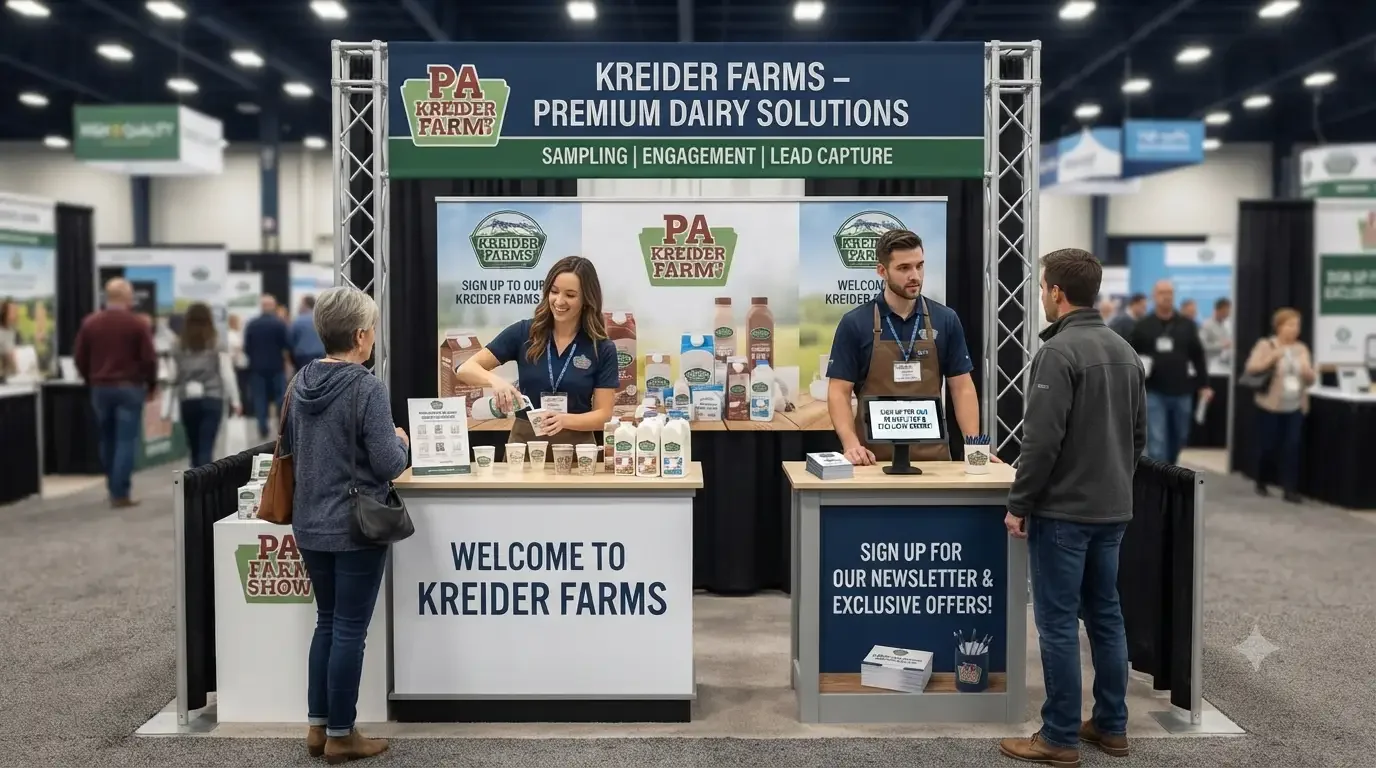
From sampling to lead capture, indoor fair activations benefit from structured booth setups and trained staff
Exhibit Hall Presence and Product Demonstrations
Commercial exhibitors at the PA Farm Show operate within the GIANT Expo Hall and surrounding arena spaces. Booth setups range from small branded kiosks to full-scale exhibit installations with demonstration areas, interactive components, and dedicated staff zones. Unlike a trade show where attendees are industry professionals, the PA Farm Show audience is a general consumer, which means display design and staff approach need to prioritize accessibility, speed of engagement, and memorable moments over technical depth.
Product demonstrations are among the highest-performing activation formats in this environment. Live demos give staff a reason to initiate conversation naturally, give attendees a reason to stop, and create visible activity that draws additional foot traffic from passersby.
Sampling, Storytelling, and Audience Interaction
Food and beverage brands have an obvious advantage at an event anchored by an expansive food court and a culture of tasting and discovery. But sampling works beyond the obvious categories. Non-food brands that offer tactile, sensory, or experiential demonstrations — skincare, cleaning products, agricultural tools, wearables — can deploy the same sampling model with equivalent effectiveness.
The storytelling layer matters as much as the sample. Attendees at the PA Farm Show respond to authenticity, local connection, and clear value propositions. A brand ambassador who can explain where a product comes from, what problem it solves, and why it matters to this specific audience will consistently outperform a passive display with the same product.
Lead Capture and Data Collection
Indoor agricultural fairs are underutilized lead-generation environments. Unlike a retail pop-up or trade show where lead capture is an expected part of the interaction, fair activations can feel more informal — which, counterintuitively, can make audiences more willing to share contact information when the ask is framed correctly.
Brands that come prepared with a simple, incentivized lead capture mechanism — a giveaway entry, a free sample subscription, a consultation sign-up — consistently leave with more qualified consumer data than brands relying on passive traffic and hope. Trained brand ambassadors who can deliver the ask conversationally, without pressure, are essential to making this work.
Staffing an Indoor Fair Activation — What You Actually Need
Brand Ambassadors vs. Product Demonstrators
Not all event staff roles serve the same function at an indoor fair activation. Brand ambassadors focus on audience engagement — initiating conversations, distributing materials, answering questions, and representing the brand's personality. Product demonstrators are more specialized, guiding attendees through a specific product experience or demonstration sequence.
Most indoor fair activations benefit from a combination of both. A demonstration station needs at least one dedicated demonstrator to run the experience consistently. The surrounding foot traffic is best captured by brand ambassadors who can pull interested passersby into the demo funnel.
For a standard eight-day run like the PA Farm Show, shift planning and staff coverage are critical. No single team can sustain peak performance across an eight-day event without structured rotation. Working with an experienced staffing agency means your activation runs at full strength on day eight, the same way it did on day one.
Registration and Check-In Support
Larger exhibitor footprints — particularly those with scheduled demonstrations, VIP experiences, or structured programming — benefit from dedicated registration and check-in staff. This role manages the flow of attendees into a demonstration or experience, gathers contact information for lead capture, distributes materials in sequence, and ensures the brand experience runs smoothly from entry to exit.
Registration staff is often the first point of human contact a visitor has with your brand at the booth. That first impression — the greeting, the warmth, the clarity of direction — shapes everything that follows.
On-Site Supervision and Operations Management
Multi-day indoor fair activations require on-site supervision that goes beyond what a single brand ambassador can provide. A lead or captain role — a senior staff member who manages the team, troubleshoots logistics, enforces brand standards, and communicates with the client in real time — is essential for activations running more than two or three days.
This is especially true for the PA Farm Show's eight-day format. Without consistent on-site oversight, the quality of consumer interactions and brand representation can drift significantly as the event progresses and fatigue sets in.
How Eleven8 Supports Indoor Activation Events Like the PA Farm Show
Eleven8 Event Staff has staffed more than 34,000 events across 36 cities nationwide, including the Philadelphia and Pittsburgh markets that serve as the primary feeder regions for the PA Farm Show in Harrisburg. With 35 years of operational experience and a roster of over 24,000 active, vetted staff members, Eleven8 brings specific capabilities that matter for indoor fair activations.
Our brand ambassadors are trained not just to be friendly, but to initiate, guide, and convert audience interactions. Our product demonstrators are matched to your product category and trained on your specific demo sequence before day one. Our registration and check-in staff manage attendee flow and lead capture with precision. And our built-in captain and supervision structure ensures your activation runs at the same quality on the final day of an eight-day event as it did at the opening.
Every Eleven8 booking includes a dedicated account manager from first inquiry through post-event recap, a briefed backup for every eight staff members, and 24/7 support on event day. For multi-day activations like the PA Farm Show, that operational continuity is not a luxury — it is the difference between an activation that holds its standard and one that quietly falls apart by day four.
If you are planning an indoor fair activation in Pennsylvania or anywhere in the eastern United States, our Philadelphia and Pittsburgh staffing teams are positioned to deploy quickly and at scale.
Explore our expo staff services, brand ambassador staffing, and trade show staff to find the right team for your activation.
How to Plan Your PA Farm Show Brand Activation in Advance
Timeline and Exhibitor Application Process
The PA Farm Show's commercial exhibitor process is competitive and structured. More than 250 commercial exhibitors participate each year, and prospective exhibitors must apply online through the official PA Farm Show exhibitor portal. Current exhibitors receive an expression of interest form following each show, while new applicants must submit during the open application window. Out-of-state companies face additional placement restrictions but are not excluded.
Planning for the PA Farm Show should begin at least six to nine months before the January show dates to allow time for exhibitor application, exhibit design, product logistics, staffing coordination, and pre-show promotional planning.
Logistics Checklist for Indoor Fair Activations
Brands preparing for an indoor agricultural fair activation should address the following areas well ahead of show week:
Exhibitor application and space confirmation
Booth design, setup, and teardown logistics
Product inventory planning and safe storage during the multi-day run
Staffing: roles needed per day, shift schedules, and backup coverage
Brand ambassador and demonstrator briefing materials
Lead capture mechanism: technology, forms, or incentive-driven sign-ups
Branded uniform and appearance standards for all staff
On-site supervision structure and point of contact escalation chain
Post-event reporting: lead data compilation, staff performance review, brand impression estimates
The PA Farm Show runs eight full days, which means most of these logistics need to be confirmed and locked well before setup day. Last-minute staffing fills are riskier at a multi-day event than a single-day activation — every unfilled shift is a full day of missed brand exposure at scale.