Why Springfield Outperforms Chicago for Certain B2C Activations

Brand ambassador engaging consumers at a Midwest pop-up activation
Every brand manager doing experiential marketing in Illinois defaults to Chicago. It's the third-largest city in the country. The traffic is real. The brand names are everywhere. And on paper, it looks like the obvious choice.
But obvious isn't always optimal — especially for B2C activations where your success depends on standing out, connecting with real consumers, and keeping your execution tight from first briefing to final handshake.
Springfield, Illinois, is quietly delivering stronger results for a specific class of B2C activation. Lower competitive noise, a highly engaged local audience, simpler permitting, and significantly reduced costs are shifting how strategic brand marketers think about the Illinois market.
This article breaks down exactly when and why Springfield outperforms Chicago — and what it takes to execute well in either market.
The Chicago Problem: Big City, Big Competition, Big Costs
Chicago has no shortage of marketing activity. That's precisely the problem. When every brand is activating on the same Magnificent Mile block, at the same Millennium Park footprint, chasing the same commuter foot traffic, the activation you spent months planning becomes wallpaper.
Permit Restrictions That Limit Your Activation Options
Chicago's Department of Cultural Affairs and Special Events (DCASE) explicitly prohibits marketing activations on public rights-of-way. Sidewalks and streets are off-limits. If your B2C activation needs street presence — sampling, demonstrations, street teams, branded pop-ups — you're restricted to private land or Chicago Park District properties, both of which require advance applications, coordination windows, and in many cases, union considerations.
Major permit applications for outdoor events in Chicago should begin at least 60 days in advance. For agile brands that want to move fast or test a new market, that lead time is a meaningful constraint on responsiveness.
Market Saturation and the Attention Problem
Chicago's scale amplifies execution gaps and dilutes brand presence simultaneously. As one industry analysis of experiential marketing in Chicago notes, the city's scale and venue mix 'punish weak execution' — meaning your activation has to be flawless just to register. Outside the convention core, strong footfall areas like West Loop, Fulton Market, and River North are crowded with competitive activations throughout the peak marketing calendar.
For B2C brands without massive production budgets or the leverage to secure premium placements, this is an environment where you spend a lot to earn a little.
The Cost of Running an Activation in Chicago
Between venue fees (private land or park permits), staffing in a high-cost labor market, logistics, and the production expectations of a major metro, Chicago activations carry a premium that doesn't always translate to proportionally better results. Multi-market experiential campaigns that have tested secondary markets report up to 40% cost reductions per market after initial deployment — with no corresponding drop in engagement quality.
What Makes Springfield a Compelling Activation Market
Springfield is Illinois' state capital and home to roughly 112,000 residents. That's not a massive market. But for specific B2C activations, market size matters far less than market quality — and Springfield delivers a genuinely interesting consumer profile.
A Captive, Under-Activated Consumer Base
The average Springfield resident hasn't been to four brand activations this month. They haven't been handed samples by four different street teams on their lunch break. When a well-executed activation shows up in their city, it registers — and it earns genuine attention, not passive acknowledgment.
Research from experiential marketing practitioners consistently shows that activating in midsize markets delivers stronger per-interaction engagement than oversaturated metros. In cities where brand pop-ups are part of the daily landscape, they're easily overlooked. In markets like Springfield, a well-executed activation is a moment people remember and share.
Government and Professional Workforce: A High-Quality B2C Audience
Springfield's audience composition is a legitimate competitive advantage for specific B2C categories. Over 22% of Springfield's non-military labor force is employed by local, state, or federal government — a stable, educated, consistently present workforce. The city's median household income is approximately $66,000, and over 35% of adult residents hold a bachelor's degree or higher. This is not a transient market. These are rooted community members with disposable income and purchasing authority who respond to product experiences when given the opportunity.
For B2C brands in categories like food and beverage, health and wellness, financial services, consumer technology, and lifestyle, Springfield's audience profile is a real opportunity.
Logistical Advantages: Simpler Permits, Lower Costs, Faster Setup
Smaller markets offer simpler regulatory environments. What takes 60+ days in Chicago can often be arranged in a fraction of the time in Springfield. Venue costs, staffing rates, and logistics expenses are all meaningfully lower. For brands running multi-city activation tours or pilot campaigns before scaling to larger markets, Springfield is an excellent testing environment — low cost, high feedback quality, manageable complexity.
The B2C Activation Types Where Springfield Wins
Product Sampling and Street Team Campaigns
Sampling and street team campaigns live or die on consumer receptivity. In Chicago, brand ambassador teams compete with dozens of simultaneous activations for consumer attention. In Springfield, a well-dressed, well-briefed street team with compelling product samples genuinely stands out. The conversion from sample to purchase — or sample to social share — is measurably higher when a consumer hasn't been handed three competitive samples the same morning.
If you're running a street team or product sampling program across Illinois, Springfield deserves a serious place in your market calendar alongside Chicago.
Pop-Up Retail and In-Store Activations
Pop-up retail activations benefit disproportionately from novelty. Springfield's retail landscape is not oversaturated with competitive pop-ups. When a brand runs a temporary retail experience in a well-trafficked Springfield location — whether a high-street storefront, a shopping center, or an event venue — it becomes a local event in its own right.
For CPG brands, DTC companies entering physical retail, or lifestyle brands building regional awareness, a Springfield pop-up delivers earned local media attention and community engagement that would cost significantly more to manufacture in Chicago.
Community and Lifestyle Events
Springfield's community event calendar — built around its identity as the state capital and as the home of Abraham Lincoln's legacy — draws consistent regional visitors from across central Illinois. Events tied to the Illinois State Fair, the Lincoln Presidential Library, and local festivals connect brands with an audience that is actively engaged and open to new experiences.
Community event sponsorship and activation in Springfield allows brands to associate with cultural moments that have authentic local resonance — something that's genuinely difficult to achieve in Chicago's crowded sponsorship environment.

Chicago's Magnificent Mile: high traffic, high competition
How Staffing Consistency Determines Activation Success in Either Market
Market selection matters. But the single most variable factor in activation performance — across every market, every brand, every format — is staffing quality. You can pick the best location in Springfield and still produce a forgettable activation if your team is undertrained, underbriefed, or assembled at the last minute.
Why Springfield Activations Are Easier to Staff Reliably
Smaller markets often have less staffing competition for qualified event personnel. When a major Chicago trade show or activation weekend competes for the same talent pool as your brand campaign, fill rates drop and quality suffers. In Springfield, a disciplined agency with an established regional roster can deliver consistent, briefed, brand-ready staff without the last-minute scramble that plagues high-demand Chicago weekends.
Eleven8 Event Staff maintains active, pre-vetted rosters in markets across Illinois — including Chicago and the broader Midwest region — deploying trained brand ambassadors, street teams, pop-up staff, and event coordinators with built-in backup coverage for every booking. That consistency of execution matters more than any single market advantage.
The Risk of Underprepared Staff in Oversaturated Markets
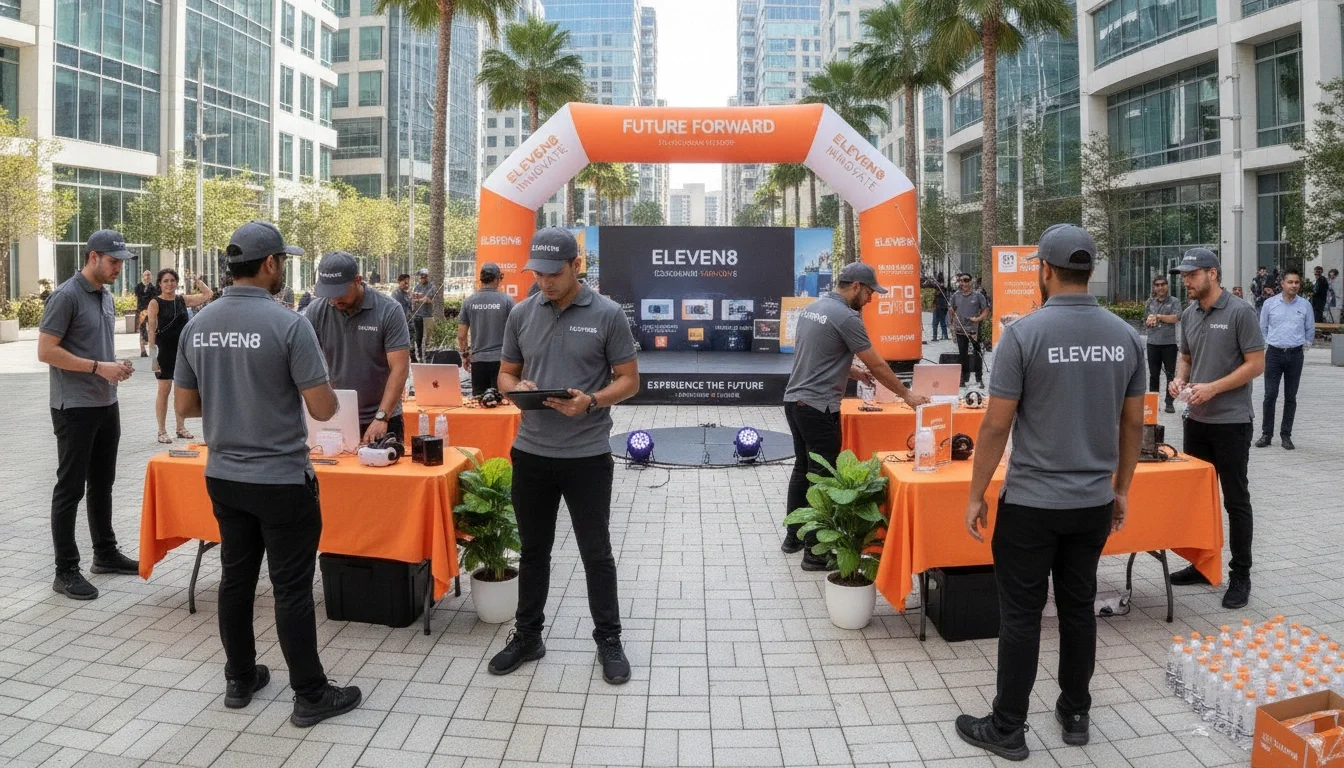
A uniformed Eleven8 event staff team preparing for a brand activation
In oversaturated markets, agencies face constant pressure to fill demand quickly — which can mean lower vetting standards, less pre-event briefing, and higher no-show rates. An activation in any market is only as good as the team executing it. A rigorous staffing partner with standardized on-site processes, dedicated account management, and off-site operations coverage is the difference between a well-run activation and an expensive brand liability.
The metrics matter here. An agency with a documented fulfillment rate above 100% — enabled by briefed backups for every booking — isn't marketing language. It's the operational difference between your activation running at full strength and running shorthanded on activation day.
When Chicago Still Makes More Sense
This is not an argument that Springfield is always the better choice. Chicago remains the dominant Illinois market for specific activation contexts:
Trade shows and conventions at McCormick Place or Navy Pier, where scale is the point and audience volume is pre-aggregated
National launch campaigns requiring major metro market presence for earned media and influencer amplification
B2B activations targeting corporate decision-makers concentrated in the Loop, West Loop, or Fulton Market
Premium consumer brands whose target demographic skews toward high-income urban professionals, specifically located in Chicago neighborhoods
Chicago's infrastructure, venue variety, and media market size make it irreplaceable for campaigns where maximum reach and urban credibility are primary objectives. The question isn't whether Chicago has value — it's whether the specific objectives of a given B2C campaign are better served by Chicago's scale or Springfield's engagement quality.
The Strategic Case for Running Both Markets as a Campaign
The most sophisticated activation strategies don't choose between Chicago and Springfield — they use both intentionally. A phased approach allows brands to test creative and messaging in Springfield's lower-cost, lower-noise environment, optimize based on real consumer feedback, and then scale the refined activation into Chicago with higher confidence and lower waste.
This is the core logic of secondary market activation strategy: not a consolation prize, but a deliberate phase in a multi-market campaign that generates better ROI than deploying an untested activation directly into the most expensive market.
For brands planning Illinois-market campaigns, Eleven8's nationwide staffing infrastructure means you don't need separate vendors for each city. One account manager, one staffing standard, consistent execution, whether your activation is in Chicago, Indianapolis, or Springfield.
The conversation about market selection deserves the same analytical rigor as creative development, budget allocation, and campaign measurement. Springfield isn't a fallback. For the right B2C activation, it's a strategic advantage.
Ready to staff a B2C activation in Illinois? Get your quote from Eleven8 →