Why the Kansas State Fair Outperforms for Heartland B2B Brands
For B2B marketing teams focused on coastal trade shows and national conferences, the Kansas State Fair rarely makes the activation shortlist. That's a mistake — and increasingly, a competitive advantage for the brands that figure it out first.
Every September, more than 350,000 people converge on Hutchinson, Kansas, for what's officially the largest single event in the state. Over ten continuous days, they come from every corner of Kansas — from agricultural communities in the west, suburban families from Wichita and Topeka, and small business owners from communities that national brands rarely reach in any other context. They're not rushing between sessions at a conference center. They're present, engaged, and open to discovery in a way that very few other events make possible.
For B2B brands selling to agribusinesses, rural professionals, small and mid-size businesses, or the Heartland consumer economy, the Kansas State Fair isn't just an interesting option. It's one of the highest-density access points to a deeply underserved audience — and it performs exactly because most of the competition isn't there yet.
This guide breaks down why the fair outperforms for Heartland B2B activation, which brand categories are positioned to win, and what it actually takes to staff a 10-day event with the consistency that makes brand investment worthwhile.
The Scale That Surprises Most Marketers
Marketers who haven't looked closely at Midwestern state fairs tend to assume they're modest, regional events — something between a county fair and a minor expo. The Kansas State Fair is neither.
Ten Days of Sustained Audience Access
The fair runs ten consecutive days, starting on the Friday following Labor Day each September. At the Kansas State Fairgrounds — a 280-acre complex with over 70 buildings and nearly 24 acres under permanent roof — that duration creates something rare: a ten-day window of audience access in a single location.
That sustained timeline fundamentally changes the economics of brand activation. Unlike a two-day trade show where setup costs eat a disproportionate share of the budget, the Kansas State Fair allows brands to amortize booth construction, staffing infrastructure, and collateral production across ten full days. A well-executed activation on day one improves on day two. Staff learn the fairgoer flow. Messaging tightens. Word of mouth spreads within the fairgrounds themselves.
A Captive, Unhurried Crowd
This is the detail that matters most for B2B marketers: fairgoers are not in a hurry. At industry trade shows and conferences, attendees are time-compressed — moving between sessions, managing meeting schedules, and processing an enormous volume of vendor interactions. The average dwell time at a fair exhibit is significantly longer, and the conversational quality is categorically different.
When a farmer from Pratt County stops at your agricultural technology booth, they're not scanning the room for their next appointment. They have time to listen. They'll ask questions that their counterpart at a national trade show might not bother to ask. And when they walk away with a relationship rather than a brochure, they carry it back to their operation, their co-op, their community.
Understanding the Kansas State Fair Audience
No activation strategy survives contact with the wrong audience. Before committing budget to the Kansas State Fair, B2B marketing teams should understand exactly who is walking through those gates.
Who Actually Walks Through Those Gates
Research conducted by the University of Kansas's Institute for Policy & Social Research profiled Kansas State Fair visitors as broadly representative of the state's population, with concentrations of agricultural industry workers, rural families, small business owners, and the full spectrum of Kansas's workforce demographics. Attendance spans all age brackets meaningfully: teens and young adults, family-stage adults aged 25 to 54, and established fairgoers over 55. The audience is genuinely cross-generational in a way that few single events can replicate.
The fair also draws approximately 700 concessionaires and exhibitors, 850 livestock exhibitors, and close to 5,000 4-H and FFA participants — a concentrated representation of the agricultural economy that powers the Heartland.
For the Kansas State Fair's official exhibitor and sponsorship information, brands can visitkansasstatefair.gov.
Why Heartland Demographics Matter for B2B
The Heartland buyer profile is distinct from urban and suburban coastal consumers in ways that matter for B2B marketing strategy. Purchasing decisions in agricultural and rural small business contexts often involve longer relationship cycles, stronger preference for trusted in-person engagement, and higher resistance to purely digital brand-building. These buyers want to know who they're doing business with before they sign anything.
That dynamic makes the Kansas State Fair an unusually efficient B2B prospecting environment. Face-to-face engagement at a community-rooted event carries more trust weight than a cold email sequence or a conference keynote. Brands that show up consistently — year after year at the same fairground — build a presence that eventually feels institutional. That kind of earned familiarity is extremely difficult to replicate digitally.
Which Brand Categories Win at the Kansas State Fair
Not every B2B category maps cleanly onto the fair audience. The brands that extract the most value from Kansas State Fair activation tend to share a common thread: they're selling something the Heartland actually uses, and the fair puts them in front of their real buyers in an unusually direct way.
Agriculture, AgTech, and Rural Services
This is the obvious fit — and it's obvious because it works. Agricultural input suppliers, farm equipment dealers, agricultural technology companies, precision agriculture platforms, crop insurance providers, and rural utilities have been active at Kansas and Midwestern state fairs for generations. The modern opportunity is in differentiating that presence: going beyond a static booth display to deploy brand ambassadors who can conduct live product demonstrations, facilitate trial conversations, and qualify leads with the nuance that printed brochures can't.
AgTech companies in particular benefit from the fair format. Explaining a soil data platform or a variable-rate application system requires sustained conversation — exactly what the fair enables.
CPG, Food & Beverage, and Product Sampling
Consumer packaged goods brands, regional food producers, craft beverage companies, and emerging F&B brands consistently outperform at state fairs because the setting is culturally aligned with tasting, sampling, and discovery. For B2B CPG brands — those selling to retail buyers, distributors, or food service operators in the region — the fair is an opportunity to build regional brand recognition that makes future wholesale conversations warmer.
Product sampling at the Kansas State Fair isn't just a consumer play. When the buyer for a regional grocery chain attends the fair and personally experiences your product, the subsequent sales call has a different starting point. That's a B2B conversion path that most brands never think to build.
Financial Services, Insurance, and Professional Services
Kansas's agricultural economy generates substantial demand for crop insurance, farm lending, estate planning, rural banking, and business services — categories that are underrepresented at national trade shows but extremely well represented at the Kansas State Fair exhibitor mix. Regional banks, insurance carriers, and professional services firms have long recognized the fair as an efficient way to reach the small business owner and agricultural operator audience at scale.
The opportunity for B2B professional services brands is to go beyond the leaflet-and-giveaway model. A staffed, well-trained team capable of having real financial or services conversations — rather than collecting business cards — produces dramatically better lead quality. Trade show staff with prior professional services experience can make that difference.
Home Improvement, Automotive, and Power Equipment
Home services brands, HVAC and utility companies, power equipment dealers, and regional automotive groups routinely activate at Midwestern state fairs because the audience is exactly right: homeowners and property operators who make significant purchase decisions and prefer evaluating them in person. These are not impulse buyers. They want to talk to someone knowledgeable before they commit — and a fair activation provides exactly that context.
Why the Fair Format Outperforms Other Activation Venues
The Kansas State Fair doesn't just offer access to a large audience. It offers a structural environment that advantages certain kinds of brand engagement in ways that other event formats simply don't.
Lower Competition, Higher Attention
At a national trade show, your booth is one of hundreds or thousands competing for professional attendees' attention, and every competitor in your category is present. At the Kansas State Fair, the exhibitor mix is comparatively diffuse. If you're an agricultural lender, you're unlikely to find a dozen direct competitors on either side of your booth. That changes how visitors engage with you — and how memorable your activation becomes.
The reduction in direct competition also means a higher proportion of uncontested conversations. When a fairgoer stops at your exhibit, they're not immediately comparing you to the identical pitch they just heard from your closest competitor. That's a structural advantage worth building an activation strategy around.
Geographic Consolidation of a Statewide Audience
Kansas is a geographically large state with a comparatively dispersed population. Reaching small business owners across Dodge City, Liberal, Garden City, Manhattan, and Emporia in a single campaign through traditional channels requires substantial media investment and still delivers fragmentary results. The Kansas State Fair draws that audience to a single location over ten days.
For B2B brands whose sales territories include the entirety of Kansas or the wider Heartland region, this geographic consolidation effect alone can justify the activation investment. The efficiency of reaching statewide coverage from a single booth in Hutchinson is genuinely difficult to replicate.
The Trust Advantage of a Fair Setting
State fairs are community institutions. The Kansas State Fair has been running since 1913 — it is, by definition, part of the cultural fabric of Kansas in a way that a pop-up event or conference will never be. Brands that participate in that setting inherit some of that institutional credibility.
That trust effect is particularly meaningful for B2B categories that depend on long-term relationship building. When a farmer encounters your brand at the Kansas State Fair year after year, you're not just generating impressions — you're building the kind of familiar presence that precedes trust, and trust precedes purchasing decisions in agricultural and rural B2B markets.
How to Structure a 10-Day Brand Activation at the Fair
Ten days is a significant commitment, and under-resourced activations are visible in ways that damage rather than build brand perception. Getting the staffing architecture right from the beginning determines whether your investment compounds across the run or degrades by day three.
Planning Your Staffing Footprint
The first planning question is scope: are you running a demonstration-heavy exhibit requiring knowledgeable product specialists, a sampling campaign requiring high-volume, high-energy staff, or a lead-generation operation requiring skilled qualification conversations? Each model implies a different staffing composition.
A demonstration-heavy B2B exhibit might prioritize two to three highly knowledgeable product-specialist ambassadors and one team lead. A sampling operation at a high-traffic location might require six to eight pop-up staff across peak hours. A lead-generation focus shifts the priority to experienced, conversational staff who can qualify prospects without feeling like a sales interrogation.
Hybrid models — common for brands that want both visibility and lead quality — typically pair a high-energy sampling or engagement team with a smaller group of dedicated conversation staff who can take qualified leads into deeper product or service discussions.
Day-by-Day vs. Full-Run Staffing Models
Most brands activating at a 10-day fair have to choose between running a consistent team for the full duration or cycling staff through in shorter rotations. Both models have legitimate use cases, and the choice significantly affects activation consistency.
A full-run staffing model — where the same team works the majority of the ten days — builds operational rhythm. Staff learn the fairground traffic patterns, recognize returning visitors, refine their messaging, and improve their conversion rate over the run. The tradeoff is managing fatigue and maintaining peak engagement on days eight, nine, and ten.
A rotation model — cycling fresh staff through in multi-day segments — maintains energy levels but sacrifices continuity. Visitors who return on day seven won't encounter staff who recognize them from day two, and the activation loses the compounding relationship-building effect.
For most B2B brands prioritizing lead quality over volume, the full-run model outperforms — provided the staffing partner has the roster depth to ensure consistent caliber across all ten days.
The Roles You Actually Need On-Site
A well-staffed Kansas State Fair activation typically requires a combination of:
Brand Ambassadors: Your front-line engagement team — trained on your brand story, key messages, and product or service fundamentals. They initiate conversations, manage traffic flow around your exhibit, and create the energy that draws in passersby.
Product Specialists or Demo Staff: If your activation includes live product demonstrations or technical conversations, these are your trained product experts who can answer detailed questions and qualify genuine leads.
Team Lead / On-Site Supervisor: For any activation running more than a few days, an on-site team lead manages daily operations, keeps staff aligned with brand protocols, handles logistical issues in real time, and serves as the point of contact between your marketing team and the on-site crew.
Street Team Support: For brands driving traffic from other fairground locations toward their exhibit, a roving street team working the pedestrian corridors can meaningfully increase exhibit foot traffic without adding to your stationary booth headcount.
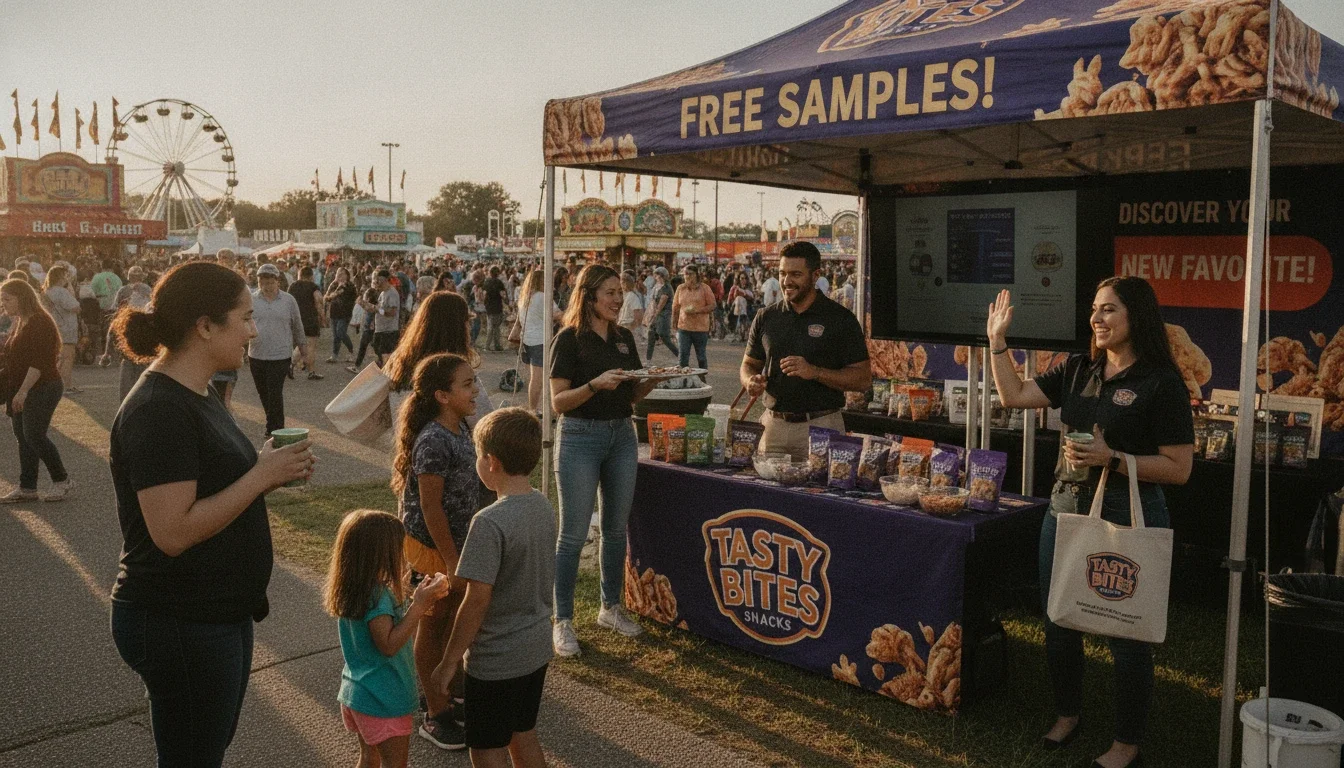
Professional brand ambassadors engage fairgoers at a product sampling activation — the kind of sustained, human-to-human engagement that state fairs uniquely enable
What Makes Event Staffing at the Kansas State Fair Different
Staffing a 10-day state fair activation is categorically different from staffing a 2-day trade show. The operational demands — and the risks of getting them wrong — scale in ways that brands without prior fair experience often underestimate.
Endurance, Consistency, and Brand Representation Over 10 Days
The single biggest failure mode in multi-day fair activation is staff quality degradation. A brand ambassador who's sharp, energetic, and genuinely engaging on day one can become visibly depleted and disengaged by day seven — if the staffing model doesn't account for it. That degradation is visible to fairgoers. It communicates something about the brand, and it communicates the wrong thing.
Professional event staffing agencies that regularly handle multi-day and multi-week events build staff rotation schedules, briefing protocols, and performance monitoring into their operational model precisely to prevent this. The brands that have consistently positive fair activation experiences tend to work with partners who treat day nine the same as day one.
Why Local Staff Knowledge Matters
Kansas State Fair activations benefit meaningfully from staff who understand the regional cultural context — who can speak authentically about agricultural work, rural community life, and Heartland business realities rather than performing a script that reads as coastal-imported. Staff who know the region, understand the audience's priorities, and can engage with genuine familiarity rather than manufactured warmth will consistently outperform those who don't.
A staffing partner with an established Heartland and Midwest roster — rather than one that recruits reactively for each event — is better positioned to deliver that cultural alignment.
Backup Coverage and No-Show Risk at Multi-Day Events
Over a 10-day activation, the probability that at least one staff member will have an illness, family emergency, or vehicle issue is high. At a 2-day trade show, one no-show is a manageable disruption. At a 10-day fair, without a backup coverage system, a no-show on a high-traffic Saturday can materially damage a week's worth of relationship-building.
Eleven8's standard staffing model includes one briefed backup staff member for every eight team members — on standby and already briefed on the activation before the event starts. For multi-day events like the Kansas State Fair, that built-in redundancy is not a premium; it's the baseline that makes the activation reliable enough to actually invest in.
How Eleven8 Staffs Regional Fair Activations Nationwide
Eleven8 Event Staff brings 35 years of event staffing experience to brand activations across all major event formats — from national trade shows to regional festivals and state fairs throughout the Heartland and beyond.
The agency maintains an established roster of 24,000+ active staff across 36+ U.S. markets, including Kansas City, which serves as the primary market hub for Kansas State Fair deployments. Staff are not recruited after a booking is confirmed; they're pre-vetted, trained on Eleven8's 11-step event process, and matched to each client's brand, event type, and audience before the first day of the activation.
Every Kansas State Fair engagement is assigned a dedicated account manager who owns the activation from initial inquiry through post-fair recap. That single point of contact handles briefing coordination, uniform logistics, daily check-ins, and any real-time adjustments across the full 10-day run. Clients aren't managing a staffing roster — they're managing one relationship.
For brands that want to evaluate specific staff before confirming their team, Eleven8 provides photo portfolios, bios, and video introductions for available staff — allowing marketing and brand teams to select the people who will actually represent their brand, not receive whoever shows up.
See how Eleven8 has staffed large-scale brand activations for clients like Nike, Netflix, and Sotheby's in the case studies section.
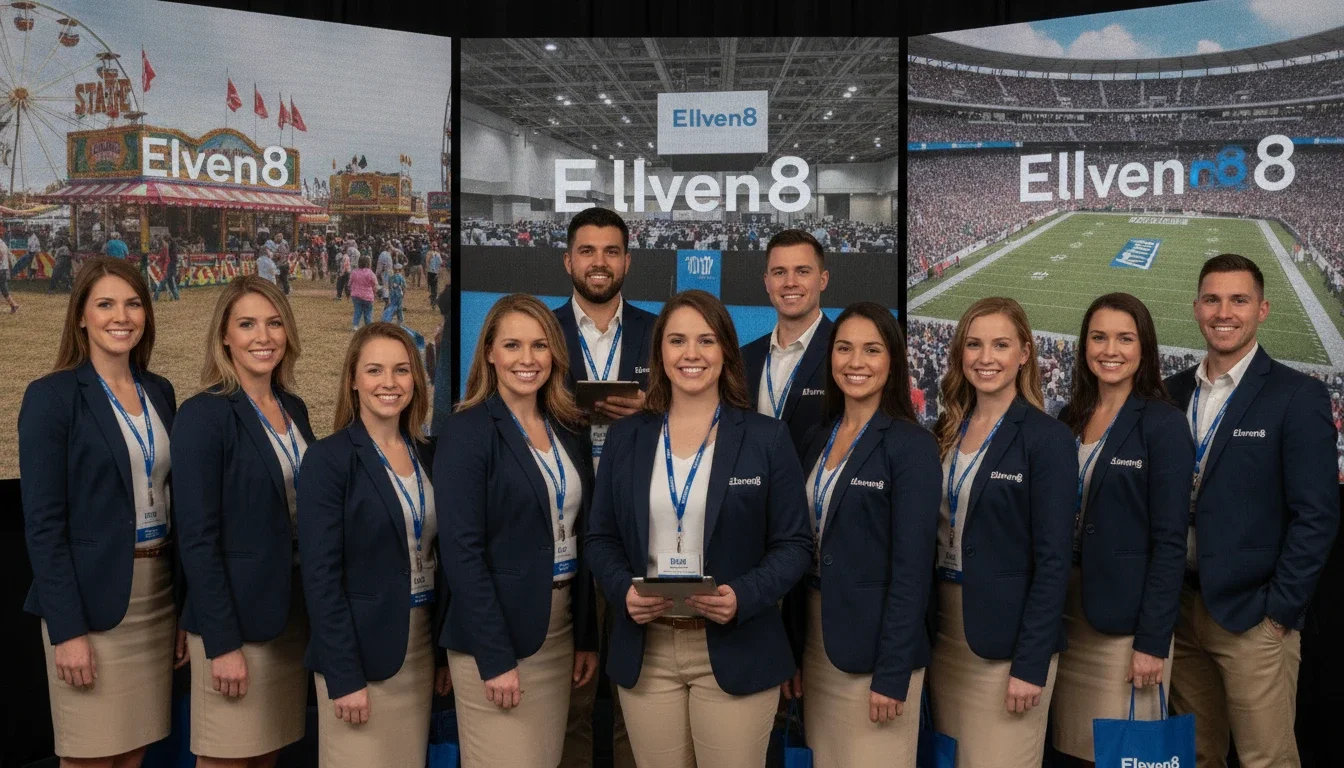
Eleven8 brand ambassadors ready to represent your brand at major events nationwide — from regional state fairs to national trade shows
Ready to Activate at the Kansas State Fair?
The Kansas State Fair runs for ten days every September at the Kansas State Fairgrounds in Hutchinson — the next edition is September 11–20, 2026. Brands that commit to the activation early secure the best booth positions, allow adequate lead time for staff briefing and uniform coordination, and arrive at the fair with a team that's ready rather than assembled at the last minute.
If you're planning a Kansas State Fair activation — or evaluating Midwestern state fairs as part of a broader Heartland brand strategy — Eleven8 can help you design a staffing model that matches your activation goals and keeps your team performing at full strength from day one through day ten.
Request a Quote for Your Kansas State Fair Activation →