NBA All-Star Weekend draws hundreds of thousands of fans, corporate executives, celebrities, and media professionals to a multi-day celebration of basketball culture. For sponsors investing six or seven figures in pavilions and fan experiences, the quality of your event staff can make the difference between a forgettable booth and a campaign-defining activation that drives measurable ROI.
The challenge is substantial: managing peak crowds that can exceed 50,000 attendees per day, maintaining brand excellence across 12-16 hour shifts, and creating personalized moments in a high-energy environment. This requires more than warm bodies in branded t-shirts. It demands strategic staffing planning, role-specific training, and operational excellence that matches the premium nature of the event.
This comprehensive guide walks you through every aspect of staffing sponsor pavilions and fan experiences at NBA All-Star Weekend, from calculating your team size to measuring post-event success. Whether you're a brand manager planning your first All-Star activation or an experienced event marketer looking to optimize your approach, you'll find actionable frameworks and industry benchmarks to elevate your staffing strategy.
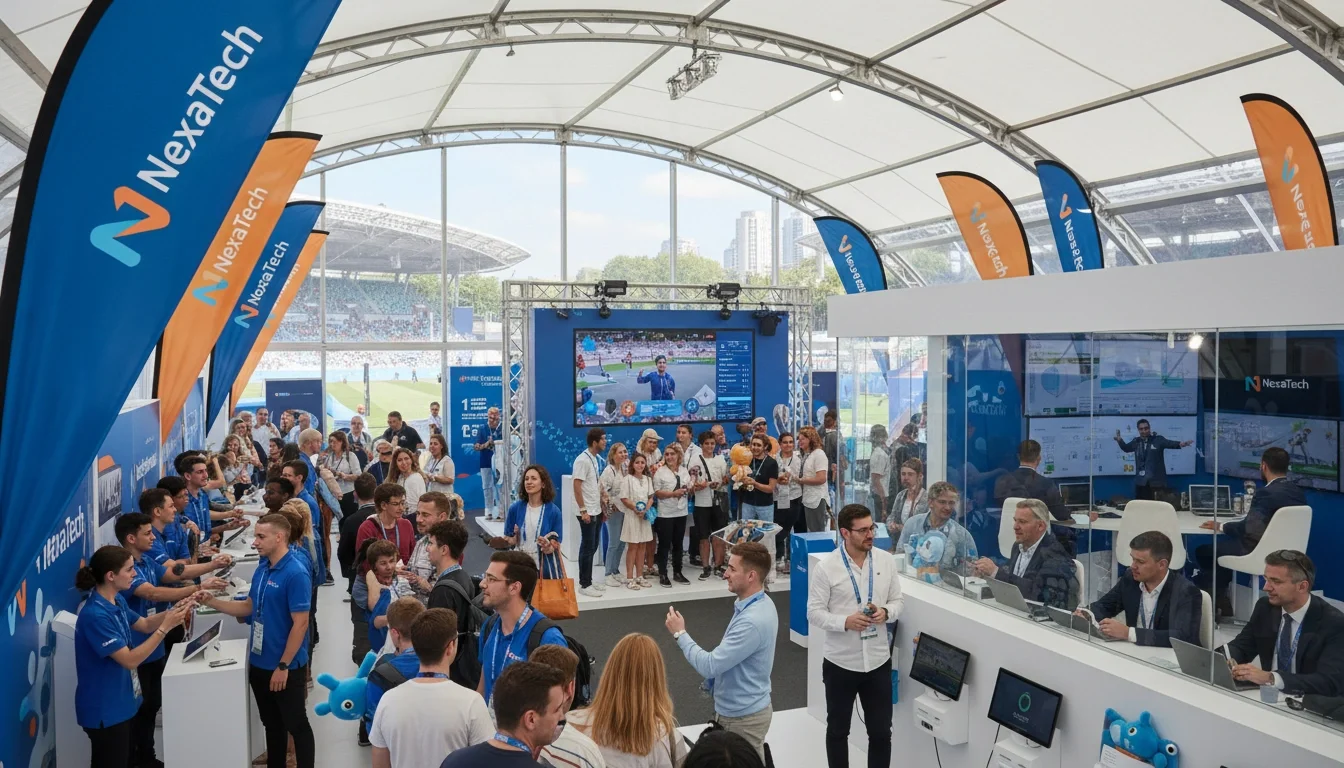
Sponsor pavilions at major sporting events require coordinated teams to manage high-volume fan interactions while achieving specific brand objectives
Understanding NBA All-Star Weekend Event Dynamics
The Scale and Scope of All-Star Activations
NBA All-Star Weekend has evolved into a four-day festival that extends far beyond the Sunday night game. Recent events have included:
Thursday through Sunday programming spanning multiple venues
200,000+ total attendees across all events and activations
Downtown takeovers with activation zones covering multiple city blocks
Concurrent events including celebrity games, skills competitions, concerts, and fan fests
Peak traffic windows concentrated around major events (Saturday night, Sunday afternoon)
For sponsor pavilions, this means planning for variable traffic patterns. Friday afternoon might see moderate, steady flow perfect for meaningful conversations, while Saturday evening could bring waves of 500+ fans per hour to a single activation. Your staffing plan must accommodate both scenarios without overspending or sacrificing experience quality.
The geographic spread matters too. Unlike a single-venue trade show, All-Star activations often occur at the convention center, arena, nearby hotels, and branded outdoor spaces. If your sponsorship includes multiple touchpoints, staff deployment and communication become complex logistical challenges.
Peak traffic typically occurs:
Friday evening (6-10 PM): Post-work crowds, local fans
Saturday afternoon (12-5 PM): Family-friendly programming
Saturday evening (6 PM-midnight): Celebrity Game and entertainment
Sunday afternoon (2-6 PM): Pre-All-Star Game excitement
Understanding these patterns allows you to schedule your strongest staff during critical windows and adjust ratios when engagement quality matters more than throughput.
Sponsor Pavilion Objectives and Success Metrics
Before determining headcount, clarify what success looks like. Different objectives require different staffing approaches:
Brand Awareness and Impressions When the goal is maximum exposure, you need high-energy brand ambassadors who can engage hundreds of passersby per shift. Think enthusiastic greeters who create photo moments, distribute premium items, and generate social media content. Staffing here emphasizes quantity and energy over deep product knowledge.
Lead Generation and Sales Pipeline B2B sponsors targeting corporate decision-makers need fewer but more sophisticated staff members. These representatives should understand complex value propositions, qualify leads effectively, and capture detailed information. A smaller team of industry-savvy professionals outperforms a larger group of generalists.
Product Sampling and Trial Consumer brands demonstrating products require patient educators who can deliver consistent messaging to thousands of fans. They need product expertise, crowd management skills, and the stamina to repeat the same demonstration dozens of times per hour while maintaining enthusiasm.
VIP Hospitality Experiences Premium sponsor packages often include private suites, meet-and-greets, or exclusive events. These require concierge-level staff who excel at personalized service, discretion, and creating memorable moments for high-value guests.
Social Media Engagement and Content Creation Dedicated content teams capture user-generated content, manage real-time social channels, and amplify the activation's digital reach. These specialists need different skills than traditional event staff—think social media fluency, basic video editing, and on-camera comfort.
Most activations combine multiple objectives, requiring a diverse team with clearly defined roles.
Core Staffing Roles for Sponsor Pavilions
Brand Ambassadors and Product Demonstrators
Brand ambassadors are your front-line representatives—often the only human touchpoint fans have with your brand during All-Star Weekend. At high-performing activations, these team members do far more than hand out samples.
Primary Responsibilities:
Proactively engage fans with authentic enthusiasm
Deliver consistent brand messaging and key talking points
Demonstrate products or explain services clearly
Facilitate interactive experiences and photo opportunities
Capture lead information when applicable
Generate social media content and encourage user posts
Maintain activation appearance and supply levels
Skills and Qualifications Required:
Genuine enthusiasm and high energy over long shifts
Strong interpersonal communication skills
Ability to think on their feet and handle questions
Professional appearance and brand-appropriate personality
Comfort with rejection (many fans will pass by)
Reliability and punctuality for demanding schedules
Typical Staffing Ratios: For general product sampling or brand engagement, plan for one brand ambassador per 75-100 attendees during moderate traffic, dropping to 1:50 during peak periods. If your activation includes complex demonstrations or technology, increase to 1:40-60 to maintain service quality.
A 2,000 square foot pavilion expecting 5,000 visitors on Saturday might need 8-10 brand ambassadors during peak afternoon hours, dropping to 4-6 during slower evening periods after the Celebrity Game begins.
Training Requirements: Successful brand ambassadors need 2-3 hours of focused training covering brand history, product knowledge, messaging dos and don'ts, technology systems, and crowd engagement techniques. Include role-playing exercises for common scenarios and difficult questions they'll encounter.
Registration and Check-In Staff
First impressions happen at registration. Whether you're checking in VIP guests, collecting lead information, or distributing RFID wristbands for gamified experiences, these staff members set the tone for the entire activation.
Flow Management Responsibilities: Professional registration staff do more than process attendees—they manage expectations, prevent bottlenecks, and create positive anticipation. During surge periods, they need crowd management skills to prevent queues from appearing chaotic or disorganized.
At NBA All-Star Weekend, fans have abundant options competing for their attention. If your registration process feels slow or confusing, many will simply walk away to the next activation. Your staff needs the authority and training to make quick decisions that keep things moving.
Technology Proficiency Needs: Modern activations rely on tablets, lead capture apps, RFID systems, and custom registration platforms. Staff must be comfortable troubleshooting basic tech issues, processing attendees even when systems slow down, and collecting information manually when technology fails entirely.
Don't assume digital nativity equals tech proficiency. Test staff with your specific platforms during training and identify who struggles before event day.
Recommended Ratios for Entry Points: One registration station (staffed by 1-2 people) can process approximately 100-150 attendees per hour with technology support. For a pavilion expecting 500 visitors per hour during peak traffic, plan for 4-5 stations with 6-8 total staff to allow for breaks and backup.
Data Collection Protocols: Registration staff must understand data privacy laws, obtain proper consent, and accurately capture information that marketing teams will use for months afterward. Rushed or incorrect data entry undermines the entire lead generation investment.
VIP and Hospitality Coordinators
Premium sponsor packages often include exclusive experiences for corporate clients, season ticket holders, or celebrity guests. These moments require a different staffing approach entirely.
Experience Creation Focus: VIP coordinators orchestrate seamless experiences where guests feel genuinely valued. This means anticipating needs before they're expressed, solving problems invisibly, and creating spontaneous moments of delight. It's concierge-level service in a fast-paced event environment.
At NBA All-Star Weekend, your VIP guests might include Fortune 500 executives, professional athletes, entertainment industry figures, or loyal customers you're rewarding. Each group has different expectations and preferences.
Relationship Management Skills: The best VIP coordinators combine warmth with discretion. They remember names and preferences, navigate sensitive situations gracefully, and make connections between guests with similar interests. These soft skills matter more than event logistics knowledge.
Concierge-Level Service Expectations: VIP staff should be empowered to solve problems creatively and spend money when necessary to elevate experiences. A $200 decision to arrange transportation or secure a last-minute request can transform a satisfied guest into a brand evangelist.
Staff-to-Guest Ratios for Premium Experiences: For intimate VIP experiences (under 25 guests), maintain a 1:8-12 ratio to ensure personalized attention. Larger VIP receptions might stretch to 1:15-20, but service quality noticeably declines beyond that threshold.
A private suite for 40 corporate guests should have at least 3-4 dedicated hospitality staff, plus a coordinator managing the overall experience and liaising with venue operations.
Event Managers and Floor Supervisors
While brand ambassadors engage fans, supervisors keep the entire activation running smoothly. These are your problem-solvers, decision-makers, and communication hubs.
Oversight Responsibilities: Event managers monitor multiple elements simultaneously: staff performance, supply levels, crowd flow, technical issues, schedule adherence, and sponsor satisfaction. They need the judgment to distinguish minor hiccups from genuine problems requiring escalation.
During NBA All-Star Weekend's compressed timeline, there's no room for slow decision-making. Supervisors need clear authority to adjust staffing, reallocate resources, or modify the experience based on real-time conditions.
Communication Hub Role: Effective supervisors maintain constant communication loops: coordinating with venue staff, updating sponsors on performance metrics, guiding their team through challenges, and escalating issues to senior leadership when necessary. They're the information nexus that keeps everyone aligned.
Equip supervisors with communication tools (headsets or group messaging apps) that allow instant coordination without pulling them off the floor for phone calls.
Problem-Solving Authority: The best supervisors are empowered to make decisions. If a popular activation element runs out of supplies, can they approve an emergency purchase? If a staff member gets sick, can they adjust breaks without waiting for approval? Clear authority boundaries prevent bottlenecks during critical moments.
Recommended Supervisor-to-Staff Ratios: One experienced supervisor can effectively manage 8-12 front-line staff members. For large activations with 30+ team members, consider a tiered structure: a senior event manager overseeing 2-3 floor supervisors, each managing their own squad.
This structure ensures someone is always available to handle issues while maintaining big-picture oversight.
Crowd Management and Queue Specialists
Popular activations create their own challenges. When hundreds of fans want to experience your VR game or meet-and-greet, professional queue management becomes essential for safety, experience quality, and legal compliance.
Safety and Flow Optimization: Crowd specialists understand density thresholds, exit path requirements, and early warning signs of dangerous crowding. At NBA All-Star Weekend, where alcohol consumption and excitement run high, professional crowd management isn't optional—it's a liability issue.
These team members position themselves at chokepoints, monitor queue lengths, communicate wait times accurately, and make real-time decisions about flow control. They work closely with venue security but focus specifically on your activation's footprint.
High-Traffic Period Management: During peak windows, queue specialists might implement virtual queuing systems, distribute timed return tickets, or create structured line formations that prevent crowd chaos. They need the confidence to enforce rules politely but firmly, even with frustrated fans.
ADA Compliance and Accessibility: Queue management includes ensuring accessible entry points, accommodating guests with mobility challenges, and providing reasonable modifications for people with disabilities. Train these staff members on ADA requirements specific to your activation design.
Integration with Security Teams: Crowd specialists bridge your activation and venue security. They should know escalation protocols, understand when situations require security intervention, and maintain professional relationships with venue staff throughout the event.
Calculating Your Staffing Needs
Staff-to-Attendee Ratios by Activation Type
Staffing ratios vary dramatically based on interaction type, complexity, and experience goals. Use these industry benchmarks as starting points, then adjust based on your specific activation design and quality standards.
| Activation Type | Recommended Ratio | Planning Notes |
|---|---|---|
| Product Sampling (Simple) | 1:75–100 | Increase for complex products requiring explanation |
| Interactive Experiences | 1:25–40 | Tech-heavy activations need more support staff |
| VIP Hospitality | 1:8–12 | Premium service expectations require higher ratios |
| Registration/Entry Points | 1:100–150 | Assumes technology support; manual processing needs more staff |
| Photo Opportunities | 1:30–50 | Includes queue management and social sharing assistance |
| Product Demonstrations | 1:40–60 | Depends on demo length and complexity |
| Gaming/Competition Areas | 1:20–35 | Rule enforcement and equipment management intensive |
| Branded Lounges | 1:50–75 | Passive rest areas need less staff than active experiences |
Staffing intensity key:
● High-touch (1:8–35) — VIP, gaming, interactive experiences require most staffing
● Medium-touch (1:30–60) — photo ops, product demos, sampling
● Low-touch (1:50–150) — lounges, registration, simple sampling
Note: Ratios represent staff-to-guest/participant counts. Always test ratios during peak hours and adjust based on activation complexity and traffic flow.
Applying Ratios to Your Activation:
If you're planning a 3,000 square foot pavilion with multiple experience zones, calculate each area separately:
Entry/Registration: Expecting 6,000 daily visitors with peak hours of 600/hour → Need 4-6 registration staff during peaks
Product Sampling Area: Moderate traffic of 200 people/hour → 3-4 brand ambassadors
Interactive VR Experience: 30 people/hour capacity → 2 dedicated staff for tech support and queue
VIP Lounge: 25 corporate guests → 2-3 hospitality coordinators
Photo Moment: Popular Instagram opportunity, 100 people/hour → 2-3 staff for facilitation
Supervisory Staff: 1 senior manager + 2 floor supervisors for 15-18 front-line team
Total Peak Staffing: 18-22 people, scaling to 10-12 during slower periods
Peak Period Staffing Adjustments
NBA All-Star Weekend traffic doesn't follow a consistent pattern. Friday afternoon might be leisurely, while Saturday evening brings sudden surges when major events conclude and thousands of fans flood activation areas simultaneously.
Identifying High-Traffic Windows: Review the official All-Star Weekend schedule and anticipate crowd behavior. Major programming creates predictable patterns:
Celebrity Game conclusion (Saturday ~10 PM): Massive crowds exit seeking food and entertainment
Pre-All-Star Game (Sunday 4-6 PM): Heightened excitement, fans arrive early
Halftime (Sunday ~8:30 PM): Quick surge if activations are near arena
Post-game (Sunday ~10:30 PM): Final rush before weekend concludes
Work with venue operations and other sponsors to understand historical traffic data if available.
Shift Overlap Strategies: Rather than rigid shift changes that temporarily reduce staff presence, implement 30-60 minute overlaps where incoming staff arrive before outgoing teams leave. This allows:
Knowledge transfer about current issues or VIP guests
Smooth transition without service disruptions
Brief period of maximum staffing to handle any backlog
Opportunity for outgoing staff to provide context
Break Rotation Without Service Gaps: Long event days require strategic break scheduling. Never allow more than 25% of role-specific staff to take breaks simultaneously. Stagger breaks by 15-30 minute intervals and designate specific areas where staff can truly rest away from the activation.
Consider providing proper meals rather than expecting staff to fend for themselves during short breaks at overpriced venues. Well-fed, rested staff perform dramatically better during final hours.
Emergency Backup Protocols: Maintain an on-call backup pool of 2-3 pre-trained staff members who can arrive within 60-90 minutes if needed. Pay them a partial rate for availability even if they're never called in. This insurance policy is worth the modest cost when facing no-shows or unexpected traffic surges.
Multi-Day Event Scheduling Considerations
Four consecutive days of high-intensity event work tests even experienced staff. Your scheduling approach dramatically impacts performance quality across the full weekend.
Staff Fatigue Management: Physical exhaustion is inevitable, but mental fatigue is what undermines experience quality. Avoid scheduling individuals for maximum shifts (12+ hours) on consecutive days. If Thursday and Friday require your full team, consider rotating who works reduced hours on Saturday to maintain freshness for the climactic Sunday.
Watch for signs of fatigue: shorter interactions, reduced smile frequency, sitting when they should be standing, or increased mistakes. Proactive supervisor interventions—sending someone for an early break or rotating to a less demanding role—prevent fatigue from becoming visible to fans.
Consistency vs. Fresh Perspective: There's tension between staff consistency (which builds expertise and rhythm) and rotation (which maintains energy). Consider a hybrid approach:
Core team works Thursday-Sunday for continuity
Supplemental staff work 2-3 days each for fresh energy
Supervisors maintain full presence for consistency
VIP coordinators stay constant (relationship continuity matters most)
Training Time Allocations: Don't sacrifice training quality to save costs. Budget for:
2-3 hours initial training covering brand, products, systems, protocols
30-minute daily briefings before each event day covering updates, learnings, and energy-building
15-minute post-shift debriefs to capture feedback and issues
Tech rehearsals for staff using specialized equipment or platforms
Well-trained staff require less supervision, make fewer mistakes, and deliver superior experiences. The training investment pays for itself in operational efficiency.
Daily Briefing Requirements: Start each day with team briefings that cover:
Previous day's successes and challenges
Today's schedule and anticipated traffic patterns
VIP guests or special circumstances
System or process changes
Recognition for outstanding performance
Energy-building activities or motivational elements
These briefings create team cohesion and ensure everyone starts aligned, informed, and energized.
Staff Training and Preparation
Brand-Specific Knowledge Requirements
Your staff represents the brand in thousands of micro-interactions. Superficial product knowledge isn't sufficient—they need depth that allows confident improvisation when fans ask unexpected questions.
Product/Service Deep Dives: Go beyond feature lists. Staff should understand:
Why the product exists: What problem does it solve? What customer need inspired it?
How it compares: What makes it different from competitors?
Usage scenarios: Who uses it and in what situations?
Common objections: What hesitations do customers express and how do we address them?
Price and availability: Where can fans purchase it? What does it cost?
For B2B sponsors, include company background, industry position, recent news, and key executive names that fans might recognize.
Campaign Messaging Alignment: All-Star Weekend activations often tie to broader marketing campaigns. Staff must understand the campaign's core message, associated hashtags, current advertising creative, and how the activation fits into larger brand goals.
Provide examples of on-message vs. off-message language. What phrases should they use frequently? What wording should they avoid? This prevents well-intentioned staff from inadvertently contradicting carefully crafted campaign messaging.
FAQs and Talking Points: Develop a comprehensive FAQ document covering:
Product/service questions fans will ask
Pricing and availability
Current promotions or All-Star exclusive offers
How to follow up or learn more
Handling of competitive comparisons
What to do when they don't know the answer
Include both the questions and approved response language, but train staff to use their own words rather than sounding scripted.
Brand Voice and Personality: Is your brand playful or sophisticated? Energetic or calm? Youth-focused or broadly appealing? Staff should embody the brand personality in their demeanor, language choices, and interaction style.
Show video examples of on-brand interactions. Better yet, have brand team members role-play scenarios during training so staff see how executives want the brand represented.
NBA All-Star Weekend Context and Culture
Generic event staff training isn't enough. NBA All-Star Weekend has unique cultural elements and expectations that your team must understand to connect authentically with fans.
Event Schedule Awareness: Staff should know the complete All-Star Weekend schedule, not just their shift times. When fans ask "What time is the Celebrity Game?" or "Where is the Skills Competition happening?", your team should provide helpful answers. This positions your brand as a valuable resource rather than an isolated activation.
Provide laminated schedule cards or ensure staff can access the official app. Being helpful with basic information builds goodwill before you ever mention your product.
Celebrity and VIP Protocols: NBA All-Star Weekend attracts current players, legends, entertainers, athletes from other sports, and entertainment industry figures. Brief your staff on:
Recognition without disruption: Notice VIPs but don't interrupt their experience
Photo discretion: Never request personal photos or post unauthorized content
Privacy expectations: What happens in VIP areas stays private
When to alert supervisors: High-value guests who might warrant special attention
The goal is professional awareness without fan-like behavior that embarrasses your brand.
Basketball Culture Literacy: Your staff doesn't need to be basketball experts, but basic cultural literacy matters. They should recognize:
Current All-Stars and major storylines
Host city team and local basketball culture
NBA legends likely to be present
Current season narratives and rivalries
All-Star Weekend traditions and history
This knowledge allows natural conversation and prevents awkward moments when fans reference players or situations staff should recognize.
Local Market Knowledge: All-Star Weekend brings fans from across the country and globally, but local attendees form a significant percentage. Staff should know:
Local restaurant and attraction recommendations
Transportation options and venue locations
Host city pronunciation and cultural elements
Local basketball history and pride points
Being helpful about the destination itself positions your brand as a valuable part of the overall experience.
Operational and Technical Training
Beyond brand knowledge, staff need practical skills to execute their roles efficiently under pressure.
Technology Platform Proficiency: Whatever systems you're using—lead capture apps, registration platforms, social media tools, or interactive game interfaces—staff must practice with actual devices during training. Watching a demonstration isn't enough.
Create realistic scenarios: "The app is running slowly and there's a line of 20 people. Show me how you'd keep things moving." Stress-test their comfort level before event pressure multiplies difficulty.
Identify tech-savvy staff members who can provide peer support when minor issues arise, reducing supervisor intervention needs.
POS and Lead Capture Systems: If you're processing transactions, distributing prizes, or capturing detailed lead information, accuracy matters immensely. Train staff on:
Proper data entry procedures
Verification and confirmation processes
Privacy and consent language
What to do when systems fail
Manual backup procedures
Conduct practice drills where staff process fictional attendees until the workflow becomes automatic.
Social Media Content Creation: If staff are creating or encouraging social media content, provide specific guidance:
Approved hashtags and handles
Photo quality standards and composition basics
How to encourage user-generated content without being pushy
Privacy and permission protocols
What content requires approval before posting
Show examples of excellent vs. poor content from previous events. Visual examples communicate standards more effectively than written guidelines.
Emergency Procedures: Every staff member should know:
Evacuation routes and assembly points
How to contact supervisors and security
Medical emergency protocols
Severe weather procedures (if outdoor activation)
Crowd emergency recognition and response
Incident reporting requirements
Conduct quick walkthrough drills so staff physically practice emergency procedures rather than just hearing about them.
Customer Service Excellence Standards
Technical competence isn't sufficient. Outstanding fan experiences require service mindset and interpersonal excellence.
High-Energy Engagement Techniques: NBA All-Star Weekend is a celebration. Fans expect energy, enthusiasm, and fun. Train staff to:
Make eye contact and smile genuinely
Use open body language and welcoming posture
Match fan energy levels (enthusiastic fans get enthusiasm back)
Create moments of surprise and delight
Celebrate fan participation and engagement
Provide examples of specific phrases and approaches. Role-play interactions until staff become comfortable initiating conversations proactively.
Handling Difficult Situations: Not every interaction will be positive. Prepare staff for:
Intoxicated or belligerent fans: De-escalation techniques and when to involve security
Disappointed fans: Managing expectations when experiences are full or items run out
Complaints: Listening actively, apologizing when appropriate, and offering solutions
Entitled behavior: Maintaining professional boundaries politely but firmly
The goal is empowering staff to resolve most situations independently while knowing when supervisor or security intervention is necessary.
Creating Memorable Moments: Encourage staff to personalize interactions when possible:
Notice and comment on fan jerseys or apparel
Ask where they traveled from and show genuine interest
Share brief personal basketball stories or connections
Go slightly beyond expectations in small ways
Remember repeat visitors and acknowledge them
These micro-moments transform transactional interactions into genuine connections that fans remember and associate with your brand.
Accessibility and Inclusivity Training: All-Star Weekend draws diverse audiences with varying needs and abilities. Train staff on:
ADA compliance and physical accessibility accommodations
Communication techniques for fans with hearing or vision impairments
Cultural sensitivity and avoiding assumptions
Gender-neutral language and pronoun awareness
Age-appropriate engagement (children vs. adults)
Multilingual support resources if available
The goal is ensuring every fan feels welcomed and valued regardless of their background or needs.
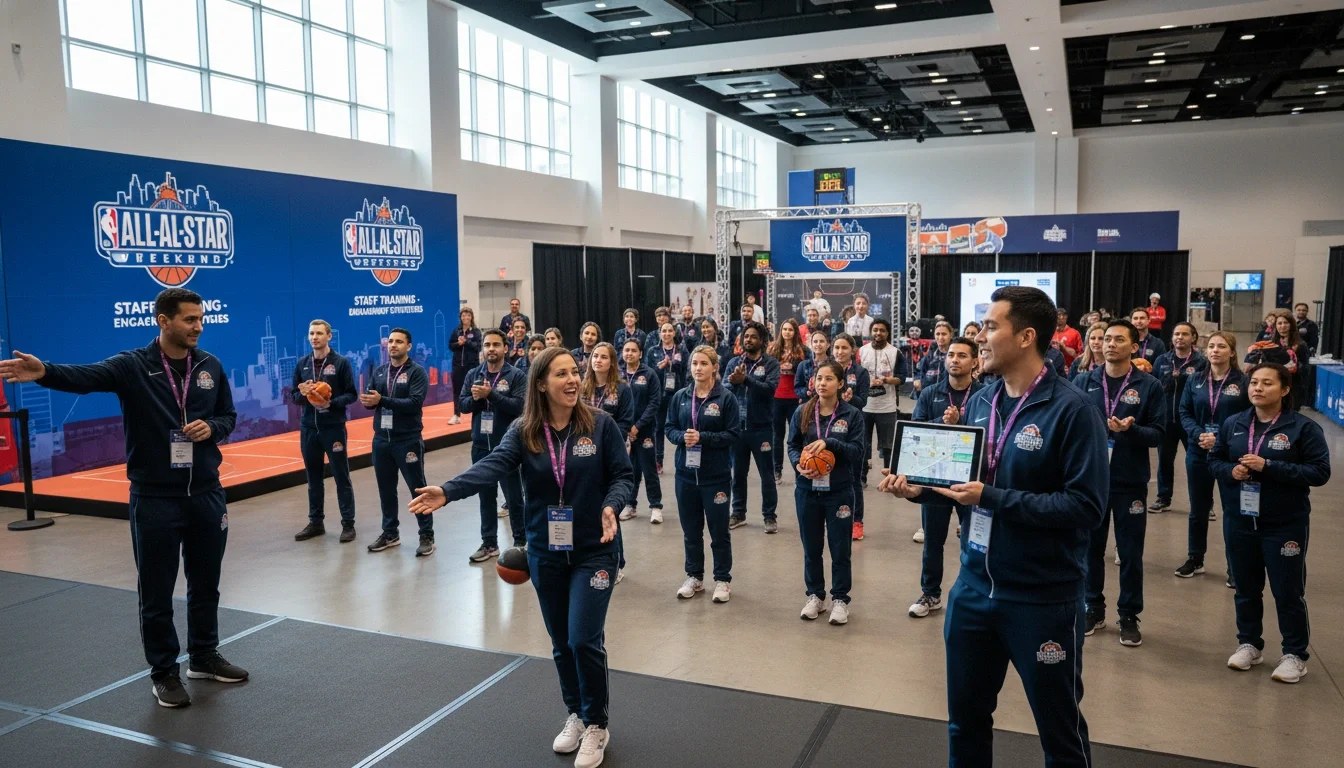
Event staffing team receiving training before NBA All-Star Weekend activation with trainers demonstrating engagement techniques
Budget Planning and Resource Allocation
Staffing Cost Components
Understanding the full cost picture ensures accurate budgeting and prevents surprise expenses that undermine activation ROI.
Hourly Rates by Role and Experience Level:
Industry standard rates vary by market, but expect these ranges for NBA All-Star Weekend:
Brand Ambassadors: $25-40/hour (higher in major markets, for experienced staff)
Product Demonstrators: $30-45/hour (specialized knowledge commands premium)
Registration Staff: $25-35/hour (technology proficiency matters)
VIP Coordinators: $40-60/hour (hospitality expertise essential)
Event Supervisors: $50-75/hour (experience and decision-making authority)
Senior Event Managers: $75-125/hour (strategic oversight and sponsor liaison)
Premium events command premium rates. NBA All-Star Weekend competes with dozens of brand activations simultaneously, creating talent scarcity that drives prices up 20-30% compared to typical events.
Overtime and Holiday Considerations: If All-Star Weekend falls on a holiday weekend or extends late into evenings, factor overtime premiums. Many markets require time-and-a-half after 8 hours or for work exceeding 40 hours weekly.
Late-night hours (past 11 PM or midnight) might warrant shift differentials to attract quality staff willing to work until 2 AM post-event breakdowns.
Training and Prep Time Compensation: Ethical staffing means paying for all working time, including training. Budget for:
2-3 hours pre-event training at regular rates
30 minutes daily briefing time each event day
Travel time if activations span multiple venues
Setup and breakdown time beyond public operating hours
Failing to compensate training time creates legal exposure and sends the wrong message about valuing your team.
Uniform and Credential Expenses: Quality staff presentation requires investment:
Custom branded apparel (typically $40-80 per person for complete outfit)
Name badges and credentials
Comfortable footwear for long standing periods (consider providing or stipend)
Weather-appropriate outerwear if partially outdoor
Replacement items for spills or damage
Some sponsors require staff to return uniforms post-event for inventory control and potential reuse. Others allow staff to keep items as a perk.
Optimal Budget Allocation Framework
Recommended Staffing Percentage: Industry benchmarks suggest allocating 25-35% of your total activation budget to staffing and related personnel costs. This includes:
Direct hourly compensation
Recruitment and onboarding
Training development and delivery
Management and supervision
Agency fees if using staffing partners
For a $300,000 All-Star Weekend activation, plan for $75,000-105,000 in total staffing investment. Skimping below 20% almost always results in understaffing that undermines experience quality and ROI.
Quality vs. Quantity Balance: It's tempting to maximize headcount by hiring less expensive staff. Resist this impulse. Experienced event professionals who command higher rates often deliver superior results that justify the premium:
Less supervision required (freeing managers for strategic work)
Better judgment in handling unexpected situations
Higher consistency in brand representation
Improved efficiency that effectively multiplies their impact
Reduced turnover and no-show risk
Consider a hybrid approach: experienced supervisors and VIP coordinators supplemented by enthusiastic brand ambassadors who bring energy even if less seasoned.
When to Invest in Experienced Specialists: Certain positions absolutely warrant premium talent:
Event Managers: Their decisions impact everything; don't economize here
VIP Coordinators: Poor service with high-value guests damages relationships worth millions
Technical Specialists: Complex activations need staff who won't be overwhelmed by technology
Brand Spokespersons: If media or influencers will interview your staff, invest in articulate professionals
Budget-friendly options work well for:
General crowd management during low-complexity periods
Product sampling of simple items
Queue management with clear protocols
Setup and breakdown labor
Cost-Saving Strategies That Don't Sacrifice Experience: Stretch your budget without compromising quality:
Recruit locally to avoid travel and lodging expenses
Leverage brand enthusiasm: Fans of your brand may accept modest rates for the experience
Cross-train staff to fill multiple roles, reducing total headcount needs
Partner with universities for motivated students seeking industry experience
Extend shifts to reduce total headcount through longer individual coverage (but watch fatigue)
Negotiate package rates with staffing agencies for multi-day bookings
Plan precisely to avoid overstaffing during predictable slow periods
Never cut corners on training, background checks, or supervisor ratios—these investments prevent expensive problems.
Hidden Staffing Costs to Consider
Recruitment and Vetting Time: Finding quality staff isn't free, whether you handle it internally or partner with an agency:
Job posting and advertising (if self-recruiting)
Resume review and initial screening time
Interview coordination and execution
Reference checking
Skills assessment or auditions
Even if using a staffing agency, budget internal time for final candidate approval, brand briefings, and coordination meetings.
Background Checks and Certifications: NBA All-Star Weekend takes place in NBA arenas and convention centers with strict security protocols. Expect to provide:
Criminal background checks ($30-75 per person)
Credential applications and approval processes
Possible security deposits for badges or access cards
Insurance certificates for your activation
Some venues require advance submission weeks before the event. Late requests incur expedite fees or get denied entirely, leaving you scrambling.
Travel and Accommodation (If Applicable): If you're bringing key staff from your headquarters or hiring specialists from other markets:
Airfare during peak travel periods
Hotel accommodations (possibly 4-5 nights for full weekend coverage)
Ground transportation or rental vehicles
Per diem for meals and incidentals
This can add $1,500-3,000 per person quickly. Evaluate whether local talent might be more cost-effective.
Meal and Break Provisions: Operating 12-16 hour days makes meal provision both an ethical obligation and a performance investment. Options include:
Catered meals in a private staff area ($15-25 per person per meal)
Meal per diems paid to staff who source their own food ($30-50 per day)
Venue food vouchers (convenient but often limited options and higher costs)
Don't forget water, coffee, and snacks throughout shifts. Dehydrated, hungry staff deliver poor experiences.
Insurance and Liability Coverage: Depending on your activation design and venue requirements:
General liability insurance for the activation
Workers' compensation coverage for staff
Specialized coverage for high-risk activities or valuable prizes
Umbrella policies for celebrity appearances or alcohol service
Consult with risk management or legal counsel to ensure adequate protection without over-insuring.
Fan Experience Optimization Through Strategic Staffing
Creating Seamless Journey Touchpoints
Exceptional fan experiences don't happen accidentally—they result from deliberate design of each touchpoint along the attendee journey. Strategic staffing makes those designed moments operational realities.
Entry and First Impression Strategy: The first seven seconds shape overall perception. Deploy your most welcoming, energetic staff at entry points where they can:
Greet fans enthusiastically and set positive tone
Orient attendees to the activation layout and highlights
Quickly assess interests to personalize recommendations
Create immediate engagement before hesitation sets in
This "welcome team" role might seem simple, but it requires specific personality traits: warmth, quick thinking, and genuine enthusiasm that withstands hundreds of repetitions.
Guided Experience Flow Design: Rather than letting fans wander randomly, consider staffing a "journey guide" role that accompanies small groups through curated experiences. This works particularly well for:
Multi-zone activations where fans might miss elements
Complex experiences benefiting from explanation
VIP groups receiving premium treatment
Media or influencers you want to showcase thoroughly
These guides elevate perceived value dramatically while ensuring your activation is experienced as designed.
Peak Moment Amplification: Identify the 2-3 highest-value moments in your activation—the VR experience climax, the photo with a NBA legend cutout, the moment someone wins a prize. Station staff specifically to amplify these peaks:
Building anticipation before the moment
Capturing photos and reactions during
Encouraging social sharing immediately after
Creating micro-celebrations that spread enthusiasm to nearby fans
Peak-end rule psychology tells us people remember peaks and endings most vividly. Strategic staffing at these moments maximizes lasting impact.
Memorable Exit Experiences: Don't let fans drift away anticlimactically. Station staff at exits to:
Thank fans for participating
Invite social media sharing or contest entries
Distribute premium giveaways as departure gifts
Collect feedback or qualify leads one final time
Provide clear next steps (where to buy, how to learn more)
This final touchpoint creates recency effect—the last interaction disproportionately influences overall memory.
Social Media and Content Amplification Roles
Modern activations generate ROI through both in-person experiences and digital amplification. Strategic staffing extends your reach far beyond physical attendees.
Dedicated Content Creators vs. General Staff: Should every staff member create content, or should you designate specialists? The answer depends on activation scale and social strategy:
Dedicated content team approach works when:
You need consistent quality and cohesive aesthetic
Content creation is a primary activation goal
You're producing video or complex content types
You want real-time social media management and response
Distributed content creation works when:
Authenticity and volume matter more than polish
Your brand aesthetic tolerates varied styles
You want diverse perspectives and voices
Budget constraints limit specialist headcount
Many activations use a hybrid: 1-2 content specialists who capture premium hero content, supported by brand ambassadors who encourage and facilitate user-generated content.
Real-Time Social Engagement: Assign staff specifically to monitor social mentions, respond to posts tagging your activation, and engage with user-generated content as it appears. This real-time dialogue:
Amplifies reach through likes, comments, and shares
Identifies influencer attendees worth special attention
Catches and addresses any negative experiences quickly
Provides instant feedback about what's resonating
This role requires social media fluency, fast typing, and good judgment about brand voice in casual digital interactions.
User-Generated Content Facilitation: The most valuable content often comes from fans themselves. Staff should be trained to:
Identify photo-worthy moments and suggest capturing them
Offer to take photos so groups can all be included
Provide optimal shooting angles and backgrounds
Share hashtags and handles for tagging
Create shareable moments (props, signage, interactive elements)
The key is being helpful without being pushy. Fans should feel you're enhancing their experience, not extracting content labor.
Influencer and Media Coordination: When influencers, media, or VIP guests arrive, they need different handling than general attendees. Designate staff who can:
Recognize high-value visitors and alert coordinators
Provide expedited experiences without frustrating other fans
Facilitate content creation needs (lighting, angles, time)
Connect them with brand spokespeople if interviews desired
Follow up to ensure they have everything needed
This specialized service maximizes the ROI of influencer relationships that extend reach to their audiences.
Managing Wait Times and Queue Experience
Popular activations face a paradox: success creates waits that undermine satisfaction. Strategic staffing transforms waiting from a negative into a neutral or even positive experience component.
Entertainment During Waits: Deploy staff in queue areas specifically to:
Engage fans in conversation or games
Share interesting brand stories or product facts
Facilitate social connections among waiting fans
Distribute samples or preview experiences
Manage expectations about timing
Think of queue staff as experience extenders rather than crowd controllers. Their role is making wait time feel valuable rather than wasted.
Clear Expectation Setting: Nothing frustrates fans more than uncertainty. Staff should proactively communicate:
Estimated current wait times (updated frequently)
What the experience includes and how long it lasts
Any requirements or restrictions
Whether waits are likely to increase or decrease
Accurate information allows fans to make informed decisions about whether to wait or return later.
Virtual Queue Technologies: Modern queue management systems let fans reserve spots virtually while enjoying other activations. Staff roles shift to:
Explaining how the system works
Helping fans register for virtual queues
Monitoring for return time arrivals
Managing priority lanes for virtual vs. physical queues
This reduces actual standing-in-line time while requiring staff who understand the technology and can troubleshoot common issues.
Staff Roles in Queue Management: Effective queue management requires multiple coordinated positions:
Queue entry point: Communicates wait times and manages flow into the queue
Mid-queue engagement: Entertains and educates waiting fans
Queue-to-experience transition: Batch management and final prep before experience
Queue monitor: Watches for problems, accessibility needs, or fans requiring assistance
This seems like overhead, but professional queue management prevents negative experiences that spread virally on social media.
Accessibility and Inclusive Experience Design
Creating welcoming experiences for all fans isn't just legally required—it's an ethical imperative and brand differentiator.
ADA Compliance Staffing: Accessibility goes far beyond physical ramps and pathways. Staff training should cover:
Recognizing and offering appropriate assistance
Communication techniques for various disabilities
Service animal protocols and awareness
Accessible entry points and modified experiences
Patience and flexibility without condescension
Designate at least one staff member per shift as the accessibility coordinator who is especially trained and empowered to make accommodations.
Multilingual Capabilities: NBA All-Star Weekend draws international fans and domestic attendees with diverse language backgrounds. Options include:
Hiring bilingual staff for key roles (especially registration and VIP services)
Using translation apps when professional interpreters aren't available
Creating visual communication aids for common needs
Partnering with venue or city resources for language support
Even basic Spanish, Mandarin, or French capability enhances inclusivity in many markets.
Sensory-Friendly Accommodations: High-energy activations with loud music, flashing lights, and dense crowds can overwhelm fans with sensory sensitivities. Staff should be trained to:
Recognize signs of sensory overload
Offer quieter alternative experiences when possible
Provide clear information about sensory elements before entry
Show empathy and flexibility without requiring detailed explanations
Consider designated "quiet hours" during slower periods or alternative versions of popular experiences with reduced stimulation.
Special Needs Coordinator Roles: For large activations, designate a staff member specifically responsible for coordinating accommodations and accessibility. This person:
Serves as point of contact for fans requesting assistance
Coordinates with other staff to implement modifications
Maintains awareness of accessibility features and resources
Troubleshoots situations requiring creative solutions
Ensures compliance with legal requirements
This specialization ensures accessibility doesn't become an afterthought addressed inconsistently.
Crisis Management and Contingency Planning
Common Staffing Challenges at High-Profile Events
Even with meticulous planning, NBA All-Star Weekend's scale and complexity create staffing challenges. Anticipating common issues allows swift, effective responses.
No-Shows and Last-Minute Cancellations: Event day no-shows occur at 5-15% rates depending on staff quality and compensation. Mitigate this by:
Overstaffing by 10% and sending extras home with partial compensation if unnecessary
Requiring confirmation calls 24-48 hours before each shift
Implementing financial penalties for unexcused no-shows
Maintaining relationships with reliable previous staff who might cover emergencies
Building last-minute availability bonuses into budget
One no-show in a critical role (VIP coordinator, event manager) creates exponentially larger problems than multiple ambassador absences.
Staff Illness or Emergency: Four-day events inevitably see staff illness, family emergencies, or unexpected situations. Plan for:
Cross-training that allows role flexibility when someone is out
Buddy systems where pairs can cover for each other briefly
Clear protocols for staff to report they can't work
Decision frameworks for when to send sick staff home vs. asking them to power through
Backup staff on-call as discussed earlier
Create a culture where reporting illness early is rewarded rather than punished—this prevents one sick staff member from infecting the entire team.
Unexpected Traffic Surges: A celebrity appearance, viral social post, or schedule change can create sudden traffic spikes you didn't plan for. Rapid response options:
Pulling non-public-facing staff (break supervisors, coordinators) to front lines temporarily
Implementing virtual queue or timed entry to manage flow
Temporarily closing less critical activation elements to concentrate staff
Calling in backup staff if surge appears sustained
Communicating with sponsors about situation and adaptations
Empowered supervisors can make these tactical decisions in real-time rather than waiting for approval as problems compound.
Technology Failures: Registration systems crash, interactive experiences malfunction, and tablets run out of battery at the worst possible moments. Staff training should include:
Manual backup procedures for every technology-dependent process
Basic troubleshooting protocols before escalating to IT support
How to keep attendees engaged during technical delays
When to shift fans to alternative experiences vs. asking them to wait
Communication protocols to notify supervisors and sponsors
The activation must continue functioning even when technology fails—staff are your failsafe.
Building Effective Backup Systems
On-Call Staff Pools: Maintain a reserve roster of 2-4 additional trained staff who agree to be on-call during the event. Compensate them with:
Flat availability fee ($100-200 per day they're on standby)
Full hourly rate if actually called in
Priority consideration for future events
This insurance policy costs $800-1,600 for the weekend but prevents catastrophic gaps when primary staff are unavailable.
Cross-Training Strategies: Every staff member should be trained for at least two roles. This flexibility allows:
Temporary shifts when someone is sick or late
Dynamic reallocation based on traffic patterns
Coverage during breaks without service gaps
Improved team understanding of complete activation
Cross-training takes additional training time but pays dividends throughout the event.
Manager Escalation Protocols: Create clear escalation matrices so staff know exactly when to involve supervisors:
Staff can handle independently:
Standard guest questions within their training
Minor technology glitches with known solutions
Routine complaints addressed with apologies and solutions
Breaking ties or minor rule enforcement
Require supervisor notification:
Guest injuries or medical situations
Aggressive or threatening behavior
Technology failures affecting multiple stations
Running out of supplies or materials
VIP guest arrivals or special requests
Media or influencer interview requests
Require senior management escalation:
Potential legal issues or liability concerns
Sponsor dissatisfaction or major complaints
Safety hazards or evacuation scenarios
Major technology or structural failures
Viral negative social media situations
Vendor Partnership Backup Plans: Develop relationships with venue operations, security, technical support, and other vendors before problems arise. When crises hit, having established contacts who already understand your activation accelerates solutions.
Conduct pre-event walkthrough with key vendor contacts so they know your layout, goals, and potential needs. This 30-minute investment prevents hours of coordination during emergencies.
Communication Protocols During Issues
Chain of Command Clarity: Every staff member should know:
Who their direct supervisor is
How to reach that supervisor instantly (phone, radio, app)
Who to contact if their supervisor is unavailable
When to break chain of command in genuine emergencies
Create simple visual org charts shared during training and posted in staff-only areas.
Real-Time Communication Tools: Invest in communication infrastructure appropriate to your activation scale:
Small teams (under 15): Group text messaging may suffice
Medium teams (15-30): Consider push-to-talk apps like Voxer or Teams
Large teams (30+): Rent professional radio systems with private channels
Whatever system you choose, test it thoroughly before the event in conditions similar to the actual environment (noise, distance, interference).
Sponsor Notification Procedures: Establish clear protocols for when and how to update sponsors about issues:
Real-time notification for major problems affecting experience quality
Hourly summary updates of minor issues and resolutions
End-of-day briefings covering performance, challenges, and learnings
Emergency contact information for after-hours sponsor liaison
Most sponsors appreciate transparency about challenges if accompanied by clear action plans. Hiding problems erodes trust faster than acknowledging them.
Post-Incident Reporting: Create simple incident report forms that capture:
What happened and when
Who was involved (staff, attendees, vendors)
How it was resolved
Whether it could happen again
Recommendations for prevention
These reports inform future planning and provide documentation if legal or insurance issues arise.
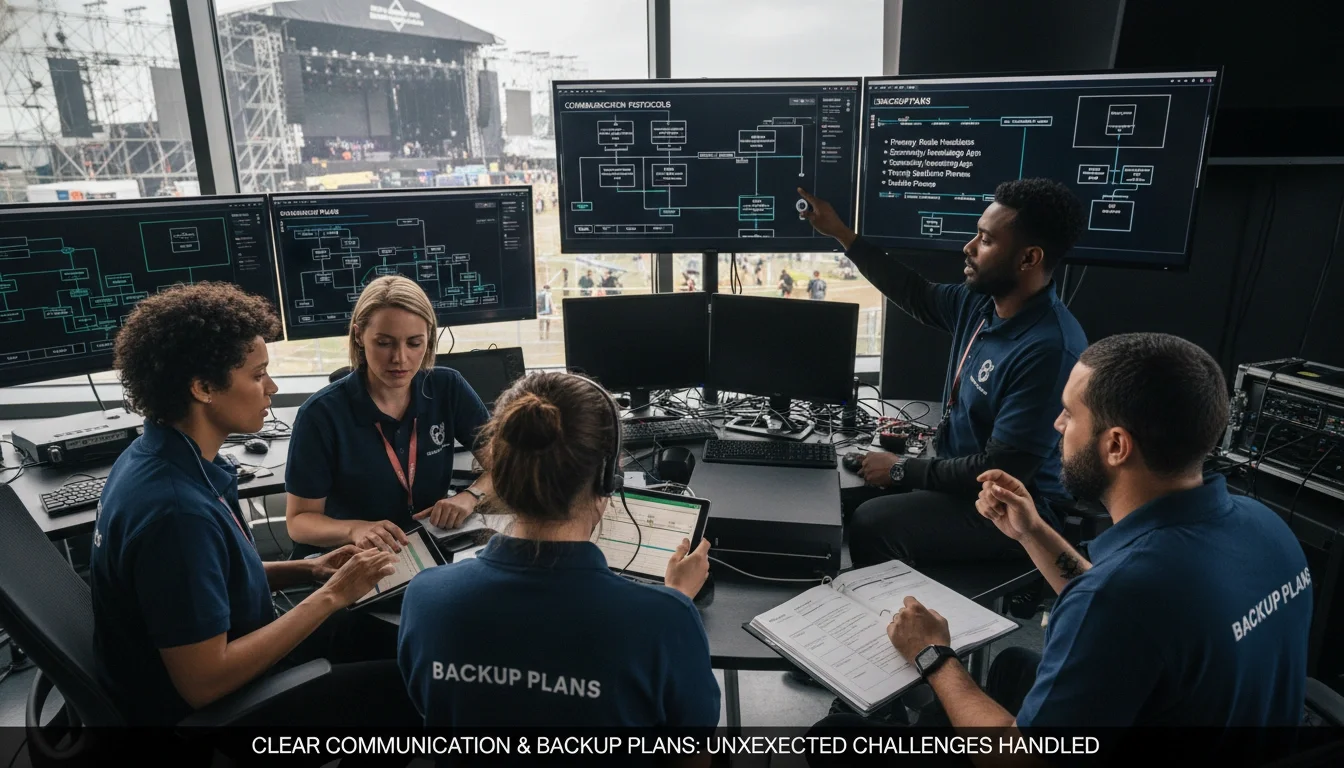
Clear communication protocols and backup plans ensure event teams can handle unexpected challenges professionally
Measuring Staffing Success and ROI
Key Performance Indicators
Measuring staffing effectiveness requires looking beyond simple headcount to outcomes that demonstrate business value.
Fan Engagement Metrics:
Interaction rate: Percentage of passersby who engage vs. continue walking
Dwell time: Average duration fans spend in your activation
Experience completion rate: Percentage who complete full intended journey vs. partial
Return visits: Fans who come back multiple times
Staff interaction quality scores: From direct observation or mystery shoppers
These metrics reveal whether staff are creating compelling experiences or merely occupying space.
Lead Capture and Conversion Rates: For activations with business development goals:
Total qualified leads generated
Lead quality scores (based on demographic or firmographic criteria)
Completion rate of lead forms (started vs. submitted)
Post-event conversion to sales or marketing qualified leads
Cost per lead compared to other marketing channels
Track these by individual staff member if possible—top performers provide training insights for future events.
Social Media Reach and Sentiment:
Total mentions and tags of brand handles and hashtags
Unique content creators (distinct individuals posting)
Aggregate reach (followers of all posters)
Sentiment analysis (positive vs. negative mentions)
User-generated content volume (photos, videos, stories)
Influencer engagement and amplification
Staff quality directly impacts social amplification—enthusiastic teams create moments fans want to share.
Staff Performance Evaluations: Assess individual and team performance through:
Supervisor observations and ratings across defined criteria
Peer feedback from team members
Mystery shopper scores if budget allows
Technology metrics (transactions per hour, lead capture accuracy)
Guest compliment and complaint tracking
Performance data helps identify top talent for future events and coaches who need additional support.
Net Promoter Score (NPS) From Attendees: Simple post-experience surveys asking "How likely are you to recommend [brand] to a friend?" provide powerful satisfaction indicators. Compare NPS across different shifts, days, or staff teams to identify patterns.
Post-Event Staff Debriefing
Feedback Collection Methods: Gather insights while experiences are fresh:
Immediate post-shift surveys (2-3 minutes, mobile-friendly)
End-of-day group debriefs (15-20 minutes with full team)
One-on-one supervisor interviews with key staff
Anonymous feedback channels for concerns staff won't raise publicly
Final comprehensive survey within 48 hours post-event
Each method captures different insights—use multiple approaches for complete picture.
Identifying Improvement Opportunities: Ask staff specific questions:
What questions did fans ask that you couldn't answer?
What technology or process frustrated you most?
What training would have been helpful that you didn't receive?
What surprised you about fan behavior or preferences?
What should we start, stop, or continue doing?
Front-line staff see problems and opportunities that managers miss. Create safe space for honest feedback without defensiveness.
Recognition and Retention Strategies: Outstanding staff are worth retaining for future events:
Public recognition during final debriefs
Specific performance feedback highlighting excellence
Bonus compensation for top performers
First invitation to future event opportunities
LinkedIn recommendations or references
Small thank-you gifts or branded merchandise
Staff who feel valued return for future events, reducing recruitment costs and improving consistency.
Lessons Learned Documentation: Create a comprehensive post-event report capturing:
Staffing plan vs. actual needs (where did we over/understaff?)
Training gaps and how to address them
Technology or process improvements needed
Vendor relationship insights
Budget allocation effectiveness
Top performer characteristics for future hiring
This institutional knowledge prevents repeating mistakes and accelerates improvement for subsequent events.
Calculating True Staffing ROI
Cost Per Engagement: Divide total staffing costs by number of meaningful fan interactions:
Total staffing investment: $85,000 Meaningful interactions: 12,000 Cost per engagement: $7.08
Compare this to digital advertising cost-per-engagement or other marketing channels to evaluate efficiency.
Quality of Leads Generated: Not all leads are equal. Track:
Marketing qualified lead (MQL) conversion rate from activation
Sales qualified lead (SQL) development
Closed business attributed to All-Star Weekend contacts
Lifetime value of customers acquired
If staffing quality directly impacts lead quality, premium staff investments justify themselves through higher conversion rates.
Brand Lift Attribution: Measure pre- and post-event brand awareness, favorability, and purchase intent among activation attendees versus control groups:
Awareness lift
Favorability improvement
Message association
Purchase intent increase
Partner with market research firms or use sponsor-provided measurement if available. Attributing brand lift specifically to staffing quality is challenging but possible through comparing different staffing approaches across multiple events.
Repeat Event Efficiency Gains: First-time activations have steep learning curves. When you retain top staff for repeat events:
Training time decreases (refresher vs. complete onboarding)
No-show rates drop (proven reliability)
Supervisor burden reduces (less guidance needed)
Experience quality improves (confidence and expertise)
Calculate cost savings from these efficiency gains when evaluating whether to pay premiums for experienced staff retention.
Working with Professional Event Staffing Agencies
Benefits of Specialized Staffing Partners
Access to Pre-Vetted Talent Pools: Established agencies maintain databases of thousands of event professionals with verified experience, reliable track records, and specific skills. Rather than recruiting from scratch, you access talent pipelines built over years.
Quality agencies continually vet their talent pools through:
Performance tracking across multiple events
Client feedback systems
Skills assessments and interviews
Background check verification
Ongoing training opportunities
This infrastructure would take months or years to build internally.
Industry-Specific Expertise: Agencies specializing in sports and entertainment events understand NBA All-Star Weekend's unique demands. They've likely staffed similar activations and can advise on:
Appropriate staffing ratios for your activation type
Role definitions and responsibility allocation
Common challenges and prevention strategies
Market-specific considerations (local culture, compensation norms)
Venue relationship navigation
This expertise accelerates planning and prevents amateur mistakes.
Scalability and Flexibility: Need to add 5 more staff three days before the event? Quality agencies can mobilize quickly because they maintain bench strength. They also handle:
Last-minute replacements for no-shows or illness
Surge capacity during unexpected traffic spikes
Geographic coverage if activations span multiple locations
Multi-market coordination for national sponsorships
This flexibility is difficult to replicate with internal recruiting.
Risk Mitigation and Insurance: Professional agencies carry:
Workers' compensation insurance for all staff
General liability coverage
Professional indemnity insurance
Legal compliance expertise (labor laws, wage requirements, break rules)
This transfers significant legal and financial risk away from your organization.
Training Infrastructure: Established agencies have training programs, facilities, and experienced trainers. They can:
Deliver brand-specific training efficiently
Provide baseline event professionalism training all staff receive
Access training technologies and platforms
Scale training across large teams quickly
This infrastructure represents substantial investment you leverage without building it yourself.
What to Look for in a Staffing Partner
Sports and Entertainment Event Experience: Ask specific questions:
How many NBA All-Star Weekends have you staffed?
What other major sporting events have you supported?
Can you provide client references from similar activations?
What's your largest single-event staffing project?
How do you handle multi-venue coordination?
Generic event staffing experience doesn't translate automatically to high-profile sports activations. Look for demonstrated expertise in this specific environment.
Geographic Coverage and Local Knowledge: The best agencies combine national infrastructure with local market expertise:
Staff recruitment in the host city
Understanding of local culture and basketball passion
Relationships with venue operations teams
Knowledge of local labor market conditions and appropriate compensation
Awareness of city logistics, transportation, and services
National agencies without local presence struggle with the on-the-ground realities. Local agencies without national experience may lack sophistication.
Vetting and Background Check Processes: Understand exactly how they qualify staff:
Initial screening criteria and standards
Interview process and skill assessment
Reference checking procedures
Background check depth (criminal history, employment verification)
Ongoing performance tracking and rating systems
How they handle poor performers (retraining vs. removal from roster)
The thoroughness of these processes directly impacts staff quality.
Training Capabilities: Evaluate their training infrastructure:
Do they have dedicated training facilities or rely on client space?
What's their trainer-to-trainee ratio?
How do they customize training to specific brands and activations?
What training technologies or platforms do they use?
Can they deliver training in multiple languages if needed?
How do they assess training comprehension and readiness?
Strong training capabilities separate exceptional agencies from mediocre ones.
Technology Integration: Modern events rely on technology for registration, lead capture, communication, and measurement:
What technology platforms do they use or support?
Can they integrate with your existing systems?
How do they handle communication during events (radios, apps)?
What reporting and analytics capabilities do they provide?
How do they track individual staff performance metrics?
Technology sophistication indicates operational maturity.
Client Testimonials and Case Studies: Request detailed case studies from similar activations:
Specific client names and contacts you can reference
Quantitative results (engagement rates, lead volumes, satisfaction scores)
Challenges encountered and how they were resolved
Staff-to-attendee ratios used and rationale
Budget ranges and value delivered
Generic testimonials matter less than specific, detailed success stories you can verify.
Timeline for Engaging Staffing Services
3-6 Months Prior: Initial Planning and Needs Assessment Begin conversations with potential staffing partners as soon as you know you're activating at All-Star Weekend:
Share activation vision, goals, and preliminary designs
Discuss anticipated staffing needs and budget parameters
Review agency capabilities and relevant experience
Negotiate contract terms, rates, and payment schedules
Establish communication protocols and primary contacts
Early engagement allows agencies to reserve top talent and plan recruitment campaigns.
2-3 Months Prior: Staff Recruitment and Selection Finalize detailed staffing plans and begin building your team:
Confirm final headcount by role and shift
Review candidate profiles and resumes
Interview finalists for critical positions
Approve final staff roster
Complete background checks and credential applications
Begin uniform ordering and preparation
This timeline ensures staff are fully vetted and credentialed before venue deadlines.
4-6 Weeks Prior: Training Program Development Develop comprehensive training materials and schedules:
Create training curriculum and materials
Schedule training sessions and reserve facilities
Brief trainers on brand messaging and activation specifics
Develop assessment tools and role-play scenarios
Finalize staff schedules with shift assignments
Communicate expectations and preparation requirements to staff
Quality training requires time to develop materials and deliver content effectively.
2-3 Weeks Prior: Final Briefings and Confirmations Ensure operational readiness:
Conduct final training sessions with full team
Walk through activation space if accessible
Distribute uniforms and credentials
Test all technology and communication systems
Review emergency protocols and escalation procedures
Confirm arrival times and reporting locations
Send final reminder communications
This period eliminates surprises and builds team confidence.
Week of Event: On-Site Coordination Execute with excellence:
Daily pre-shift briefings and energy building
Real-time supervision and support
Performance monitoring and coaching
Issue resolution and adaptation
Daily debriefs and continuous improvement
Sponsor communication and reporting
Agency representatives should be on-site throughout the event for seamless coordination.
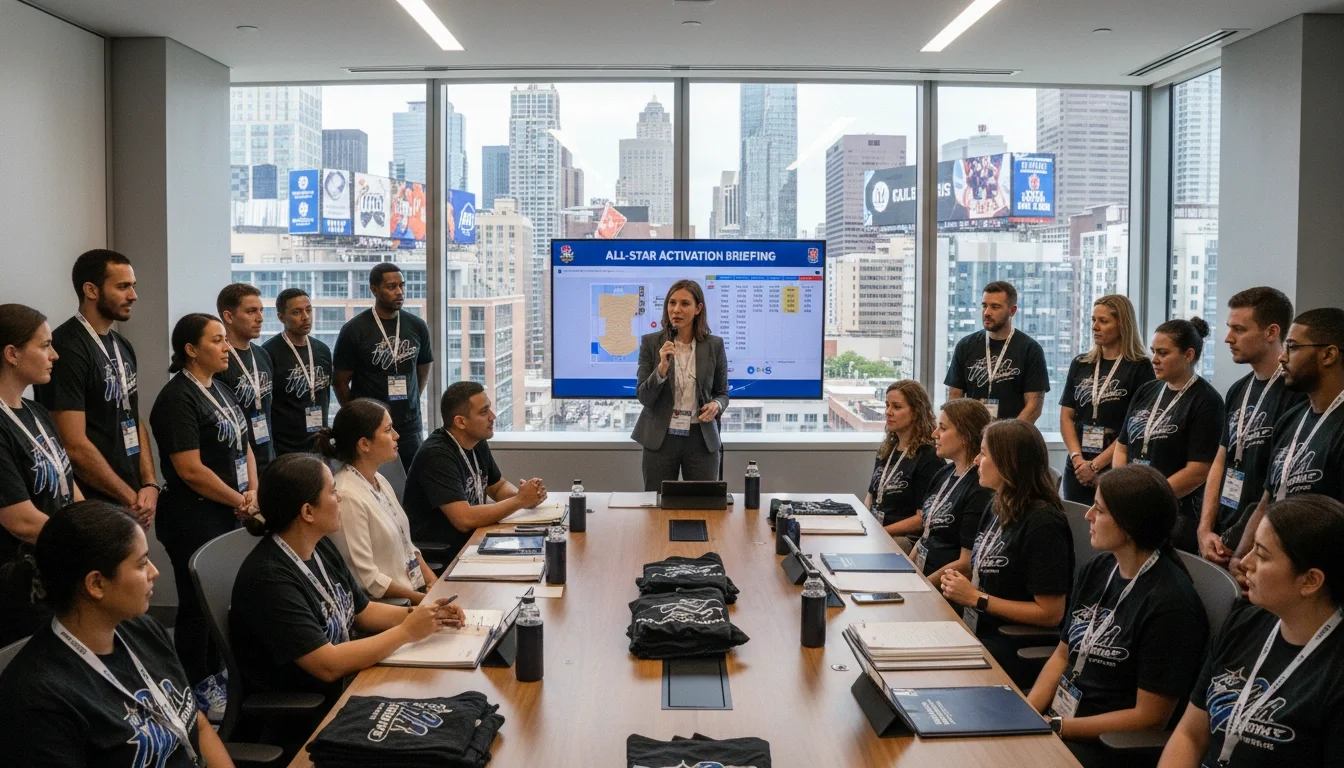
Event staffing agency coordinator briefing professional brand ambassadors before NBA All-Star Weekend activation
NBA All-Star Weekend Staffing Checklist
Use this comprehensive checklist to ensure nothing falls through the cracks as you plan and execute your activation.
Pre-Event (6-8 Weeks Out)
Strategy and Planning:
Define activation goals and success metrics
Map complete fan journey and identify key touchpoints
Calculate staff needs by role and shift using appropriate ratios
Set staffing budget and approve hourly rates by position
Decide between internal recruitment vs. staffing agency partnership
Create detailed job descriptions for each role
Recruitment and Onboarding:
Identify and engage staffing partner (or begin direct recruitment)
Review candidate qualifications and experience
Interview finalists for supervisor and specialist positions
Finalize complete staff roster with 10% backup pool
Submit background check requests and credential applications
Order uniforms and name badges
Training Development:
Create brand training materials (product knowledge, messaging, FAQs)
Develop operational training content (systems, processes, protocols)
Build NBA All-Star Weekend context and culture briefing
Design customer service excellence scenarios and role-plays
Prepare accessibility and inclusivity training modules
Schedule training sessions and reserve facilities
Pre-Event (2-4 Weeks Out)
Final Preparations:
Complete all background checks and verify credential approval
Conduct comprehensive training sessions (2-3 hours minimum)
Test all technology platforms with actual staff users
Confirm uniform fit and distribute complete outfits
Create daily shift schedules with break rotations
Establish communication protocols and tools (radios, apps)
Review emergency procedures and evacuation routes
Operational Readiness:
Conduct activation space walkthrough with supervisors
Coordinate with venue operations and security teams
Verify meal and break arrangements
Prepare staff-only spaces for breaks and storage
Load contact information and org charts to all phones
Create supervisor reference guides and cheat sheets
Send final confirmation and reporting instructions to all staff
Sponsor Alignment:
Brief sponsors on staffing plan and key team members
Establish sponsor communication protocols during event
Clarify escalation procedures for sponsor concerns
Confirm reporting cadence and metrics to be tracked
Event Days
Daily Operations:
Pre-shift briefings 30-45 minutes before public hours
Energy builders and team motivation activities
Review previous day learnings and today's expectations
Distribute any necessary supplies or materials
Verify all stations are staffed before opening
Real-Time Management:
Monitor traffic patterns and adjust staffing dynamically
Implement break rotations without service gaps
Track performance metrics and engagement quality
Address issues immediately through proper escalation
Communicate with sponsors per established schedule
Capture photos and videos of team in action
End-of-Day Protocols:
Conduct post-shift debriefs (15-20 minutes)
Collect feedback on what worked and what didn't
Recognize outstanding individual performances
Address any concerns or issues raised
Secure supplies and equipment overnight
Preview next day schedule and any changes
Post-Event
Staff Management:
Conduct final team debrief and appreciation
Distribute post-event feedback surveys
Process final payroll and expense reimbursements
Send thank-you communications and recognition
Identify top performers for future event opportunities
Collect and process uniform returns if required
Performance Analysis:
Compile engagement metrics and KPIs
Analyze lead quality and conversion data
Review social media reach and sentiment
Calculate cost-per-engagement and ROI metrics
Compare staffing plan to actual needs (gaps and overages)
Lessons Learned:
Create comprehensive post-event report
Document what worked well to repeat
Identify improvement opportunities for next time
Archive training materials and schedules
Update staffing templates and planning tools
Maintain top performer contact information
Conclusion
NBA All-Star Weekend represents one of the most prestigious platforms in sports marketing—and one of the most operationally demanding. Your sponsor pavilion or fan experience activation can generate extraordinary brand value, but only if executed flawlessly under intense scrutiny from hundreds of thousands of fans, corporate stakeholders, and media professionals.
Strategic staffing isn't an operational afterthought to be delegated to the cheapest vendor. It's the foundational investment that determines whether your activation becomes a forgettable booth or a campaign-defining success that drives measurable business outcomes. The difference between adequate and exceptional staffing manifests in thousands of micro-moments: the brand ambassador who transforms a skeptical passerby into an enthusiastic advocate, the VIP coordinator who creates a memorable moment for a key client, the supervisor who prevents a technology failure from becoming a crisis.
This guide has provided comprehensive frameworks for every aspect of staffing sponsor pavilions and fan experiences at NBA All-Star Weekend. You now understand how to calculate precise staff-to-attendee ratios, define specialized roles, budget appropriately, train effectively, and measure ROI. More importantly, you understand why each element matters and how strategic staffing decisions compound to create competitive advantage.
The most successful All-Star Weekend activations begin planning 6-8 months in advance, engage professional staffing partners with demonstrated sports marketing expertise, and invest 25-35% of total activation budgets in quality personnel. They recognize that well-trained, enthusiastic staff don't cost money—they generate it through superior fan experiences that drive engagement, leads, and lasting brand affinity.
As you plan your NBA All-Star Weekend activation, remember that fans will forget the expensive technology and elaborate set design long before they forget how your team made them feel. Invest in people who embody your brand values, train them comprehensively, empower them to create magical moments, and support them with systems that allow excellence to emerge naturally.
Whether you're planning your first All-Star activation or optimizing based on previous experience, professional event staffing expertise can elevate your execution from good to exceptional. The right staffing partner brings vetted talent pools, industry-specific knowledge, training infrastructure, and operational support that transforms complex logistics into seamless experiences.
Ready to build a staffing strategy that matches the premium nature of NBA All-Star Weekend? Start planning early, set quality standards high, and invest in the people who will bring your brand vision to life in thousands of individual fan interactions.