Brand Tour Activation Staffing: How to Plan the Perfect Team
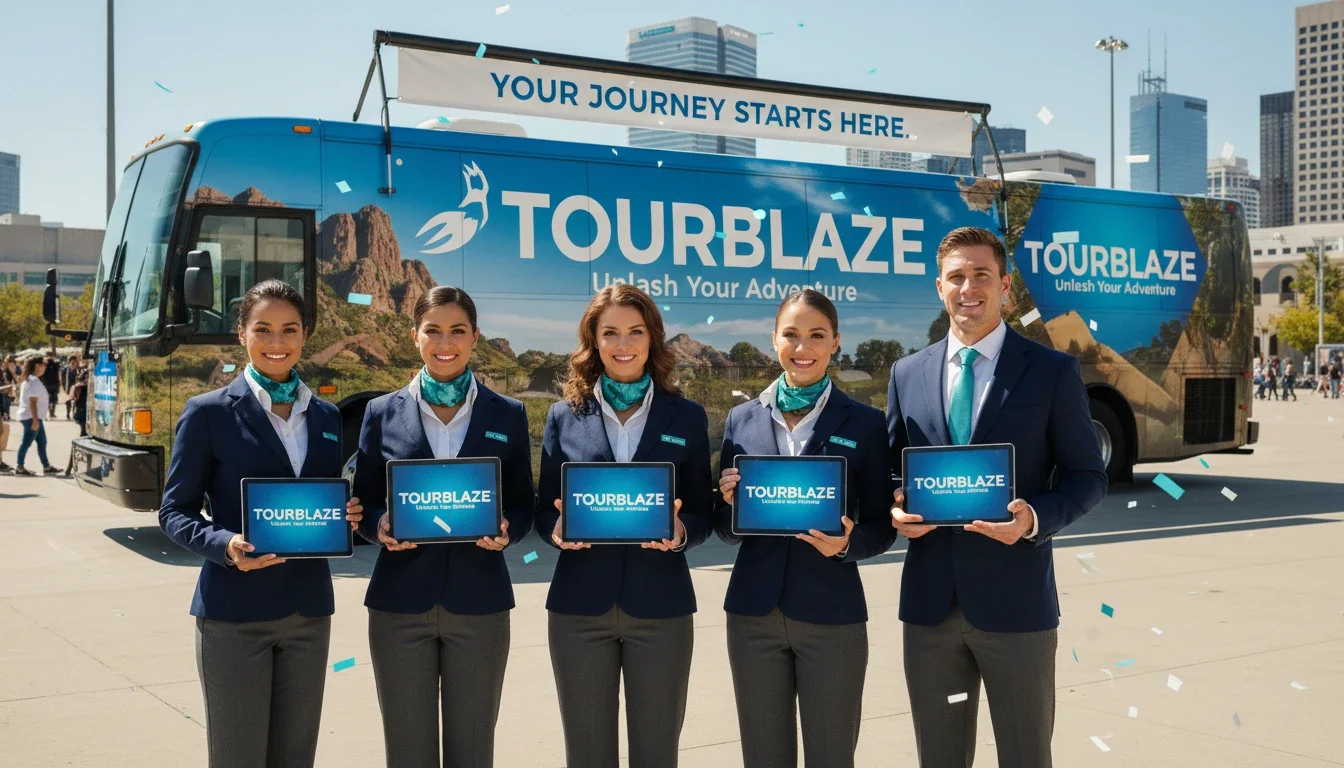
A professional brand activation team ready to represent your tour
A brand tour lives or dies by the people standing in front of consumers. You can have the most creative concept, the most eye-catching truck wrap, and the best product on the market — but if the team representing your brand misses the mark, the whole investment suffers.
Brand tour activation staffing is the discipline of identifying, hiring, training, and deploying the right combination of talent across every stop on your tour. Done well, it transforms individual activations into a consistent, memorable experience that compounds market by market. Done poorly, it creates brand inconsistency, no-shows, and consumer impressions that you can't take back.
This guide breaks down every component of planning the perfect activation team — from defining the roles you need to managing the logistics of a multi-city rollout — so you can walk into every market ready to perform at your best.
What Is Brand Tour Activation Staffing?
Brand tour activation staffing is the process of sourcing, vetting, training, and managing event staff who represent a brand across multiple locations during a marketing tour or experiential campaign. Unlike general event staffing — which might cover a one-off conference or gala — tour activation staffing requires consistency across markets, coordinated logistics for traveling and local talent, and a deep alignment between staff behavior and brand messaging.
A well-staffed brand tour delivers the same consumer experience in Atlanta as it does in Los Angeles. The staff is the variable most likely to introduce inconsistency, which is why activations that invest in professional, brand-trained teams consistently outperform those that don't.
Why the Right Staff Makes or Breaks Your Activation
Brands spend enormous budgets on vehicles, fabrication, permits, and media — and then underinvest in the people consumers actually interact with. It's a costly mistake.
Consider what's at stake. The average consumer makes a judgment about a brand interaction in the first two to three seconds of contact. If the person they meet is underprepared, unenthusiastic, or unfamiliar with the product, that impression sticks — not just with that consumer, but across the social content they create and the conversations they have afterward.
Conversely, a skilled, brand-immersed activation team can turn a 30-second sample handout into a genuine brand story moment. They gather data, generate social content, answer detailed questions, and move consumers through the marketing funnel in ways that passive signage never can.
Staffing is not a line item to minimize. It's the delivery mechanism for everything else your marketing investment is trying to accomplish.
The Core Staff Roles You Need for a Brand Tour
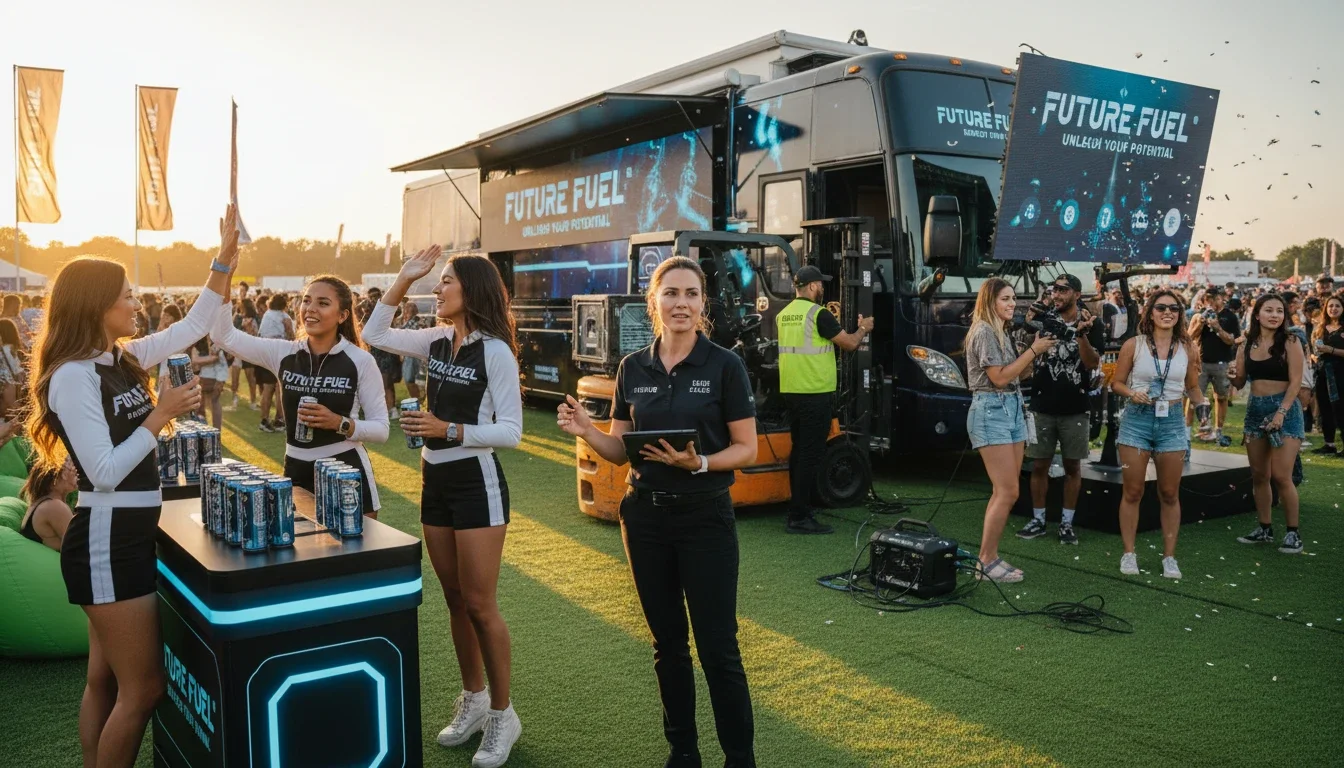
The five essential staff roles in a brand tour activation team
Not every tour needs the same configuration, but most successful brand tour activations require some version of the following team structure.
Tour Manager / Event Lead
The Tour Manager — sometimes called the Event Lead or Field Manager — is the operational backbone of the activation. This person is responsible for on-site setup, staff management, schedule adherence, reporting, and real-time problem solving. On multi-city tours, you'll typically have either a single traveling Tour Manager or a dedicated Event Lead at each market.
Strong Tour Managers have experience in experiential marketing execution, are comfortable making decisions under pressure, and serve as the bridge between your brand's goals and what's happening on the ground. When evaluating candidates or agencies, look specifically for experience managing mobile or touring activations — not just single-location events.
Brand Ambassadors
Brand Ambassadors are the face of the activation. They engage directly with consumers, deliver your key messages, distribute samples or collateral, collect consumer data, and create the kind of face-to-face interactions that build brand loyalty. For a brand tour, you typically need two to five Ambassadors per market, depending on activation size.
The best brand ambassadors for touring activations are articulate, outgoing, adaptable, and genuinely curious about the people they meet. They shouldn't be reading from a script — they should understand the brand well enough to have authentic, natural conversations. This comes from quality briefing and training before day one, which we'll cover in detail below.
Street Team Staff
Street Team staff extend the reach of your activation beyond the activation footprint itself. They distribute collateral, drive foot traffic to the main experiential area, create buzz in surrounding areas, and maximize the number of consumer touchpoints your team generates per market.
On a brand tour, street teams are especially valuable when you're activating in high-foot-traffic outdoor venues — music festivals, college campuses, sporting events, or downtown districts. They create the buzz that pulls consumers toward your brand experience.
Experiential / Engagement Staff
Depending on your activation concept, you may need staff with specific skills: product demonstrators, sampling specialists, interactive experience guides, or promotional models who anchor specific brand moments. These roles are distinct from general brand ambassadors — they're embedded in a specific experience moment within the activation.
For product-heavy activations, demonstrators need hands-on training with the product. For immersive experience activations, these staff members need to understand the narrative arc of the experience and guide consumers through it authentically.
Production Assistants
Production Assistants handle the operational and logistical tasks that keep an activation running smoothly: setup, teardown, inventory management, asset organization, load-in and load-out, and general support for the Tour Manager. On large-scale touring activations, having dedicated PA support frees your consumer-facing staff to stay focused entirely on engagement.
The ratio of PAs to ambassadors varies by activation complexity, but a general rule of thumb is one PA per four to six consumer-facing staff, or one PA per major setup task that needs dedicated management.
How to Plan Your Brand Tour Staffing: A Step-by-Step Timeline
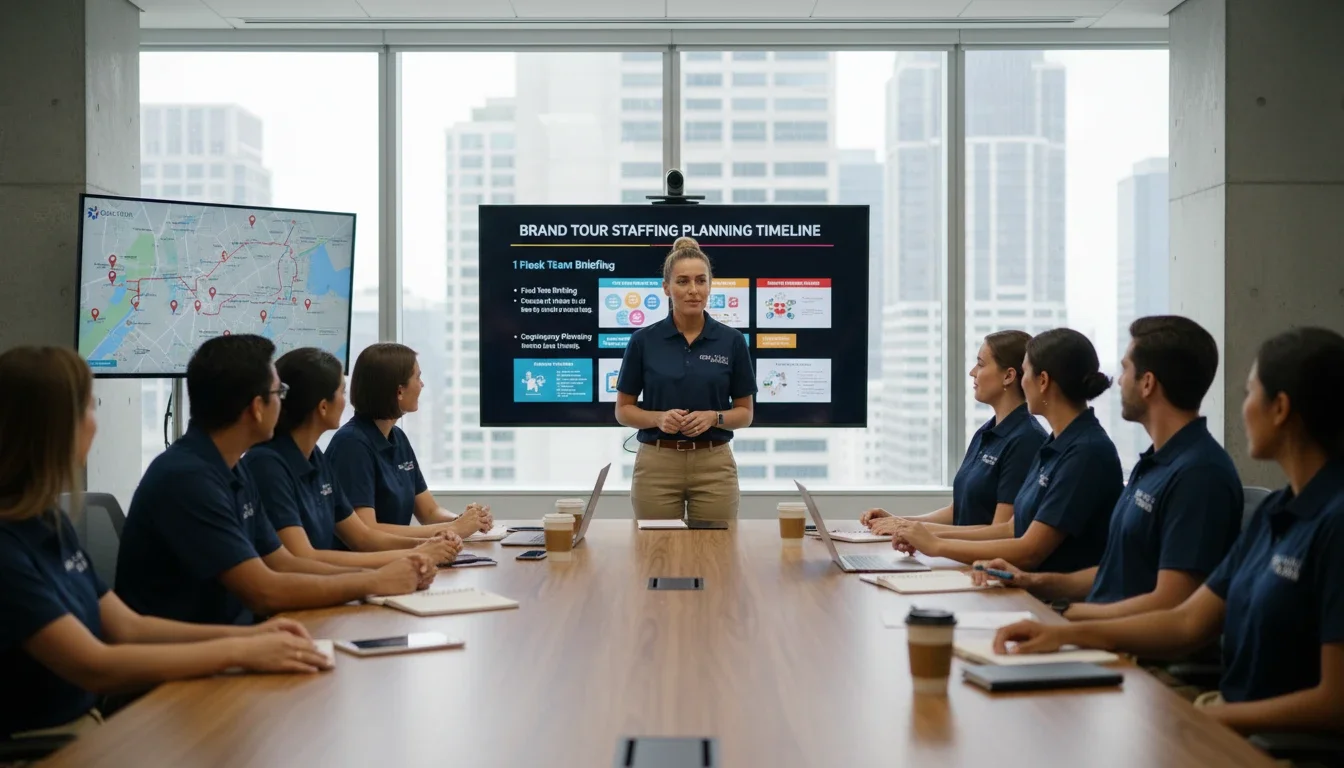
Brand tour staffing planning timeline from 12 weeks out to post-tour debrief
The biggest mistake brands make in tour staffing is starting too late. Staffing a multi-city activation is not a two-week task. Here is the timeline framework that experienced tour producers use.
8–12 Weeks Before the Tour
Define your full tour schedule: dates, cities, venues, and activation footprint at each stop.
Determine your staffing configuration: roles needed, headcount per market, and whether key staff will travel the full tour or be sourced locally.
Identify and brief your staffing agency. Share your brand guidelines, activation concept, target demographic, staff appearance requirements, and key messaging.
Establish the selection process: will you review staff profiles and select preferred team members yourself, or delegate fully to the agency?
Confirm insurance coverage and any market-specific permit or credential requirements (food handling, bartending certifications, etc.).
Set up your reporting framework: what data will staff collect at each stop? Leads, samples distributed, photos, consumer feedback?
4–6 Weeks Before the Tour
Finalize staff selections for each market. If your staffing partner allows it, review bios, photos, and experience profiles for key roles.
Confirm uniforms and branded attire: specify exactly what staff should wear at each activation. Share a visual reference if possible.
Conduct initial brand training for traveling staff. Provide product samples, brand story materials, key messaging documents, and FAQ prep.
Confirm backup coverage: Every professional staffing agency should have a briefed backup for each critical role. Confirm this explicitly.
Brief the Tour Manager on your full tour logistics: route, venue contacts, load-in windows, and any market-specific notes.
1–2 Weeks Before the Tour
Distribute final staff briefing documents to all team members — not just the Tour Manager. Every person who touches the activation should understand the brand, the goals, and their specific role.
Confirm all local staff have received their briefing and understand the activation concept.
Run through contingency scenarios with the Tour Manager: what happens if a staff member cancels, if weather forces an activation to move, or if consumer volume exceeds expectations?
Do a final equipment and asset check for traveling components.
Confirm staff call times, parking/access details, and on-site contact information for each market.
Day of the Activation
Conduct a pre-activation team walkthrough: confirm each staff member's positioning, talking points, and data collection responsibilities.
Establish a communication channel for real-time updates during the activation — a group chat with the Tour Manager and agency operations contact.
Brief the team on crowd flow, activation zones, and any time-sensitive moments (celebrity appearances, media windows, sample releases).
Ensure your agency's operations team is reachable in real time — not via an email inbox. Issues that arise on-site need live resolution, not a next-day response.
Post-Tour Debrief
Collect post-market reports from each stop: data metrics, staff performance notes, consumer feedback, and asset condition.
Identify market-specific takeaways: what worked in one city that should be implemented across remaining stops?
Rate and note preferred staff — great performers should be flagged for future activations.
Compile the full tour wrap report: total consumer interactions, leads captured, samples distributed, and a qualitative assessment of brand experience consistency across markets.
Traveling Staff vs. Local Staff: Which Is Right for Your Tour?
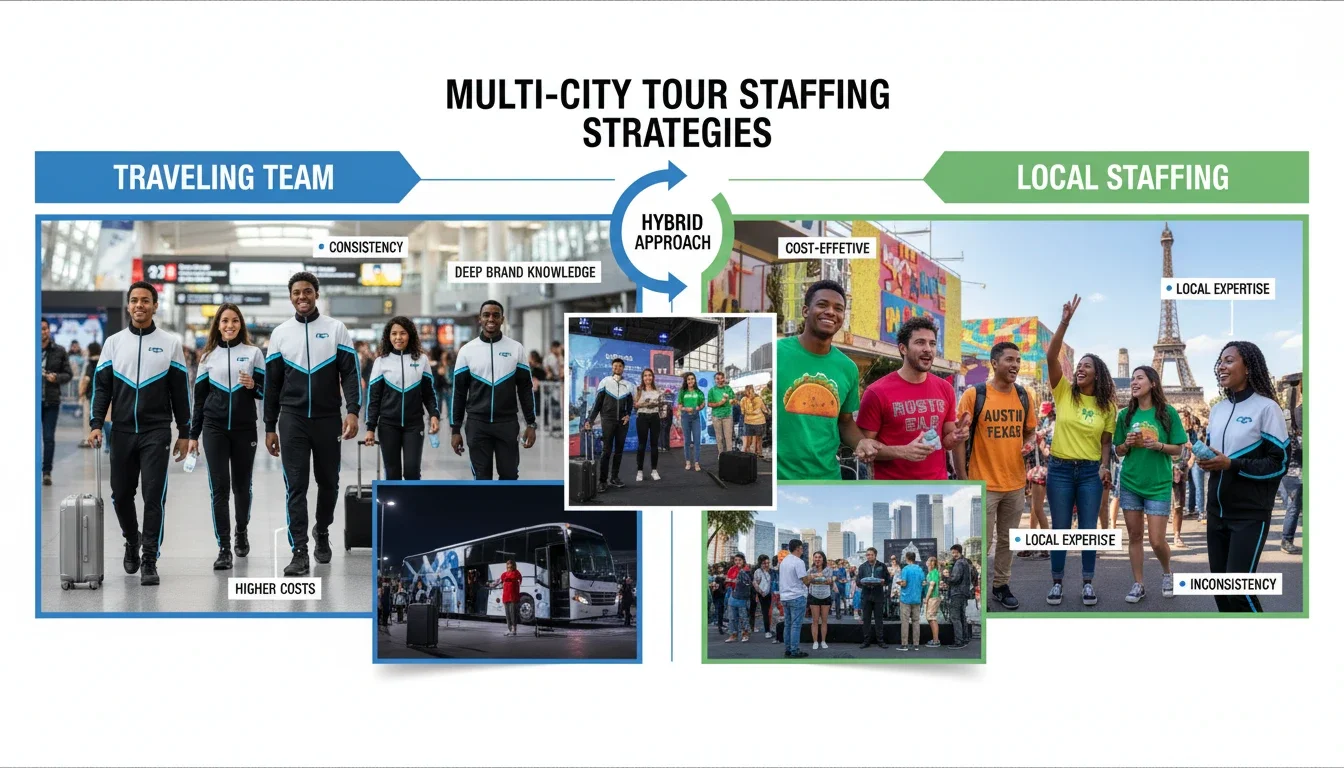
Comparing traveling and local brand ambassador staffing strategies for multi-city tours
One of the most consequential decisions in tour staffing is how to balance traveling staff (who follow the tour from city to city) and locally sourced talent (hired market-by-market). Each approach has real advantages and tradeoffs.
Pros and Cons of Traveling Staff
Traveling staff offer one major advantage above all else: consistency. A team that has worked together from stop one will have refined the activation experience by stop three. They know the product inside out, they know the setup routine, and they know how to read crowds. This consistency compounds — activations that use consistent traveling teams typically improve in quality and efficiency as the tour progresses.
The tradeoff is cost and logistics. Traveling staff require accommodation, transportation, and per diem budgets. They can also experience fatigue on long tours, particularly if the activation schedule is aggressive. For tours spanning more than four to six weeks, even dedicated traveling staff typically need scheduled rotation or rest stops.
When to Hire Locally
Local staff is cost-effective for markets where the tour has a single activation day or where your touring team simply can't expand further. They bring authentic local knowledge and regional market fluency that traveling staff often can't replicate — this matters particularly for activations targeting specific cultural communities or regional audiences.
The challenge with local staffing is quality control and training. Local staff have less immersion time before the activation and may not have the same depth of brand knowledge as the core touring team. This is where a staffing agency with an established, rated local roster in each market is essential — you want professionals who can receive a briefing quickly and execute confidently, not new hires being onboarded the morning of.
Hybrid Approach: Best of Both Worlds
Most experienced tour producers use a hybrid model: a small core team of two to three highly trained traveling staff (typically the Tour Manager, a lead Brand Ambassador, and possibly an Experiential Specialist) who travel the full tour, supplemented by locally sourced staff in each market.
This approach preserves consistency at the leadership and consumer-engagement levels while keeping travel and accommodation costs contained. The core travelers ensure the local team is briefed, integrated, and executing to brand standards within the first hour of setup.
How to Brief and Train Your Activation Team
Even the best-hired staff will underperform without proper briefing. Brand training for activation teams is not optional — it's the difference between staff who represent your brand and staff who simply show up.
Brand Immersion Before Day One
Provide staff with a brand immersion package at least one week before the first activation. This should include:
Brand story and core values overview
Product details, ingredients, or key selling points (as applicable)
Target consumer profile — who are they trying to reach?
Key messaging: top three to five things staff should communicate
Common consumer questions and suggested responses
Competitor context: what alternatives exist, and what makes this brand different?
Social media handles and hashtags for consumer-generated content
Branded content guidelines (what staff can and cannot post personally)
For teams sourced through an agency, the agency's account manager should oversee the distribution and confirmation of this briefing package — not leave it to staff to discover on their own.
On-Site Briefings and Walkthroughs
Every activation should begin with a structured on-site walkthrough led by the Tour Manager. This walkthrough covers:
Set up verification and zone assignments
Confirmation of staff roles and responsibilities for the day
Review of key messaging and common consumer interactions
Reporting and data collection procedures
Emergency procedures and escalation contacts
Energy check — this is the moment to establish the team's mindset before consumers arrive
A 15-minute walkthrough executed well creates the team cohesion and clarity that prevents the small errors that compound into a poor consumer experience.
Backup Coverage and Contingency Planning
No-shows happen — even with the most professional staff. The safest brands on tour are those whose staffing partners guarantee backup coverage as a standard part of the agreement, not a last-minute scramble.
When evaluating staffing agencies for your tour, ask specifically: do you include a briefed backup for every critical role? Can you guarantee a qualified replacement with equivalent brand training if someone cancels within 24 hours? The answer to these questions separates professional tour staffing partners from reactive platforms.
At Eleven8, every booking includes a pre-briefed backup for every eight staff at no additional charge. Your activation runs at full strength regardless of last-minute changes — because the backup is already prepared, not recruited after the fact.
What to Look for in a Brand Tour Staffing Agency
Choosing the right staffing partner for a brand tour is different from booking event staff for a one-day corporate event. Multi-city touring activations require an agency with specific capabilities. Before you commit, ask these questions:
Do you have an established local roster in every market on my tour, or do you recruit on demand? A roster means speed, reliability, and quality. Recruiting on demand means uncertainty.
Can I review and select my preferred staff before the tour begins? Professional agencies offer photo portfolios, bios, and experience histories. You should be choosing your team, not accepting whoever is available.
What does your backup coverage policy look like? Is it a guaranteed service or a best-effort?
Do you have a dedicated account manager who will be reachable on event day? Not a shared inbox — a single point of contact who knows your tour.
What is your average staff rating, and how do you handle underperforming staff mid-tour? A feedback system with real accountability is non-negotiable for multi-stop activations.
What is your fulfillment rate? An agency should be able to tell you exactly how often they fill bookings completely and on time.
Are your staff fully insured? Workers' compensation, general liability, and umbrella coverage should all be standard — not optional add-ons.
Measuring Success: KPIs for Your Tour Activation Team
Staffing metrics matter. A well-run brand tour generates trackable data at every stop, and your activation team is a critical part of that data collection infrastructure. The following KPIs should be tracked consistently across every market:
Consumer interactions: total number of meaningful engagements per shift
Samples or materials distributed: by type and by market
Lead capture rate: opt-ins, email signups, app downloads, or contest entries per interaction
Social engagement: user-generated content created and tagged, branded hashtag usage
Net Promoter Score (NPS): captured through brief on-site surveys or QR code feedback forms
Staff performance ratings: post-shift feedback from the Tour Manager and client contact
Fulfillment compliance: on-time arrival rate, full headcount maintained, zero no-shows
Tracking these metrics at the individual staff and market level allows you to identify which staff are your highest performers, which markets need adjustments, and how the activation quality evolves across the tour. This data feeds directly into post-tour debrief reports and informs smarter staffing decisions for future campaigns.