How to Staff a Trade Show in Tampa: A Complete Guide for Exhibitors
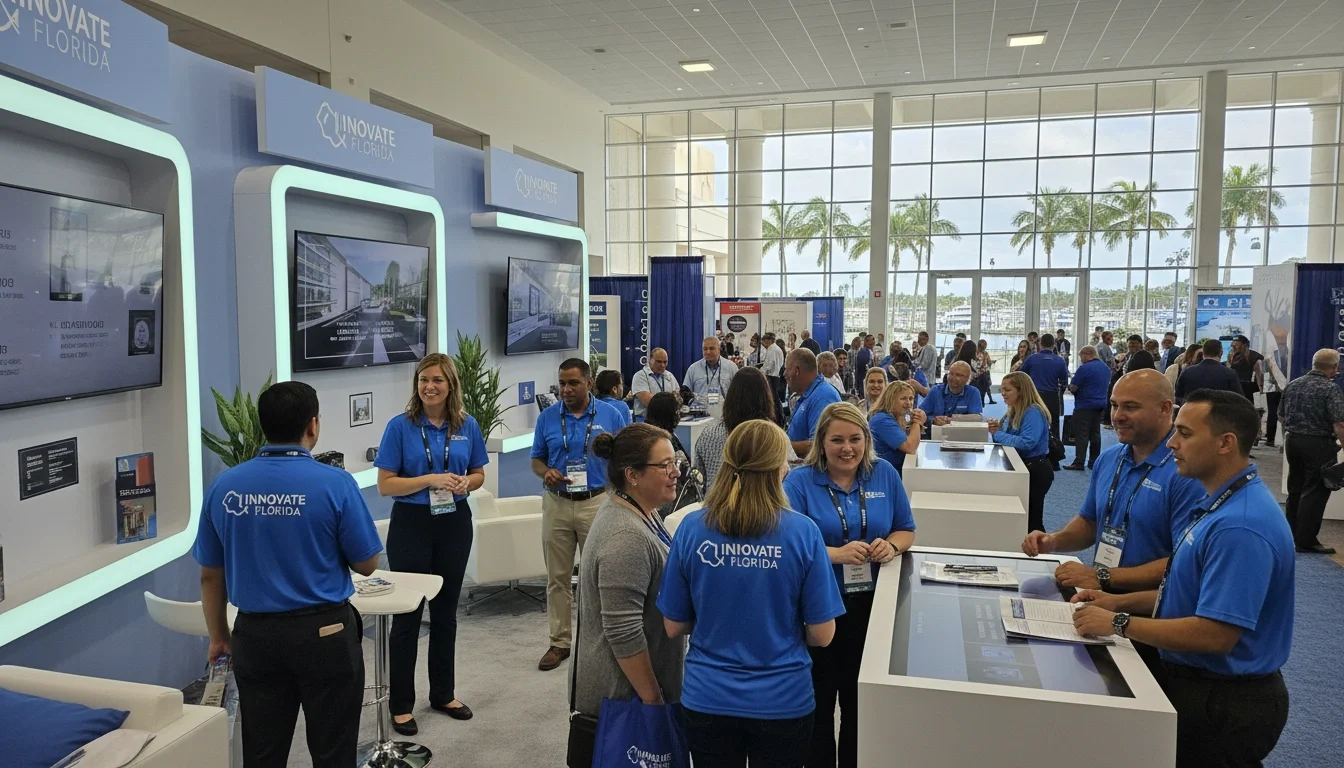
Professional trade show booth staff engaging attendees at the Tampa Convention Center
Your booth can be perfectly designed, your product can be market-ready, and your location can be prime — but if the people staffing your exhibit aren't performing, the ROI simply isn't there. That's the reality of trade show participation, and it's why staffing decisions deserve the same attention as any other line item in your event budget.
Tampa has emerged as one of the Southeast's most active trade show markets. With the Tampa Convention Center projecting more than 326,000 attendees and $149 million in economic impact for 2026 alone, the competition for attendee attention is intense. The brands that walk away with qualified leads and lasting connections are almost always the ones with the right people on the floor.
This guide covers everything you need to know — from identifying the right staff roles and calculating headcount, to training your team, navigating Florida labor law, and deciding when to partner with a professional event staffing agency.
Why Tampa Is a Top Trade Show Destination
Tampa has quietly become one of the most important convention cities in the South. The city offers a compelling combination of world-class infrastructure, a growing business community, and a year-round climate that supports an active event calendar.
The Tampa Convention Center sits at the heart of it all. A multi-award-winning waterfront venue, it has earned the Gold Medal for Best Convention Center from the Stella Awards three years in a row, along with recognition from ConventionSouth Media Group and Smart Meetings. These aren't just accolades — they reflect the kind of experience that draws national associations, Fortune 500 companies, and high-profile trade shows to Tampa year after year.
Key Venues for Trade Shows in Tampa
Tampa Convention Center — 600,000+ sq ft of flexible event space in downtown Tampa, the primary home for major expos and conventions
Florida State Fairgrounds Expo Hall — popular for consumer shows, boat shows, and home expos
Amalie Arena — home to large-scale consumer events and corporate activations
The Westin Tampa Waterside and Marriott Water Street — premium hotel ballroom venues for mid-size shows
Each venue has its own exhibitor services, credentialing requirements, and logistical constraints. Understanding the specifics of where you're exhibiting shapes your staffing approach from the start.
Tampa's Trade Show Calendar
Tampa's event schedule peaks in the spring and fall, with corporate and convention activity tapering slightly during peak summer heat. Notable recurring events include:
EXHIBITORLIVE — the annual gathering for trade show and event marketing professionals, held at the Tampa Convention Center
Tampa Build Expo — construction and building industry, drawing 200+ exhibitors
The Great American Franchise Expo — franchising industry, free admission, large public attendance
Florida Health Care Expo — healthcare professionals and vendors
Florida Restaurant & Lodging Show — hospitality industry
Tampa Bay Boat Show — Florida State Fairgrounds
Booking your staffing early matters. The best agencies in Tampa fill their rosters quickly around peak show dates, and last-minute requests for specialized roles — product demonstrators, bilingual brand ambassadors, lead capture specialists — are harder to fulfill at full quality.
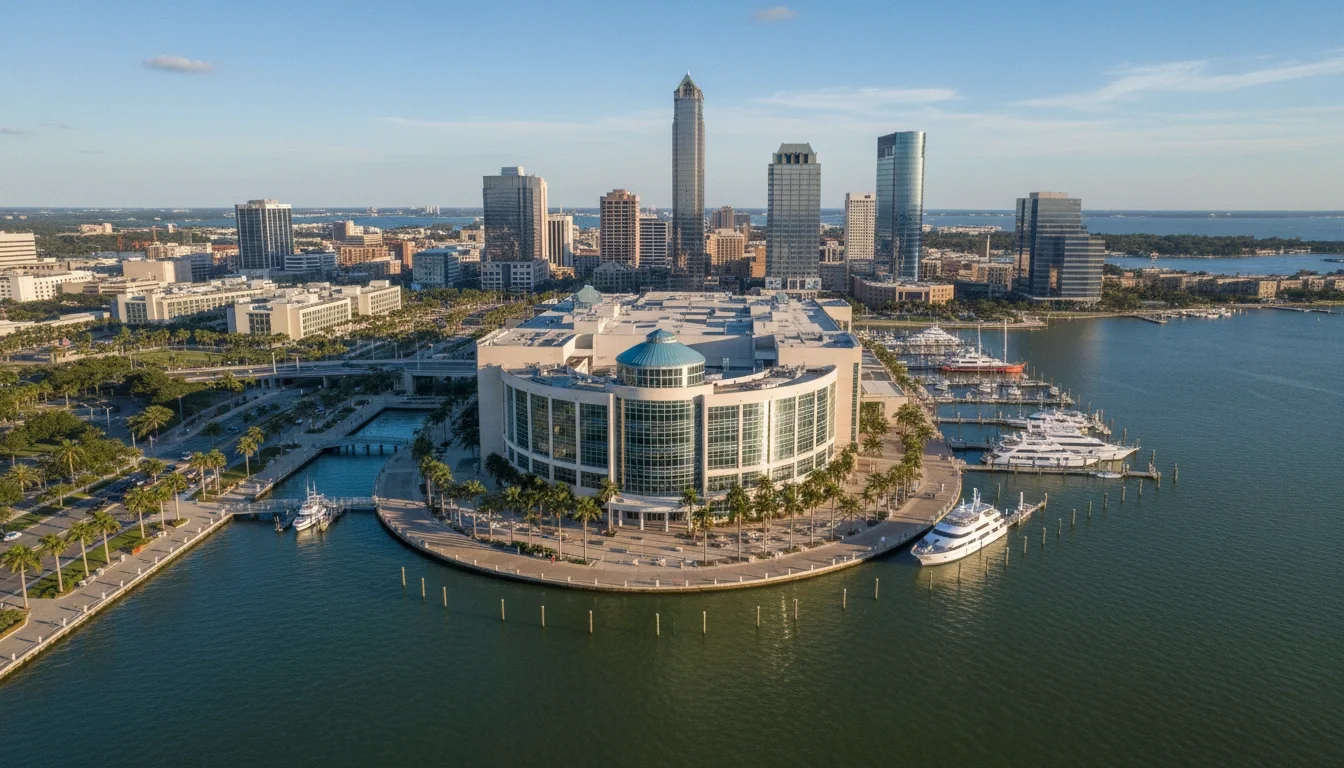
Aerial view of the Tampa Convention Center waterfront venue
The Core Staff Roles at a Trade Show Booth
Trade show staffing is not one-size-fits-all. The roles you need depend on your booth size, your objectives, the nature of your product or service, and the type of audience attending the show. Here's a breakdown of the most common roles and what each one actually does.
Brand Ambassadors
Brand ambassadors are your booth's front line. Their job is to draw qualified attendees into the conversation — not to hard-sell, but to create the kind of warm, engaging interaction that makes your brand memorable. The best brand ambassadors are outgoing, well-briefed on your core message, and skilled at quickly qualifying whether a visitor is worth a longer conversation.
For a trade show in Tampa, where attendees are often professionals attending on a specific budget of time, a sharp brand ambassador who can deliver a 30-second value proposition clearly is worth more than five staffers standing idle at the back of the booth.
Booth Hosts and Product Demonstrators
If your exhibit involves a product demo, a tech platform, or a hands-on experience, you need dedicated demonstration staff. These are people who can operate the demo comfortably, field technical questions, and guide attendees through the experience without losing energy over an 8-hour show day.
Product demonstrators should be briefed on both the demo and the most common objections or questions they'll encounter. Comfort with the material is what allows them to focus on the attendee experience rather than the mechanics.
Registration and Check-In Staff
For shows where your booth includes gated sessions, demos by appointment, or tracked lead capture, a dedicated check-in staff member keeps the process smooth. These roles require organization, attention to detail, and a friendly demeanor under pressure — especially during high-traffic periods.
Lead Capture Specialists
Lead capture is where your trade show investment converts into a pipeline. Whether you're using a badge scanner, a landing page, a paper form, or a custom lead retrieval system, you need staff who understand the goal: qualify the lead and capture the right information. A lead capture specialist who doesn't understand the difference between a hot prospect and a casual browser is a significant liability at a high-cost show.
Event Supervisors and Booth Managers
For larger booths or multi-day exhibitions, a dedicated on-site supervisor makes a meaningful difference. This person manages the staff schedule, resolves issues in real time, communicates with the show organizer, and ensures the booth runs at full strength from open to close. Think of this role as your on-the-ground operations manager so you can focus on high-value conversations.
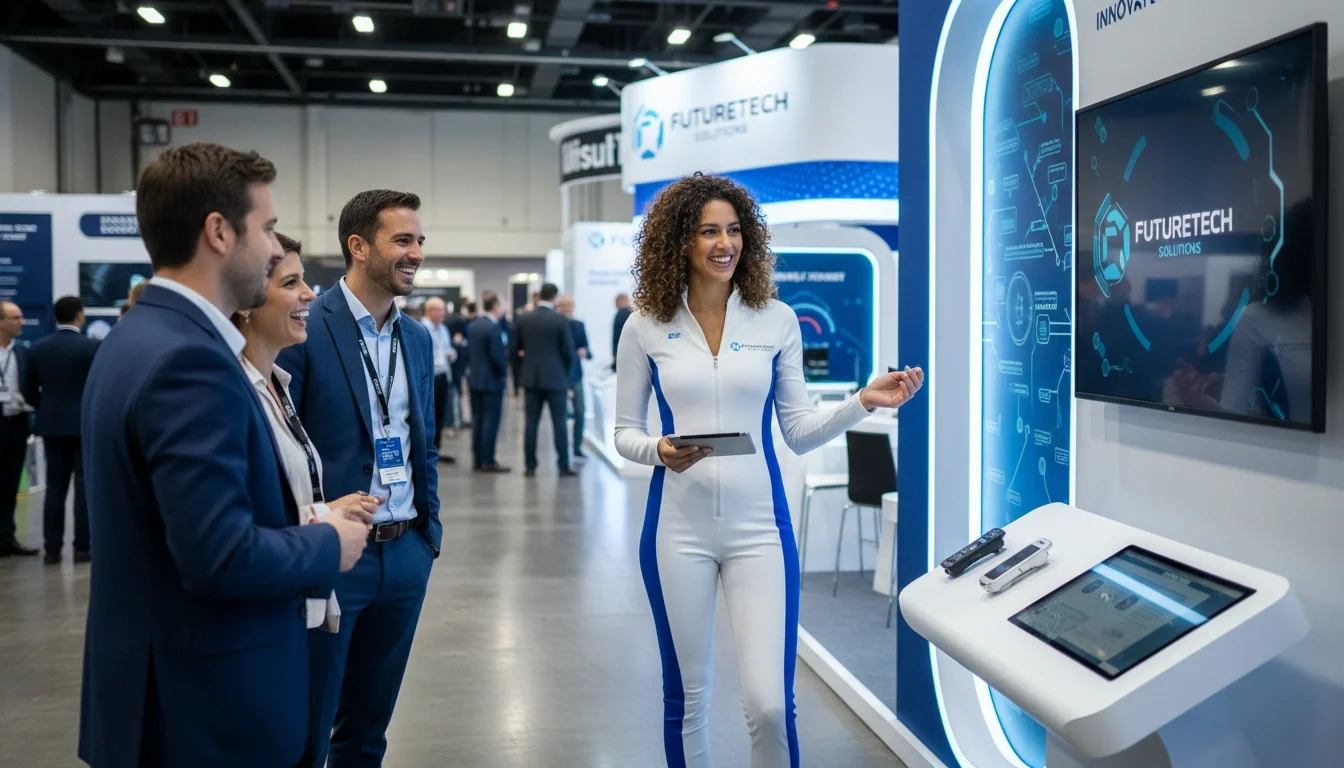
Trade show brand ambassador engaging visitors at an expo booth
How Many Staff Do You Need for Your Booth?
Over-staffing a booth makes it feel crowded and disorganized. Under-staffing it means missed leads and a poor attendee experience. Getting the headcount right requires a formula — and an honest assessment of your show-day goals.
The 50 Sq Ft Rule
The widely used industry standard is one staff member per 50 square feet of active exhibit space. This is the working area of your booth — not storage or display-only zones. A standard 10x10 booth (100 sq ft) comfortably supports 2 staff members. A 20x20 island booth (400 sq ft) typically needs 6-8 staff, depending on traffic and activities.
Staffing by Booth Size
| Booth Size | Recommended Staff | Notes |
|---|---|---|
| 10x10 (100 sq ft) | 2–3 | Ideal for 1 BA + 1 lead capture or demo staff |
| 10x20 (200 sq ft) | 3–4 | Add 1 floater or dedicated check-in for session booths |
| 20x20 (400 sq ft) | 6–8 | Separate roles: BA, demo, lead capture, supervisor |
| 30x30+ (900 sq ft) | 10–15+ | Requires supervisor, full role breakdown, shift planning |
Adjusting for Event Type and Traffic Volume
The 50 sq ft rule is a baseline, not a ceiling. High-traffic shows — those drawing 10,000+ attendees over two days — demand higher staffing density and shift rotations to keep energy levels up throughout the day. Consumer-facing shows typically need more customer-engagement staff, while B2B shows benefit from fewer but more knowledgeable staff who can handle detailed product conversations.
Multi-day shows introduce fatigue management as a staffing variable. A staff member performing well on Day 1 may be visibly depleted by Day 2 afternoon if no rotation is built into the schedule. Plan for this — it directly affects your lead quality and brand impression.
Building a Pre-Show Staffing Strategy
The most common mistake exhibitors make is treating staffing as a logistics problem to solve in the final week before a show. In reality, your staffing strategy should be built at the same time as your booth design — because the two are deeply connected.
Define Goals Before You Define Headcount
Are you trying to maximize lead volume? Generate brand awareness? Conduct appointments with pre-registered prospects? Close sales at the booth? Each of these objectives calls for a different staff composition and training focus. A lead generation booth needs high-energy, outgoing ambassadors trained in quick qualification. A premium brand experience needs fewer but more polished staff who can hold longer, substantive conversations.
Write down your top three show goals before you build your staff plan. Every staffing decision — how many people, what roles, what training, what uniform — should flow from those goals.
Staff Briefing and Brand Training
Research from the Center for Exhibition Industry Research (CEIR) shows that 80% of trade show visitors form their impression of your brand based on their brief encounter with your booth staff. Yet the same research has found that staff training accounts for historically less than 2% of the average trade show budget. That gap represents a significant opportunity.
At a minimum, every staff member working your Tampa booth should know:
The company's core value proposition in one sentence
The three most common attendee questions and the correct answers
The goal for each interaction (lead capture, demo booking, brand impression)
How to use your lead retrieval system
The booth layout, product locations, and where to direct specific inquiries
A 60-minute pre-show briefing the morning of your first show day is non-negotiable. Use it to align the team, walk through the space, and set the tone.
Uniforms, Dress Code, and Brand Presentation
Visual consistency matters on the show floor. A unified look makes your team instantly identifiable to attendees and signals professionalism. Whether you opt for branded polo shirts, branded lanyards over business attire, or a custom uniform, communicate the requirements clearly before show day — and provide staff with enough lead time to obtain or prepare the right attire.
Many professional staffing agencies, including Eleven8, routinely outfit staff in client-provided branded uniforms. A good agency will confirm attire requirements during booking and communicate those details to every staff member ahead of the event.
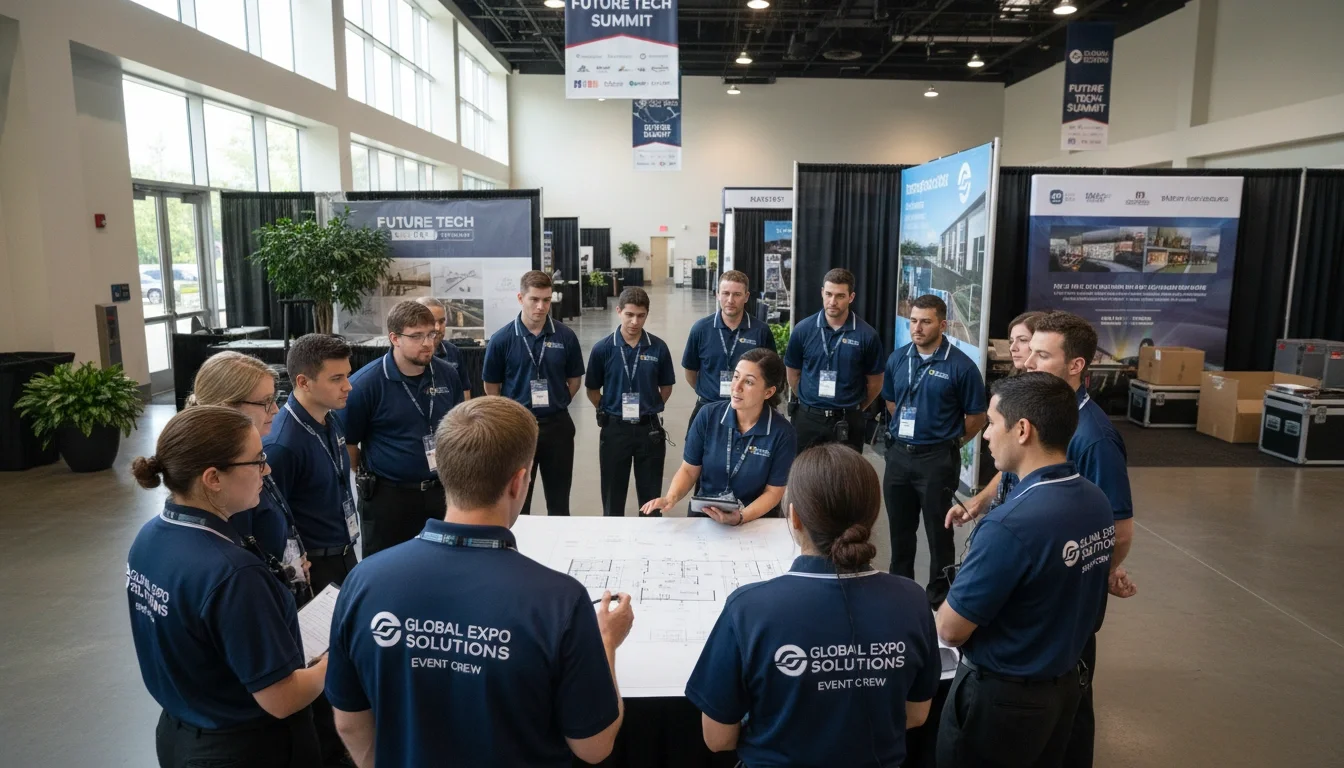
Event staff in branded uniforms conducting a pre-show briefing before a trade show
In-House Staff vs. a Professional Staffing Agency
This is the decision most exhibiting companies wrestle with — and there's no universal right answer. The right choice depends on your show goals, your internal team's availability, the nature of your product, and your budget.
When to Use Your Internal Team
Your internal staff has a depth of product knowledge that no external hire can replicate overnight. If your booth experience relies heavily on technical expertise, ongoing customer relationships, or high-stakes sales conversations, having your actual sales engineers or account managers present is often the right call.
The trade-off is fatigue and availability. Your team is likely attending the show for multiple purposes — meetings, sessions, networking — in addition to working the booth. If they're not fully present at the exhibit, the experience suffers.
When a Tampa Staffing Agency Makes More Sense
A professional event staffing agency fills the gaps your internal team can't cover — and often outperforms on pure engagement metrics because that's their only job at the show. The right agency brings:
Pre-vetted, experienced trade show staff who know how to operate in a high-traffic exhibit environment
Flexibility to scale headcount up or down based on show-day demand
Built-in backup coverage so no-shows don't derail your event
Staff trained in lead retrieval, brand presentation, and attendee engagement
Liability insurance and workers' compensation coverage
For Tampa shows in particular, a local or nationally deployed agency with a Florida presence can fill your roster quickly, understands Tampa venue logistics, and can respond to day-of issues without the complications of flying in staff from other markets.
What to Look for in a Trade Show Staffing Agency
Not all staffing agencies are built for trade shows. When evaluating a vendor for your Tampa exhibit, look for:
A rigorous vetting process — agencies that accept everyone offer the same experience as random hiring; you want a selective agency with a meaningful acceptance rate
Verified fulfillment rates — ask specifically about no-show policies and backup coverage. The best agencies include a brief backup for every set of staff at no additional charge.
Trade show-specific experience — brand ambassador experience does not automatically translate to trade show expertise; ask for examples
Transparent pricing — flat hourly rates with no hidden agency fees make budget planning straightforward
A dedicated account manager — a single point of contact from booking through post-event debrief prevents miscommunication and ensures accountability
Proof of insurance — a Certificate of Insurance (COI) should be available on request, covering general liability and workers' compensation
Compliance and Logistics in Tampa
Florida's event staffing landscape has specific legal and logistical considerations that exhibitors — especially those coming from out of state — should understand before show day.
Florida Labor Law Basics for Event Staff
Florida is a right-to-work state, meaning union membership cannot be required as a condition of employment. This generally creates a more flexible staffing environment than markets like Las Vegas or Chicago, where union rules more commonly govern certain event labor categories.
However, the Fair Labor Standards Act (FLSA) governs overtime at the federal level, and worker classification is a meaningful compliance issue. Event staff should be properly classified — a reputable agency employs its staff as W-2 employees, covering workers' compensation, payroll taxes, and unemployment insurance, rather than misclassifying them as 1099 contractors. Misclassification creates legal exposure for exhibiting companies that could outlast the show itself.
Venue Credentialing and Badge Requirements
The Tampa Convention Center and most major Tampa venues require advance contractor registration for event staff. Photo ID verification is standard. If your staffing agency isn't already credentialed with the venue, allow extra lead time for the process — and confirm badge requirements when you book your exhibit space.
For multi-day shows, coordinate with your staffing agency to ensure all staff have the appropriate credentials before the first day of load-in, not on the morning of the show.
Insurance and Liability Coverage
Verify that any staffing agency you work with carries: general liability insurance, workers' compensation covering all staff placed at your booth, and preferably excess and umbrella coverage for high-traffic events. Request a COI before signing any agreement, and confirm your company can be named as an additional insured if required by the venue or show organizer.
On-Site Management and Performance
Having the right people in place is step one. Keeping them performing at a high level from booth open to booth close — across a multi-day show — requires active on-site management.
Running a Pre-Show Staff Briefing
Every show day should start with a team briefing. Keep it focused: review goals, confirm roles, walk through any changes from the previous day, address questions, and set the energy. A 15–20 minute briefing done consistently is one of the highest-ROI activities at any trade show. Staff who feel aligned, informed, and energized perform better in attendee interactions within minutes of the booth opening.
Managing Staff Energy Across Multi-Day Shows
Trade show days are physically and mentally demanding. Staff are standing for 8–10 hours, having hundreds of conversations, and projecting energy even when they don't feel it. Build rotation schedules for multi-day events, ensure staff have time for meals and breaks, and designate a quiet space for rest where possible.
Small daily recognition moments — acknowledging the staff member with the most leads captured, or the one who received a spontaneous compliment from an attendee — maintain team morale and healthy competition across show days.
Real-Time Issue Resolution
Issues will arise. A staff member may not show up. Equipment may malfunction. An unexpected rush may overwhelm your headcount. The difference between an agency and a staffing marketplace is what happens when things go wrong.
A professional agency should have 24/7 event-day support — a live person you can reach immediately to resolve issues, dispatch a backup, or adjust logistics. If your agency's answer to real-time problems is a shared email inbox or a voicemail, that's a risk that doesn't need to be taken on a high-stakes show day.
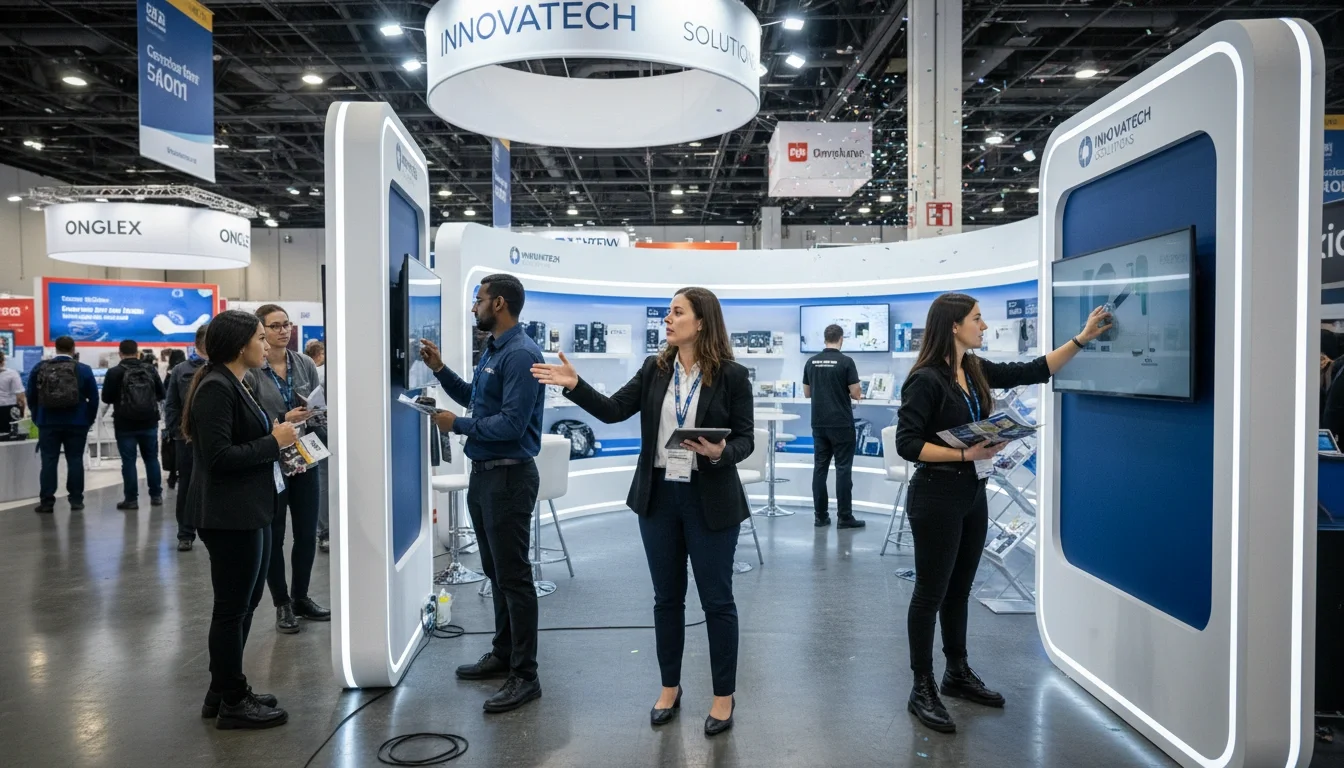
Event supervisor managing booth staff during a busy trade show day
Measuring Your Trade Show Staff ROI
The investment in quality staffing is real. The return on that investment — in leads generated, brand impressions made, and partnerships initiated — is measurable if you set up the right tracking framework before the show.
Tracking Lead Volume and Quality
Define what a 'lead' means for your exhibit before the show, and communicate that definition clearly to every staff member. A quantity-over-quality lead capture approach fills your CRM with contacts who will never convert. Quality lead capture means staff are qualifying attendees, noting specific interests, and flagging high-priority follow-ups.
Most major trade shows offer badge-scanning lead retrieval systems. Supplement these with structured notes — even a simple rating of hot/warm/cold and a one-line context note for each lead dramatically improves post-show follow-up performance.
Post-Show Debrief
Within 24–48 hours of the show closing, debrief with your staff and your staffing agency. What worked? What didn't? Which staff performed well and should be requested again? Which processes should be adjusted for the next event?
A quality agency will proactively conduct post-event feedback and share performance data with you. Eleven8, for example, collects ratings on every staff member after every event — which means by the time you're booking your next Tampa show, you have performance history to draw from when selecting your team.
How Eleven8 Event Staff Supports Tampa Exhibitors
Eleven8 Event Staff is a national premium event staffing agency with an active presence across Florida and 25+ U.S. markets. For exhibitors planning trade shows at the Tampa Convention Center, the Florida State Fairgrounds, or any other Tampa-area venue, Eleven8 provides:
Pre-vetted, trained trade show staff matched to your specific event type and brand requirements
Booth staff, brand ambassadors, product demonstrators, registration staff, and event supervisors
Flat hourly pricing with no agency fees
Built-in backup coverage — one briefed backup for every eight staff, included at no additional charge
A dedicated account manager from inquiry through post-event debrief
24/7 live event-day support
Full liability insurance, workers' compensation, and COI available on request
The ability to select your preferred staff from bios, photos, and prior event history before event day
With more than 34,000 events staffed and an 83% client retention rate, Eleven8 brings the operational depth to handle both the planning and the unpredictable realities of a live trade show environment.
Ready to staff your next Tampa trade show? Get an estimate.