One Fair, Six States: How The Big E Lets Brands Hit All of New England
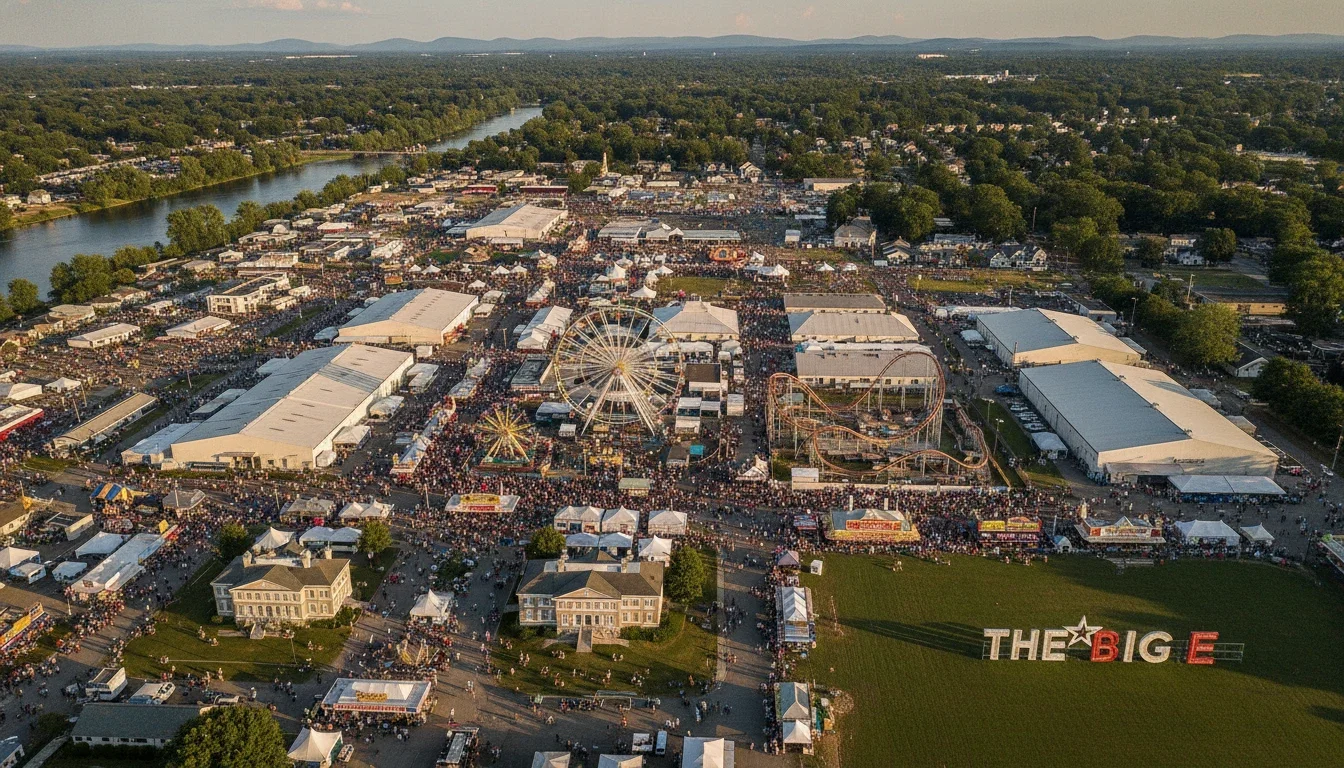
Aerial view of the Eastern States Exposition fairgrounds during The Big E, West Springfield, Massachusetts
There is no other fair like it in the world.
Most state fairs represent one state. The Big E — formally known as the Eastern States Exposition — represents six. Connecticut. Maine. Massachusetts. New Hampshire. Rhode Island. Vermont. All under one roof, across 17 days each September in West Springfield, Massachusetts.
For brand managers and experiential marketing teams, that distinction is not just a novelty. It is a strategic opportunity unlike anything else on the East Coast.
In 2024, The Big E drew a record-breaking 1,633,935 attendees — shattering previous records and welcoming at least 45,000 visitors every single day of its run. In 2025, even after deliberate crowd management changes, the fair still brought in 1,538,463 visitors from all 50 states, Puerto Rico, Canada, Mexico, and beyond.
That is not a local audience. That is New England's consumer base, concentrated and captive, for more than two weeks.
If your brand has been looking for a way to reach the Northeast at scale — without executing six separate state activations — The Big E is the answer you have been overlooking.
What Makes The Big E Different From Every Other State Fair
The World's Only Multi-State Fair
The Big E holds a designation that no other event in North America can claim: it is the world's only multi-state fair.
Organized by the Eastern States Exposition (established in 1917), the fair was built from the beginning to represent all six New England states collectively. That mission is not just ceremonial. It shapes who attends, what they buy, and how they engage with brands on the grounds.
Where the Texas State Fair draws Texans primarily, and the Indiana State Fair pulls mostly Hoosiers, The Big E functions more like a regional cultural convergence — a gathering point for the entire Northeast. Attendees do not just come from Western Massachusetts. They travel from every corner of New England, and increasingly from neighboring states like New York and New Jersey as well.
That geographic diversity is what makes The Big E uniquely powerful for brands. You are not reaching one market. You are reaching six — simultaneously, in a single activation.
Scale That Other Fairs Cannot Match
The Big E is consistently ranked among the top five largest fairs in the United States and Canada. In 2024, it held the title of fourth largest fair in North America by attendance. On its busiest single day that year, 178,608 people passed through the gates — a single-day attendance record.
Stretched across 17 days, that volume gives brands something most activations cannot: time to test, refine, and optimize their approach mid-campaign. A one-day pop-up is a single shot. A 17-day presence is a campaign with feedback loops.
The Avenue of States: Your Six-State Brand Footprint in One Walk
The centerpiece of The Big E's multi-state identity is the Avenue of States — a pedestrian thoroughfare lined with replica state buildings, each representing one of the six New England states. It is one of the fair's most popular attractions and one of its most strategically valuable spaces for brands.
How Each State Building Works as a Marketing Asset
Each state building is operated by that state's government (typically an agricultural or commerce agency) and features products, food, crafts, and promotional content specific to that state. Brands that align with a state's agricultural or commercial identity can rent exhibit space within these buildings, gaining access to the steady flow of visitors specifically interested in that state's offerings.
The buildings are not passive display spaces. They are high-traffic retail and promotional environments. The Maine Building alone attracts more than 850,000 visitors across the fair's run. Connecticut's building draws exhibitors from across the state who are given a platform to showcase products to an audience that is already predisposed to engage.
For brands with regional roots — or those looking to build credibility within a specific New England market — a presence inside a state building can carry authenticity that a generic sponsorship banner cannot.
Activation Zones Beyond the Avenue
The Avenue of States is just one activation opportunity at The Big E. The broader fairgrounds include:
The New England Center — A large multi-use exhibit hall ideal for corporate and commercial brand presences
The Better Living Center — High foot traffic consumer goods and lifestyle-focused space
The Midway and Giant Wheel area — High-visibility, high-energy zone ideal for sampling and street team work
The Court of Honor Stage — Premium placement with the broadest exposure on the grounds
The Big Top — Covered entertainment venue with captive seated audiences
Food Court and Gate areas — Strategic positions for brands in food, beverage, and FMCG categories
The sponsorship structure at The Big E ranges from Silver ($25,000+) to Presenting ($150,000+), with each tier unlocking different activation real estate and promotional assets. But official sponsorship is not the only path in — exhibitor space within state buildings and commercial exhibit halls offers a more accessible entry point for brands with tighter budgets.
Why Brand Managers Are Paying Attention to West Springfield, MA
Audience Demographics and Reach
The Big E's attendee base is one of its most compelling assets for brand teams. In 2025, fairgoers came from all 50 states, Puerto Rico, the U.S. Virgin Islands, Canada, Mexico, England, and Ireland. That is a level of geographic reach that most regional events simply cannot produce.
Demographically, The Big E skews family-oriented with a broad age distribution — from young children attending for rides and food, to retirees who have made the annual trip a tradition for decades. It also draws a meaningful agricultural and small-business community, given its roots as an agricultural exposition.
What this means for brands: The Big E's audience is not a niche. It is a cross-section of the Northeast consumer base, arriving already in a receptive, exploratory mindset. Fair attendees are there to discover. They are predisposed to sampling, engagement, and purchase in ways that a commuter passing a billboard is not.
Sponsorship and Activation Tiers
For brands ready to make a formal commitment, The Big E's 2026 sponsorship structure offers multiple entry points:
Presenting Sponsor (from $150,000): Naming rights across major venues, including the Court of Honor Stage, Big E Arena, Coliseum, and Better Living Center — plus on-site activation, social media promotion, and year-round opportunity
Platinum Sponsor (from $100,000): Court of Honor Stage, the Midway, the Giant Wheel, and the Official Product of The Big E status
Gold Sponsor (from $50,000): Storrowton Village, New England Center, Avenue of States, Big Top, and the Big Parade
Silver Sponsor (from $25,000): Food Court, Transportation Center, gate areas, and the popular $11 after-5 pm ticket program
Each tier includes on-site activation rights, promotional recognition, and an admission and credentials package. Custom arrangements are also available for brands with specific activation goals.
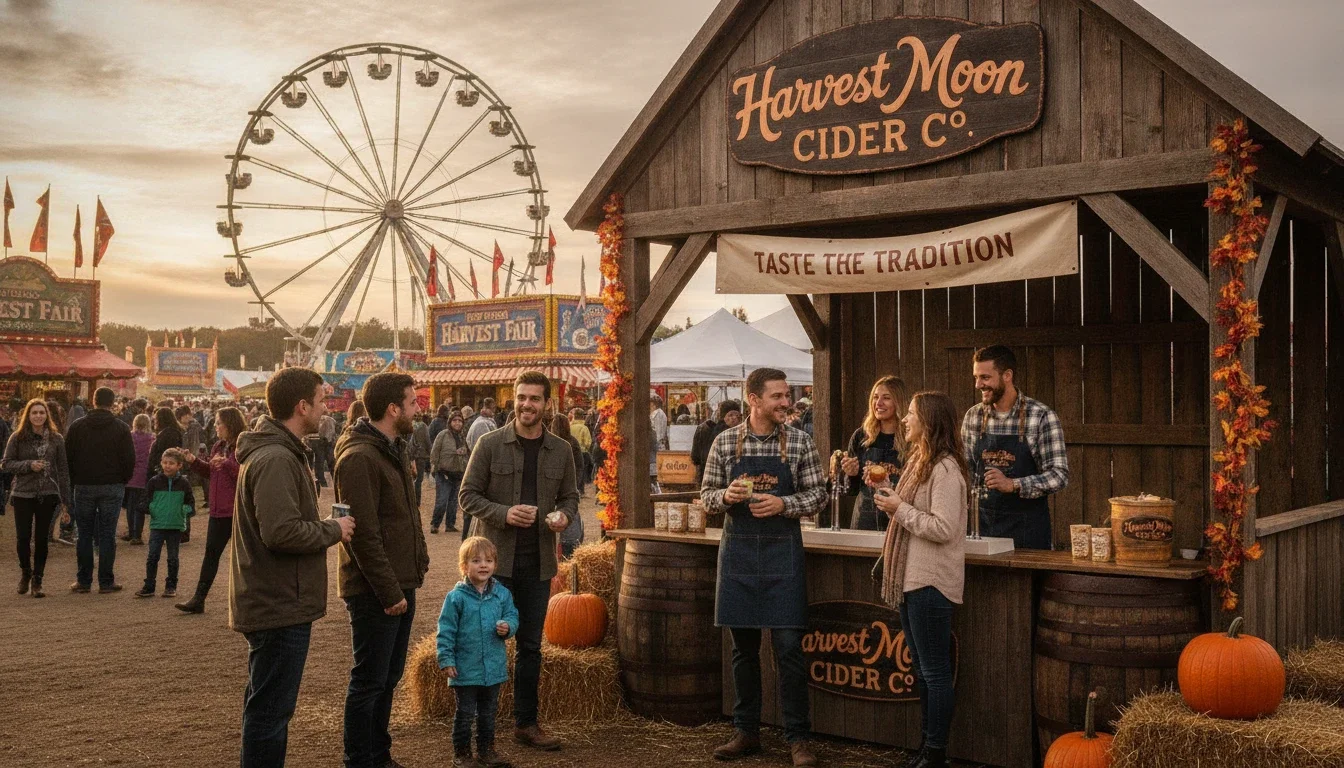
Brand activation booth setup at a major New England fair with staff engaging fairgoers
How to Structure a Big E Brand Activation That Actually Works
Defining Your Activation Goals Before You Arrive
The most common mistake brands make at large-scale fairs is showing up without a clear primary objective. The Big E offers so many activation options that it is easy to spread resources too thin — a little bit of sampling here, a banner there, a few staff members with no clear directive.
Before your team books a single square foot of space, align on one primary outcome. Are you driving a product trial? Building email or first-party data lists? Generating social content? Moving retail inventory? The answer should shape every subsequent decision, from the type of space you select to the staff profiles you hire.
Choosing the Right Activation Format
Product Sampling and Demonstrations
For consumer packaged goods, food and beverage, and personal care brands, product sampling at The Big E is exceptionally effective. The fair's audience is already in consumption mode — they are eating, tasting, and trying things all day. A well-placed sampling station with trained demonstrators can generate thousands of qualified trials per day.
The key is staff quality. Sampling without engagement is just giving the product away. Effective demonstration staff engage, explain, handle objections, and direct consumers toward the next action — a purchase, a follow-up, or a sign-up. This requires trained product demonstrators, not just someone handing out cups. For staffing support on product demos, Eleven8's pop-up and product demo staff are matched to your brand and category before event day.
Street Team and Foot Traffic Engagement
With 45,000+ daily visitors moving through the fairgrounds, The Big E is a street team brand's dream environment. Mobile brand ambassadors can cover significant ground — distributing samples, handing out coupons or QR codes, driving social engagement, and steering traffic toward a fixed activation point.
The challenge with street teams at large fairs is coverage and energy management. A team that is vibrant and on-brand at 11 am can be exhausted and disengaged by 4 pm. Experienced brand ambassadors know how to maintain energy and messaging consistency across a full shift — a skill that matters more over 17 days than it does at a single-day event.
Experiential Booth Concepts
Experiential activations — interactive installations, photo moments, immersive brand environments — perform particularly well at The Big E because the fair already primes visitors for shared, shareable experiences. An activation that earns a social post extends its reach well beyond the fairground.
For experiential booths, the staffing calculus changes. You need hosts who can manage flow, explain mechanics, keep the energy up, and handle the inevitable crowd management challenges that come with popular activations. These are not roles you fill with last-minute general labor.
Staffing a 17-Day Activation: What Brands Get Wrong
The Staffing Math at Scale
Most brands underestimate what it actually takes to staff a multi-week fair presence. A single activation point staffed by four people per shift, running two shifts per day, across 17 days, requires a pool of 30 to 50 qualified individuals — factoring in days off, no-shows, travel constraints, and performance variability.
That is not a number you can recruit against on short notice. Brands that call a staffing agency two weeks before The Big E opens are almost always working with whoever is available, not whoever is right. The results reflect that.
Brand Ambassadors vs. General Event Staff: Knowing the Difference
Not all event staff are the same, and the distinction matters more at a brand-forward activation than anywhere else.
General event staff handle logistics: registration, crowd flow, setup and breakdown, guest services. They are essential to event operations and they keep things moving.
Brand ambassadors represent your product, your values, and your voice. They field questions about your category, engage strangers in conversation, maintain your brand standard under pressure, and directly influence purchase decisions.
Deploying general event staff in brand ambassador roles is one of the most common and costly activation mistakes. The person handing out samples at your booth is often the only interaction a consumer will ever have with your brand in person. That interaction should be staffed accordingly.
Why Multi-Day Events Need On-Site Supervisors
At a single-day activation, a strong briefing and a group text can hold a team together. Over 17 days, you need structure.
On-site supervisors — sometimes called event captains — serve as the operational backbone of a long-run activation. They manage daily briefings, handle scheduling adjustments, maintain brand standards, escalate issues before they become problems, and act as the communication bridge between your brand team and the on-ground staff. Their value compounds over the course of a multi-week fair in ways that are difficult to quantify until you have run an activation without them.
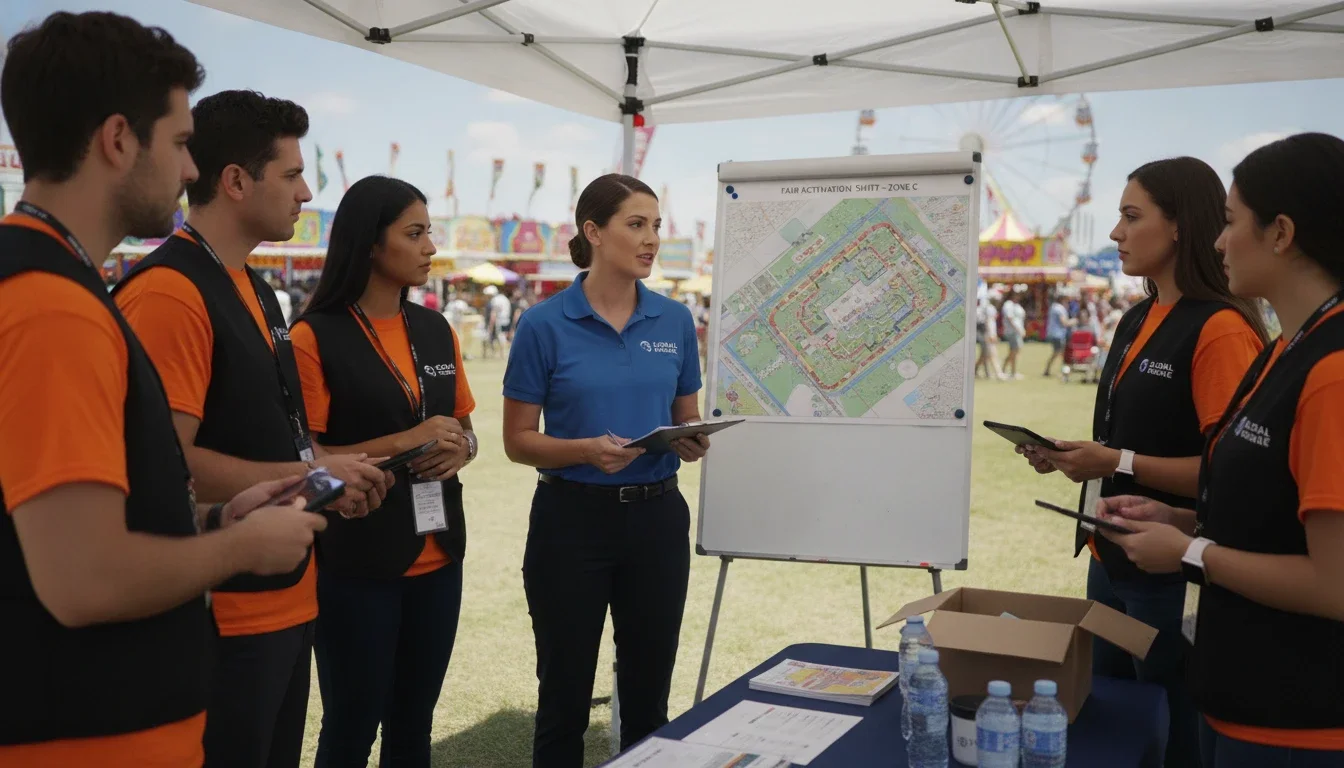
Event captain briefing brand ambassador team before fair activation shift
Working With a Staffing Partner for The Big E
What to Look for in a Fair Staffing Agency
Not every staffing agency has the infrastructure for a 17-day commitment. Before signing a contract, ask these questions:
Does the agency have an existing roster in Western Massachusetts and the surrounding region — or will they be recruiting fresh for your event?
What is their backup coverage policy? If a staff member does not show, how quickly can they deploy a qualified replacement?
Do they provide dedicated account management, or will you be calling a general support line when issues arise?
How do they verify brand alignment and train staff on your specific product, messaging, and interaction style?
Can they handle multi-role activations — mixing brand ambassadors, product demonstrators, and event supervisors under one staffing agreement?
These questions separate agencies with genuine multi-day fair capability from those that are accustomed to single-event staffing only.
How Eleven8 Approaches Multi-Day Fair Activations
Eleven8 Event Staff has spent 35+ years building the staffing infrastructure that multi-week activations require. Every booking includes a dedicated account manager who oversees your entire campaign — not just individual shifts. Built-in backup coverage (one briefed backup per every eight staff) means that if someone cannot make a shift on day nine of a 17-day run, a qualified replacement is already on standby — not being recruited that morning.
With 24,821 active staff members and a rigorous vetting process that accepts only the top 3.5% of applicants, Eleven8 does not staff your Big E activation with whoever is available. Staff is matched to your event type, brand profile, and audience before day one. For brand teams that have experienced the frustration of under-prepared or off-brand fair staff, the difference is immediate.
To inquire about staffing for your Big E activation, submit a request through Eleven8's staffing inquiry form.
The Logistics Side Brands Overlook
Credentialing, Scheduling, and Shift Coverage
The Big E has its own credentialing requirements for staff working the grounds. Exhibitors must submit staffing rosters and credential requests according to the fair's deadlines — and those deadlines arrive earlier than most brand teams expect.
Scheduling across 17 days also requires more than a simple shift calendar. Staff availability changes. Fair attendance patterns shift across the run (weekends are dramatically busier than weekdays). Weather affects foot traffic. A good staffing plan for The Big E is a living document, not a spreadsheet you build once and forget.
Backup Coverage and Contingency Planning
No event of this length and complexity runs without at least some staffing disruptions. The question is not whether something will go wrong — it is whether your partner has already planned for it.
For brands running a serious activation at The Big E, contingency planning should include: pre-briefed backup staff for every scheduled role, a clearly defined escalation chain for day-of issues, and a communication protocol between your brand team, your on-site supervisor, and your staffing agency's account manager.
Eleven8 builds this structure into every engagement by default. The 24/7 event day support model — with offsite operations management included at no extra cost — means that issues at 6pm on a Saturday get resolved in real time, not on Monday morning. Explore Eleven8's full event staffing services to understand how the model works.
Is The Big E the Right Fit for Your Brand?
The Big E makes sense for brands that can answer yes to most of these:
Your target consumer is based in New England or the broader Northeast
Your category benefits from an in-person trial, demonstration, or interaction
You can commit to a staffed presence for at least a portion of the 17-day run
You have the staffing infrastructure (or a partner) to maintain quality across multiple days
Your brand story connects to regional identity, heritage, food, family, or the outdoors
It is a harder fit for hyper-niche B2B brands, products that require extensive explanation, or teams that cannot staff beyond a one-day window. But for the right brand — a regional food company, a consumer goods brand entering the Northeast, a lifestyle brand building New England credibility — The Big E offers a platform that no other single event in the region can replicate.
One fair. Six states. 17 days. 1.5 million consumers.
The only question is what you do with it.