
Production Assistants vs. Event Coordinators: Roles Explained
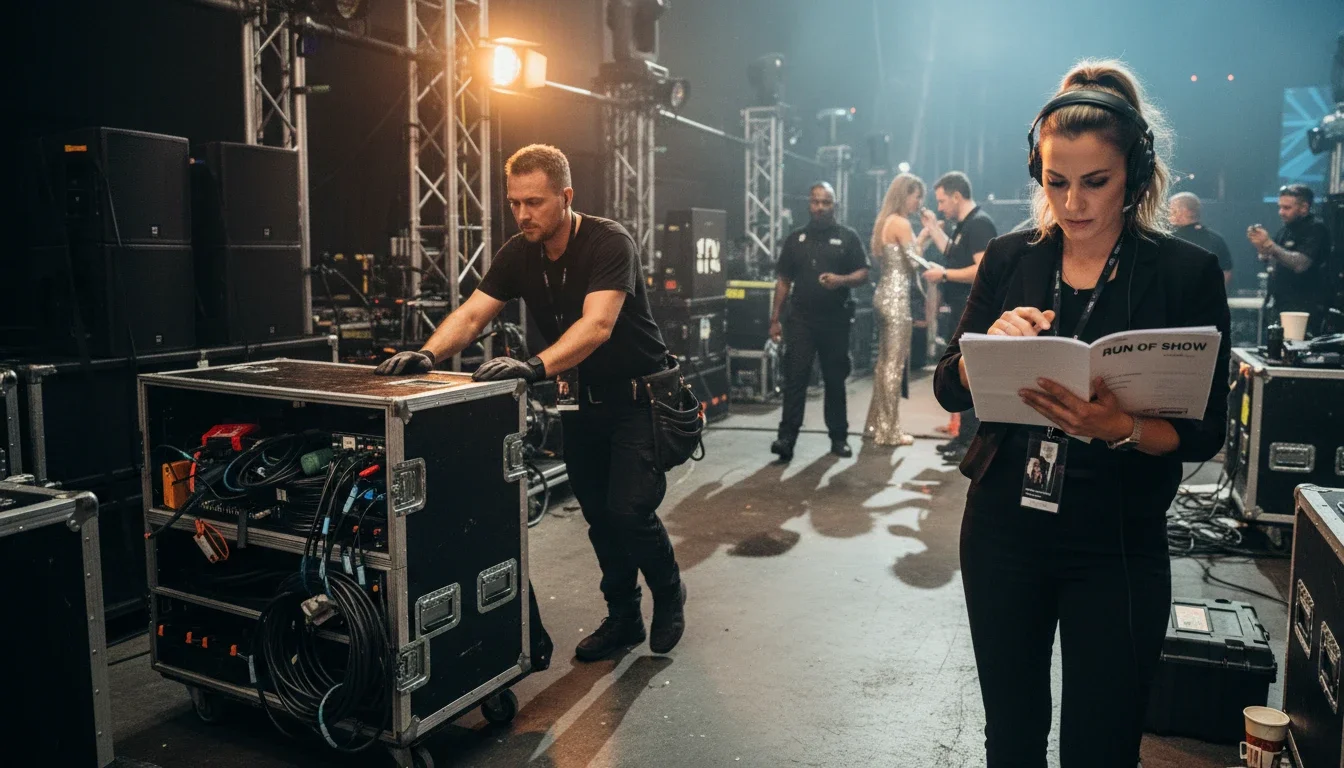
A bustling event backstage showing both a production assistant loading equipment and an event coordinator reviewing a run-of-show document
You're organizing a corporate gala, a brand activation, or a large-scale conference — and you know you need help on the ground. But somewhere between your venue contract and your run-of-show document, a familiar question comes up: do you need a production assistant, an event coordinator, or both?
These two roles sit at the heart of every well-executed event, yet they're frequently confused, misused, or conflated with each other. Understanding the distinction isn't just an industry technicality — it directly affects how smoothly your event runs, how your guests experience it, and whether your team is set up to succeed from the first hour of load-in to the final moment of breakdown.
This guide breaks down exactly what each role does, how they compare, where they overlap, and — most importantly — how to decide which one your next event actually needs.
Understanding the Event Staffing Landscape
Modern events are run by layered teams, each with distinct responsibilities. Confusing those layers leads to over-stretched staff, accountability gaps, and a guest experience that falls short of the vision.
At the heart of most professional event teams, you'll find three key roles working in close coordination: the event producer (who owns the overall vision and budget), the event coordinator (who manages logistics and vendor relationships), and the production assistant (who executes on-the-ground tasks in real time). Understanding how each fits into this structure is the starting point for building an event team that actually functions under pressure.
How Event Teams Are Typically Structured
Event Producer / Director — Owns the creative vision, budget, and overall strategy
Event Coordinator / Manager — Manages logistics, vendor relationships, and day-of execution
Production Assistants (PAs) — Execute hands-on tasks before, during, and after the event
Support Staff — Bartenders, servers, greeters, brand ambassadors, registration staff
Each layer reports to the one above it. A breakdown at any level affects the others. The question of production assistant vs. event coordinator is really a question of which layer you need to fill — or reinforce.
What Is a Production Assistant at an Event?
QUICK DEFINITION
A production assistant (PA) at a live event is a hands-on support role responsible for the physical execution of event logistics. PAs assist with load-in, setup, vendor coordination, on-site troubleshooting, guest assistance, and breakdown. They operate on the ground, report to the event coordinator or manager, and are the first responders to any logistical need during the event day.
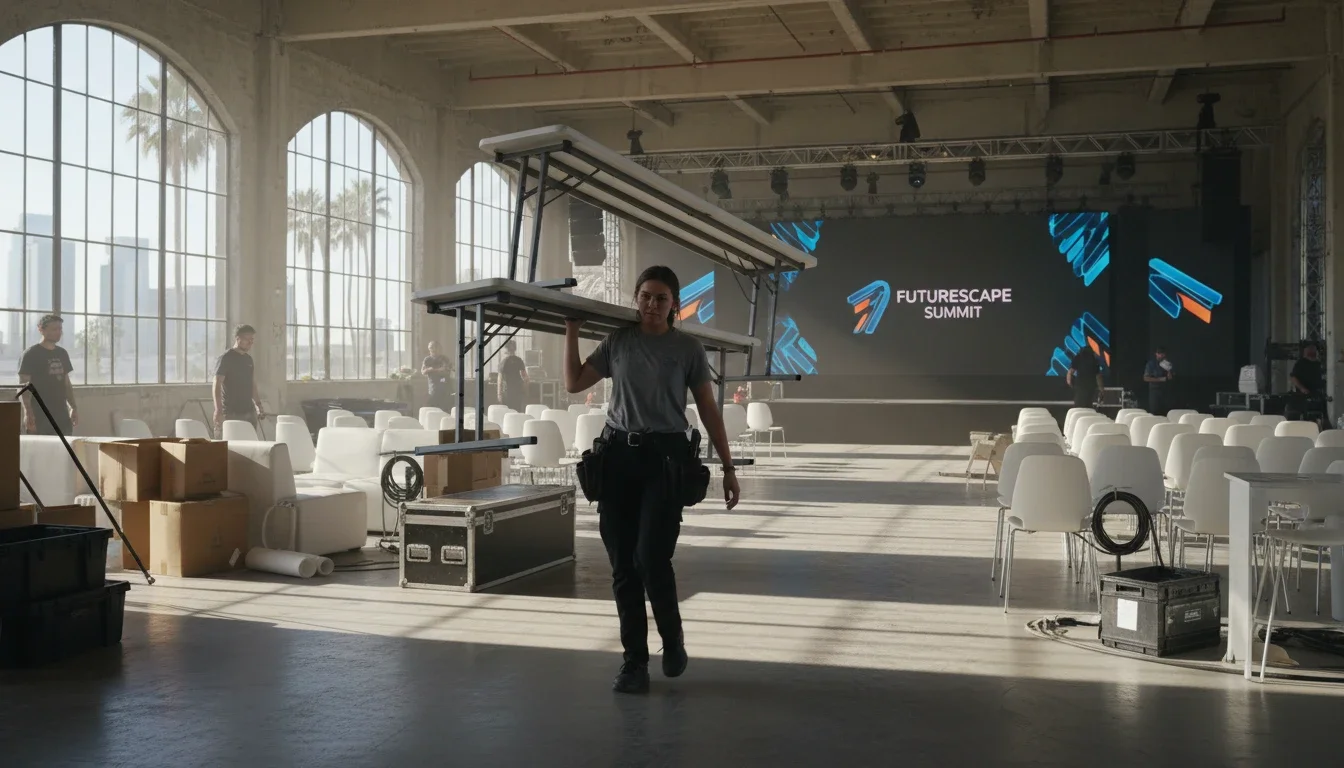
Production assistant carrying event furniture during setup at a Los Angeles corporate event venue
Think of the production assistant as the event team's engine. They don't design the event — they make it happen. While the coordinator is managing timelines and communicating with vendors by phone, the PA is physically moving equipment, directing delivery trucks, managing supply stations, and making sure the venue is ready for doors to open.
In the live events context, production assistants are distinct from film PAs, who work on film sets and assist with talent, crafty, and set operations. Event PAs are specifically trained for the demands of live event environments, where adaptability and physical stamina matter as much as communication skills.
Core Responsibilities of an Event Production Assistant
Load-in and load-out: transporting, placing, and removing equipment, decor, and supplies
Vendor and supplier management: directing deliveries, confirming placement, flagging issues
Supply management: monitoring and replenishing stations throughout the event
Guest-facing support: providing directions, answering questions, assisting with accessibility needs
Venue maintenance: keeping event spaces clean, organized, and presentation-ready
Real-time troubleshooting: addressing any on-site issues that arise during the event
Breakdown: dismantling, packing, and restoring the venue after the event concludes
Before, During, and After the Event
A strong production assistant isn't just useful during the event itself — they're critical across all three phases:
Before: assisting with setup, confirming equipment placement, liaising with vendors on arrival
During: serving as a real-time point of contact for guests, vendors, and the event coordinator
After: leading or supporting the breakdown process, ensuring the venue is returned to original condition
What Is an Event Coordinator?
QUICK DEFINITION
An event coordinator is a logistics and planning professional responsible for ensuring every vendor, timeline, and operational detail of an event is properly executed. They manage vendor relationships, build run-of-show documents, and serve as the primary communication hub between the client, suppliers, and on-site staff. Event coordinators make operational decisions and manage the overall flow of the event.
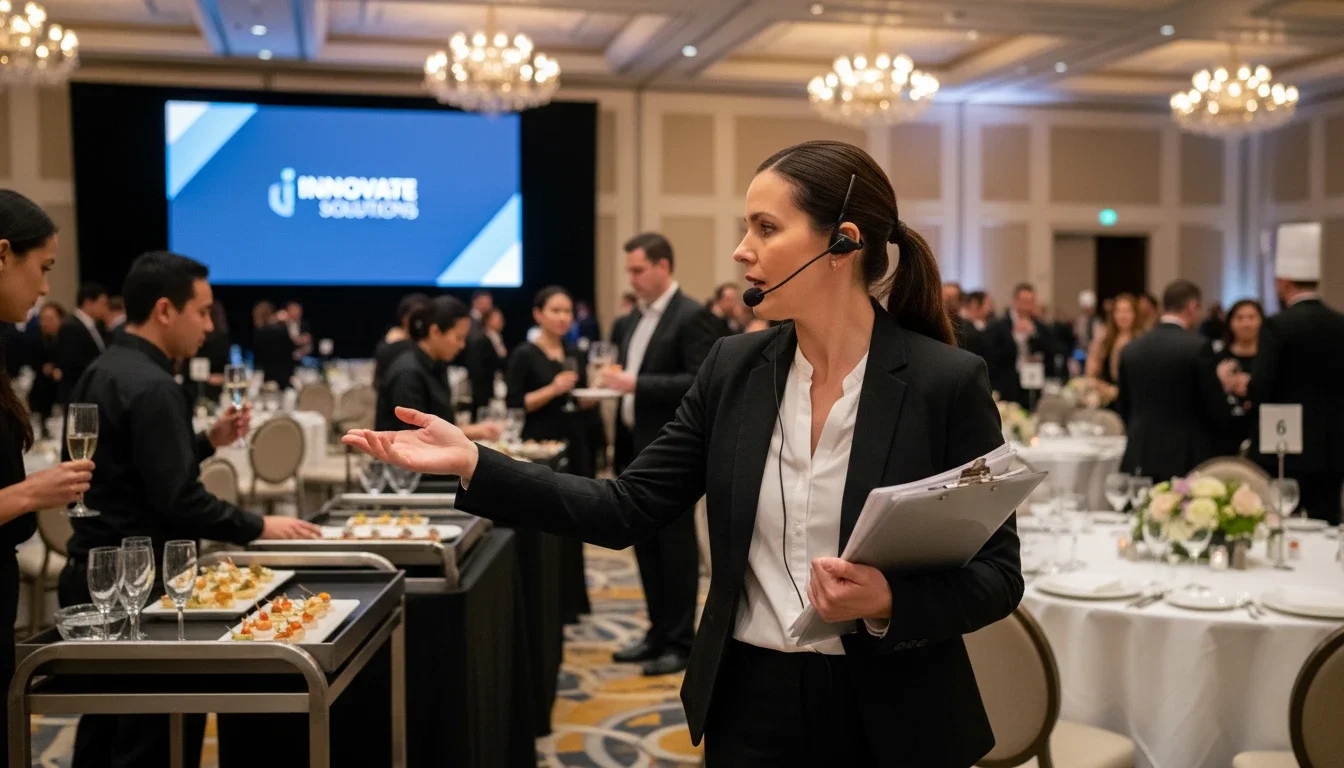
Event coordinator with headset and clipboard managing vendor flow during a corporate gala
Where a production assistant executes, an event coordinator orchestrates. The coordinator is responsible for the decisions: which vendor enters first, what happens if the caterer is running 20 minutes behind, how the room transitions from cocktail hour to dinner seating. They're the person with the headset and the checklist, managing multiple moving parts simultaneously.
It's worth noting that the titles 'event coordinator' and 'event planner' are sometimes used interchangeably — but they describe different scopes of work. Planners typically own big-picture strategy and vision. Coordinators implement what's been planned, managing the practical logistics of execution. On larger events, you'll commonly find both on the team.
Core Responsibilities of an Event Coordinator
Building and managing the event timeline and run-of-show document
Vendor coordination: confirming contracts, managing arrivals, resolving issues in real time
Budget tracking and vendor payment oversight
On-site event management: directing staff, managing transitions, acting as client liaison
Guest management: overseeing check-in, seating, and attendee flow
Emergency planning: maintaining contingency protocols and managing unforeseen changes
Post-event reconciliation: reviewing feedback, finalizing invoices, coordinating breakdown logistics
Event Coordinator vs. Event Planner: Are They the Same?
Not quite. The planner designs the experience — setting the strategy, selecting the venue, and establishing the event vision. The coordinator operationalizes that vision on execution day. In practice, the line blurs at smaller agencies where one person does both. For staffing purposes, the coordinator is the logistics and execution specialist; the planner is the strategic architect.
Production Assistant vs. Event Coordinator — A Side-by-Side Comparison
Here is a direct breakdown of how these two roles compare across key dimensions:
| Dimension | Production Assistant (PA) | Event Coordinator |
|---|---|---|
| Primary Focus | Hands-on physical execution | Logistics orchestration & decisions |
| Reports To | Event Coordinator or Manager | Event Producer or Client |
| Decision-Making | Task-level execution | Operational decisions |
| Event-Day Role | Setup, support, breakdown | Manages flow, directs team |
| Communication | Operational (vendors, guests) | Strategic (clients, vendors, staff) |
| Seniority Level | Entry to mid-level | Mid-level management |
| Compensation | $20-$35/hr | $25-$60/hr or $45K-$75K+ salaried |
| Career Path | PA → Coordinator → Manager → Director | Coordinator → Manager → Director → Producer |
| Key Skills | Physical stamina, adaptability, problem-solving | Organization, crisis management |
| Best For | Events needing execution muscle | Events needing logistics authority |
Where the Roles Overlap — And Why That's a Good Thing
In real-world event environments, the line between production assistant and event coordinator blurs more than textbooks suggest. A seasoned PA often has enough event experience to flag logistical issues before the coordinator spots them. A coordinator at a smaller event may pull their own equipment or assist with vendor check-in.
This overlap is a feature, not a bug. The most effective events run on teams where roles are clearly defined but individuals are willing to step outside them when needed. The best production assistants communicate proactively with coordinators, surfacing problems early. The best coordinators empower their PAs with clear briefings, making the ground team more self-sufficient under pressure.
Understanding where the roles intersect helps you build a team that's both structured and flexible — exactly the combination high-stakes events demand.
When Should You Hire a Production Assistant?
A production assistant is the right hire when your event requires significant physical execution and on-ground support. Specifically, consider bringing on one or more PAs when:
Your event has a complex setup or teardown requiring dedicated hands — large decor installations, AV equipment transport, or multi-room configuration
You need consistent vendor management on arrival day, ensuring deliveries go to the right locations without pulling your coordinator off their primary responsibilities
Your guest count exceeds what your core team can manage in terms of directions, seating assistance, or real-time requests
You want a dedicated point of contact for on-site issues so the coordinator stays focused on the bigger event flow
You're running a multi-day event like a conference, convention, or trade show where physical execution demands are continuous
For large-scale events, multiple PAs with clearly defined zones dramatically improve execution quality and reduce the risk of things slipping through the cracks.
When Should You Hire an Event Coordinator?
An event coordinator is the right hire when your event requires active logistical management and someone with the authority to make real-time decisions. Bring in a coordinator when:
You have multiple vendors and need a single professional managing all their timelines and arrivals
Your event has a complex run-of-show with multiple transitions, performances, or program elements requiring active management
You need someone to act as the client-facing representative on event day, handling issues without escalating everything to you
Your event spans more than four hours and requires sustained oversight of logistics and staff
You're planning a high-profile event — a gala, conference, or product launch — where errors carry real business consequences
You have a production assistant team and need someone to direct and coordinate them effectively
Do You Need Both? Building the Right Event Team
For events of any real scale, the answer is almost always yes. A coordinator without PAs is a manager with nothing to manage on the ground. PAs without a coordinator are a team without direction. The two roles are designed to work in concert.
A practical starting framework:
Events with 50-150 guests: 1 coordinator + 1-2 PAs
Events with 150-500 guests: 1-2 coordinators + 3-5 PAs
Events with 500+ guests: Multiple coordinators, a dedicated event captain, and a full PA team organized by venue zone
The exact ratio depends on your event type, venue complexity, and how many simultaneous operational needs you'll have. A single-room corporate dinner runs differently than a multi-building trade show, even at the same guest count.
How Professional Event Staffing Agencies Simplify the Process
For many event organizers, the challenge isn't just understanding the difference between a production assistant and an event coordinator — it's finding reliable, vetted professionals in both categories on a tight timeline.
That's where a professional event staffing agency delivers real value. Rather than sourcing, screening, and briefing staff individually, you get a curated team that's already been selected for your event type, professionally trained, and available with built-in backup coverage that reduces risk substantially.
At Eleven8 Events, every staff placement goes through a rigorous vetting process that admits only the top 3.5% of applicants. Staff are briefed on your specific event before they arrive, and a dedicated account manager remains available throughout to handle any issue that arises.
30+ years of experience staffing events across Los Angeles and nationwide
10,000+ events successfully staffed — from intimate dinners to 140,000-person conventions
Trusted by Nike, Versace, Netflix, The Academy, and Porsche
24/7 management support and prorated reimbursement for any unforeseen delays
A dedicated event captain introduced 24 hours before your event
The Bottom Line
The difference between a production assistant and an event coordinator isn't just semantic — it's organizational. PAs execute; coordinators orchestrate. PAs carry, set up, and support; coordinators plan, decide, and direct.
For most professional events, the question isn't which role to choose. It's how to staff both effectively. Getting this right is what separates an event that merely happens from one that truly delivers.
If you're planning an event in Los Angeles or anywhere across the US and want a team that's already trained, vetted, and ready to make your production run smoothly — Eleven8 Events is here to help. Contact us at elev8.la to get a custom staffing quote for your next event.