Top Skills Every Event Production Assistant Should Master in 2026
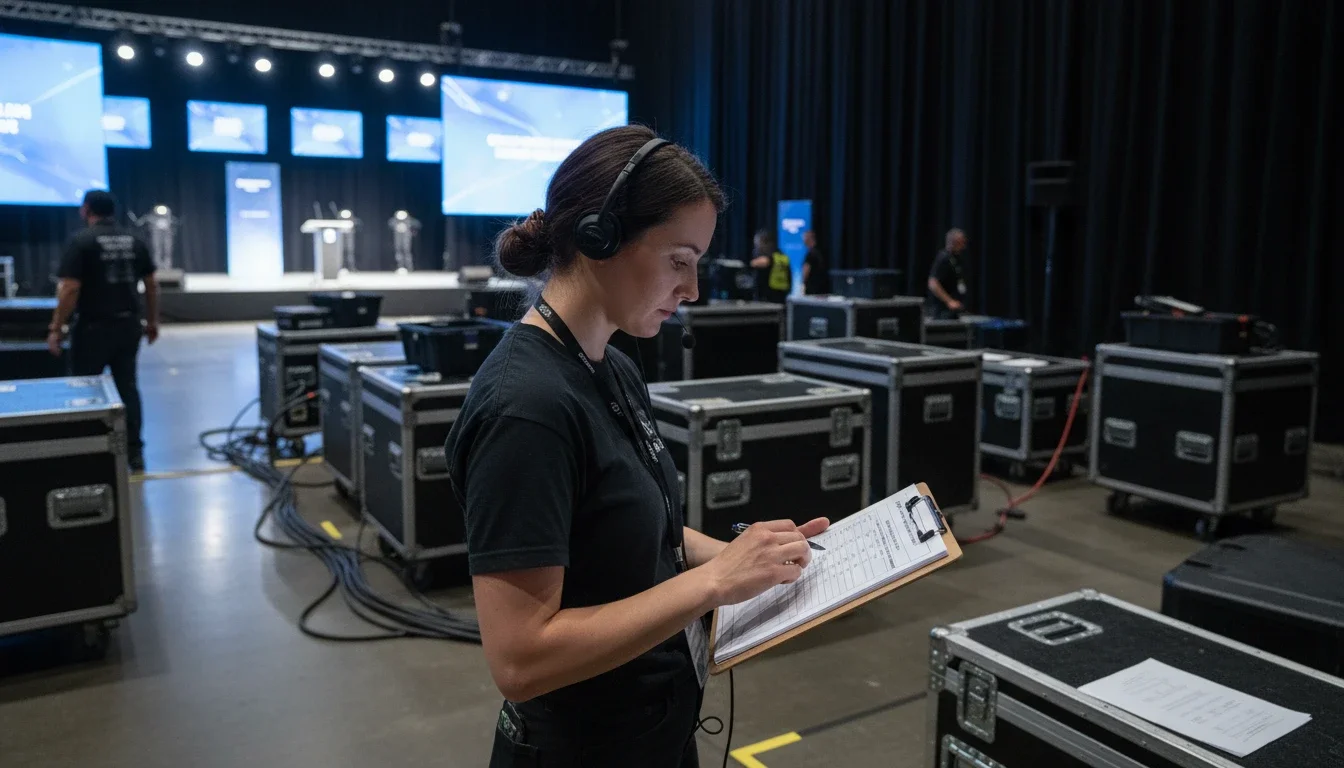
A professional event production assistant reviewing a run-of-show document on a clipboard backstage at a large corporate event
What Does an Event Production Assistant Actually Do?
Every polished event — whether it's a product launch at the Beverly Hills Hotel, a convention at the LA Convention Center, or a red carpet awards show in Hollywood — runs on the invisible effort of a dedicated production assistant. While guests see seamless transitions, a professional stage, and an effortless guest experience, the PA is backstage, clipboard in hand, solving problems before they become crises.
An event production assistant (PA) is an entry-level, hands-on role responsible for supporting every phase of event execution — from load-in and setup through event day operations to breakdown and load-out. They report to event coordinators or production managers, and they act as the connective tissue between the creative vision and the physical reality of putting on a live event.
If you're wondering what it takes to excel in this role — or what agencies and production companies look for when they hire — this guide covers every skill that matters. Not just the generic "good communication" advice you've already read, but the real, practical competencies that separate a reliable PA from an unforgettable one.
The PA's Role in the Production Ecosystem
Production assistants don't just assist — they enable. On a well-run event team, the PA is the person who knows where everything is, who's arriving when, and what needs to happen in the next 15 minutes. They carry information between departments, keep the production schedule moving, and absorb the unpredictability that's inherent in live events.
Think of it this way: the event director has the vision. The event coordinator has the plan. The production assistant makes both real.
Why the Right Skill Set Matters More Than Ever in 2026
The events industry has changed dramatically over the past several years. Hybrid formats, AI-driven registration platforms, sustainability requirements, and increasingly demanding client expectations have raised the bar for every role on the production team — including production assistants.
According to the U.S. Bureau of Labor Statistics [External: bls.gov/ooh/business-and-financial/meeting-convention-and-event-planners.htm], employment in the meeting, convention, and event planning industry continues to grow steadily, with increasing demand for skilled event personnel at all levels. At the same time, event staffing agencies are raising their own hiring standards — Elevate Event Staff, for example, accepts only the top 3.5% of applicants and puts every staff member through an 11-step vetting and training process before they're deployed on an event.
That means the competition for production assistant roles is real. The candidates who get hired — and who build lasting careers — are those who arrive with a diverse, practiced skill set and a genuine understanding of what live event production demands.
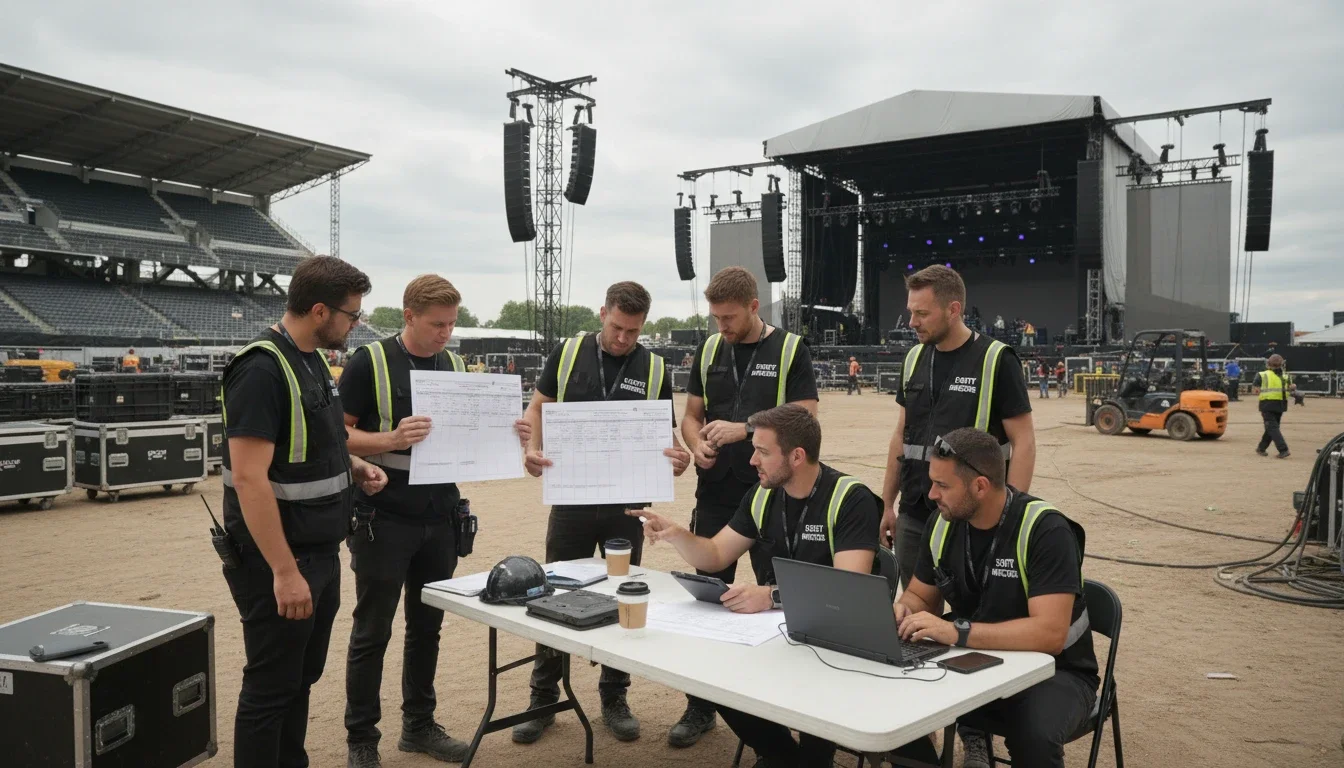
An event production team collaborating on-site at a large event venue, reviewing production schedules and coordinating logistics
The Core Skills Every Event Production Assistant Needs
These are the skills that every production assistant should be able to demonstrate from day one. They're not glamorous, but they're the foundation of every successful event — and every successful event career.
1. Run-of-Show Literacy
The run-of-show (ROS) document is the Bible of any live event. It's a minute-by-minute (sometimes second-by-second) schedule of everything that happens from the moment the venue opens to the moment the last guest leaves. Every speaker entrance, AV cue, catering service window, performer changeover, and vendor access window is documented here.
A production assistant who can't fluently read and work from a run-of-show document is like a navigator without a map. This is non-negotiable.
How to Read and Use a Production Schedule
The best PAs don't just read the run-of-show — they internalize it. That means:
Knowing your own assignments and their timing before the event starts
Understanding how your tasks feed into the broader event flow
Flagging potential scheduling conflicts or ambiguities before they become problems on event day
Being able to quickly answer, "Where are we in the show right now?" at any given moment
If you want to become indispensable on a production team, start by becoming the person who knows the ROS better than anyone else in the room. Tools like Shoflo [External: shoflo.tv] and other run-of-show software are increasingly common — familiarity with at least one platform gives you a tangible edge.
2. Load-In and Load-Out Efficiency
For most events, the production assistant's day begins long before the venue doors open — often before the sun comes up. Load-in is the process of physically staging the event space: transporting equipment and supplies, constructing staging and signage, setting up tables, chairs, and AV infrastructure, and ensuring every vendor arrives in the right place at the right time.
Load-out is the inverse: the organized, efficient breakdown of everything after the event ends, often with time pressure due to venue rental windows.
The Physical Intelligence of Event Setup
Load-in and load-out aren't just physical work — they require spatial reasoning, logistics awareness, and the ability to keep track of dozens of variables at once. Great PAs develop what you might call "physical intelligence": they can look at a venue floor and immediately understand the logical staging sequence, anticipate bottlenecks, and direct vendors to the right loading zones without being told twice.
Physical stamina matters here too. Production days routinely run 12–16 hours, and the ability to remain sharp and reliable during the final breakdown — after a full day on your feet — is genuinely rare and genuinely valued.
3. On-Site Communication and Radio Etiquette
Live events run on communication. Whether it's walkie-talkies, headsets, group text channels, or event-specific apps, the ability to communicate clearly, concisely, and at the right moment is one of the most important skills a production assistant can develop.
Why Clear Communication Prevents Event Disasters
Most event problems start as small miscommunications that compound into crises. The caterer who didn't know the loading dock was occupied. The AV tech who wasn't told the speaker changed. The registration line that backed up because nobody told the floor manager the doors were opening early.
Production assistants are often the first people to notice when something has gone sideways. The ability to communicate that information quickly, accurately, and calmly to the right person — without creating panic in the room — is a skill that takes practice and pays enormous dividends.
Radio protocol basics: keep transmissions brief and clear, identify yourself, confirm receipt of information, avoid ambiguous language, and never use the radio for non-essential chatter during high-pressure moments.
4. Vendor and Supplier Coordination
On any given event day, a PA may be the point of contact for venue staff, caterers, floral designers, lighting companies, AV technicians, print vendors, transportation services, and security teams — sometimes all before 10 AM. The ability to manage these relationships efficiently, without losing composure or creating bottlenecks, is a hallmark of a seasoned production assistant.
Managing Arrivals, Deliveries, and Expectations
Know every vendor's expected arrival window and access protocol before the day starts
Have a point of contact and direct phone number for each vendor
Confirm deliveries and setups against the production checklist in real time
Communicate delays up the chain immediately — never hold onto a problem
Be the calm, professional face that vendors interact with — it reflects directly on the event's brand
5. Basic AV and Technical Awareness
You don't need to be an audio engineer or lighting designer to be an effective production assistant. But you do need to understand enough about AV and production technology to communicate effectively with the technical team, identify when something looks wrong, and relay the right information to the people who can fix it.
You Don't Need to Be a Technician — But You Need to Speak the Language
In practice, this means understanding the difference between a monitor and a speaker, knowing what "the board" refers to, understanding what a cue sheet is, and recognizing when a microphone is live versus muted. It means knowing who to call when the projector fails and being able to describe the problem clearly when you do.
As hybrid events become more standard in 2026, basic familiarity with livestreaming platforms, virtual event software, and simple audio routing is increasingly valuable. Industry resources like Event Tech Live [External: eventtechlive.com] and PCMA [External: pcma.org] publish regular updates on the tools that are reshaping live event production.
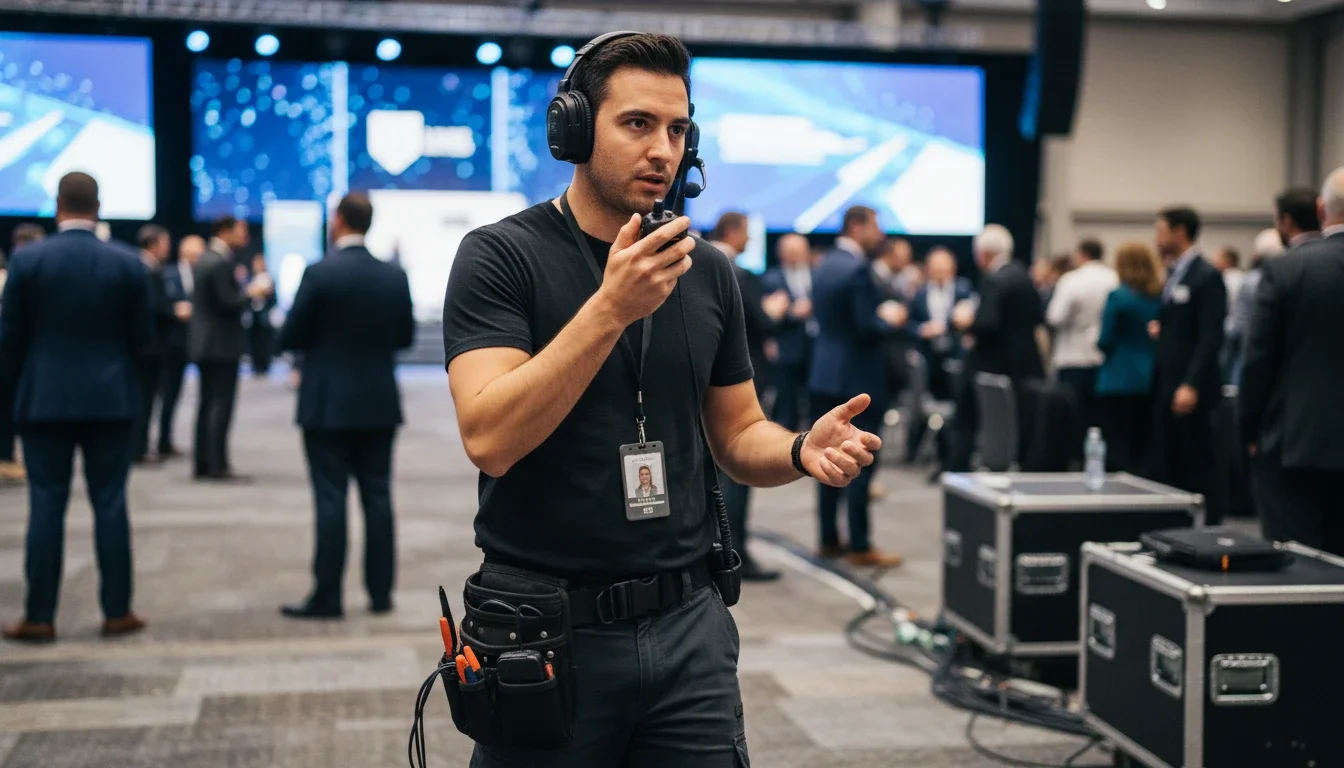
A production assistant operating a headset and walkie-talkie at a corporate event, demonstrating on-site communication skills
6. Hospitality and Guest Experience Instincts
Even in a behind-the-scenes production role, production assistants regularly interact with guests, speakers, VIP attendees, and clients. How you engage in those moments — whether it's directing a confused attendee, escorting a keynote speaker to the green room, or managing a check-in line that's moving too slowly — shapes the overall event experience.
The Difference Between Good Service and Exceptional Service
Good service is responsive. Exceptional service is anticipatory. The best hospitality instincts mean you notice when a speaker looks lost before they have to ask for help, you spot the VIP guest who's been waiting longer than they should, and you take ownership of the moment instead of pointing someone toward a different team member.
For high-profile events in Los Angeles — from award season productions to luxury brand activations — this level of attentiveness is an expectation, not a bonus.
7. Problem-Solving Under Pressure
No event unfolds exactly as planned. Vendors are late. Speakers run long. Weather interferes with outdoor setups. Microphones fail. Guests don't follow the flow. Production assistants who thrive are those who can assess a problem in real time, identify available solutions, communicate with the right people, and keep the show moving — without losing their composure or disrupting the guest experience.
What Real Event Day Problem-Solving Looks Like
Here's a scenario: it's 45 minutes before doors open and the catering truck has blocked the only loading dock access that the AV company needs. The AV team is getting frustrated. The client is asking for an update.
A trained production assistant doesn't freeze. They immediately contact the catering supervisor, identify an alternative staging area, relay the update to the AV team, communicate the delay to the production manager in clear terms, and keep both vendors calm and moving. The guest never knows anything happened.
That's problem-solving under pressure. It's not a natural talent — it's a developed skill, and it's one of the most valued qualities in any event professional.
8. Physical Stamina and Situational Awareness
Event production is physically demanding work. Production assistants routinely work 12-hour days on their feet, carry equipment, move furniture, and stay sharp through the final breakdown at the end of an exhausting day. Physical conditioning and genuine endurance are practical requirements, not soft preferences.
Equally important is situational awareness: the ability to maintain a mental map of the event space, track where key team members and vendors are, notice when something in the environment changes, and stay alert to developing situations. This is particularly important at large conventions, festivals, and multi-room corporate events where dozens of variables are moving simultaneously.
9. Digital Tools and Event Technology Proficiency
The 2026 event production landscape runs on digital tools. Production assistants who can navigate event management software, communicate across multiple digital channels, and adapt to new platforms quickly are far more valuable than those who treat every new tool as a learning curve.
Event Tech Stack Basics for Production Assistants in 2026
Run-of-show software — Shoflo, Loopcam, or similar platforms for live event scheduling and cue management.
Event management platforms — Cvent, Eventbrite, or Whova for registration, attendee data, and logistics.
Project/task management — Asana, Trello, or Monday.com for pre-event task tracking.
Communication tools — Slack, Microsoft Teams, or dedicated event operations apps for team coordination.
Digital check-in tools — tablet-based check-in apps, badge printing systems, QR code scanners.
Hybrid/virtual event platforms — basic familiarity with Zoom Webinars, Hopin, or Streamyard for events with a virtual component.
You don't need to be an expert in all of these. But being comfortable learning new platforms quickly — and not needing hand-holding every time a new tool appears — signals the kind of professionalism that production teams actively look for.
10. Professionalism, Adaptability, and Brand Alignment
Event production assistants are, at every moment, representing the brand of the event, the client, and the staffing company they work for. That representation extends to appearance, communication style, attitude under pressure, and the way you interact with everyone from venue staff to A-list clients.
Professionalism in event staffing means showing up early, dressed appropriately for the event brief, ready to work without needing to be managed. It means reading the room — understanding when an event calls for formal precision versus energetic engagement, and adjusting accordingly.
Adaptability means embracing the fact that event day will almost never go exactly as planned, and responding to change with flexibility rather than frustration.
Brand alignment means understanding what the event is trying to achieve and being a visible part of that mission — not just a body filling a role.

A well-dressed event production assistant smiling and assisting guests at a high-end corporate event in Los Angeles
Advanced Skills That Set Top Production Assistants Apart
Once you've mastered the core competencies, these advanced skills are what elevate a good PA into a career professional — someone who gets called back first and recommended by name.
Budget Awareness and Cost Consciousness
Production assistants aren't typically responsible for budgets, but the best ones understand that every decision they make on event day has a cost implication. Wasteful use of materials, missed rental return windows, damaged equipment, and uncoordinated vendor overtime all translate directly into dollars. PAs who demonstrate cost consciousness — protecting equipment, flagging potential overruns to the production manager, managing supplies efficiently — earn the trust of senior team members quickly.
Photography and Content Capture Basics
In an era when every event produces content for social media, marketing, and client reporting, production assistants who can capture quality smartphone photos and video — understanding basic composition, lighting, and what moments to document — add tangible value to the production team. This isn't about replacing the event photographer; it's about being a resourceful team member who can capture behind-the-scenes content and document logistics for post-event reporting.
Sustainability and Waste Management Awareness
Sustainable events are no longer optional for major clients. PCMA, MPI [External: mpi.org], and IAEE [External: iaee.com] all publish guidelines around sustainable event production practices. Production assistants who understand basic sustainability protocols — waste sorting, material reduction, responsible vendor sourcing — bring additional value, particularly on corporate events with ESG reporting requirements.
How Event Staffing Agencies Evaluate Production Assistant Candidates
Understanding what professional event staffing agencies look for can help you present your skills more effectively — whether you're applying to work with an agency or building your own event career independently.
Elite staffing agencies like Elevate Event Staff use a rigorous multi-step vetting process that goes well beyond reviewing a resume. Candidates are evaluated on professionalism, adaptability, experience with different event types, and their ability to work effectively under pressure. References are verified. Interviews assess real-world scenario responses, not just listed qualifications.
The traits that make candidates stand out most are consistent reliability, genuine hospitality instincts, physical readiness, and communication clarity. Technical skills can be taught. Professionalism and adaptability have to be demonstrated.
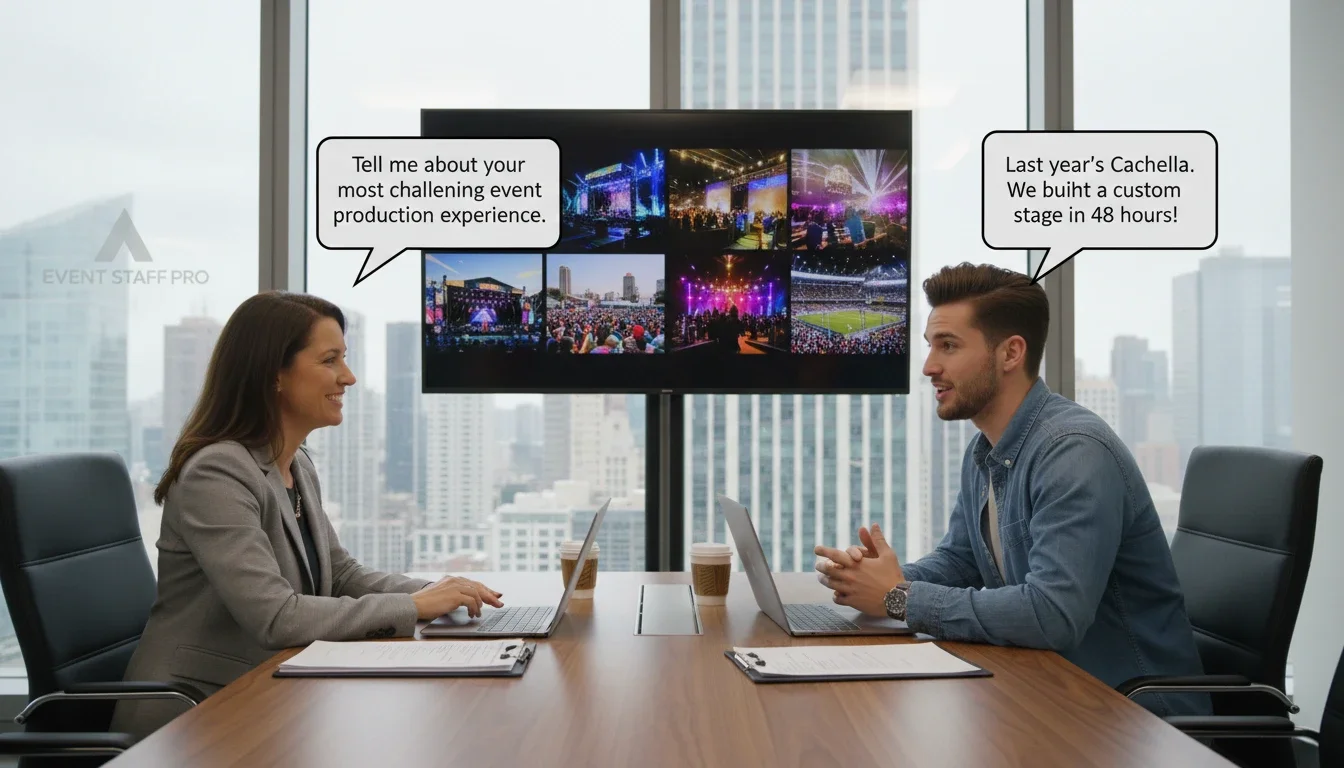
An event staffing agency interview process, with a professional interviewer and a production assistant candidate discussing event experience
Building Your Career: From Production Assistant to Coordinator
The production assistant role is one of the most valuable entry points in the events industry precisely because it exposes you to every aspect of event execution. Production assistants who treat every event as a learning environment — observing how coordinators make decisions, asking thoughtful questions, and consistently exceeding expectations — build the experience base that leads to coordinator, manager, and director roles.
Here's what career progression in event production typically looks like:
Production Assistant → Event Coordinator (1–2 years of consistent PA experience)
Event Coordinator → Event Manager (3–5 years of coordination experience)
Event Manager → Director of Events or Production Director (5–10+ years)
The Bureau of Labor Statistics [External: bls.gov] projects continued growth in the meeting and events industry through 2030. Positions for meeting, convention, and event planners are expected to grow faster than average, with the strongest opportunities in major metropolitan markets like Los Angeles — particularly with the city's upcoming role as host of the FIFA World Cup 2026, Super Bowl 2027, and the 2028 Olympic Games.
For those building careers in the LA events market, the volume and caliber of events on the horizon represent a generational opportunity. The production assistants who are sharpening their skills now will be the coordinators and managers who run those events.