A Retail Temp's Guide to Shaping Amazing In-Store Experiences
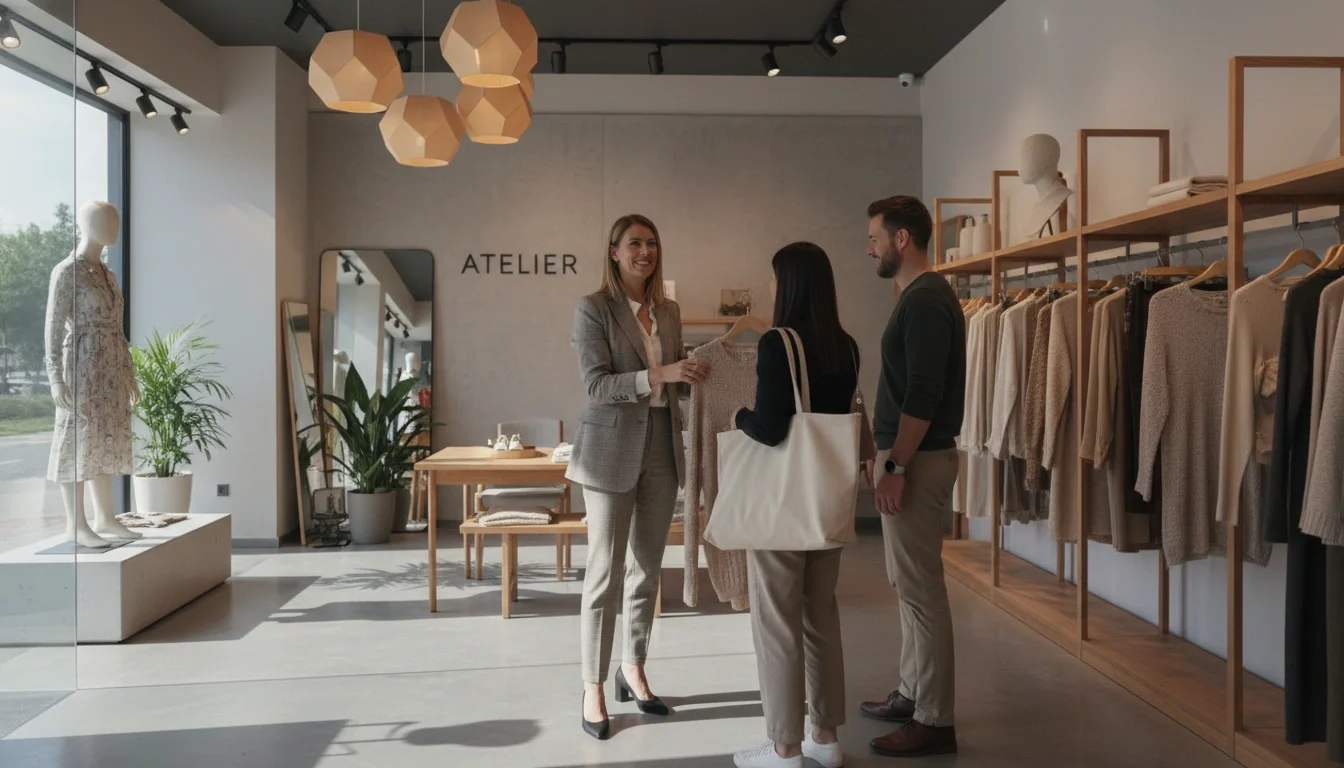
A confident retail brand ambassador assisting shoppers in a modern boutique store
Walking into a store where you've never worked before — no established relationships, no deep product knowledge, no institutional memory — and being expected to deliver a five-star customer experience within minutes? That's the reality of retail temp work. And it's a harder job than most people realize.
But here's what the best retail temps understand: your impact on a customer's in-store experience doesn't depend on how long you've been with the company. It depends on your preparation, your mindset, and your execution on the floor.
Whether you're covering a holiday rush, staffing a brand activation, or supporting a pop-up shop, this guide gives you the practical tools to walk in ready, perform with confidence, and leave the kind of impression that gets you re-booked — and earns you a reputation as someone worth calling again.
💡 Pro Tip: The same skills that make an excellent retail temp are the exact qualities that top event staffing agencies look for when selecting brand ambassadors and experiential retail staff. We'll connect those dots throughout this guide.
What It Really Means to Be a Retail Temp Today
The Difference Between Filling a Shift and Making an Impact
There's a wide spectrum in temp retail performance. On one end, you have the worker who shows up, clocks in, avoids eye contact, and clocks out. On the other, you have the temp who a store manager is on the phone with their staffing agency about by end of shift — asking to book them again.
The difference has almost nothing to do with prior retail experience. It has everything to do with intentionality. The best temps approach every shift as though they're representing their own professional brand, not just a client's store.
That mindset shift — from 'I'm covering a shift' to 'I'm delivering an experience' — is what separates forgettable from memorable.
Why In-Store Experience Matters More Than Ever
Physical retail is far from dead. Studies consistently show that the vast majority of retail purchases still happen in brick-and-mortar environments, and customer expectations for those in-person interactions have risen sharply. Shoppers don't just want products — they want experiences, connection, and service that makes them feel valued.
As a temp, you're often the first human touchpoint a customer has in-store. Your warmth, your product knowledge, your ability to solve a problem quickly — these things shape whether a customer leaves satisfied, posts a glowing review, or never comes back.
When a customer has a poor interaction with a temp staff member, they rarely distinguish between 'temp' and 'permanent employee' in their minds. To them, you are the store.
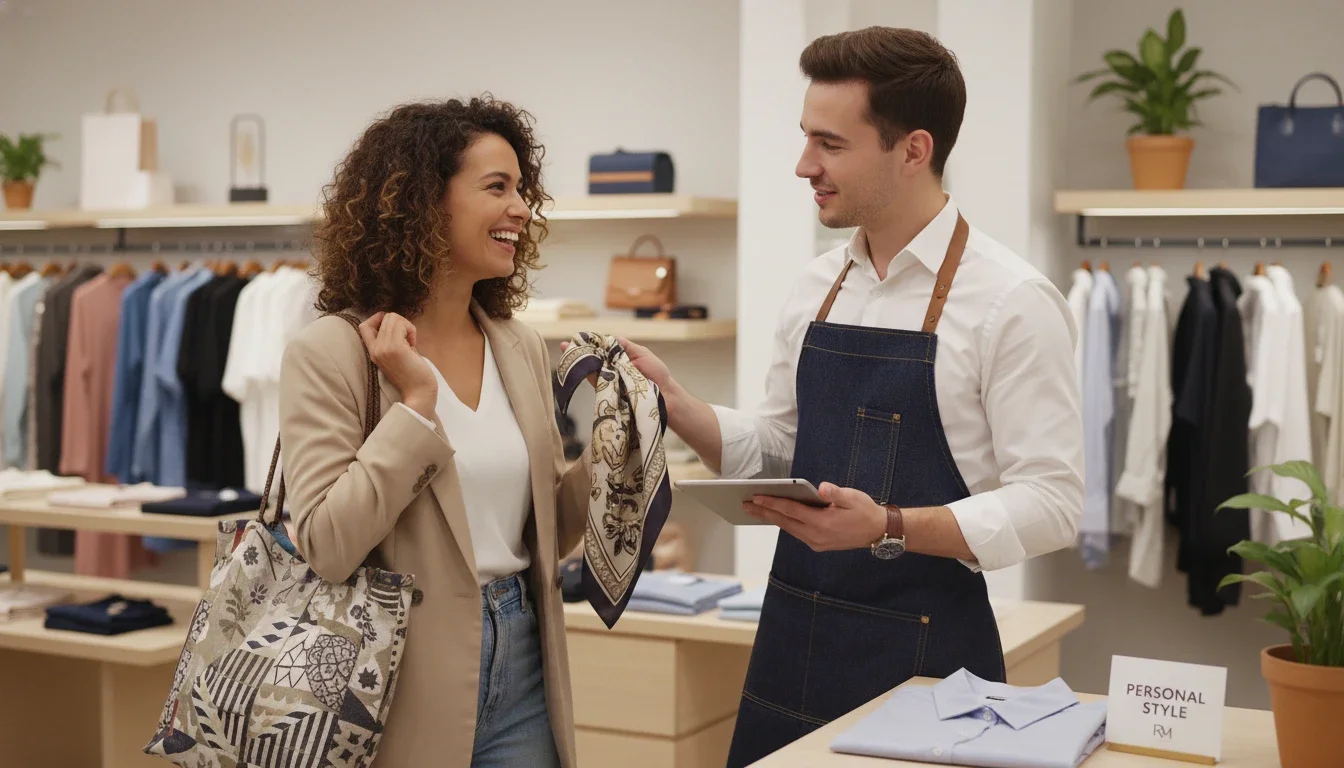
Happy shopper receiving personalized service from an attentive retail associate
Before You Walk Through the Door: Pre-Shift Preparation
Research the Brand Before Day One
This single habit separates professional temp workers from everyone else. Before any shift, spend 20 minutes doing the following:
Browse the brand's website and identify their top product categories, current promotions, and brand values.
Check their social media — what language do they use? What's their aesthetic? What do customers love about them?
Read recent reviews on Google or Yelp. What do shoppers praise? What do they complain about?
If it's a fashion or lifestyle brand, understand the price point and target demographic.
You won't know everything on day one. But arriving with genuine context — knowing the store's best-selling category, understanding the brand's personality — allows you to have real conversations rather than fumbling for basic answers.
Know the Store Layout and Key Policies
If you can visit the store before your shift (even for ten minutes as a customer), do it. If not, arrive early and ask a team member for a quick walkthrough. Prioritize:
Fitting room locations and capacity limits
Restroom directions (customers ask constantly)
Return and exchange policy basics
Current sale areas or promotional sections
Where staff accessories, bags, or tags are kept
Nothing undermines your credibility faster than being unable to point a customer toward the bathroom or explain a basic return policy.
Dress the Part — and Then Some
Your staffing agency will provide uniform guidelines. Follow them precisely — and then go slightly above and beyond. Iron your shirt. Wear clean, polished shoes. Keep accessories minimal and professional. If the brand is fashion-forward, reflect that energy in how you carry yourself.
Appearance communicates competence before you've said a word. In a retail environment, where customers make split-second decisions about who to approach for help, looking like you belong is half the battle.
The First Five Minutes: How to Make Instant Credibility
Reading the Room on Arrival
When you arrive for a shift, you're stepping into an existing culture, rhythm, and dynamic. The worst thing you can do is arrive like you already know how things work. The best thing you can do is arrive curious and immediately helpful.
Scan the floor. Is it busy or slow? Are staff overwhelmed or underutilized? Are there obvious tasks that need doing — a folded display that's been disrupted, a queue forming at checkout, a customer wandering without direction? Act on what you see. Don't wait to be told.
Introducing Yourself to the Team the Right Way
Your relationship with the permanent staff determines your effectiveness on shift. They're your guides, your support system, and ultimately the people who will give feedback on your performance to your agency.
Introduce yourself briefly and genuinely: your name, that you're from [agency], and that you're there to help in whatever way is most useful. Ask the shift lead or floor manager: 'What are the two or three things you most need covered today?' Then deliver on exactly that.
Avoid overstepping, being excessively chatty during busy periods, or projecting false familiarity. Earn your place through competence and reliability first.

Retail temp staff member being introduced to permanent store team in a professional handshake
On the Floor: Shaping Every Customer Interaction
The Art of the Warm Greeting
The greeting is your single most powerful tool for setting the tone of a customer's visit. Research consistently shows that a genuine, friendly welcome significantly increases the likelihood of a positive shopping experience — and a completed purchase.
Best practices for retail greetings:
Acknowledge every customer who enters within the first 30 seconds — eye contact and a smile are the minimum.
Use an open-ended greeting rather than 'Can I help you?' (which invites 'no'). Instead: 'Welcome in! Let us know if you're looking for anything specific.'
Match your energy to the environment — a luxury boutique calls for calm warmth; a youth streetwear brand calls for genuine enthusiasm.
Don't overwhelm: if a customer signals they want to browse independently, give them space and check back after 5-7 minutes.
Active Listening as a Sales and Service Superpower
Most retail errors — wrong size recommendations, unhelpful suggestions, frustrated customers — come from not truly listening. Active listening isn't just hearing words; it's picking up on tone, body language, what's left unsaid.
When a customer describes what they're looking for, resist the urge to immediately jump to a solution. Ask one or two clarifying questions first: 'Is this for a specific occasion?' or 'Are you looking for something in a particular color family?' Then let their answer guide your recommendation.
When a customer is frustrated, acknowledge before solving. 'I completely understand that's frustrating — let me see what we can do' achieves more than immediately reaching for policy language.
Product Knowledge — How to Get Up to Speed Quickly
You won't know the product catalog in depth on your first shift. That's expected. What's not acceptable is pretending you know and giving wrong information. Instead, develop a smart rapid-learning approach:
During quieter moments, pick up and examine products. Read labels, tags, and any shelf signage.
Ask a permanent team member about the top 5 most frequently asked-about products — and commit those to memory first.
When asked a question you can't answer: 'Great question — let me find out for you right now.' Then actually find out.
Never guess or invent product information. Wrong information costs the brand a sale and damages trust.
Being honest about what you're still learning, while demonstrating genuine effort, actually builds more customer trust than feigned omniscience.
Handling Difficult Customers with Grace
At some point on every retail shift, you'll encounter a challenging interaction. A dissatisfied customer, a return dispute, someone who's had a bad day. How you handle these moments defines your professional reputation far more than how you handle the easy ones.
The 'Acknowledge, Apologize, Act' framework works reliably:
Acknowledge — Acknowledge: 'I can see this has been really frustrating.'
Apologize — Apologize: 'I'm sorry your experience hasn't been what you'd hoped.'
Act — Act: 'Here's what I can do right now, and here's who I can connect you with for the rest.'
Never escalate defensively. Never dismiss. And never make promises the store can't keep. Your job is to de-escalate and find a dignified resolution — then escalate to a permanent manager for anything outside your authority.
The Bigger Picture: Embodying the Brand, Not Just the Uniform
What Brand Ambassadors Know That Regular Staff Often Miss
The concept of brand ambassadorship extends far beyond the traditional sense of representing a company at trade shows or events. Every retail floor worker, especially temps, is a brand ambassador in the truest sense — they are often the living, breathing embodiment of what a brand stands for.
Professional brand ambassadors are trained to:
Internalize the brand's values and translate them into every micro-interaction
Speak in language that reflects the brand's personality — formal, playful, technical, aspirational
Notice and respond to the emotional state of each customer, not just their stated request
Create experiences that feel personal, not transactional
As a retail temp, you may not have weeks of brand immersion. But you can review the brand's mission statement, social voice, and customer testimonials before your shift — and consciously incorporate those signals into how you communicate.
Creating Micro-Moments That Drive Loyalty
Customer loyalty is rarely built on grand gestures. It's built on dozens of small, unremarkable moments that collectively add up to a feeling: 'This store gets me.'
As a temp, you have the power to create those moments:
Remembering a preference a customer mentioned ten minutes ago and referencing it later
Walking a customer to a product rather than pointing
Offering an unsolicited, genuine compliment on a good choice
Making a checkout feel like a conversation rather than a transaction
Saying goodbye in a way that makes them feel remembered, not processed
None of these require tenure. They require intention.
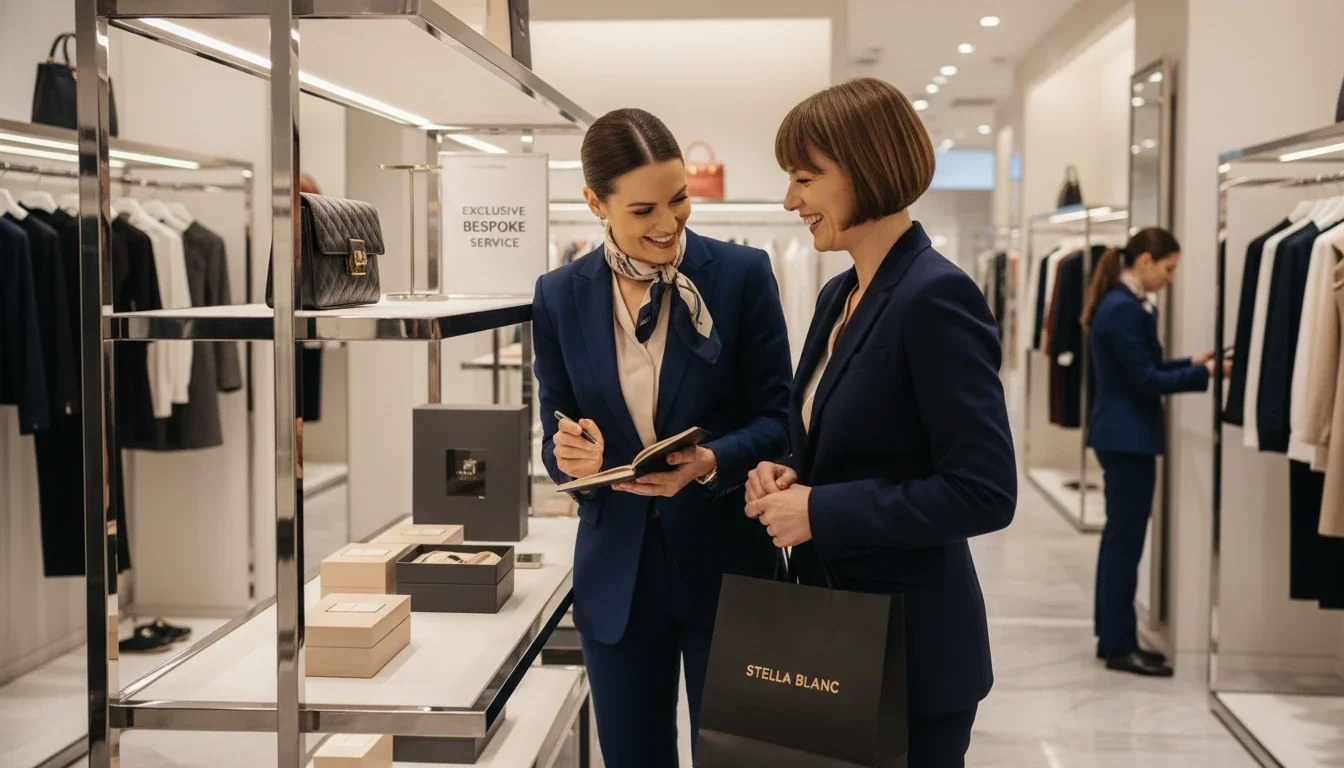
Brand ambassador creating a personalized moment with a customer in a high-end retail store
Managing High-Traffic and Pop-Up Retail Environments
Working Efficiently When the Store Gets Busy
High-traffic retail environments — holiday weekends, sales events, store launches — are where good temps prove their value. These conditions demand a different gear: calm under pressure, rapid prioritization, and seamless coordination with permanent staff.
Strategies for busy floor management:
Triage customer needs: acknowledge waiting customers immediately, even if you can't help them yet ('I'll be right with you in two minutes')
Keep visual communication with teammates — make brief eye contact with permanent staff to signal when you need backup or when you're freeing up
Keep your area organized continuously, not just at the end of the day — a cluttered display costs sales
Stay visible: position yourself where you can see the most of the floor, not tucked in a corner
The best temps in high-volume environments are described by managers as having 'presence' — an ability to be everywhere at once without seeming rushed or frantic.
Pop-Ups, In-Store Activations, and Experiential Retail Shifts
More brands are investing in experiential retail — pop-up shops, in-store brand activations, product launch events, and immersive shopping experiences. These engagements are staffed almost entirely by temporary workers, often placed by specialized event staffing agencies.
Experiential retail shifts require an additional layer of skill beyond standard floor work:
Energy management: these activations often run long and require sustained enthusiasm — you can't fade mid-shift
Storytelling ability: you're not just selling a product; you're communicating a brand narrative
Engagement techniques: drawing foot traffic, initiating conversations naturally, and creating memorable interactions
Social media awareness: in experiential retail, customers often document and share — your energy and presentation become part of the brand's content
Staffing agencies like Elevate Event Staff specialize in placing workers for exactly these kinds of high-stakes, brand-critical activations. If you excel on standard retail floors, experiential staffing is a natural and often more lucrative next step.
How to Build a Reputation That Gets You Re-Booked
What Staffing Agencies Look For in Top Performers
If you're working through a staffing agency, your individual performance directly affects your future placement opportunities. Top agencies — particularly selective ones that admit only a small fraction of applicants — maintain detailed records of staff performance and actively rank their roster.
The characteristics agencies consistently flag as exceptional:
Punctuality and reliability: arriving early, communicating proactively about any issues
Zero-direction initiative: doing what needs to be done without being explicitly asked
Professionalism under pressure: maintaining composure and brand standards during high-stress moments
Positive feedback from clients: unsolicited compliments from store managers carry significant weight
Appearance consistency: always looking the part, every single shift
Communication: briefing your supervisor at end of shift, flagging issues clearly, confirming next-day bookings promptly
The Behaviors That Lead to Repeat Placements
Beyond performance, the soft behaviors that agencies notice:
Sending a brief follow-up or thank you after a placement — 'Happy to help again anytime' keeps you top of mind
Being flexible on shift timing, especially for last-minute requests — agencies remember who says yes when it's difficult
Suggesting improvements or sharing observations from the floor (done appropriately through your agency contact, not directly to the client unless invited)
Building genuine rapport with both the agency coordinator and the client's team
The temp workers who go from occasional placements to preferred roster status are the ones who treat every shift as an audition — not for a permanent job necessarily, but for a permanent reputation as someone worth booking.
💼 Interested in working with a staffing agency that values excellence? Elevate Event Staff selects only the top 3.5% of applicants for its national roster, placing them with brands like Nike, Versace, and Netflix.