Ambush Marketing at the LA 2028 Olympics: How Non-Sponsors Can Still Win With Street Teams
The official sponsorship price tag for the LA 2028 Olympic Games runs into the tens of millions of dollars. For most brands, that number isn't just a stretch — it's off the table entirely.
But here's what the big spenders don't want you to know: some of the most memorable marketing moments in Olympic history have come from brands that never paid a dime in official fees. They showed up smarter, moved faster, and put their people exactly where the crowds were. And they walked away with the kind of brand recognition money usually can't buy.
This is the art — and the strategy — of ambush marketing. And with the world's biggest sporting event returning to Los Angeles in 2028, the opportunity for non-sponsors to capture Olympic energy has never been more geographically, culturally, or strategically rich.
If your brand isn't on the official sponsor list, this guide is your playbook.
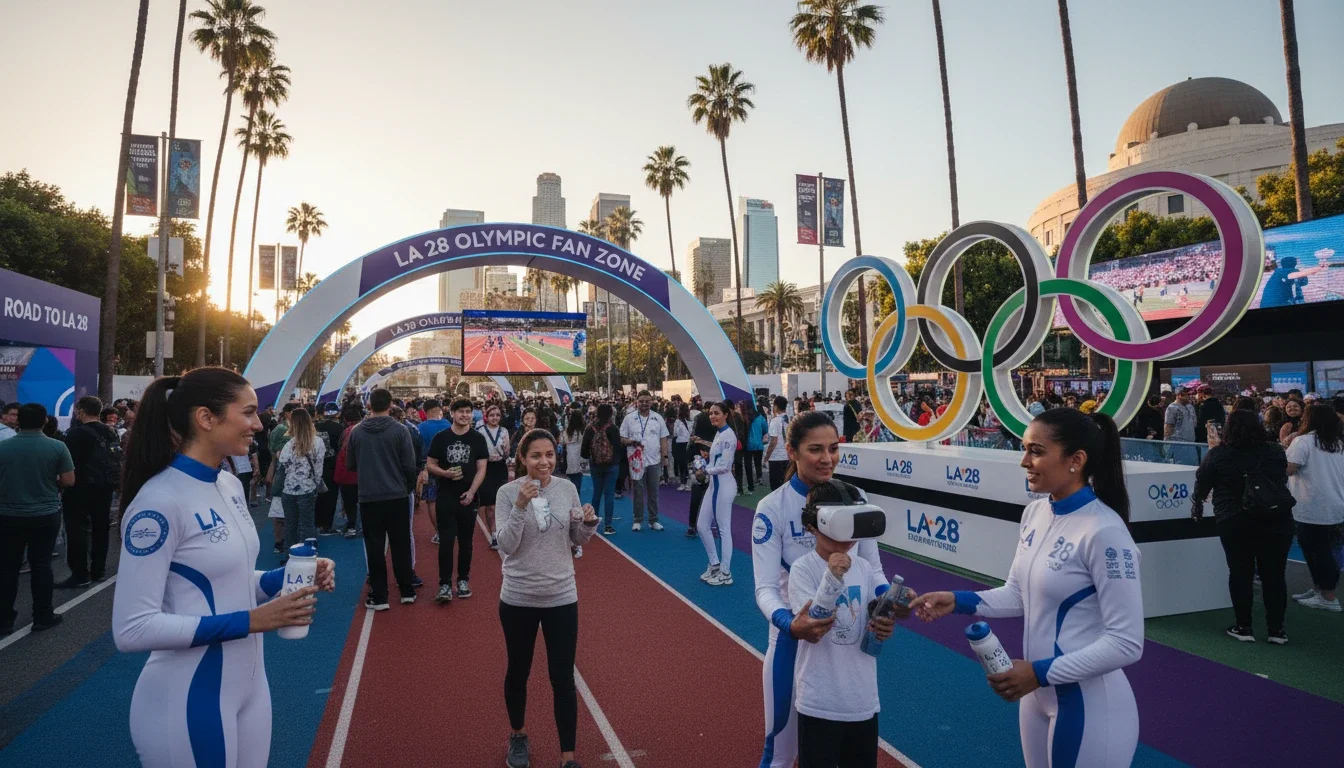
Professional brand ambassadors engaging with the public near an Olympic fan zone.
What Is Ambush Marketing — and Why the Olympics Make It Irresistible?
Ambush marketing is a strategy where a brand that has not paid for official event sponsorship rights finds clever, legal ways to associate itself with that event's energy, audience, and cultural moment. The term was coined by Jerry Welsh, head of marketing at American Express in the 1980s, and it's been a fixture of major sporting events ever since.
The Olympics, in particular, is a breeding ground for ambush creativity. You have billions of global eyeballs, concentrated audiences in specific cities, intense media coverage, and an emotional atmosphere that makes people highly receptive to brand messaging. Official sponsors pay for exclusive access to that environment. Ambush marketers find the doors that aren't locked.
To be clear: this isn't about deception or trademark infringement. The most effective — and most legal — ambush campaigns work by positioning a brand in and around the cultural conversation surrounding an event without falsely implying an official sponsorship relationship.
The Legal Line: What You Can and Can't Do
There's a meaningful distinction between lawful and unlawful ambush marketing, and any brand planning activity around LA 2028 needs to understand it.
What's generally permitted:
Advertising near (but outside designated "clean zones" around) Olympic venues
Running brand campaigns that capture the general spirit of athletic achievement without referencing Olympic trademarks
Distributing branded merchandise, samples, or giveaways in public spaces
Sponsoring nearby events, community gatherings, or parallel programming
Social media content tied to the energy of the moment without using protected terms
What crosses the line:
Using the Olympic rings, "LA 2028," "Olympics," or any protected trademark without authorization
Creating the false impression of an official sponsor relationship
Advertising within the IOC-designated "clean zones" around official venues
Using current competing athletes in advertising during the Games without compliance with Rule 40
Understanding IOC Rule 40
Rule 40 of the Olympic Charter is the piece of regulation that governs commercial use of athlete images and performances during the Olympic period. Historically quite strict, it has been progressively relaxed since 2015 and more significantly for Paris 2024 — a trend expected to continue for LA 2028.
Under updated Rule 40 provisions, non-Olympic sponsors can use or mention an athlete's name, image, or performance in advertising, provided the campaign meets specific criteria: it typically must have started before the Olympic period, not be intensified during competition, and have no direct reference to Olympic properties. The exact key principles for LA 2028 will be published by the IOC and relevant National Olympic Committees as the Games approach.
The bottom line: consult with a qualified IP or sports marketing attorney before finalizing any campaign that features Olympic athletes or closely references the Games. The rules are more permissive than many brands assume — but they're still rules.
Why LA 2028 Is a Unique Opportunity for Non-Sponsors
Every Olympic Games offers some version of this opportunity. But Los Angeles in 2028 is genuinely different, and in ways that dramatically favor brands who aren't official partners.
LA's Geographic Advantage: The City Is the Venue
Unlike Paris, which concentrated activities around a more compact urban core, the LA 2028 Games will be spread across Southern California in a way that is unprecedented in Olympic history. The no-new-build model means existing stadiums, arenas, and parks across a sprawling metropolitan area become the theater of competition.
This matters enormously for non-sponsor brands. When official venues are dispersed across Venice, Downtown LA, Long Beach, Pasadena, and beyond, the crowds don't flow through a single corridor that can be "locked down." They flow through neighborhoods, along boulevards, past storefronts, through fan zones, and onto beaches and boardwalks. Every one of those touchpoints is an activation opportunity for the brand willing to show up with the right team.
Four Sports Parks and Dozens of Activation Zones
LA 2028 is organized around four unique sports parks, each anchoring a distinct part of the city. This creates multiple epicenters of Olympic energy — and multiple perimeters of high-traffic, brand-receptive audiences just outside official boundaries.
Smart non-sponsors won't try to go inside. They'll own what's just outside: the blocks, the parks, the plazas, and the transit corridors where fans gather, travel, and linger before and after competition.
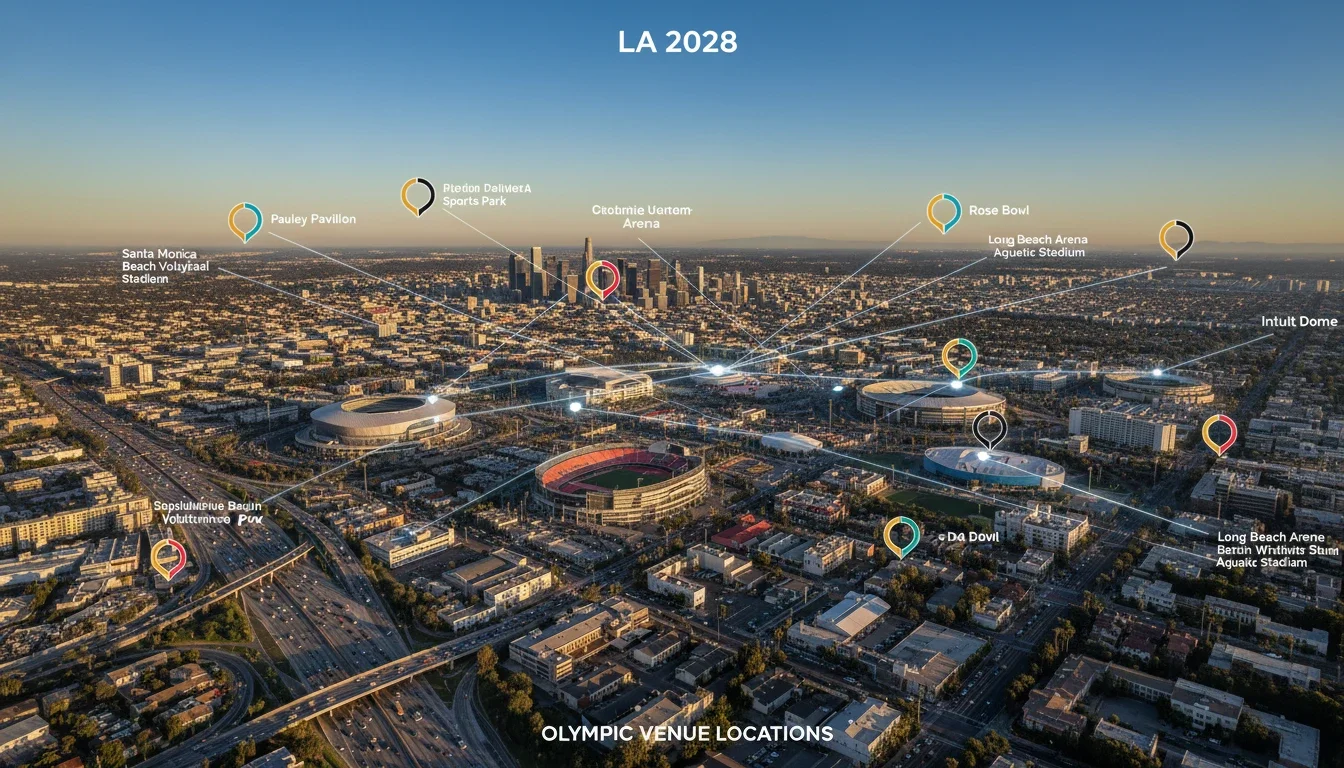
Aerial view of Los Angeles highlighting the dispersed Olympic venue locations across the city.
The Cultural Program: Your Open Door to Legitimate Visibility
The City of Los Angeles has committed to a citywide cultural program running from 2026 through the Games, with at minimum $4 million in grant funding supporting community activations, public art, festivals, and Olympic-themed programming across all 15 city council districts.
This is an underutilized opportunity. Brands that partner with, sponsor, or activate alongside this cultural programming gain legitimate visibility in the Olympic ecosystem without approaching any IOC-protected territory. Supporting local arts organizations, co-presenting community events, or activating in cultural corridors during the lead-up period is entirely within bounds — and it earns goodwill while building brand presence.
The Non-Sponsor Playbook: Street Team Tactics That Work
This is where strategy becomes execution. And execution, at scale, requires people. Here are the tactics that consistently deliver for non-sponsor brands at major sporting events — and how street teams make them happen.
Proximity Activations: Own the Perimeter
The single most proven ambush marketing tactic is positioning your brand in high-visibility locations just outside official clean zones. Nike famously turned this into an art form at Atlanta in 1996, buying up billboard and outdoor advertising across the city to surround Reebok's official presence with Swoosh branding. Today's version of this is more human.
A well-briefed team of brand ambassadors stationed along fan transit routes — Metro stations, pedestrian corridors, pickup/drop-off zones — creates organic brand touchpoints that reach the same audience without touching any restricted space. The key is density and professionalism: enough people to create a presence, trained well enough to represent the brand with excellence under pressure.
Pop-Up Experiences in High-Traffic Neighborhoods
LA's neighborhoods offer a distinct advantage: they're globally iconic. Santa Monica Pier, Venice Beach, the Beverly Hills Golden Triangle, Koreatown, and Culver City will all see surges in Olympic-adjacent foot traffic. A well-executed pop-up brand experience in any of these locations doesn't need the Olympic rings to feel like part of the Olympic moment.
The best pop-ups aren't just sampling stations or branded tents — they're experiences that people want to photograph, share, and remember. Think about what your brand can offer that fits the athletic, celebratory, international spirit of the moment. Then staff it with people who can bring that experience to life.
Sampling and Giveaway Campaigns
Product sampling and branded giveaways in public spaces remain one of the most effective — and legally clean — forms of ambient Olympic marketing. When tens of thousands of people are moving through a city for two weeks, a branded item they receive on the street travels with them into venues, onto social media, and back home.
The operational reality matters here: managing a giveaway campaign at Olympic scale requires a coordinated team, clear shift structures, solid logistics, and staff who are trained to engage professionally with a global, multilingual audience. This is not an intern operation.
Social Media Amplification Through Live Field Teams
Paris 2024 was widely called the first "social media Olympics." LA 2028 will take that further. The most forward-thinking non-sponsor brands are already thinking about how their field teams can become content-generation engines.
This means training street team staff not just to distribute or engage, but to capture moments, support brand creators filming content, and create the kind of authentic human-level footage that performs on TikTok, Reels, and YouTube Shorts. A clip of your product being enthusiastically received by a tourist from Brazil or a family from Japan carries authenticity that a produced ad spot never can.
Athlete and Influencer Partnerships (Within Rule 40 Limits)
While using active competing athletes during the Olympic period is governed by Rule 40, former athletes face no such restrictions. Partnering with retired Olympians — especially those with local LA roots or existing audiences — is a fully legal way to build Olympic-adjacent credibility for a non-sponsor brand.
Similarly, working with sports-adjacent influencers and creators who are attending the Games or covering them provides another avenue for authentic reach. Train your field teams to identify and facilitate content moments with these creators in the wild.
Historical Ambush Marketing Wins That Rewrote the Rulebook
Understanding how brands have successfully executed this in the past gives non-sponsors in 2028 a cleaner blueprint.
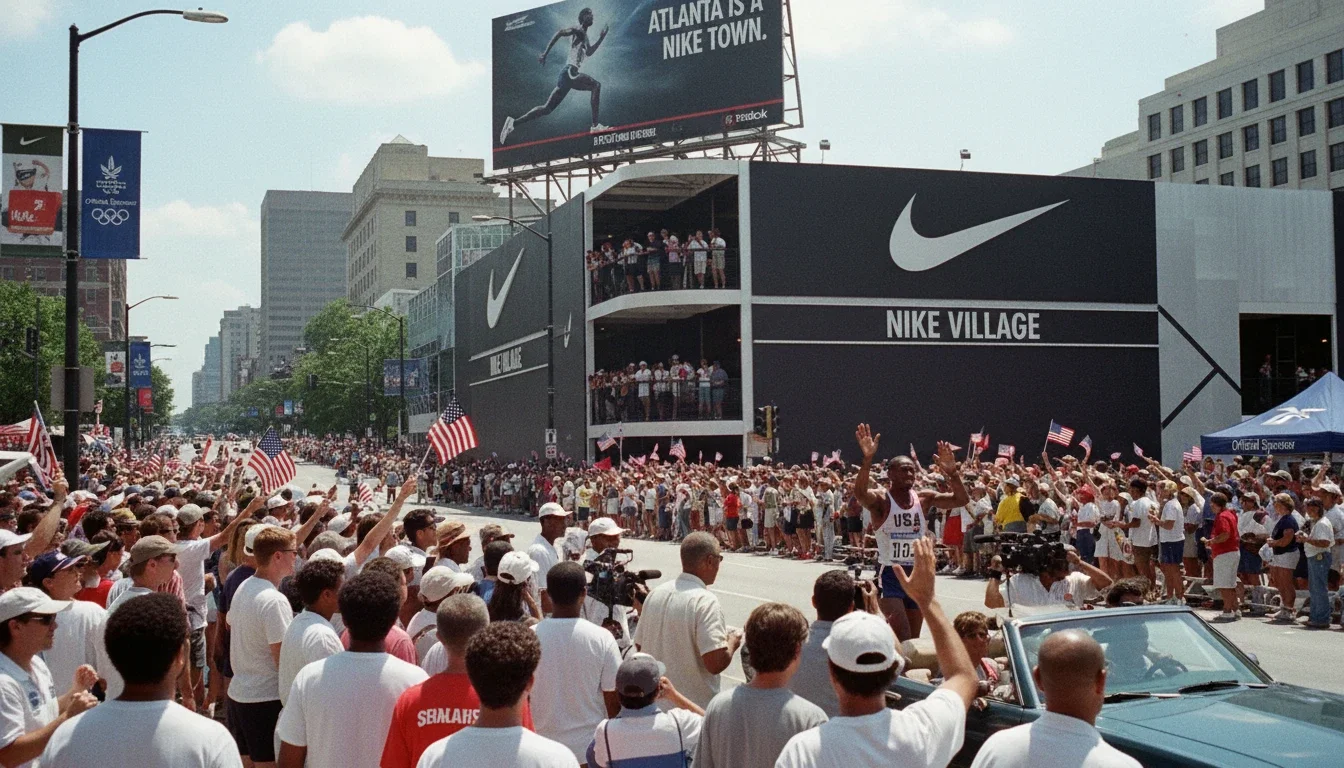
Nike's Atlanta 1996 strategy showed how a non-official sponsor could dominate Olympic marketing.
Nike at Atlanta 1996: The "Nike Village" Play
When Reebok paid $50 million to become the official sponsor of the 1996 Atlanta Games, Nike declined to pay and chose a different game entirely. The brand leased space near the official Olympic Village, created its own "Nike Village" open to athletes, and blanketed the surrounding city with Swoosh branding through billboards and outdoor media.
The result? A significant portion of the public came away from the Games believing Nike was an official sponsor, not Reebok. The campaign was so effective that the IOC tightened enforcement rules afterward, which is itself a testament to how well it worked.
American Express vs. Visa at Albertville 1992
Visa was the official card sponsor of the Albertville Winter Games, paying premium fees for exclusive rights. American Express ran a campaign centered on the simple truth that you didn't need a Visa to travel to France — using geographic wordplay to imply Olympic relevance without ever referencing the Games directly.
This case remains a textbook example of ambush marketing wit: legally clean, strategically effective, and enormously damaging to the sponsoring competitor's exclusivity perception.
Under Armour at Rio 2016: Winning Without the Rings
Perhaps the most relevant modern case study for performance-oriented brands is Under Armour's Rio campaign. The brand sponsored Michael Phelps, Misty Copeland, and other athletes and built campaigns around their training, their struggle, and their humanity — without making the Olympics the center of the story.
The result was remarkable: an 8.4% rise in share price over the Games period, a 20% lift in brand consideration, and one of the five most shared Olympic videos ever — all achieved without official sponsorship status. The lesson is that the human story is the vehicle, not the five rings.
How to Build a Street Team That Can Execute at Olympic Scale
Knowing the tactics is one thing. Being able to field a team capable of executing them — at the pace, scale, and professionalism that a global event demands — is another.
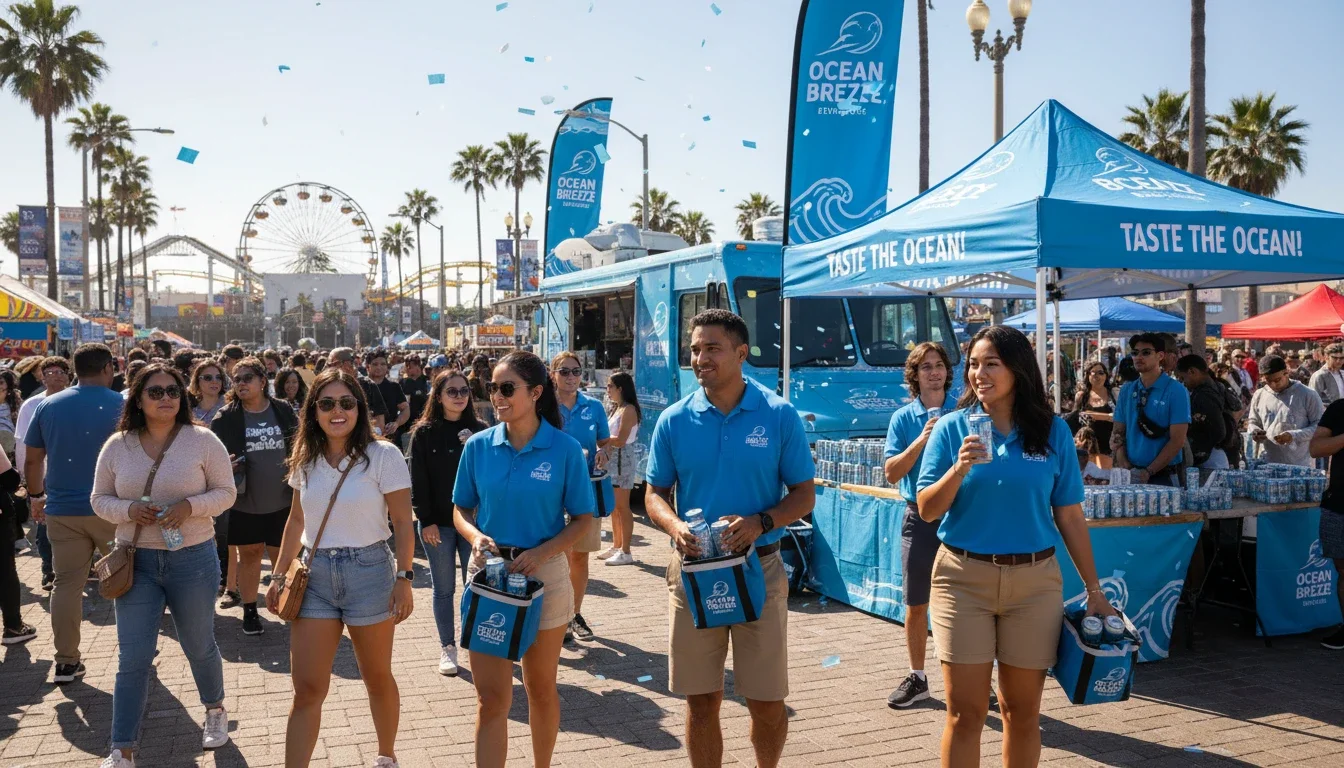
A professional brand ambassador street team executing a sampling campaign at a high-traffic Los Angeles event.
What to Look for in Olympic Street Team Staff
The LA 2028 Olympic period will bring a global, multilingual audience to Los Angeles. Your street team needs to reflect that reality. When working with a professional brand ambassador staffing agency, prioritize:
Multilingual capability — Spanish, Mandarin, French, Portuguese, and Japanese coverage is highly valuable, given the expected international attendance
High-pressure poise — Olympic crowds are not ordinary crowds. Staff must be composed, professional, and adaptable when the environment is chaotic
Brand fluency — Staff who can articulate your brand message clearly, naturally, and in real time without a script
Physical stamina — Long shifts in the LA summer heat require staff with the endurance to remain energetic and professional throughout
Social media literacy — If content creation is part of the activation, staff who understand what makes a great on-the-ground clip
How Many People Do You Actually Need?
This depends entirely on your activation footprint. A single pop-up experience in one neighborhood might be supported effectively by a team of six to ten people per shift. A multi-location campaign running across multiple Olympic weeks will require a much larger roster with rotating shifts, team leads, and logistics coordinators.
As a general rule, most brands underestimate how many people they need to actually create a visible street presence. A team of two feels like a table. A team of twelve feels like an event. Work with your event staffing partner early to map your activation geography and calculate the right team size for your goals.
Training, Briefing, and Brand Alignment
The quality of a street team is entirely determined by the quality of the brief and the training behind it. Staff who don't know your brand story, your talking points, your dos and don'ts, and the boundaries of what they're authorized to say or do will create more liability than value.
A proper pre-activation training should cover:
Brand story, mission, and key messages
Product knowledge and demonstration (if applicable)
Interaction guidelines — especially for bilingual situations or sensitive audiences
Geographic briefing — where to be, when, how to handle crowds
IOC-compliance reminders — what not to say, wear, or imply
Content capture expectations
Working With a Local LA Staffing Agency
There's a meaningful difference between booking staff online and working with an agency that knows Los Angeles at an operational level — which venues attract which crowds, which neighborhoods spike at which times, how to navigate LA traffic and logistics, and how to field a replacement quickly when someone calls in.
For Olympic-scale activations, that local knowledge is not a nice-to-have — it's a competitive advantage. Eleven8 Event Staff has spent three decades building relationships with brands, venues, and talent across the LA area, staffing everything from intimate brand activations to massive multi-day conventions with thousands of attendees.
Common Mistakes Non-Sponsors Make (and How to Avoid Them)
Even brands with a smart strategy can undermine their own campaign. The most frequent missteps at Olympic-adjacent activations include:
Using protected terms or imagery. The words "Olympics," "LA 2028," "Games," the five rings, the torch — all protected. Brief your teams, your social media managers, and your creative team on this before anything goes live.
Underestimating logistics. LA is enormous, traffic is notorious, and Olympic periods add unpredictable surges to both. An activation plan that works in theory falls apart if your staff can't get to the location on time, or your supply logistics break down on day three.
Hiring staff without proper vetting. The energy and professionalism your street team projects directly reflects on your brand. Staff who are unprepared, visibly uncomfortable, or unable to communicate clearly in a high-pressure environment do damage. Work with an agency that vets rigorously.
Launching too late. The best ambush marketing campaigns at major events build brand presence in the months before the Games — positioning the brand in consumers' minds before the official sponsors dominate every channel. Start early. Plan for the lead-up.
Trying to do too much. A focused, well-executed activation in one neighborhood beats a scattered, thin presence across ten locations. Concentration creates visible momentum. Spread creates invisible noise.
Start Planning Now: The LA 2028 Timeline for Non-Sponsors
The temptation is to treat 2028 as something to plan for in 2027. That's the wrong approach — and your competitors who figure this out first will be positioned well ahead of you.
Official Olympic sponsors are already deep into multi-year activation planning. Non-sponsors who want to credibly compete for the same eyeballs need to start building their strategy, their partnerships, and their on-the-ground teams now.
A realistic planning timeline for a street team–led ambush campaign might look like this:
2026: Strategy development, legal review, creative concept, LA market research
Early 2027: Agency partnerships secured, staffing requirements mapped, permit research underway
Mid 2027: Pre-Games campaign launches — building brand presence in LA audiences before the Games begin
Late 2027–Early 2028: Staff recruited, trained, and rehearsed; activation materials produced; logistics tested
July–August 2028: Execution — with enough lead time, your team operates smoothly from day one
The brands that wait until 2027 to begin this process will be executing under pressure. The ones that start now will run an activation that feels effortless — because it actually was, by the time the flame was lit.
To explore how Eleven8 Event Staff can support your LA 2028 brand activation — from brand ambassadors and street teams to full event staffing — contact our team today.