Bilingual Event Staff for the LA 2028 Olympics: Why Language Matters at a 206-Nation Event
When Los Angeles welcomes the world in the summer of 2028, it won't just be welcoming athletes. It will be hosting delegations, tourists, sponsors, and fans from 206 nations — representing hundreds of languages, dozens of cultural norms, and billions of global viewers paying close attention.
For brands, sponsors, and event organizers preparing Olympic activations, this presents an extraordinary opportunity. But it also presents a challenge most people don't talk about until it's too late: language.
The guests showing up to your fan zone, sponsor activation, VIP lounge, or registration desk won't all speak English. Some will speak it imperfectly. Many will feel far more comfortable — and far more receptive to your brand — when greeted in their native tongue. That's not a nice-to-have. That's a competitive strategy.
This is why bilingual and multilingual event staff are one of the most underrated investments a brand can make heading into LA 2028.
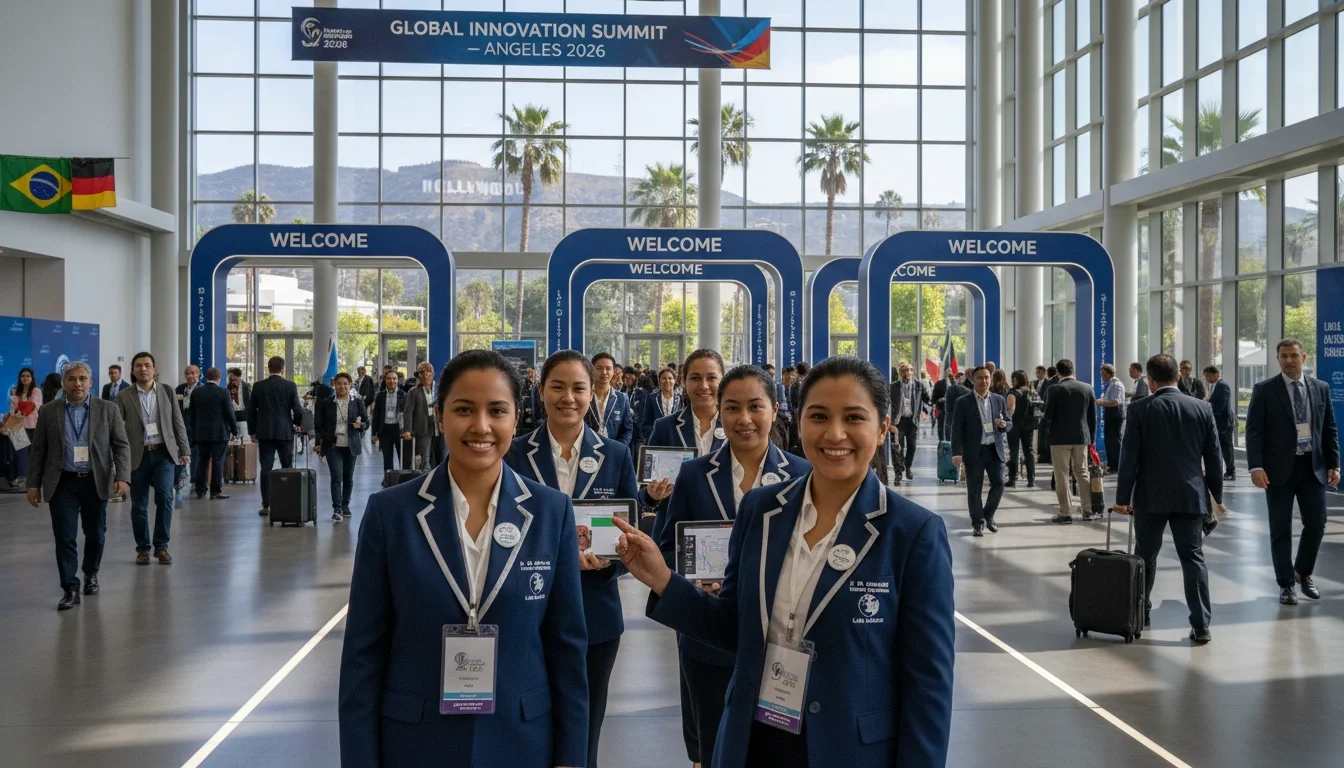
Bilingual event staff in professional uniforms welcoming international guests at a Los Angeles convention.
The Linguistic Scale of the Olympic Games
206 Nations, Dozens of Languages, One Host City
The International Olympic Committee currently recognizes 206 National Olympic Committees — meaning 206 distinct national delegations will arrive in Los Angeles for the 2028 Games. The Olympic Movement's two official languages are French and English, but that designation applies to official documentation and ceremonies, not to the daily human experience of navigating a foreign city.
In practice, the linguistic reality is far more complex. Athletes, coaches, delegation staff, and international fans arrive speaking everything from Mandarin and Arabic to Portuguese, Japanese, Korean, German, and Swahili. When your event staff can only communicate in English, you're functionally invisible to a massive segment of your potential audience.
The Most Common Languages at the Olympics
While no comprehensive linguistic breakdown of Olympic attendees exists, the picture becomes clear when you look at which countries send the largest delegations and tourism footprints to a Summer Games. Based on attendance patterns from Tokyo 2020 and Paris 2024, the most represented language groups tend to include:
Spanish — representing athletes and fans from over 20 nations across Latin America and Spain
French — an official Olympic language with strong representation from African and European nations
Mandarin Chinese — with China consistently among the top medal-winning nations
Japanese — still significant following Tokyo 2020's passionate fan base
German — Germany, Austria, and Switzerland collectively field strong delegations
Portuguese — Brazil alone sent one of the largest delegations to recent Summer Games
Korean — South Korea fields competitive squads across multiple sports
Arabic — representing 22 Arab League nations and growing Islamic world participation
For an LA-based activation, Spanish deserves particular emphasis — not just because of Latin American Olympic participation, but because of Southern California's own demographics.
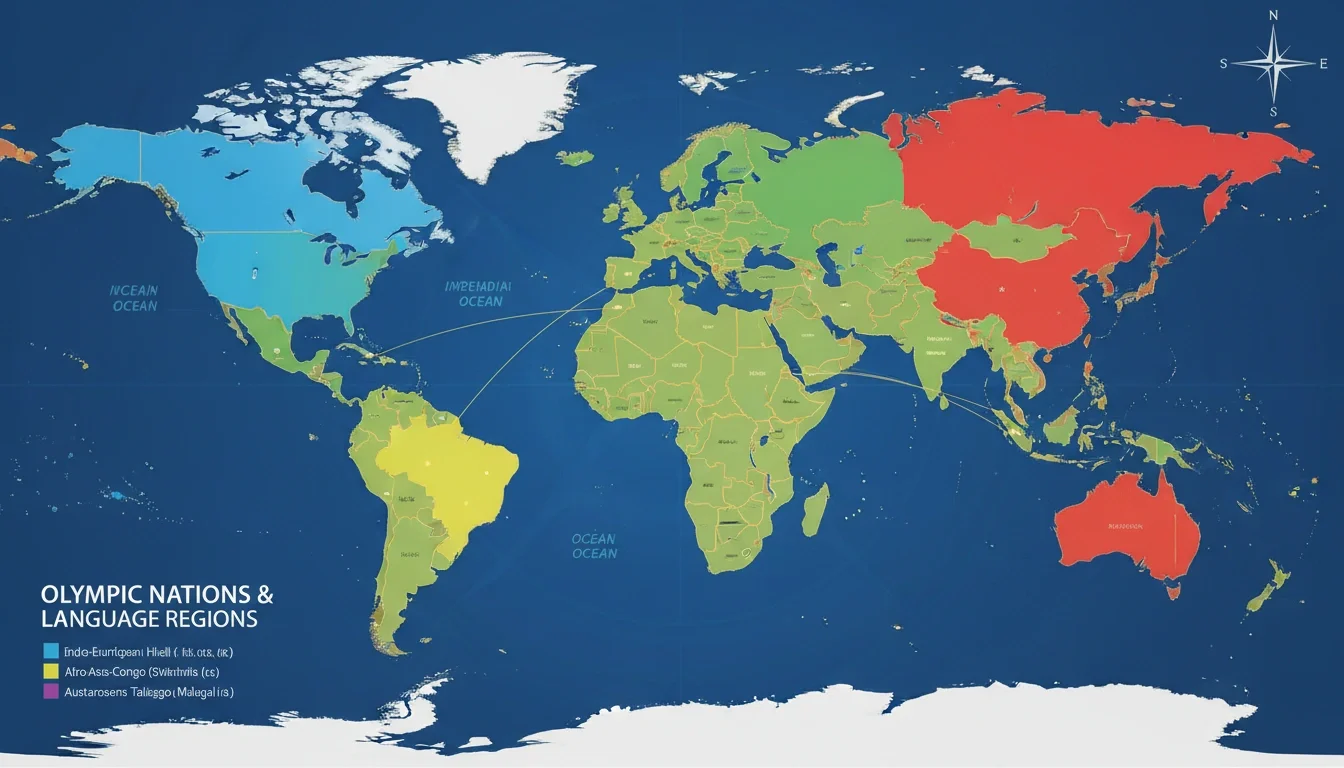
World map showing the 206 nations represented at the Olympic Games with primary language regions highlighted.
Why Language Barriers Are a Real Risk at Major International Events
The Guest Experience Breakdown
Imagine an international visitor arriving at your brand's activation booth at an Olympic venue. They're excited, they're engaged — and then they're met with a staff member who can only gesture and smile. The moment breaks. They move on.
This isn't a hypothetical. It's a pattern that repeats itself at every major international event where staffing is treated as a commodity rather than a strategic communication function. Language barriers create friction at exactly the moments when you most need flow: arrival, engagement, conversion, and departure.
At an Olympic event, that friction is amplified. Your window with each guest is brief. Your brand's message is competing with a thousand other stimuli. The fastest way to create a genuine, memorable connection is in the language the guest actually thinks in.
Brand Activation ROI and Lost Connections
Brand activations at the Olympics are significant investments. Sponsorship packages, build-out costs, promotional materials, logistics — the numbers are substantial before you even hire a single staff member. Yet many brands underinvest in the one element that determines whether guests leave with a positive experience or leave at all: who's actually talking to them.
A bilingual brand ambassador doesn't just fill a shift. They create conversations that would otherwise never happen. They capture leads that would otherwise walk away. They generate social moments — photos, shares, stories — that extend your brand's reach far beyond the activation footprint.
VIP and Athlete Hospitality: Where Language Matters Most
At the VIP level, language proficiency isn't a nice touch — it's a basic expectation. Delegations, international sponsors, and athlete families attending hosted hospitality events will notice immediately if your team can't communicate beyond surface-level pleasantries. For luxury brands and high-end hospitality settings, this can be the difference between a guest who feels celebrated and one who feels like an afterthought.
Los Angeles: A Uniquely Multilingual Host City
LA's Native Language Diversity
Los Angeles is one of the most linguistically diverse cities on the planet. More than one-third of LA County residents are foreign-born, and the city's population speaks over 200 languages. Spanish is spoken by nearly half the region's population. Significant Korean, Mandarin, Armenian, Tagalog, Japanese, and Persian-speaking communities exist throughout the metro area.
This means that, unlike many Olympic host cities, Los Angeles already has a large, locally rooted, professionally active workforce that speaks the languages of the world's Olympic nations. The talent is here. The question is whether event organizers and brands think about recruiting and leveraging it.
Why LA Locals Make Ideal Bilingual Event Staff
There's a meaningful difference between hiring a staff member who speaks another language and one who lives in the cultural community that language represents. Los Angeles is full of the latter. A Korean-American staff member from Koreatown doesn't just speak Korean — they understand the cultural cues, hospitality norms, and social dynamics that make Korean visitors feel genuinely welcomed rather than merely acknowledged.
This combination of language fluency and cultural fluency is what separates excellent multilingual event staffing from a checkbox exercise.
What Bilingual Event Staff Actually Do at Olympic Activations
Multilingual staff isn't a single role — they serve across the full event experience. Here's how language competency applies to the most common Olympic event positions:
Registration and Wayfinding
First impressions happen at registration and entry points. For international guests unfamiliar with LA venues and Olympic logistics, a staff member who can answer questions, read credentials, and provide wayfinding guidance in their native language reduces anxiety and creates immediate goodwill. This is especially important at high-traffic, multi-venue events where directions and credentials are already complicated.
Brand Ambassador and Fan Engagement Roles
Brand ambassadors are the human face of your Olympic activation. Their job is to engage, inform, and excite. A Spanish-speaking brand ambassador at a Latin American athlete's competition day can connect with fans who might otherwise walk past your booth entirely. A Mandarin-speaking ambassador at an activation near a Chinese delegation hotel can open doors that English-only staff simply cannot.
VIP Hosting and Hospitality
VIP hospitality staff operate in high-stakes, relationship-driven environments. Whether you're hosting international sponsors in a private suite, entertaining delegation officials at a sponsored dinner, or running a luxury brand experience for global media, the ability to communicate naturally — without awkward pauses, mistranslations, or language-related discomfort — defines the quality of the experience.
Athlete and Delegation Liaison Support
Some activations and hospitality programs involve direct interaction with athletes and their teams. Coaches and athletic trainers often travel exclusively in their native language. Having a staff member who can communicate directly, clearly, and warmly with these individuals creates a fundamentally different level of service.
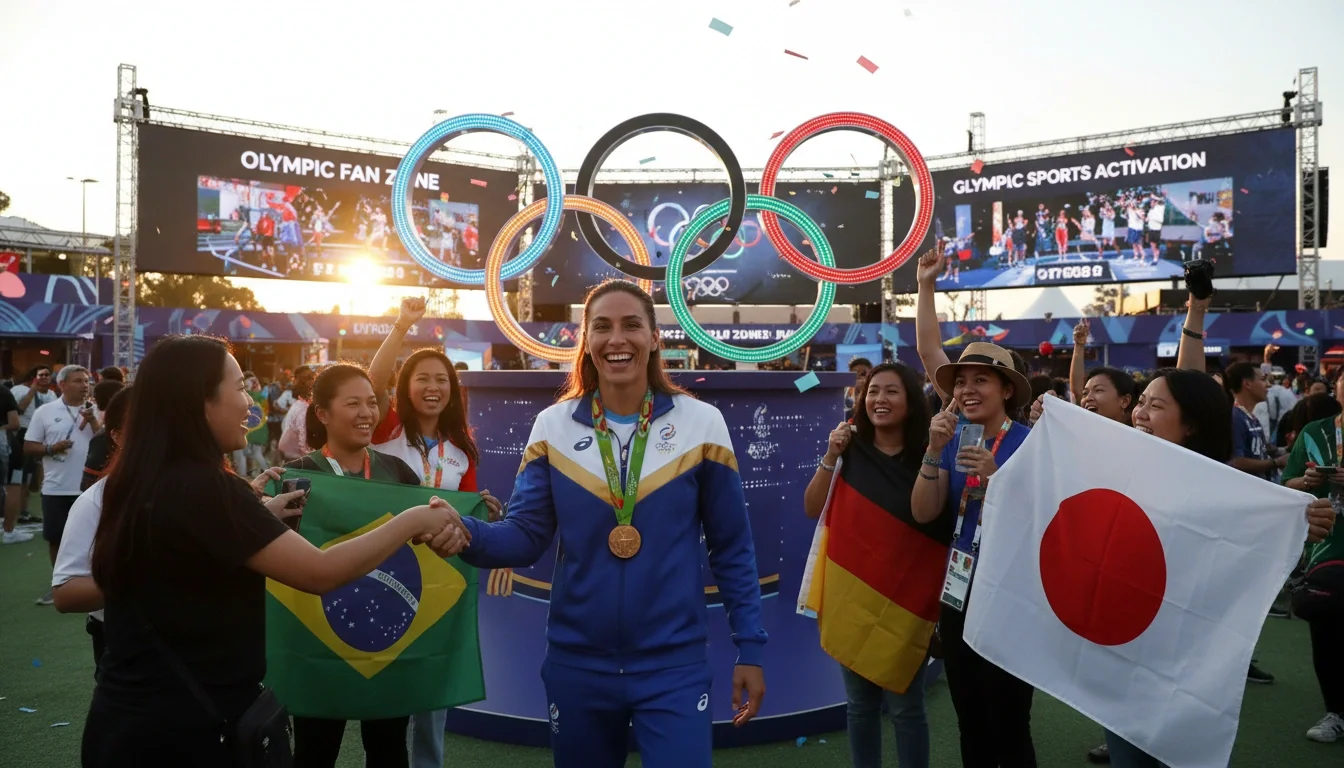
Brand ambassador engaging with international attendees at a fan zone activation at an outdoor event.
Which Languages Should You Prioritize for LA 2028?
Not every brand can or should staff every language. Strategic prioritization based on your audience, sponsorship category, and activation location will yield better results than spreading thin.
Tier 1: Must-Have Languages for Most Activations
For most brands activating at LA 2028, these languages represent the highest-value, highest-volume communication needs:
Spanish — Non-negotiable given LA's demographics and Latin American Olympic representation
Mandarin Chinese — China consistently commands one of the largest presences at the Summer Games
French — One of two official Olympic languages; speaks to African, Canadian, and European audiences
Portuguese — Covers Brazil, one of the world's most enthusiastic Olympic nations
Korean — High-value audience with strong purchasing power and deep Olympic engagement
Tier 2: High-Value Languages for Specific Sponsorship Targets
Depending on your brand's specific sponsorship category, market, and target audience, these languages add meaningful reach:
Japanese — Particularly relevant for technology, automotive, and precision brands
German — Important for European B2B relationships and luxury categories
Arabic — Growing Olympic participation and significant sponsorship interest from Gulf nations
Tagalog — One of the largest language communities in the LA metro area
How to Vet and Book Bilingual Event Staff for a Major Event
Language Proficiency Standards
Not everyone who lists a second language on a résumé is event-ready in that language. For high-stakes Olympic activations, you need staff who can hold natural, confident conversations — not just read a script. When working with a staffing agency, ask specifically about:
Fluency level (conversational vs. professional vs. native)
Whether staff have worked at previous events in that language
Whether the agency conducts language screening as part of its vetting process
A reputable event staffing agency in Los Angeles will have these conversations proactively and won't place a staff member claiming bilingual capability without verifying it.
Cultural Competency vs. Translation Alone
Language is the vehicle; culture is the destination. A staff member who speaks Mandarin but has no familiarity with Chinese hospitality customs, formalities around gift-giving, or business hierarchy etiquette will miss important cues. The best multilingual staffing agencies train for cultural competency, not just vocabulary.
How Far in Advance to Book
For an event of LA 2028's scale, early booking is not optional — it's a survival strategy. The pool of qualified, professionally experienced, bilingual event staff in Los Angeles is not unlimited. Brands and agencies that begin their Olympic staffing conversations years in advance — not months — will have access to the strongest talent. Those who wait until 90 days out will be competing for whatever remains.
Given that the LA 2028 Games run from July 14–30, 2028, serious planning conversations should begin no later than early 2027, with preferred rosters being secured well before that.
Eleven8 Event Staff's Track Record with Multilingual Staffing
Elev8.la isn't theorizing about multilingual event staffing — it's already doing it at scale.
When KCON, one of the largest K-Pop and Korean culture conventions in the United States, needed convention staffing in Los Angeles, Eleven8 Event Staff deployed 40+ bilingual staff members for a three-day event that drew over 50,000 attendees from around the world. Managing registration, crowd flow, cultural programming, and attendee experience across language groups required not just headcount, but genuinely language-competent professionals who understood the cultural context of the event.
That experience — combined with 30+ years in the Los Angeles event industry and partnerships with global brands including Nike, Versace, Porsche, and Netflix — positions Eleven8 uniquely for the demands of LA 2028. This is not a team learning on the job. It's a team that has already done it.
Clients planning Olympic activations, brand launches, hospitality programs, or fan zone staffing can connect directly at hello@elev8.la or by calling 323-426-6910.
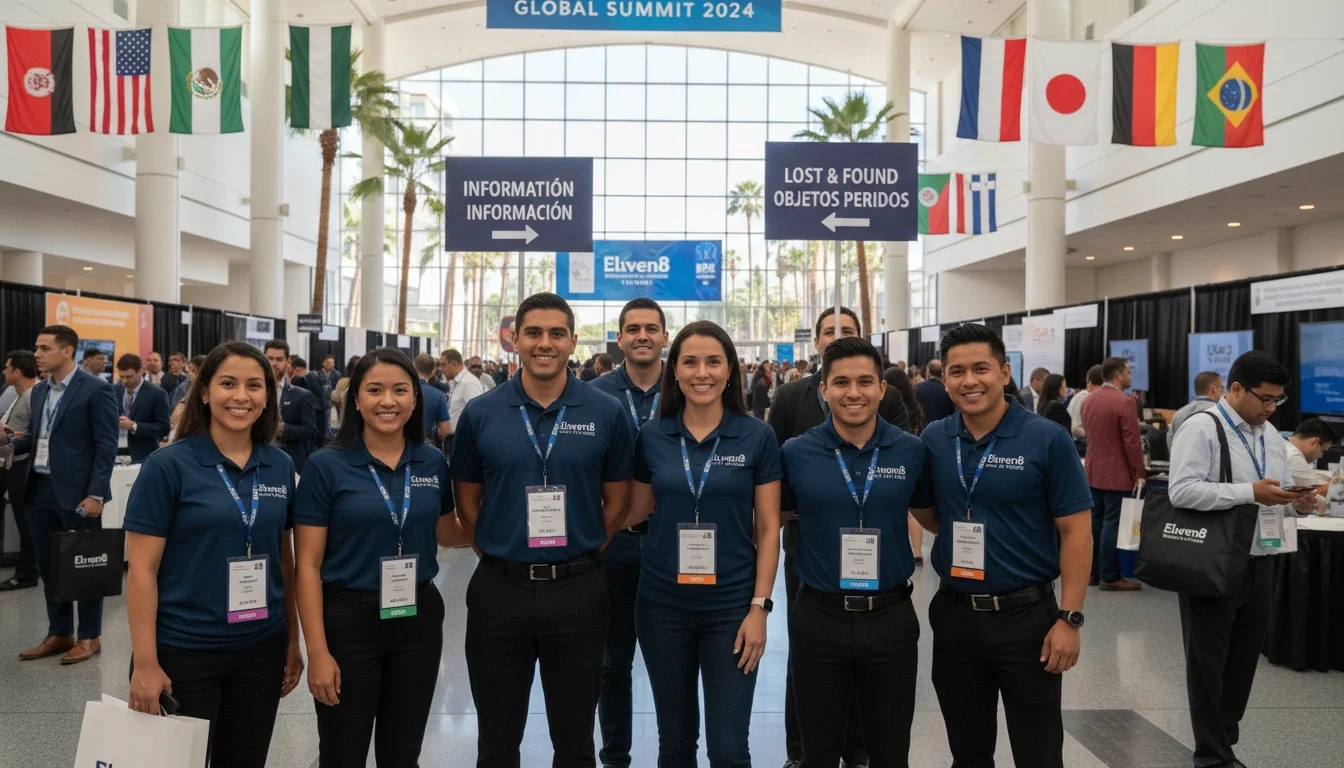
Event Staff bilingual team at a large-scale international event in Los Angeles supporting diverse attendees
Final Thoughts: Language Is a Competitive Advantage at LA 2028
Every brand at the LA 2028 Olympics will have a booth, a banner, and a budget. Very few will have genuinely fluent, culturally intelligent, professionally trained staff who can engage the world in its own languages.
That gap is your advantage — if you act on it.
The 2028 Olympic Games are coming to Los Angeles precisely because this city reflects the world better than almost anywhere on earth. The right staffing strategy doesn't just support that reality — it leverages it. Multilingual event staff aren't a service upgrade. They're the bridge between your brand's investment and the human connection that makes that investment worthwhile.