Tour Activation Logistics: How to Staff & Schedule for Maximum Impact
Running a brand activation tour is one of the most effective marketing strategies a team can execute. Nothing builds consumer trust, drives trial, and generates content like showing up in person, city after city, with a polished team that knows exactly what they're doing.
But the execution side — staffing, scheduling, backup planning, multi-city logistics — is where even well-funded campaigns quietly fall apart.
This guide breaks down exactly how to structure your tour activation staffing from the first planning call to the final post-event debrief. Whether you're planning three stops or thirty, these principles apply.
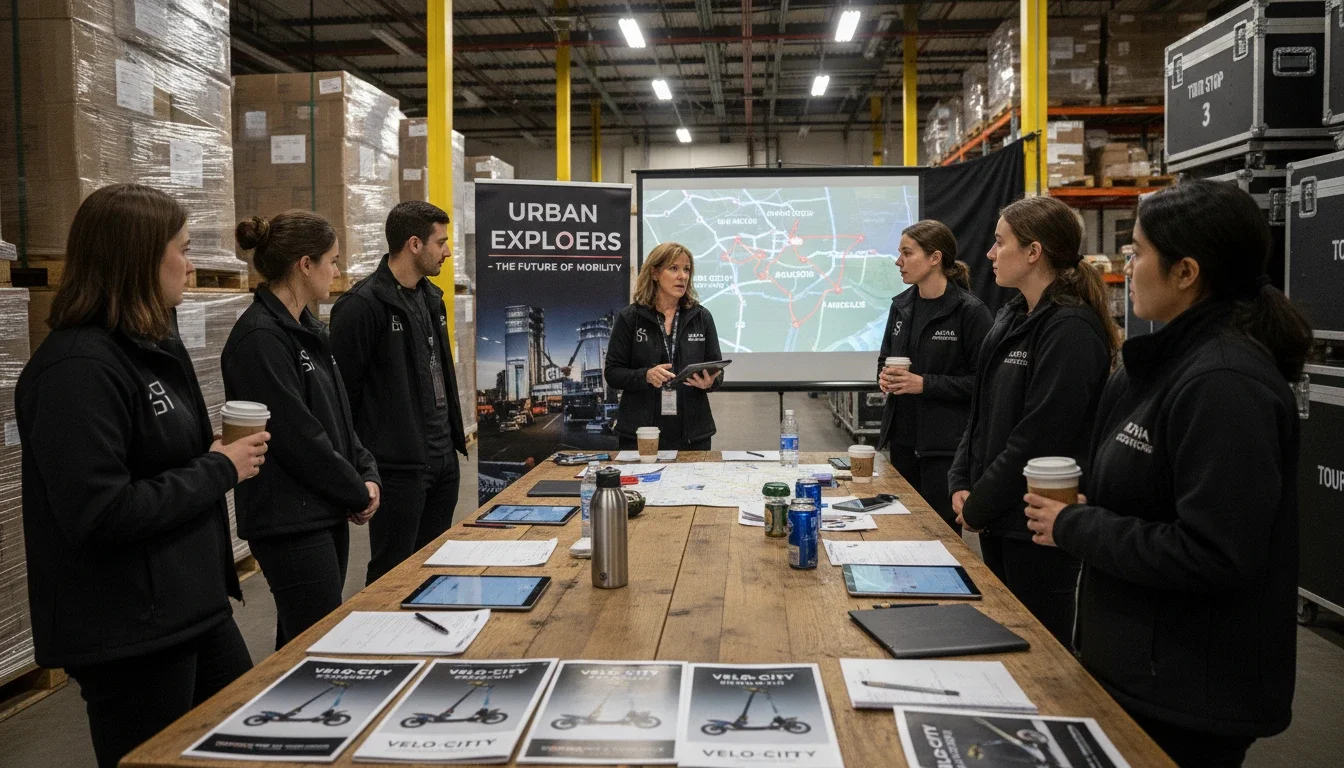
A brand activation team briefing before a multi-city tour stop — the kind of preparation that separates seamless campaigns from costly misfires
What Is Tour Activation Staffing — and Why It's Different From Single-Event Staffing
Most brands have booked staff for a one-day event. Tour activation staffing is an entirely different challenge.
Instead of deploying a team once, you're coordinating people across multiple cities, multiple dates, and multiple venue formats — while keeping brand messaging, energy, and execution consistent from the first stop to the last.
The operational complexity multiplies fast. A single no-show on a standalone event is an inconvenience. A no-show on stop three of a seven-city tour — when your traveling team is three time zones away — can derail the entire day's activation.
The Compounding Pressure of Multi-Stop Tours
Each activation stop builds on the last. Consumer content gets shared. Press coverage compounds. Brand momentum accumulates — or it doesn't, depending entirely on what happens on the ground.
That means your staffing decisions in week one create the foundation (or the cracks) for everything that follows. Inconsistent briefings lead to inconsistent experiences. Under-staffed stops lead to overwhelmed teams. Poor scheduling leads to exhausted brand ambassadors who can't bring the energy your activation requires.
Why Generic Staffing Platforms Fall Short
Marketplace-style staffing platforms — the kind where you post a shift and whoever's available picks it up — are designed for single, low-stakes fills. They weren't built for coordinated, multi-market tour campaigns.
What brands running activation tours actually need is a staffing partner with existing rosters in each target market, a standardized briefing process, built-in backup coverage, and dedicated account management throughout the campaign. That infrastructure simply doesn't exist in the self-serve marketplace model.
The Core Staff Roles Every Tour Activation Needs
Before you can build a schedule, you need clarity on what roles are required. Tour activations typically involve a combination of traveling and local staff, each with distinct responsibilities.
Tour Manager / Activation Lead
This is your on-the-ground commander at each stop. The activation lead is responsible for managing setup and strike, briefing local staff, troubleshooting in real time, tracking KPIs, and communicating with offsite operations. On smaller tours, this role may travel with the campaign. On larger campaigns, you may designate a local lead at each market who is pre-briefed and managed remotely.
Key skills to prioritize: strong communication, crisis management, brand familiarity, and prior multi-day event experience.
Brand Ambassadors
Brand ambassadors are the human face of your activation at every stop. They're responsible for consumer engagement, sampling, lead capture, messaging delivery, and generating the kind of authentic enthusiasm that makes people stop, try, and share.
On a tour, brand ambassador quality is everything. One disengaged or off-message ambassador can damage the very brand perception you're investing to build. This is why ambassador vetting — not just availability — must be your primary staffing filter.
What to look for: relevant product or industry experience, high energy levels, strong verbal communication, and the ability to stay "on" through a full activation day.
Production Assistants
PAs handle the operational layer of each activation: setup and breakdown of branded assets, inventory management, equipment troubleshooting, materials restocking, and logistical coordination with venue contacts. On complex activations with heavy builds or premium materials, PAs are as critical as your brand-facing staff.
Local Market Staff vs. Traveling Staff
Most successful tours run on a hybrid model:
Traveling core team: 1–3 key personnel (tour manager, senior brand ambassador, PA lead) who maintain continuity across every stop and serve as the institutional memory of the campaign.
Local market hires: City-specific brand ambassadors and support staff, sourced by your staffing partner in each market, who bring local knowledge and don't require travel accommodation.
This model balances cost efficiency with execution consistency. Your traveling team holds the standard; your local team brings the market intelligence.
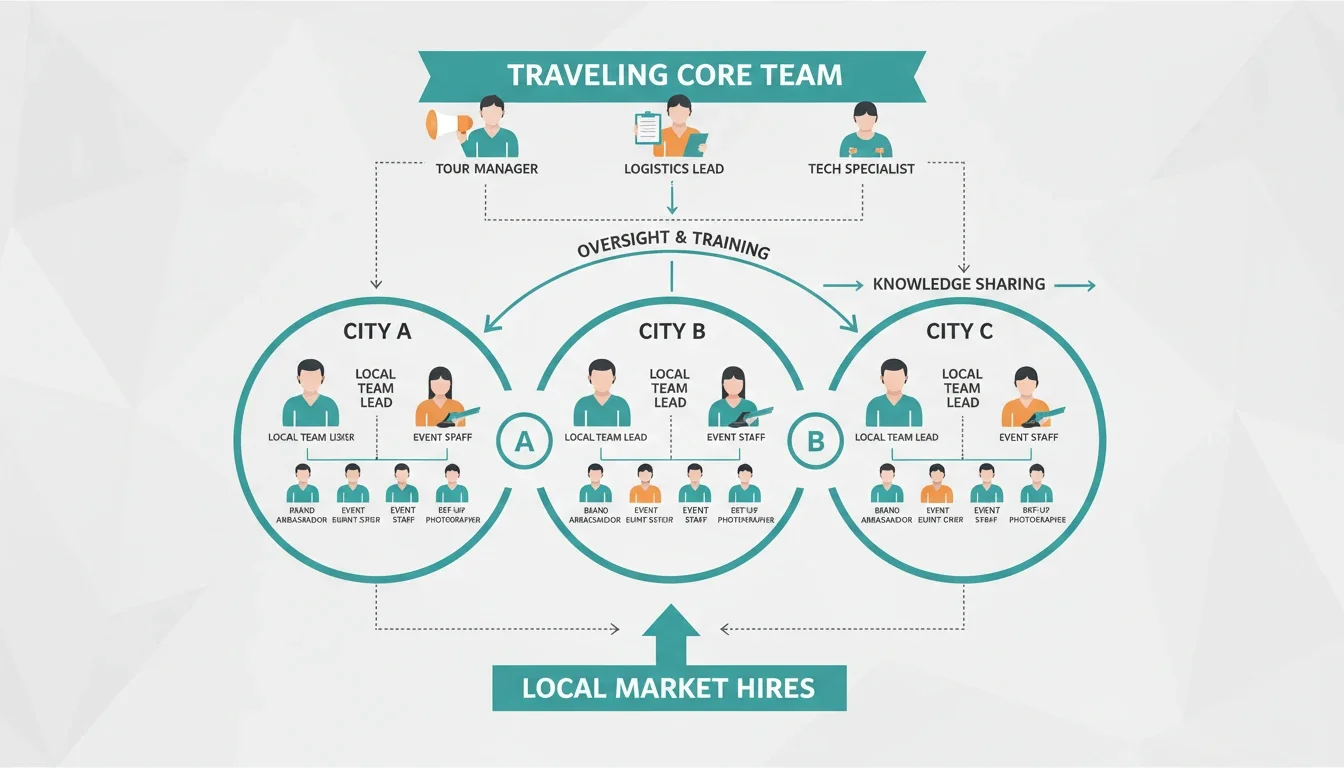
Illustration of a tour activation staffing structure showing the relationship between traveling core team and local market hires
Staffing Ratios: How Many People Do You Actually Need?
One of the most common tour planning mistakes is under-staffing activations in the name of budget efficiency. The math is simple: if your ambassador team is stretched thin, consumer engagement suffers — and the ROI of your entire campaign drops.
Here's a general framework, though your specific activation type, venue size, and consumer traffic projections should always inform the final numbers.
Small Activations (1–3 Staff)
Suitable for: retail sampling demos, intimate pop-up activations, targeted in-store promotions
1 activation lead/brand ambassador hybrid
1 PA (if heavy setup is involved)
Backup: 1 pre-briefed standby per market (non-negotiable even at this scale)
Mid-Size Activations (4–10 Staff)
Suitable for: street-level sampling tours, festival activations, college campus campaigns, branded pop-ups
1 on-site activation lead
3–7 brand ambassadors (ratio determined by square footage and consumer flow)
1–2 PAs for setup, strike, and inventory
Backup: 1 pre-briefed standby per 8 active staff
Large-Scale Activations (10+ Staff)
Suitable for: festival main stage activations, national brand launch tours, multi-zone experiential setups
1 senior tour manager
1 on-site activation captain per zone
8–20+ brand ambassadors, depending on zone count and traffic projections
2–4 PAs
Backup ratio: 1 briefed backup per 8 staff, confirmed before launch day
A general industry benchmark: plan your activation staffing assuming 20% above the minimum you think you need. Consumer traffic at live activations is notoriously difficult to predict, and arriving under-staffed is far more damaging than running a slightly larger team.
The 8-Week Staffing Timeline for Tour Activations
Successful tour staffing isn't something you finalize two weeks before launch. The brands that execute cleanly start the staffing process 8 weeks out — sometimes more for complex national campaigns.
Here's a timeline framework that works:
8 Weeks Out — Strategy & Staffing Brief
Confirm tour route, stop dates, venues, and activation formats
Draft your staffing brief: role definitions, brand voice guidelines, uniform requirements, KPIs per stop
Engage your staffing partner and share the brief — the earlier they begin roster matching, the better your options
Identify which roles require traveling staff vs. local hires in each market
6 Weeks Out — Staff Selection & Market Research
Review staff profiles, photos, bios, and relevant experience provided by your staffing agency
Select preferred staff for each market where possible
Confirm local knowledge requirements (bilingual needs, market-specific cultural nuance)
Finalize headcount per stop based on traffic projections
4 Weeks Out — Confirmation, Uniforms & Brand Briefing
Lock in confirmed staff assignments across all markets
Ship uniforms, branded kits, and collateral to traveling staff and to local market coordinators
Conduct initial brand briefing: product knowledge, campaign goals, key messages, tone guidelines
Confirm logistics: parking, load-in times, venue contacts, equipment drop-off schedules
2 Weeks Out — Logistics Lock-In & Contingency Planning
Confirm backup staff for every market (pre-briefed, not just "on call")
Finalize shift structures, break schedules, and activation windows at each stop
Coordinate travel logistics for your traveling core team
Brief your activation lead on real-time reporting expectations and escalation protocols
1 Week Out — Final Briefings & Backup Confirmation
Conduct a pre-tour all-hands briefing (virtual or in-person) with the full team
Reconfirm every staff assignment with written confirmations
Share the day-of contact list, venue addresses, load-in windows, and emergency protocols
Verify backup staff are still available and briefed for each market
Event Week — On-Site Execution & Real-Time Support
Deploy geo-clocked arrival tracking where possible
Conduct an on-site walkthrough with the activation lead before consumer-facing hours begin
Maintain a real-time communication channel between the on-site lead and offsite operations manager
Conduct post-shift debrief at each stop and capture learnings to brief the next market
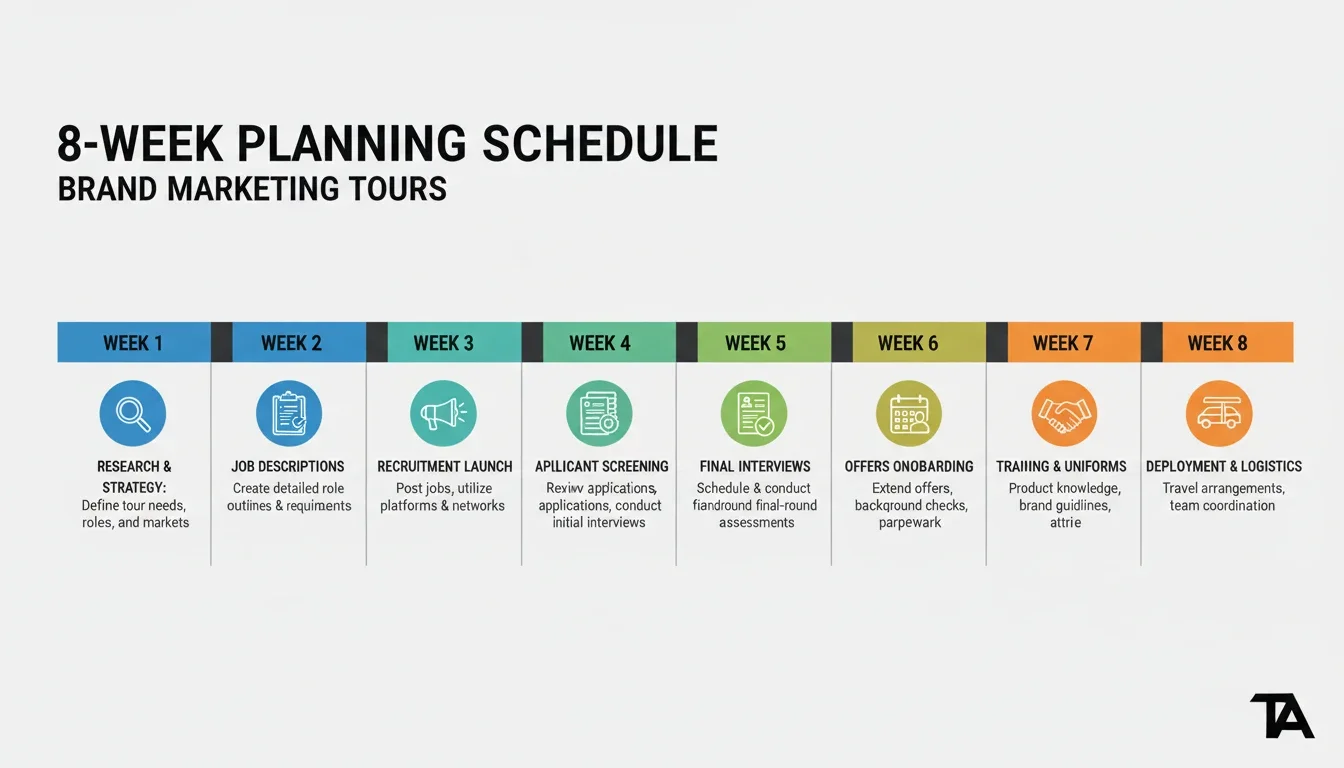
An 8-week countdown timeline showing the key milestones for tour activation staffing from strategy brief to post-event debrief
Multi-City Scheduling: Coordinating Staff Across Multiple Markets
The scheduling challenge on a multi-city tour isn't just about filling shifts — it's about maintaining energy, quality, and brand integrity across markets that may have vastly different consumer profiles, venue setups, and logistical conditions.
Traveling Core Staff vs. Local Hires
Your traveling team is your quality anchor. They know the campaign inside and out, they've absorbed every iteration of the brief, and they've seen how the activation plays in real conditions. Lean on them to set the standard at each new stop.
Your local staff brings something the traveling team can't: authentic local market knowledge. They know the neighborhood, the crowd, what resonates culturally, and how to engage local consumers in a way that feels native rather than imported.
The scheduling tension to manage: your traveling core will accumulate fatigue across a long tour. Build in recovery time between high-intensity stops. Don't schedule four cities in four consecutive days for a team of two without rest days factored in.
Using Market-Specific Brand Ambassadors
For major metro stops, work with a staffing partner that maintains active rosters in each city — not one that recruits on demand when you call. Pre-existing rosters mean vetted staff, not scrambled fills.
Cities like Los Angeles, New York, Chicago, Miami, and Atlanta have deep talent pools. Smaller markets may require more lead time and specific sourcing — factor this into your timeline.
Briefing Consistency Across Markets
One of the biggest activation tour failures is drift — where the experience at stop seven looks and feels nothing like stop one because local teams received inconsistent briefings.
Prevent this with:
A standardized written brief is shared with every market team before their stop
A video or recorded walkthrough of the activation from your tour manager
A dedicated channel (Slack, WhatsApp, or your agency's ops platform) for real-time Q&A between local staff and your traveling lead
A post-event feedback loop at each stop that informs the next market brief
Shift Scheduling Best Practices for High-Impact Activations
Getting the right people on site at the right time is as important as having the right people at all. Poor shift scheduling wastes your best ambassadors during slow periods and leaves you under-resourced during your highest-impact windows.
Split Shifts vs. Full-Day Staffing
For festival or street activations running 8–12 hours, full-day single shifts often lead to visible fatigue in the afternoon — exactly when second-wave foot traffic arrives. Consider split shifts with a morning and afternoon team, especially for activations running more than 8 consecutive hours.
For activations tied to specific events (pre-game windows, conference lunch breaks, evening product launches), single-shift scheduling aligned with the peak traffic window often outperforms an all-day model.
Peak Traffic Windows by Activation Type
Festival activations: Afternoon arrival surge (12 PM–3 PM) and evening social window (5 PM–8 PM) typically generate the highest engagement
Retail/mall activations: Lunch rush (11:30 AM–1:30 PM) and post-work window (5 PM–7 PM)
Corporate conference activations: Morning pre-session (8:30 AM–10 AM) and lunch break (12 PM–1:30 PM)
Street-level sampling: Weekday morning commute and weekend afternoon windows
Schedule your highest-energy staff into your peak windows. Rotate your supporting team into setup and administrative tasks during slower periods.
Building In Buffer Time for Setup and Strike
Never schedule your staff arrival time and your activation start time as the same moment. A standard rule: brand ambassadors should arrive 45–60 minutes before consumer-facing activation begins, and your PA team should arrive 90–120 minutes before for full setup.
Strike time is equally important — a rushed breakdown creates damaged assets, missing inventory, and exhausted staff who arrive depleted at the next market. Build 60–90 minutes post-activation for strike into every scheduling block.
Backup Staffing: The Non-Negotiable That Most Brands Overlook
No-shows on a tour activation aren't just logistically painful — they're brand-damaging. When you're three cities in, your brand is gaining momentum, and a key ambassador doesn't show, there is no graceful recovery without a backup plan.
What a Backup Staffing Protocol Looks Like
An effective backup staffing protocol is not "we'll call someone if there's an issue." It looks like this:
Every confirmed shift has a corresponding backup identified by name, briefed on the campaign, and confirmed for availability on that date
Backup staff receive the same briefing materials, brand guidelines, and uniform instructions as primary staff
The activation lead has direct contact with every backup before the event day — not through a chain of intermediaries
Escalation protocol is clear: if a primary can't make it, the backup is contacted at a defined trigger point (e.g., no check-in confirmation 2 hours before call time), not when the activation is already in crisis
How Built-In Backup Coverage Protects Your Campaign
At Eleven8, every booking includes a pre-briefed backup for every 8 active staff at no additional charge. This isn't reactive coverage — it's embedded redundancy. By the time an activation starts, every market has a confirmed team and a confirmed contingency, so the only variable on event day is execution.
For tour campaigns where every stop compounds on the last, that kind of operational certainty isn't a nice-to-have. It's the foundation that everything else rests on.
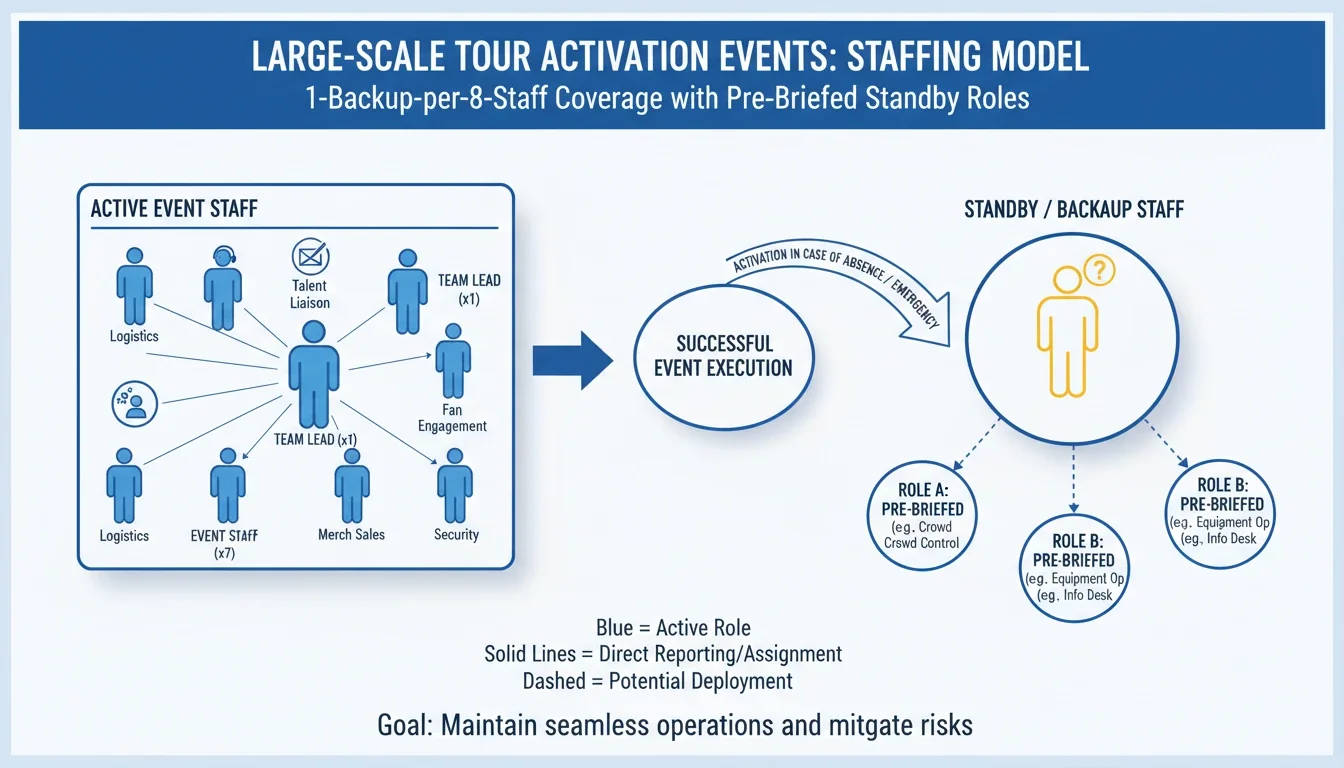
Diagram showing a 1-backup-per-8-staff coverage model for large-scale tour activation events, with pre-briefed standby roles illustrated
How to Brief Tour Staff for Brand Consistency
The gap between a good activation and a great one often isn't the creative concept or the venue — it's the briefing. Staff who are thoroughly prepared perform consistently. Staff who receive a one-page PDF three hours before launch don't.
What a Great Staff Brief Includes
A comprehensive activation brief should cover:
Campaign overview: What is this tour about? What is the brand trying to achieve?
Product knowledge: What are the staff actually representing? Key features, benefits, origin story, common questions
Target consumer profile: Who are we trying to engage? What do they care about?
Engagement script and talking points: Opening lines, key messages, natural conversation flows (not rigid scripts — frameworks)
Do's and don'ts: Brand language guidelines, topics to avoid, how to handle complaints or negative interactions
KPIs: What does success look like at this stop? Samples distributed, leads captured, social posts encouraged
Logistics: Exact call time, load-in location, parking, uniform, break schedule, strike time
Escalation contacts: Who to call if something goes wrong
Uniform, Messaging & Tone Alignment
Staff appearance directly shapes consumer perception. On tours where multiple markets run simultaneously or in close sequence, uniform consistency matters — a consumer who attended stop two in LA and stop five in Chicago should see the same brand presentation.
Communicate uniform requirements explicitly: not just "wear the branded T-shirt" but specific guidelines on footwear, hair, accessories, and how the brand kit should be worn or carried.
Measuring Tour Activation Performance by Staff
Data collected per market is only useful if it's structured consistently across all stops. Establish your reporting framework before tour launch, not after.
KPIs to Track Per Market
Consumer interactions: Total engagements per activation hour
Samples or products distributed: Tracking inventory drawdown against traffic estimates
Leads captured: Email sign-ups, app downloads, contest entries
Social content generated: Posts tagged, hashtag usage, and user-generated content collected
Staff performance scores: On-site supervisor ratings, post-event client feedback
Qualitative notes: Consumer reactions, common questions, objections, and feedback that inform the next stop
Using Post-Event Feedback to Improve Future Stops
Each market stop should generate a brief post-activation recap — from your activation lead — that captures what worked, what didn't, and what the next market should adjust. Over a multi-city tour, these iterative learnings compound into measurable execution improvements.
Brands that review activation data between stops consistently outperform those that treat each city as a standalone event. The tour format is an advantage — you get multiple shots to refine the execution before your highest-profile markets.
Choosing the Right Staffing Partner for Your Tour
Your activation concept, your media spend, and your campaign messaging can all be exceptional. But without the right staffing partner, the consumer experience at each stop will be inconsistent at best and damaging at worst.
What to Look for in a Tour Staffing Agency
Existing rosters in your target markets — not reactive recruiting after you book
Dedicated account management — one point of contact who owns the entire campaign, not a shared inbox
Built-in backup coverage — pre-briefed standbys included as standard, not as an add-on
A vetting process — the agency should be able to tell you exactly how staff are screened, trained, and evaluated
Fulfillment data — ask about their fill rate and no-show rate; agencies with high operational standards will share these readily
Experience with tour-format campaigns — not just one-off event fills
Questions to Ask Before You Book
Before committing to a staffing agency for your activation tour, ask:
How do you source local staff in markets where you're not headquartered?
What is your fulfillment rate, and how do you handle no-shows?
Do you provide built-in backup staffing, and at what ratio?
Who is my primary point of contact throughout the tour campaign?
Can I review staff profiles and select my preferred team?
How do you handle briefing consistency across multiple markets?
What does your event-day operations support look like?
A staffing partner that can answer all seven of these questions clearly and confidently is worth a premium over one that can only guarantee availability.
Eleven8 has staffed over 34,000 events nationwide, maintains a roster of 24,821 active staff, and operates with a 101.8% fulfillment rate powered by built-in backup coverage at every booking. For activation tours that can't afford operational surprises, that track record matters.