Tour Activation Roles Explained: From Support to Lead Staff
You've confirmed the venues, finalized the schedule, and locked in the creative. But when it comes time to staff the activation, the questions start stacking up fast: Do we need a tour manager or will a team lead do? What's the difference between a brand ambassador and a shift lead? How many support staff does a two-city tour actually require?
If you've ever stared at a staffing proposal wondering which roles are essential and which are optional, you're not alone. Tour activations involve one of the most layered staff structures in all of event marketing — and understanding each role is the difference between a smooth, on-brand experience and a chaotic day your team is still debriefing about a month later.
This guide breaks down every major tour activation role from the ground up: what they do, when you need them, and how they all fit together to execute a seamless brand experience.

A professional brand activation team in uniform at an outdoor experiential event
What Is a Tour Activation and Why Does Staffing Structure Matter?
A tour activation — sometimes called a mobile marketing tour, experiential road show, or multi-market brand activation — is any branded experience that travels across multiple cities or venues over a defined campaign window. These can range from a sampling campaign hitting 10 college campuses over six weeks to a 50-city road tour anchored to a product launch.
Unlike a single-day event, tour activations are logistically complex. Staff need to maintain brand consistency across markets, adapt to different venues and audiences, manage equipment, track metrics, and represent the brand professionally, whether they're in Los Angeles on day one or Nashville on day thirty.
Without a clearly defined staffing hierarchy, things unravel quickly. The wrong person makes a call they weren't authorized to make. Inventory goes untracked. Consumer interactions go unmeasured. And when something actually goes wrong — because on long tours, something always does — there's no clear chain of command to resolve it.
Getting the structure right isn't a luxury. It's the foundation the entire activation runs on.
The Cost of Getting the Hierarchy Wrong
When roles aren't clearly defined before an activation begins, a few predictable failure modes emerge:
Brand ambassadors make operational decisions they're not trained for, leading to inconsistent consumer experiences across markets
No one owns post-event reporting, so the brand receives incomplete or inaccurate recap data
On-site issues escalate to the client directly because there's no in-field leadership layer to absorb them
Staff turnover mid-tour because expectations weren't set clearly at the start
A proper staffing structure prevents all of this — not by adding bureaucracy, but by ensuring every person on-site knows exactly what they own.
The Tour Activation Staff Hierarchy at a Glance
While specific titles vary by agency and client, the typical tour activation staff hierarchy looks like this, from foundational to senior:
Support Staff — Setup, teardown, logistics, materials handling
Brand Ambassador — Direct consumer engagement, product demonstration, sampling
Shift Lead — On-the-floor team oversight during active event hours
Team Lead — Full-site command, client communication, reporting
Assistant Tour Manager — Multi-market logistics coordination, staff onboarding, travel management
Tour Manager — Program ownership, KPI tracking, client relationship, end-to-end execution
Not every activation needs all six levels. A small pop-up might run perfectly with two brand ambassadors and a team lead. A 40-city national tour needs the full stack.
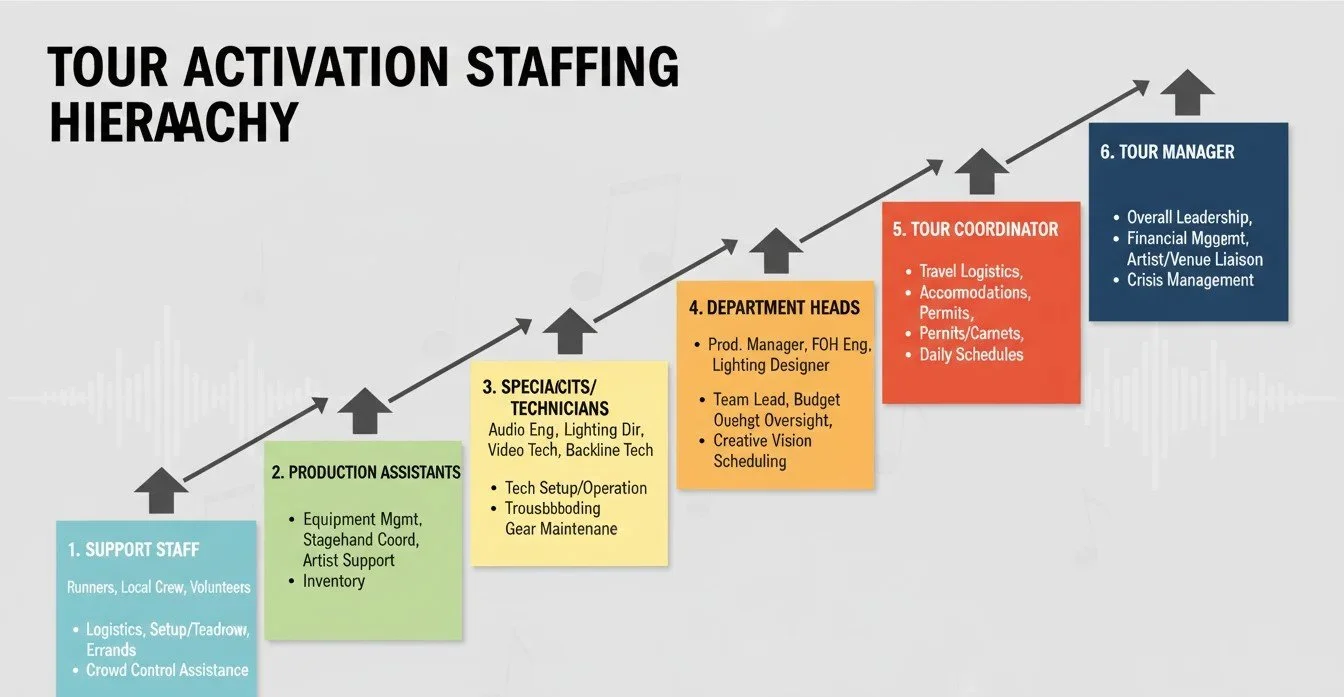
Visual chart showing the six-tier tour activation staffing hierarchy from support staff to tour manager
Support Staff — The Operational Backbone
Support staff are often the first to arrive and the last to leave. They don't always get the spotlight, but without them, nothing else functions. Their work is physical, logistical, and essential.
What Support Staff Actually Do On-Site
Support staff responsibilities typically include:
Load-in and load-out — Moving, assembling, and striking activation assets, including pop-up structures, signage, branded furniture, sampling equipment, and branded vehicles
Inventory management — Counting and tracking product samples, premiums, giveaways, and materials before and after each activation
Site preparation — Laying out floor plans, running power, setting up AV equipment, and ensuring the activation area is clean, safe, and brand-accurate
Replenishment — Keeping sampling stations stocked and swapping out depleted materials throughout the event
Break coverage — Rotating in for brand ambassadors during breaks to maintain a continuous presence
Support staff roles are often staffed locally in each market, making a reliable nationwide staffing network essential for maintaining consistency across markets.
Key Skills and Qualities to Look For
The best support staff bring physical stamina, attention to detail, and a team-first attitude. They should follow directions without requiring hand-holding, understand basic brand standards, and work quickly without cutting corners on setup quality. On long tours, reliability matters as much as any skill.
When working with a staffing agency, look for a partner that vets support staff with the same rigor as consumer-facing roles — because a sloppy setup telegraphs brand quality before a single consumer interaction happens.
Brand Ambassador — The Face of the Activation
Brand ambassadors are the human expression of your brand at every stop on the tour. They are consumer-facing, energy-forward, and responsible for delivering the brand message consistently and compellingly to everyone who walks up to the activation.
Core Brand Ambassador Responsibilities
At a tour activation, a brand ambassador's day typically includes:
Consumer engagement — Proactively approaching and welcoming consumers, initiating conversations, and guiding people through the activation experience
Product demonstration or sampling — Explaining product features, distributing samples, and answering consumer questions accurately
Lead capture — Collecting consumer data via digital tools, sign-up forms, or contest entries as directed by the campaign
Social content facilitation — Encouraging consumers to share the experience on social media, assisting with photo moments, and supporting any UGC capture components
Brand standards compliance — Maintaining the correct uniform, language, and conduct in alignment with brand guidelines throughout the event
What Makes a Great Brand Ambassador at a Tour Event
Tour brand ambassadors face a different challenge than those working a one-off event: they need to maintain energy and consistency across dozens of consecutive activations in cities they may have never visited before. The best ones are self-motivated, adaptive, and deeply knowledgeable about the brand they represent.
They also need to be trained before day one. At Eleven8, brand ambassadors are briefed on each client's specific talking points, campaign goals, and brand voice before every activation — so the message is consistent whether the event is in Chicago or Miami.
How Brand Ambassadors Differ Across Activation Types
The brand ambassador role shifts depending on the activation format:
Sampling activations — High-volume, fast-paced; focus is on throughput and positive micro-interactions
Experiential/immersive activations — Longer engagements; requires storytelling ability and deeper product knowledge
Trade show or expo activations — Professional audience; formal tone, lead qualification skills needed
Street team / grassroots activations — Mobile, outbound; requires confidence, resilience, and navigation skills
Knowing which ambassador profile fits your activation type is something a quality staffing agency should guide you through during the proposal stage.

Brand ambassador engaging consumers at a product sampling station during a mobile tour stop
Shift Lead — The First Level of On-Site Leadership
As an activation grows in size or duration, brand ambassadors alone can't manage themselves. That's where the shift lead role comes in. The shift lead is a senior brand ambassador who takes on light supervisory responsibilities during their working hours.
Shift Lead vs. Brand Ambassador: What Changes
A shift lead still engages with consumers — they don't step out of the consumer-facing role entirely. But they take on additional responsibilities:
Ensuring brand ambassadors are staying on task, on brand, and on message
Monitoring floor dynamics and adjusting staff positioning as needed
Managing break rotations so coverage never drops
Acting as the first escalation point for consumer issues or questions the team can't answer
Conducting brief team check-ins throughout the shift
The key distinction between a shift lead and a full team lead is scope. A shift lead is responsible for what's happening on the floor right now, during their shift. They're not running post-event reporting or communicating directly with the client.
When Do You Need a Shift Lead?
For activations running more than six hours, or with more than five brand ambassadors on the floor, adding a shift lead is highly advisable. It keeps peer-to-peer accountability intact when a full team lead is managing broader site operations or stepping away briefly for logistics.
For multi-day activations, a shift lead structure also enables two-shift days without losing oversight between rotations.
Team Lead — Your On-Site Command Center
The team lead is the most critical hire for a single-market activation. They are responsible for the entire on-site experience — from the moment staff arrive to the moment the last piece of branded collateral is packed, and the post-event report is submitted.
What a Team Lead Manages Day-to-Day
A team lead's scope on an activation day includes:
Conducting pre-event briefings with all on-site staff
Confirming the site is set up to brand standards before doors open
Serving as the primary point of contact for the venue, client representative, or agency on the day
Monitoring team performance and managing any issues in real time
Keeping inventory logs accurate throughout the event
Overseeing break schedules and staff rotation
Troubleshooting logistical problems without escalating unnecessarily to the client
Submitting a detailed post-event recap including attendance figures, consumer feedback, product counts, and notable moments
The Team Lead's Pre-Event and Post-Event Responsibilities
A strong team lead is already working before the event day starts. Pre-activation, they review the staff brief, confirm all team members received their assignments and arrival time, verify the supply checklist, and scout the venue if possible.
Post-event, their recap report is the data foundation that the client uses to evaluate ROI, adjust messaging, and make staffing decisions for the next market. A thorough, accurate report is one of the highest-value deliverables a team lead can produce.
How to Identify a Strong Team Lead
The most reliable indicator is a track record. Look for someone who has worked multiple brand ambassador roles, understands the activation from the floor up, and has shown the ability to stay calm and solutions-oriented when things don't go according to plan.
At Eleven8, team lead and captain-level staff go through dedicated leadership training — 320 captains were trained in a recent year alone — ensuring they can manage an activation the same way at any of the 25-plus markets the agency operates in.
Assistant Tour Manager — Bridging Operations and Leadership
Once an activation expands into multiple cities, a new logistical layer emerges that a team lead alone can't handle. The assistant tour manager (ATM) is the connective tissue between on-site execution and tour-level management.
The Assistant Tour Manager's Unique Role in Multi-City Tours
While the tour manager owns the overall program, the ATM focuses on making sure each market runs smoothly. Their responsibilities include:
Onboarding and briefing local in-market staff for each tour stop
Managing pre-event logistics, including equipment shipping, vehicle coordination, and permit tracking
Conducting or supporting pre-shift staff briefings when the tour manager is unavailable
Acting as the team lead for markets where the tour manager is managing remotely
Monitoring KPIs at each stop and flagging underperformance early
Handling day-to-day communication with local venue contacts
Logistics, Reporting, and Brand Consistency
One of the most underrated functions of an ATM is brand consistency enforcement. When you're running activations in eight cities over three weeks with partially different local staff at each stop, the ATM is the person ensuring the experience in Austin feels as polished as the experience in Seattle.
They review local staff performance against brand standards, conduct debrief conversations after each stop, and surface patterns — good and bad — that the tour manager and client need to know about.
Tour Manager — The Architect of the Entire Activation
The tour manager is the most senior role in field execution. They own the campaign from kick-off to close-out and serve as the bridge between the brand or agency and the entire touring team.
Tour Manager Responsibilities: Before, During, and After
Before the tour:
Collaborating with the client or agency to finalize the activation plan, market sequence, and staffing model
Recruiting, interviewing, and confirming the touring and in-market staff roster
Coordinating logistics: vehicle wraps, branded equipment, travel, accommodation, permits
Building the training program and briefing materials for all team levels
Establishing KPIs and the reporting framework, the client will receive at each stop
During the tour:
Serving as the primary point of contact for the client for all field-level communication
Managing daily and weekly operations across all active markets
Reviewing and approving post-event recaps from team leads before submitting to the client
Handling any escalations — venue issues, staff problems, brand challenges — in real time
Making tactical adjustments to the activation based on early-stop learnings
After each stop and at the tour's close:
Producing comprehensive final recap reports, including performance metrics, consumer data, photo documentation, and spend summaries
Conducting debrief conversations with the client and agency
Providing recommendations for future activations
What Separates a Good Tour Manager From a Great One
A good tour manager executes the plan. A great one improves it.
The best tour managers come to the field with deep experiential marketing knowledge, genuine relationships with their teams, and the ability to solve problems fast without disrupting the consumer experience. They are proactive communicators who make clients feel informed and confident — not reactive — and they treat their on-the-ground staff as strategic assets, not interchangeable headcount.
Tour Manager vs. Account Manager: What's the Difference?
These two roles are sometimes confused, especially when working with a staffing agency. The account manager is the client's relationship owner at the agency level — they handle booking, logistics coordination, billing, and escalations from the agency side. The tour manager is the field-level leader embedded in the activation itself.
At Eleven8, every client is assigned a dedicated account manager who supports them from inquiry through post-event recap — a separate layer from the on-site leadership the agency deploys into the field. These two roles work in tandem, but they're distinct.
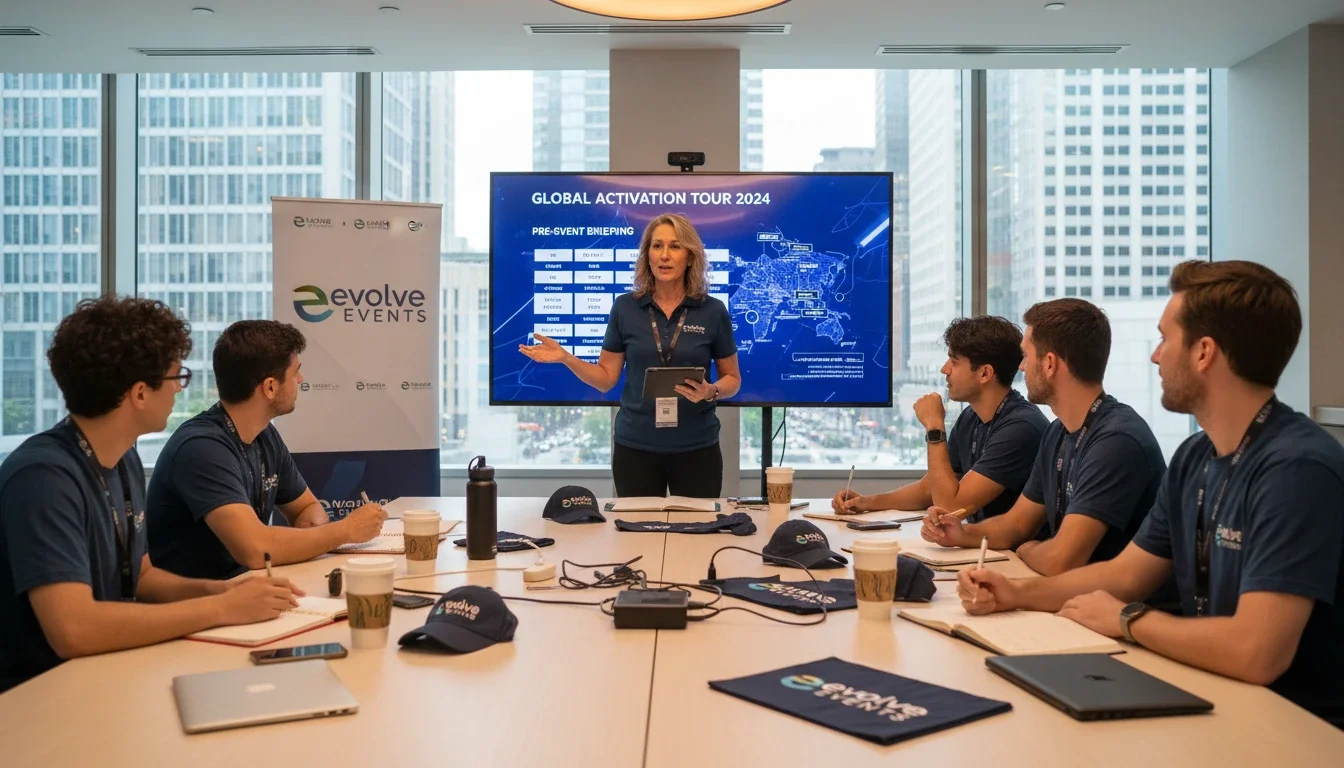
Experienced tour manager conducting a pre-event briefing with the brand activation team
How to Build the Right Staffing Mix for Your Activation
Understanding each role is useful. But knowing how many of each to request — and which tiers are non-negotiable for your specific activation — is where the strategy actually lives.
Small Activations (Under 10 Staff)
For a single-market pop-up, product launch, or sampling event with under 10 staff:
1 Team Lead (required)
3–8 Brand Ambassadors (depending on footprint)
1–2 Support Staff (for builds requiring significant setup)
A tour manager is typically not needed for a single-stop activation. Your team lead handles on-site leadership, and the agency account manager handles any off-site coordination.
Mid-Size Activations (10–30 Staff)
For a regional tour covering 3–8 markets with 10–30 staff:
1 Tour Manager or Senior Team Lead covering travel stops
1 Shift Lead per 6–8 brand ambassadors on the floor
Local brand ambassadors in each market (3–10 per stop)
Support staff scaled to the build complexity at each venue
At this level, the shift lead role becomes especially important for maintaining floor-level consistency across staff who may not have worked together before.
Large Multi-City Tours (30+ Staff Across Markets)
For a national tour covering 15+ markets with overlapping market schedules:
1 Tour Manager (traveling)
1–2 Assistant Tour Managers (rotating or market-specific)
Team Leads in each market
Shift Leads for floor coverage
Market-specific brand ambassadors (often 5–20 per stop)
Support staff at each venue
For a large national tour, working with a staffing agency that already has vetted, experienced staff in every target market — without needing to recruit fresh for each stop — is the most reliable path to consistent execution.
Eleven8's experiential staffing team supports exactly this model, with active staff across 25+ markets and a built-in backup system that ensures no stop runs under-resourced.
What to Ask Your Staffing Agency About Role Definitions
Not every agency uses consistent terminology, and "team lead" means very different things at different companies. Before signing off on a staffing proposal for a tour activation, ask your agency these direct questions:
What is the exact scope of the team lead role you're proposing? Do they handle post-event reporting?
Is the tour manager traveling with us for every stop, or are they remote for some markets?
What training does each role receive before the first event?
What is the escalation path if there's an on-site issue at a market where the tour manager isn't present?
Who owns inventory reconciliation at each stop?
What happens if a team lead calls out on the day of an event?
The quality of the answers to these questions tells you more about an agency's operational depth than any slide deck.
Red Flags to Watch For
Vague role titles without a defined scope. If a proposal lists "team lead" without explaining what they own, push for specifics.
No backup coverage. On a multi-city tour, someone will call out. If the agency doesn't mention backup staffing protocols, ask — or find a new agency.
One contact managing everything. A single agency rep handling sales, booking, compliance, and field escalation is a bandwidth problem waiting to become your problem.
No post-event reporting infrastructure. If the agency can't explain what a post-event recap includes and who produces it, you won't have the data you need to evaluate ROI.
How Eleven8 Structures Tour Activation Teams
At Eleven8, every tour activation booking includes a dedicated account manager as your off-site coordination point, with on-site team leads and senior staff trained through the agency's proprietary 11-step event process. Every booking includes built-in backup coverage — one briefed backup per eight staff at no additional charge — so no-shows never leave a market running below strength.
Staff are matched to your specific event format, brand, and audience before day one. You can review staff profiles, bios, and prior event experience before confirming your team. And for tours running across multiple markets, the agency's nationwide coverage means the same hiring standards apply in every city.
That's what accountable tour activation staffing looks like in practice.