What Is the LA 2028 Olympics? Everything Brands Need to Know Before the Games
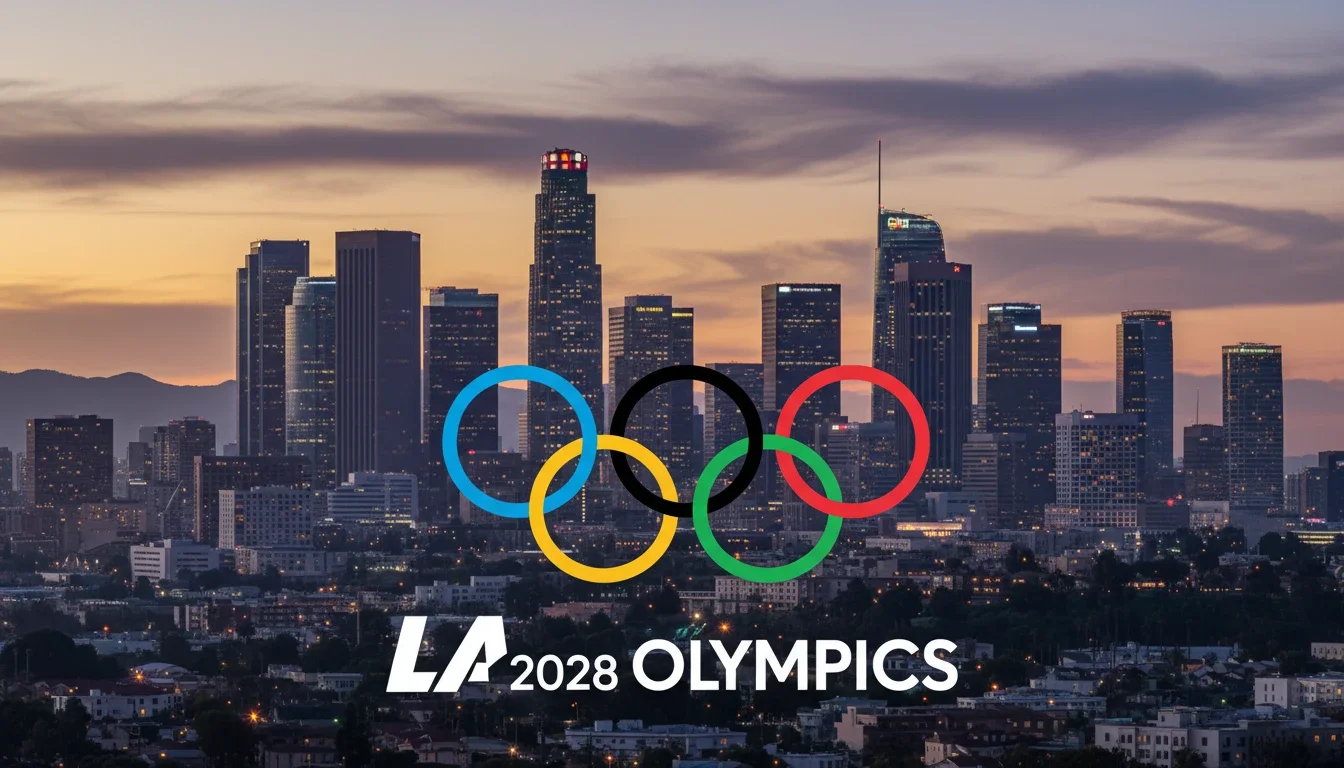
Los Angeles skyline at sunset with Olympic rings overlay — LA 2028 Olympics
The countdown is real. The world is coming to Los Angeles in 2028, and the brands that will win this moment are the ones building their strategies right now.
The 2028 Los Angeles Summer Olympics — officially known as LA28 — represent far more than a sporting event. For global and local brands alike, LA28 is a marketing phenomenon, a cultural milestone, and a commercial window that opens once in a generation. With over 10,000 athletes from more than 200 nations, record-setting viewership projections, and a city purpose-built for spectacle and storytelling, the Games will transform Los Angeles into the center of the global stage for 17 days in the summer of 2028.
But here's what most brands get wrong: they wait too long. The brands that walk away from an Olympic cycle with real results — real recall, real revenue, real relationships — are the ones who started two years out. Not two months out.
Whether you're a Fortune 500 brand with a major sponsorship already locked in or an emerging company looking to ride the wave without spending a fortune, this guide gives you the full picture. From what LA28 actually is to how to build an on-the-ground brand activation strategy — including the staffing you'll need to execute it — this is everything marketers need to know before the Games begin.
The Basics: What Is the LA 2028 Olympics?
The 2028 Summer Olympics, officially called the Games of the XXXIV Olympiad, are scheduled to take place in Los Angeles, California, from July 14 to July 30, 2028. The Paralympic Games will take place from August 15 to 27, 2028.
Los Angeles was formally awarded the Games by the International Olympic Committee (IOC) in 2017, following a historic dual-announcement that simultaneously awarded Paris the 2024 Games. This will be the third time Los Angeles has hosted the Summer Olympics, after the 1932 and 1984 Games. The 1984 edition is widely regarded as one of the most commercially successful Olympics in history — and LA28 is designed to build on that legacy.
The organizing committee, LA28, is led by chair Casey Wasserman and operates under a fully private financial model, heavily relying on corporate sponsorship and ticket sales rather than public funding. As of late 2025, over $2 billion in sponsorships had already been secured — surpassing Paris 2024's total more than two years before the opening ceremony.
Key Facts About LA 2028 at a Glance
Dates: July 14–30, 2028 (Olympics) | August 15–27, 2028 (Paralympics)
Host City: Los Angeles, California (with venues in Inglewood, Long Beach, Pasadena, and more)
Organizing Committee: LA28
Sports: 32+ Olympic sports; 22 para sports approved
Expected attendance: Millions of visitors from across the globe
Broadcast partner: NBCUniversal and Versant (formerly CNBC, USA Network)
Target sponsorship revenue: $2.5 billion
Founding partners include: Honda, Starbucks, Google, Delta, T-Mobile, and Intuit
What Makes LA28 Different From Any Previous Games
LA28 isn't just another Olympic Games. The IOC has introduced a series of structural changes that make this edition particularly significant for brand marketers.
Venue naming rights: For the first time in Olympic history, venues are permitted to carry naming rights during the Games — provided their naming rights partner is a Worldwide Olympic Partner (WOP) or Founding Partner. This opens a new category of commercial visibility that has never existed at any previous Olympics.
Athlete social media freedom: The IOC has loosened historically tight restrictions on athlete social media activity during the Games. Athletes can now post more freely, enabling brands with athlete partnerships to benefit from authentic, real-time content in ways that were previously blocked.
Integrated sponsorship bundles: The new LA28 sponsorship model bundles rights across the Summer Olympics, the Paralympics, and Team USA competing in both the 2026 Winter Games and the 2028 Summer Games — giving sponsors a longer, richer marketing runway than ever before.
Prime-time competition scheduling: Unlike some previous Olympics held in time zones that hurt U.S. viewership, LA28 competitions are planned to fall largely in American prime time. This is expected to drive viewership well beyond the 32 million average daily viewers NBC attracted during Paris 2024.
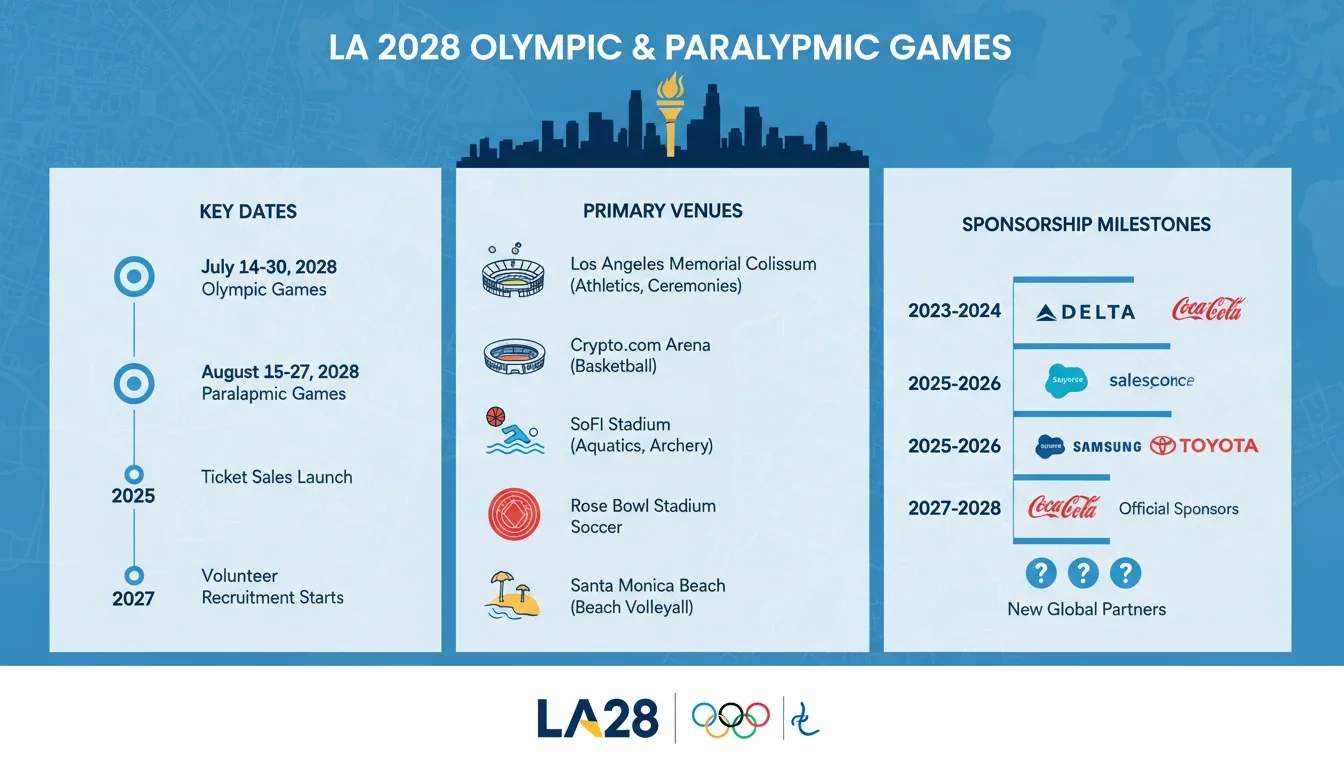
Infographic showing LA 2028 key dates, venues, and sponsorship milestones.
The Business Opportunity: Why LA 2028 Is a Once-in-a-Generation Moment for Brands
The numbers tell the story before we even start talking strategy.
During the 2024 Paris Olympics, NBC averaged 32 million viewers per day across digital and linear broadcast. Total Olympic content engagement across social media platforms reached 412 billion engagements. With LA28 scheduled in prime time, backed by the full weight of American cultural enthusiasm, and following what many called the most socially engaged Games in history, those numbers are expected to climb significantly in 2028.
This isn't just reach. It's the kind of reach that comes wrapped in genuine human emotion — triumph, heartbreak, national pride, and collective joy. Brands that show up meaningfully in those moments don't just get seen. They get remembered.
New Commercial Rules That Favor Brands
Perhaps the most compelling reason brands should be paying attention to the LA 28 Olympics right now is the structural evolution of how commercial partnerships work. The IOC has spent the last several cycles progressively loosening restrictions that previously made Olympic activation complicated and limiting.
The integrated partnership model is a significant shift. A brand partnering with LA28 starting in 2025 can promote its sponsorship across the U.S. Olympic and Paralympic teams competing in the 2026 Milano-Cortina Winter Games, Team USA at LA28, and the LA28 Games themselves. That's a multi-year marketing platform, not a one-time event.
And for brands not in the official sponsor tier? The IOC's more relaxed social media stance and the rise of athlete-driven content mean there are more legitimate, creative paths to Olympic relevance than at any previous Games.
LA 2028 Venue Map — Where the Action and Your Audience Will Be
One of LA28's defining structural decisions is the use of existing and already-in-progress venues rather than purpose-building new ones. This keeps costs down and ensures infrastructure is genuinely useful to the city long after the torch is extinguished.
For brands and event producers, the decentralized venue model across Los Angeles County creates a different kind of opportunity: audiences won't be concentrated in one Olympic park. They'll be spread across multiple districts, neighborhoods, and communities — creating activation opportunities well beyond the immediate vicinity of competition venues.
Key Venue Zones for Brand Activations
Inglewood / SoFi Stadium Area: Track and field, opening/closing ceremonies — the highest-profile district
Downtown LA / Los Angeles Memorial Coliseum: Iconic venue with strong neighborhood foot traffic
Long Beach: Sailing and aquatic events, beach activation opportunities
Santa Monica / Venice Beach: Surfing, beach volleyball — premium lifestyle brand territory
Pasadena / Rose Bowl: Storied venue with affluent, international-leaning audience
Staples Center (Crypto.com Arena): Basketball — urban downtown LA positioning
Hollywood Park Studios: International Broadcast Centre — media hub and content opportunity
For brands planning on-the-ground activations, understanding which venues align with your audience profile is step one. The brand that shows up in the right place, with the right team, at the right moment will win.
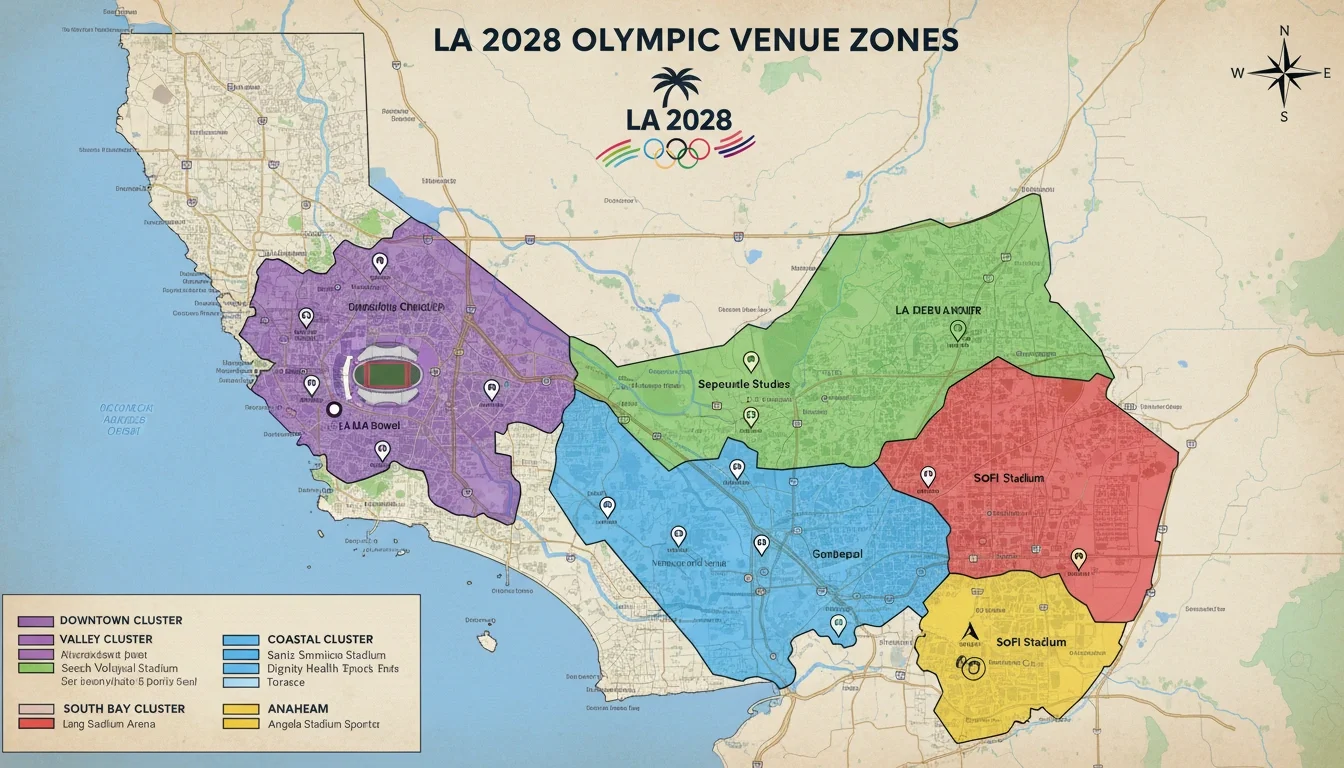
Map of LA 2028 Olympic venue zones across Greater Los Angeles
The Olympic Sponsorship Landscape — From $200M to DIY
Not every brand has the resources to become a Founding Partner of LA28. Honda, Starbucks, Google, Delta, T-Mobile, and Intuit reportedly each committed close to $200 million for founding-tier status. Coca-Cola, celebrating 100 years of Olympic partnership at these Games, represents the pinnacle of long-term Olympic brand alignment.
But the official sponsor tier is only one layer of the Olympic marketing ecosystem. Here's the full landscape.
Official Sponsorship Tiers
Tier 1 — Worldwide Olympic Partners (TOP): Global brands with full IOC partnership rights across all Games. This is the most expensive and exclusive tier.
Tier 2 — Founding Partners (LA28 specific): Brands that partnered early with LA28 for a bundled package covering multiple Games and Team USA.
Tier 3 — Official Partners and Suppliers: A broader range of brands with more targeted rights — category exclusivity within LA28's domestic program.
Non-Sponsor Brand Strategies (The Smart Play for Most Brands)
The majority of brands that activate meaningfully around major sporting events do so without official sponsorship. For LA28, there are several powerful, legitimate ways to be part of the story.
Athlete partnerships: With athletes now having more social media freedom, endorsement deals and content partnerships with Olympians offer an accessible, authentic path to Olympic relevance. Athletes building their profiles now — particularly breakout stars from the 2026 Winter Games — are available to sign today at a fraction of what their cost will be post-Games.
National Governing Body (NGB) partnerships: Sponsoring an NGB (like USA Track & Field or USA Swimming) gives a brand season-long visibility with Olympic athletes and fans — well before and after the Games themselves.
Olympic-adjacent experiential activations: Pop-up brand experiences, fan zones, hospitality events, and street-level campaigns in high-traffic Olympic areas don't require official sponsorship. They require strategic placement, compelling creative, and an exceptional on-the-ground team.
Content and media play: Brands that create compelling Olympic-adjacent content — without violating IP restrictions — can generate massive organic reach during the Games when audiences are actively engaged and searching.
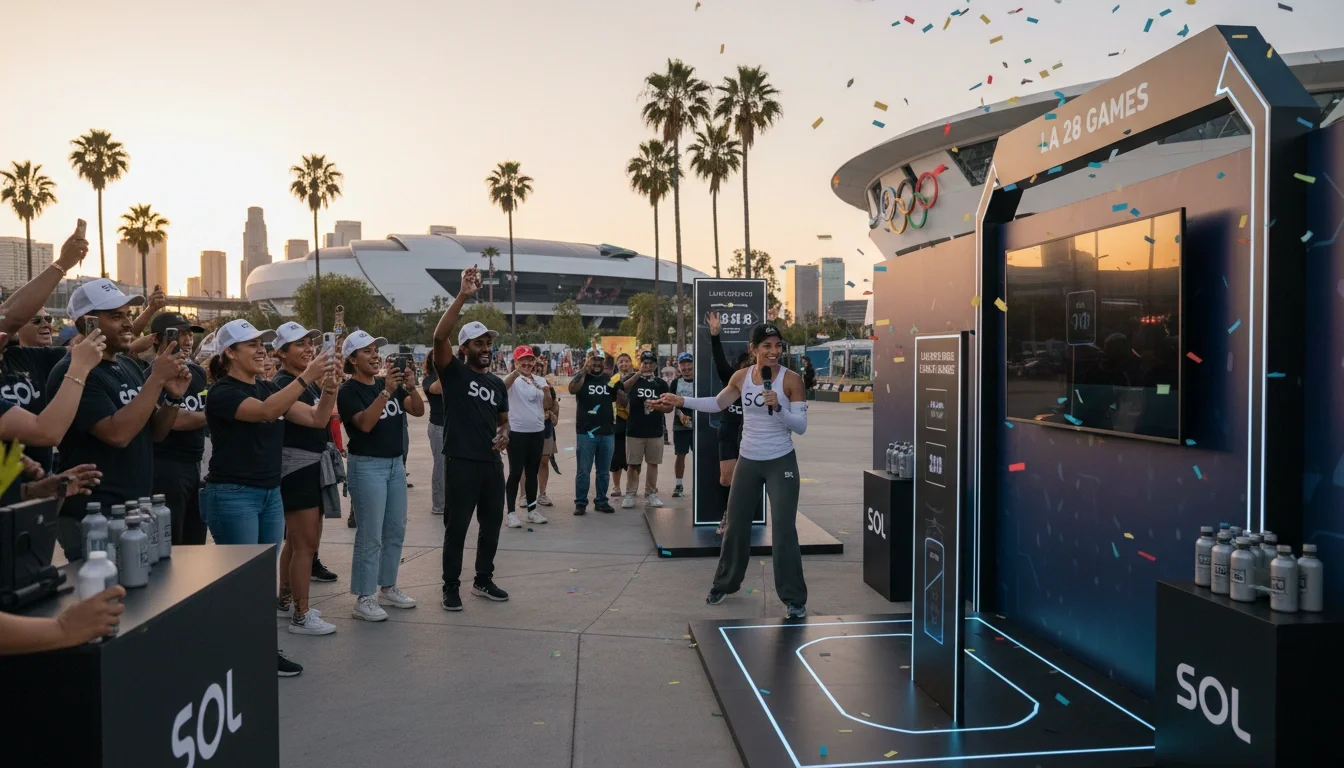
Brand ambassador engaging fans at an experiential marketing activation near Olympic venue.
How to Build Your LA 2028 Brand Strategy Starting Now
The single most important thing to understand about Olympic marketing is this: two years is not a long time. Athlete contracts take months to negotiate. Campaign creative takes months to develop. Activation logistics in a city as operationally complex as Los Angeles — permits, vendor relationships, staffing, insurance — take even longer.
The brands that scramble at the six-month mark will get second-tier results. The brands that start now will own the moment.
Your LA 2028 Preparation Timeline
2026 — Foundation Year
Identify your brand's strategic connection to the Olympics — what story do you tell?
Research athlete partnership opportunities, especially breakout stars from the 2026 Winter Games
Begin conversations with NGB sponsorship teams if applicable
Start venue and location scouting for activation sites around LA28 venues
Begin staffing agency conversations — especially for large-scale activations
2027 — Build Year
Lock in athlete contracts and content partnerships
Secure your activation locations, permits, and vendor agreements
Develop creative campaigns, brand ambassador training materials, and activation concepts
Begin booking experienced event staffing for the Games window (July–August 2028)
Conduct test activations at major LA events to refine your approach
2028 — Execute Year
Full activation launch: pop-ups, brand experiences, hospitality, athlete content
Real-time social and content amplification during the Games
On-the-ground team execution with experienced staff across all activation sites
Post-Games measurement: reach, recall, revenue, relationship impact
The Activation Playbook: What Great Olympic Brand Experiences Look Like
Great Olympic activations share several characteristics. They're immersive, not passive. They create genuine moments worth sharing. And they're executed by people who know what they're doing — teams that can handle crowds, represent a brand under pressure, and deliver consistent quality across every hour of a multi-day event.
Consider these activation formats that are expected to dominate LA28:
Pop-up brand experiences in Olympic-adjacent neighborhoods
Fan hospitality zones with curated brand moments
Athlete meet-and-greet and appearance events managed by trained brand ambassadors
Sampling campaigns and product demonstrations in high-foot-traffic areas
VIP hospitality suites with premium service staffing
Street team promotions along parade routes and transit corridors
Branded content studios capturing real-time content for social amplification
The Human Element — Your Activation Is Only as Good as Your Team
Here's the piece that most brand marketing guides miss entirely, and it's arguably the most operationally important: none of this works without the right people on the ground.
A beautifully designed brand activation that's staffed by undertrained, disengaged, or poorly managed people will fail. Conversely, a modest activation backed by a sharp, professional, brand-aligned team will punch well above its weight. In a city like Los Angeles, at an event like the Olympics, the quality of your human touchpoints is your brand's most critical variable.
What Brand Ambassadors and Event Staff Do at Olympic Events
Professional brand ambassadors and event staff are the human infrastructure of any major activation. At Olympic-scale events, they're responsible for:
Representing your brand with consistency and professionalism across every interaction
Engaging fans and attendees to drive brand recall and positive sentiment
Distributing product samples, marketing materials, and promotional items
Managing crowd flow at pop-up activations and branded experiences
Supporting athlete appearances and media moments
Staffing hospitality suites, registration areas, and VIP zones
Capturing real-time content and supporting brand social teams on-site
Handling logistics, problem-solving, and unexpected situations with professionalism
The best brand ambassadors don't just hand out flyers. They become a living extension of your brand — and at the Olympics, when the eyes of the world are watching, that distinction matters enormously.
How Eleven8 Supports LA 2028 Brand Activations
Eleven8 Event Staff is already positioned as a preferred staffing partner for the LA 2028 Olympic and Paralympic Games. With 30+ years of event staffing experience, a roster of elite brand ambassadors, promotional models, convention staff, and hospitality professionals — and a client list that includes Nike, Versace, Netflix, Adidas, and The Academy — Eleven8 brings both the track record and the local knowledge that Olympic-scale events demand.
As brands begin building their LA28 activation plans, choosing an experienced, LA-based event staffing partner early is a strategic advantage. Eleven8's team knows Los Angeles — the venues, the neighborhoods, the traffic patterns, the permit landscape — and has already staffed major events at this scale, including FIFA World Cup 2026 activations and Super Bowl 2027 in Los Angeles.
Whether you need brand ambassadors for a high-volume sampling campaign near SoFi Stadium, VIP hospitality staff for a Founding Partner event, or a full team of trained professionals for a week-long brand activation, the right staffing partner turns your strategy into a flawless execution.

Eleven8 Event Staff team professionally dressed at a large LA brand activation event.
The Bottom Line: Start Now or Fall Behind
The LA 2028 Olympics are the biggest commercial moment in modern event marketing history. For brands that show up strategically, creatively, and operationally, these Games will generate returns — in awareness, in loyalty, in cultural relevance — that compound long after the closing ceremony.
The brands that wait will compete for second-tier opportunities. The brands that move now will have their pick of athletes, locations, agencies, and activation concepts — and they'll execute with the calm confidence of teams that have been preparing for two years.
If you're a brand thinking about LA28, the question isn't whether to engage. It's how to engage, when to lock in your partnerships, and who you're going to trust to put the right people on the ground when it matters most.