What Does an Olympic Brand Activation Actually Look Like? A Guide for First-Time Sponsors
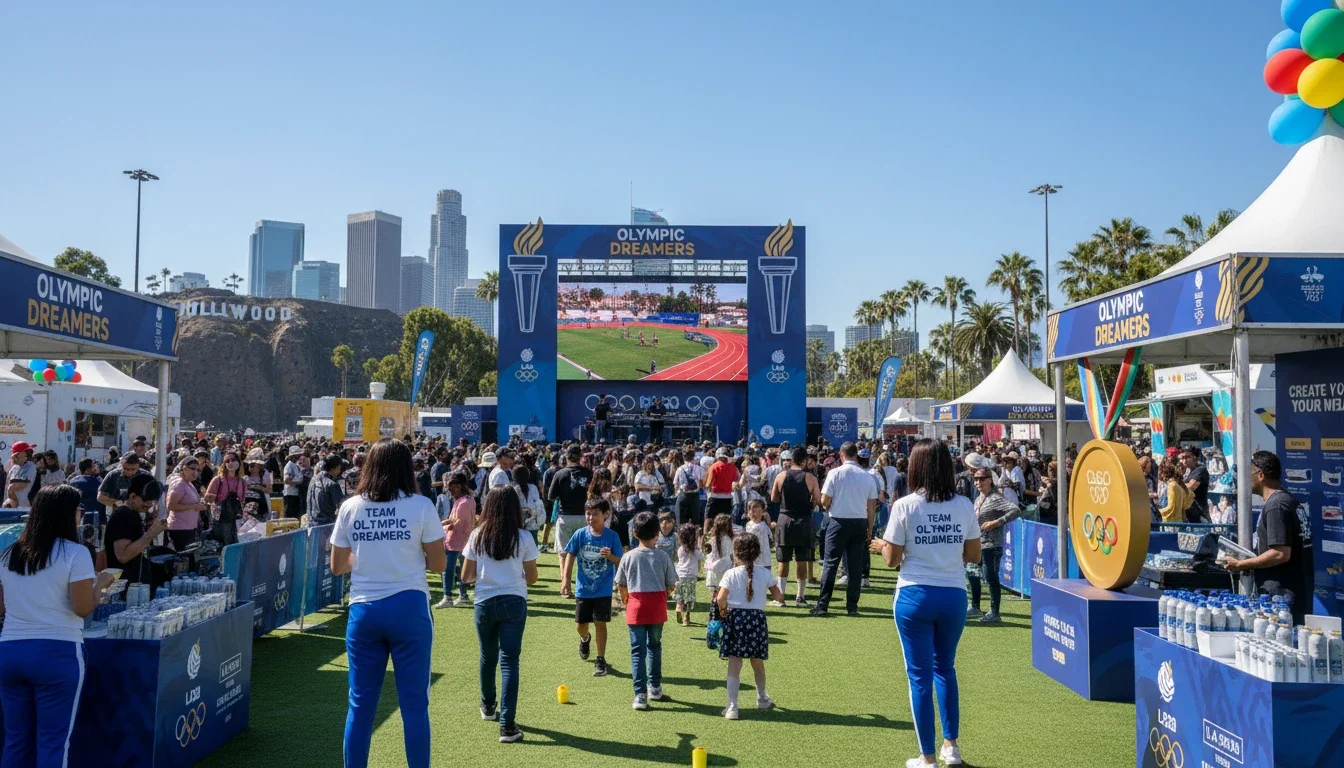
A branded fan zone at an outdoor Olympic activation with brand ambassadors engaging attendees in Los Angeles.
If your brand just secured an Olympic sponsorship — or is seriously evaluating one for LA 28 — congratulations. You're about to step into one of the most powerful marketing environments on earth. The Olympic Games reach billions of people worldwide. Emotion is at an all-time high. Audiences are extraordinarily engaged. And in Los Angeles in 2028, the Games are coming home to the United States for the first time in more than 30 years.
But here's what most first-time sponsors don't realise until they're deep in the planning process: the sponsorship itself is just the starting point. The rights, the logo placements, the official partner designation — those get you in the door. What actually moves the needle for your brand, what creates lasting consumer memory and measurable ROI, is the activation.
So what does an Olympic brand activation actually look like? What happens on the ground? Who's involved? What does it cost in time, budget, and people? And if you've never done this before, where do you even start?
This guide answers all of those questions with practical clarity — drawing on real examples from Paris 2024, the emerging LA28 landscape, and decades of on-the-ground event execution experience.
First, Let's Define What a Brand Activation Actually Is
Before we get into the specifics of the Olympic environment, it's worth grounding the term. A brand activation is any experience, event, or campaign that brings your brand to life in a way that invites participation rather than just observation. Where traditional advertising says 'here we are,' a brand activation says 'come experience us.'
In practical terms, an activation might be a pop-up experience, an interactive product demonstration, a hospitality space, a digital campaign tied to a live on-site moment, or an experiential installation that people line up to interact with. What defines it is engagement — the consumer does something, feels something, and remembers something.
How Activations Differ From Traditional Sponsorship
Traditional sponsorship is passive. Your logo is on the dasherboard. Your name appears in the broadcast. That has value — particularly for awareness — but it's a one-way communication. Activation transforms the sponsorship into a dialogue. You're not just present at the Olympics; you're creating a reason for people to seek out your brand specifically.
The most successful Olympic sponsors understand that a sponsorship fee buys them a right. The activation is how they exercise that right in a way that actually impacts consumers.
Why the Olympics Create a Unique Activation Environment
The Olympic Games generate a level of collective attention, emotional investment, and national pride that virtually no other event can match. The audience isn't just watching sports — they're experiencing a cultural moment. That emotional backdrop is a tremendous asset for brands that show up thoughtfully.
But the Olympic environment also comes with specific rules, logistics, and constraints that don't apply at a typical trade show or festival. Clean venue policies, IOC IP restrictions, official partner zones, and the sheer scale of the host city all shape what's possible. Understanding the environment is the first step to planning something that works.
The 5 Main Types of Olympic Brand Activations
Not all Olympic activations are created equal — and not all are available to every type of sponsor. Your access to specific activation types depends significantly on your sponsorship tier, your rights package, and whether you're an official IOC partner, a domestic partner, a national team sponsor, or an Olympic-adjacent brand activating in the host city without official partnership.
1. Fan Zone & Public Experience Activations
Fan zones and public-facing activations are arguably the most democratic form of Olympic engagement. Whether you're inside an officially designated Olympic fan park or setting up an adjacent experience in the surrounding city, this type of activation brings your brand to the tens of thousands of everyday visitors, tourists, and locals who converge on the host city.
These activations typically involve a physical footprint — a branded structure, a tent, a pop-up build — with interactive elements designed to draw foot traffic and create shareable moments. Product sampling, skill challenges, photo moments, live entertainment, and free giveaways are common features. The goal is dwell time, social media content, and brand impression.
For LA28, the opportunity is extraordinary. The Games span Southern California across venues including SoFi Stadium in Inglewood, the Intuit Dome, Crypto.com Arena in Downtown LA, the Rose Bowl in Pasadena, and Honda Centre in Anaheim — creating multiple high-footfall zones across the region rather than a single concentrated venue cluster.
2. Hospitality Suites & VIP Experiences
For official partners and premium sponsors, private hospitality is often the highest-ROI activation type — though it's the least visible to the general public. A hospitality suite or official Olympic House gives your brand a dedicated space to host clients, partners, media, and VIPs in an environment that's both premium and emotionally charged.
These spaces are typically operated by sponsors' own teams or through a specialist agency, and they require meticulous staffing: professional hosts, branded hospitality leads, catering staff, registration and check-in personnel, and entertainment coordinators. The environment carries the Olympic brand's prestige while delivering your company's values through every guest touchpoint.
3. Athlete Village & Official Partner Activations
A select tier of Official Partner sponsors gains access to the athlete village and competition venues for dedicated activation spaces. P&G's Beauty and Grooming salon at Paris 2024 — set up within the Olympic Village to serve competing athletes — is a standout example of this category. These are powerful earned media opportunities precisely because access is so limited, but they require a full official partnership agreement with either the IOC, the organizing committee, or the national Olympic committee.
4. Olympic-Adjacent Pop-Ups (Non-Official Sponsors)
You don't need an official partnership to activate around the Olympics. Many brands — particularly consumer brands, F&B companies, and entertainment companies — establish a presence in the host city outside the official Olympic footprint. Wingstop's 'House of Flavour' during Paris 2024 is a textbook case: an old fire station transformed into a nightclub, event space, and brand experience that lived entirely outside the official Games but captured enormous attention during them.
These activations must be careful to navigate IOC rules about ambush marketing — specifically avoiding the use of Olympic intellectual property (the rings, 'Olympics,' 'LA28,' etc.) without authorization. But a well-conceived Olympic-adjacent activation can achieve tremendous visibility and cultural relevance without the investment of a full official partnership.
Important Note on IOC Rules: Non-partner brands must avoid using Olympic IP, including the rings, the word 'Olympics,' or 'LA28' in their activation marketing. However, brands can activate 'around' the Games by referencing the city, the season, sports culture, or their athletes directly. Always consult legal counsel before finalizing activation messaging.
5. Digital & Social-First Activations With On-Site Presence
The Paris 2024 Games were widely described as the first true social media Olympics. The 2028 Games in Los Angeles are expected to be the first true AI Olympics. For forward-thinking brands, this means designing activations that exist simultaneously in physical and digital spaces.
A pop-up booth might be the hub, but the real activation is the AR filter, the real-time leaderboard, the athlete challenge that lives on TikTok and Instagram. Your on-site staff become content engines as much as brand representatives — creating, capturing, and distributing moments as they happen.
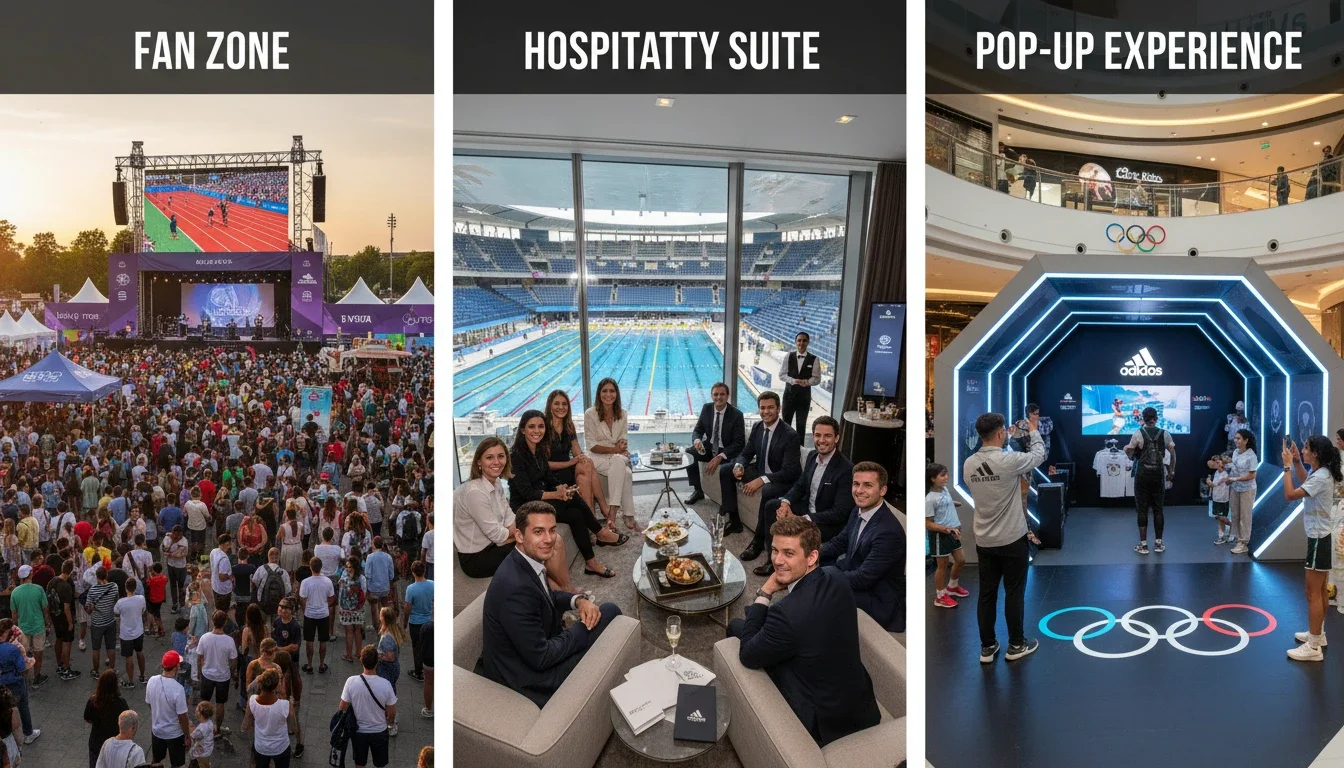
Side-by-side comparison of different Olympic brand activation types including fan zone, hospitality suite, and pop-up experience.
Real Examples From Paris 2024 — What Worked and Why
The Paris 2024 Games delivered some of the most creative and effective brand activations in Olympic history. For first-time sponsors preparing for LA28, these examples are essential study material. Here's what the best-in-class looked like:
Michelob ULTRA: The Team USA House
As the exclusive beer sponsor of Team USA for the 2024 Games, Michelob ULTRA committed to its most extensive Olympic campaign to date. The centerpiece was a dedicated space within the Team USA house in Paris where visitors could participate in interactive activities, enjoy live music, and attend athlete appearances. The activation was perfectly aligned with the brand's identity — beer for active people — and created a premium, exclusive atmosphere that drove earned media and social content throughout the Games.
The lesson: Great activations don't just feature the brand — they embody it. Every element of the Michelob ULTRA experience reflected their brand values.
P&G: The Athlete Village Beauty & Grooming Experience
P&G set up a full Beauty and Grooming salon inside the Olympic Village, serving the athletes directly. By showcasing Pantene, Gillette, Head & Shoulders, and Braun in a genuinely useful way, P&G earned authentic endorsement from the athletes themselves. They also included a Pampers-sponsored nursery — the first ever at the Olympics — recognizing that many competing athletes are parents.
The lesson: The highest-impact activations create genuine utility. P&G didn't just brand the space — they provided something athletes actually needed, which made the brand association feel earned rather than transactional.
Wingstop: The House of Flavor Pop-Up
Wingstop occupied an old fire station in Paris and transformed it into a multi-day cultural experience: break-dancing competitions, pick-up basketball, tattoo and nail art services, a nightclub with Parisian DJs and hip-hop artists. The activation had almost nothing to do with chicken wings — and that was the point. By creating a genuine cultural moment, Wingstop extended far beyond their category and became part of the broader Olympic conversation.
The lesson: Olympic activations that attempt to recreate a brand's store or product experience often fall flat. The most memorable activations use the Olympic moment to do something culturally unexpected.
Uber: The Free Seine River Cruise
Uber launched its first-ever water transportation service in Paris during the Games, offering free cruises and day trips on the Seine. The initiative served a real logistical need — Paris anticipated a significant surge in visitor traffic — while simultaneously executing Uber's brand promise of effortless movement. The activation generated global media coverage and positioned Uber as a generous, thoughtful presence in the city rather than just a logo on a banner.
The lesson: Activations that solve a real problem while demonstrating brand values are irresistible to media and audiences alike.
Bumble: The Paris Café
Bumble partnered with Good News to create a dedicated Parisian café during the Games — a physical space where app users could meet up or hang out between events. The activation followed through on Bumble's brand promise of creating real human connections, and it demonstrated that relatively modest activations can generate enormous brand equity when they're deeply authentic.
The lesson: You don't need a $200 million founding partnership to make a meaningful mark. The right idea, executed with authenticity, can outperform bigger budgets.
Reference: Paris 2024 Olympic Brand Activation Examples — ATN Event Staffing
What Makes LA28 Different — And Why First-Time Sponsors Need to Plan Now
The 2028 Los Angeles Olympics are not just another edition of the Games. They represent a fundamental reinvention of the Olympic commercial model, and the implications for brand activations are significant.
The LA28 Venue Map and What It Means for Activation Logistics
LA28 is spreading competitions across an unusually wide geographic footprint. Sports are scheduled at SoFi Stadium in Inglewood (track and field), Crypto.com Arena in Downtown Los Angeles (gymnastics), Intuit Dome in Inglewood (basketball), Honda Center in Anaheim (volleyball), the Rose Bowl in Pasadena (soccer), Long Beach (11 sports, including beach volleyball), and multiple other Southern California venues.
This geographic spread creates both a challenge and an opportunity. Unlike Paris, where venues were concentrated in a walkable city center, LA's venues require brands to make strategic choices: activate at one high-footfall location, or create a multi-site presence? Brand managers who wait too long to secure premium locations in the surrounding areas risk losing the best spots to competitors who moved earlier.
IOC Clean Venue Policies and Ambush Marketing Rules
LA28 has strict clean venue policies that prevent unauthorized commercial signage and messaging within official competition venues and their immediate perimeters. This means that even if you're a brand manager standing 100 feet from SoFi Stadium during the Olympics, you can't fly a branded banner or distribute promotional materials without the proper authorizations.
For official partners, this is actually good news — it protects the value of their investment. For non-partner brands activating adjacent to the Games, understanding these boundaries is non-negotiable. Working with an activation agency or legal counsel experienced in Olympic-adjacent events is strongly recommended.
The Opportunity Window Is Already Closing
LA28 has already secured over $2 billion in sponsorship revenue — surpassing the total Paris 2024 raised, and still more than two years before the Opening Ceremony. Founding partners, including Honda, Starbucks, Google, Delta, T-Mobile, and Comcast, have committed at the highest levels. The most premium activation locations, the best agency relationships, and the top staffing partners are being locked up now.
For first-time sponsors, the message is clear: planning cycles that work for a typical trade show or product launch don't work at Olympic scale. The brands that execute effectively in July 2028 are the ones starting today.
Reference: LA28 Official Partners and Sponsorship Structure — la28.org
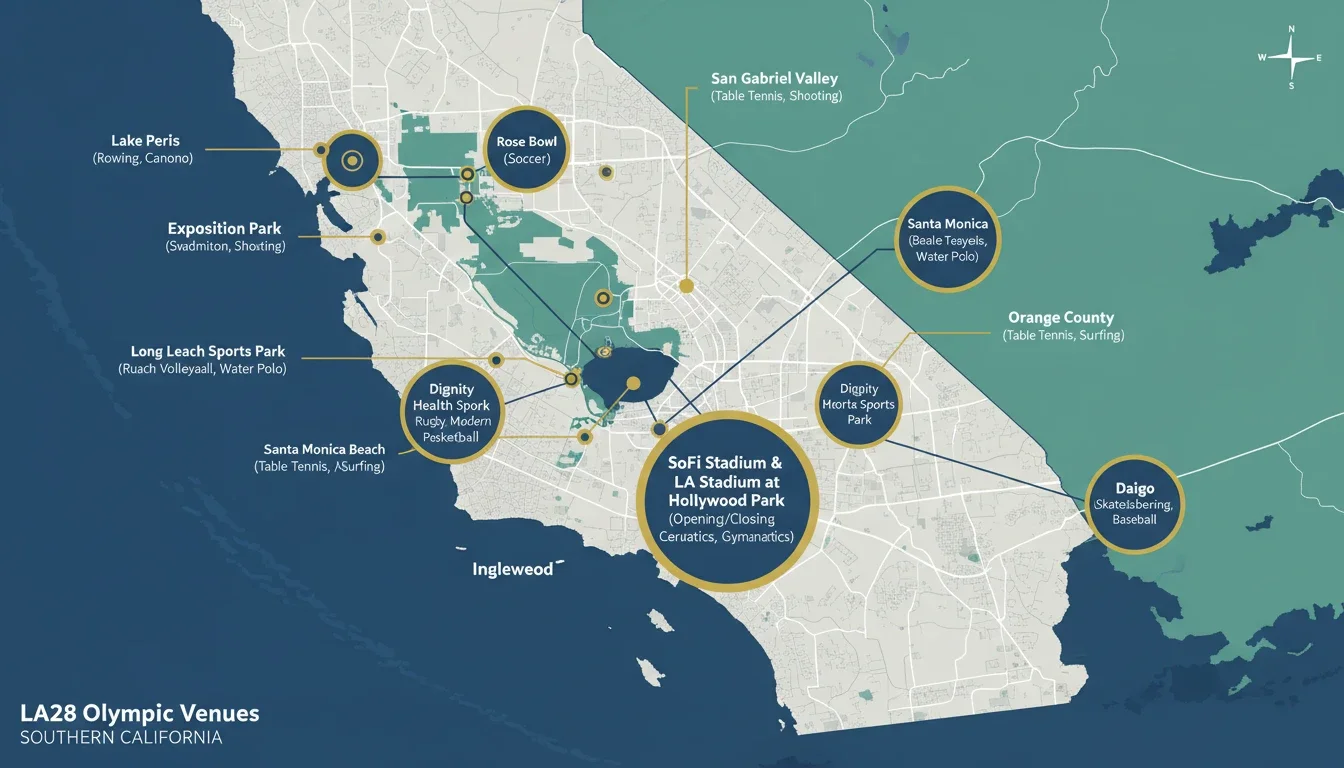
Map of LA28 Olympic venues across Southern California showing the geographic spread of competition sites from SoFi Stadium to the Rose Bowl.
The Key Components of a High-Impact Olympic Brand Activation
Regardless of your budget tier or sponsorship level, high-performing Olympic brand activations share a consistent set of core elements. Understanding these components lets you design and resource your activation intentionally rather than reactively.
Location, Location, Location — Selecting Your Activation Zone
Your activation's physical location relative to competition venues, fan zones, hospitality hubs, and transportation corridors determines your foot traffic potential more than almost any other factor. The best locations in any Olympic host city are typically within easy walking distance of primary fan zones, on major transit routes, and in areas with natural dwell time (restaurants, hotels, retail districts).
For LA 28, key activation zones are likely to emerge around SoFi Stadium and the Inglewood corridor, in Downtown Los Angeles around Crypto.com Arena, along the Long Beach waterfront, and in the Hollywood and West Hollywood areas that will serve as cultural hubs during the Games. Securing space in these areas — even a sidewalk activation permit — requires early planning and local relationships.
Creative Experience Design
The most important question to ask early in the planning process is: what do I want people to feel, do, and share? The best activations are built around a single clear emotional arc. Are you making people laugh? Inspiring them? Surprising them? Giving them something genuinely useful? The creative concept should flow directly from this emotional intention, and every physical element — the structure, the branded collateral, the interactive moments — should reinforce it.
Increasingly, activations are designed to live equally well in vertical video. If an experience isn't camera-ready for TikTok and Instagram Reels, it's not ready for launch. Build content capture into the design, not as an afterthought.
The Staffing Layer — Why Your People Are the Activation
This is where many first-time sponsors underestimate the operational reality. The most beautiful activation built in the world will fall flat without the right people executing it. Your brand ambassadors, greeters, hospitality leads, and engagement staff are the living embodiment of your brand in that moment. They're the ones making eye contact, starting conversations, handing over samples, capturing content, managing flow, and creating the emotional memory that outlasts the event.
Under-staffing an activation — or staffing it with untrained, misaligned people — is one of the most common and costly mistakes first-time Olympic sponsors make. At a typical activation footprint, plan for more staff than you think you need, with clear role assignments for brand engagement, logistical support, content capture, and flow management.
Content Capture Strategy
Your activation is a content production opportunity. Every moment — athlete meet-and-greets, product interactions, crowd reactions, big reveal moments — can become social content, earned media, and campaign assets. Plan for a dedicated on-site content team (videographers, social editors, real-time publishing) as well as staff who are specifically trained to facilitate organic social capture by attendees. Photo moments, QR-triggered AR experiences, and shareable branded backdrops are proven tools for extending your activation's reach far beyond the immediate audience.
Measurement and ROI Tracking
Define your success metrics before you spend a dollar on creative. Are you measuring brand awareness lift? Social impressions? Foot traffic count? Product trials? Lead generation? Media coverage? Different activation types optimize for different outcomes, and knowing your priority metric shapes every design decision. Post-activation analysis should also capture qualitative signals — what did people say, what did they share, what was the dominant emotional tone of the coverage?
How to Staff an Olympic Brand Activation
Professional staffing is one of the most operationally critical — and commonly under-planned — elements of any Olympic activation. For a first-time sponsor unfamiliar with this scale of event, the staffing requirements can be surprising. Here's how to think about it.
Brand Ambassadors — The Face of Your Activation
Brand ambassadors are your primary customer-facing staff. They represent your brand in every interaction — warmth, product knowledge, energy, and on-brand communication are non-negotiable qualities. For an Olympic activation, you want ambassadors who are comfortable in high-traffic, high-energy environments, capable of working long shifts (often 8-12 hours), and skilled at converting brief encounters with strangers into genuine brand impressions.
Top-tier event staffing agencies like Eleven8 select from only the top 3.5% of applicants, specifically because brand ambassador quality has a direct, measurable impact on activation outcomes. An ambassador who is genuinely engaging and professionally presented creates 10x the impression of someone who is merely physically present.
Hospitality and VIP Staff
If your activation includes a hospitality component — a suite, a branded lounge, a private dinner, a media reception — you need professional hospitality staff who understand the expectations of VIP environments. This includes experience with high-profile guests, discretion, service sequence, and the ability to manage unexpected situations gracefully. For activations hosting athletes, media personalities, or C-suite clients, the standard must be unambiguously premium.
Registration and Flow Management
Any activation that draws significant volume — whether a ticketed event, an RSVP experience, or a high-demand product sampling program — needs dedicated staff for registration, check-in, queue management, and crowd flow. These roles are often undervalued in activation planning and then become the source of the most negative guest experiences when under-resourced. A guest who waits 45 minutes to enter your activation is not forming positive brand associations.
How Many Staff Do You Actually Need?
There is no universal formula, but here are practical guidelines for common Olympic activation types:
Small pop-up or sampling activation (50-200 daily visitors): 4-8 brand ambassadors + 1-2 logistics/support staff + 1 on-site captain
Medium public fan zone footprint (200-1,000 daily visitors): 10-20 brand ambassadors + dedicated registration, content, and flow staff + operations lead
Large hospitality suite or official partner space (150+ guests per session): 8-15 hospitality staff + registration + executive hosting staff + back-of-house support
Multi-venue or touring activation: Each site scaled individually + centralized coordination team
Always add 10-15% buffer staffing to account for last-minute unavailability. At Olympic scale, where timelines are compressed, and stakes are high, redundancy is not a luxury — it's operational hygiene.
Working With a Professional Staffing Partner
For a first-time Olympic sponsor, partnering with an event staffing agency that has direct experience with major sports sponsorship activations is strongly advisable. An experienced partner can help you build the right team structure, manage scheduling logistics across multiple event days, provide contingency staff, and ensure that every person representing your brand has been properly vetted, briefed, and prepared.
As a preferred staffing partner for the LA 28 Olympic and Paralympic Games, Eleven8 provides brand ambassadors, greeters, promotional models, and experiential staff specifically trained for Olympic sponsor activations across Los Angeles.
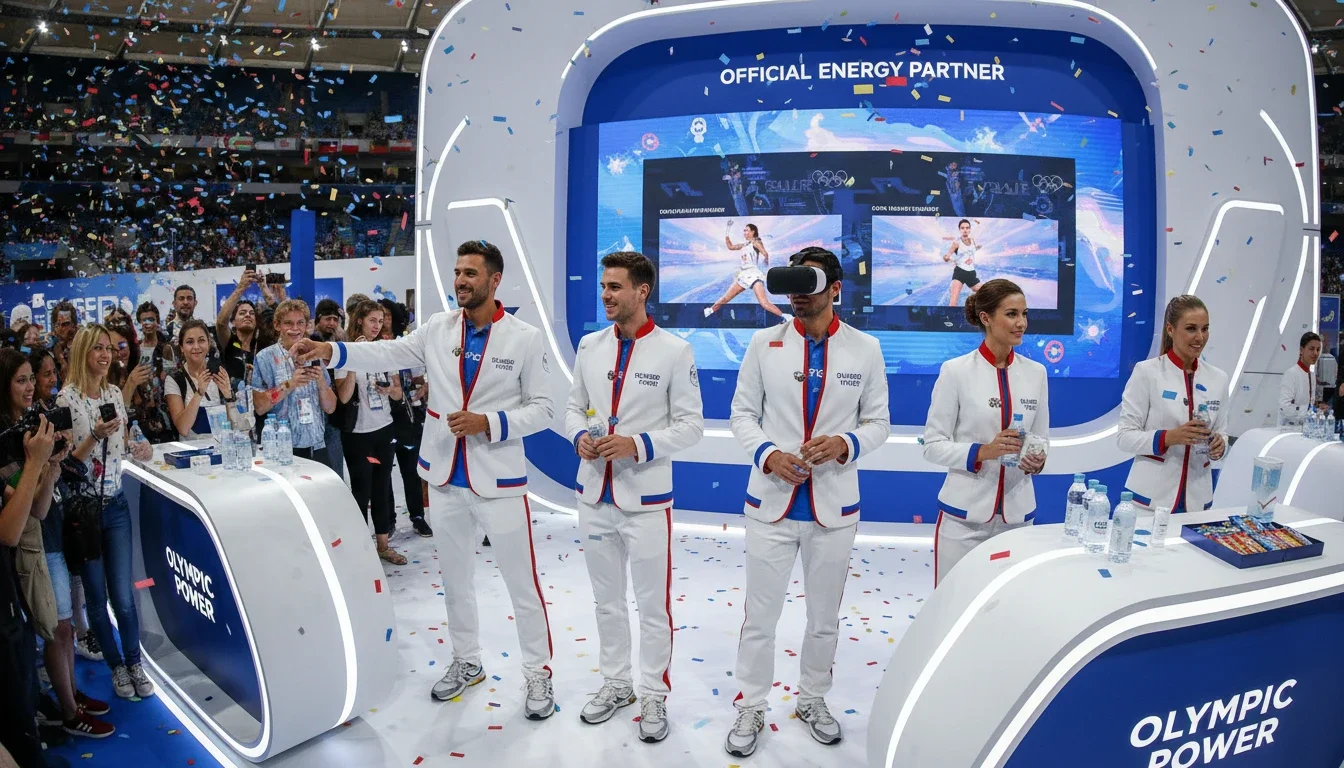
Professional brand ambassadors in branded uniforms engaging with event attendees at an Olympic sponsor activation.
A Timeline for First-Time Olympic Sponsors
One of the most common questions we hear from brands new to Olympic sponsorship is: when should I start? The honest answer is: you're already behind — but it's not too late to execute well if you begin now and plan systematically. Here's a realistic production timeline.
18-24 Months Out (Now — for LA 28)
Confirm sponsorship rights package and understand exactly what activation rights you hold
Begin location scouting and preliminary venue/site conversations
Engage a creative agency or experiential production partner
Begin conversations with the event staffing agency for staff projections and early commitment
Identify your activation budget and ROI measurement framework
Start monitoring LA28's official activation zones and partner programming
12 Months Out
Finalize activation concept and creative direction
Lock in physical location(s) and begin permitting process
Confirm staffing agency partnership and agree on scope and pricing
Begin athlete and talent negotiations if relevant to the activation
Develop a content strategy and social media amplification plan
Submit all required documentation to the relevant authorities (city permits, IOC brand guidelines review if applicable)
6 Months Out
Finalize physical build design and production vendors
Confirm staff headcount, roles, and scheduling structure
Begin staff recruitment and vetting process with staffing partner
Run pre-event staff briefings and brand training
Finalize all logistics: transportation, storage, security, catering
Conduct risk assessment and contingency planning
30-60 Days Out
Conduct site visits and final production checks
Complete staff uniform and branded materials procurement
Run a full activation dress rehearsal where possible
Finalize real-time content capture schedule and team deployment
Brief all staff on brand values, activation goals, and their specific responsibilities
Confirm all vendor relationships and on-site contact lists
Week-Of and On-Site
Deploy the activation captain and the management team first for setup oversight
Conduct daily staff briefings covering the day's program and any changes
Maintain a real-time communication channel between the on-site captain and central operations
Document everything — social content, attendance counts, media appearances, incident reports
Adapt in real time — something will change from the plan, and the ability to pivot gracefully is what separates great activations from good ones
Reference: Why brands need to act now for LA28 — Marketing Week
Ready to Activate? Start With the Right Team
An Olympic brand activation is, at its core, a human experience. The creative concept matters. The location matters. The timing matters. But what attendees will remember — what will shape their lasting impression of your brand — is the people they interacted with, the service they received, and the way they felt in the moments your activation created.
For brands activating at the LA 28 Olympic and Paralympic Games, Eleven8 is a preferred staffing partner with the experience, the roster, and the operational infrastructure to help you execute at Olympic standard. From brand ambassadors and hospitality staff to registration teams and on-site coordinators, we've staffed over 10,000 events for clients including Nike, The Academy, Adidas, Versace, and Netflix — and we're ready to help your brand show up on the world's biggest stage.