The Ultimate LA 2028 Olympics Brand Activation Checklist: Staff, Logistics, and Execution
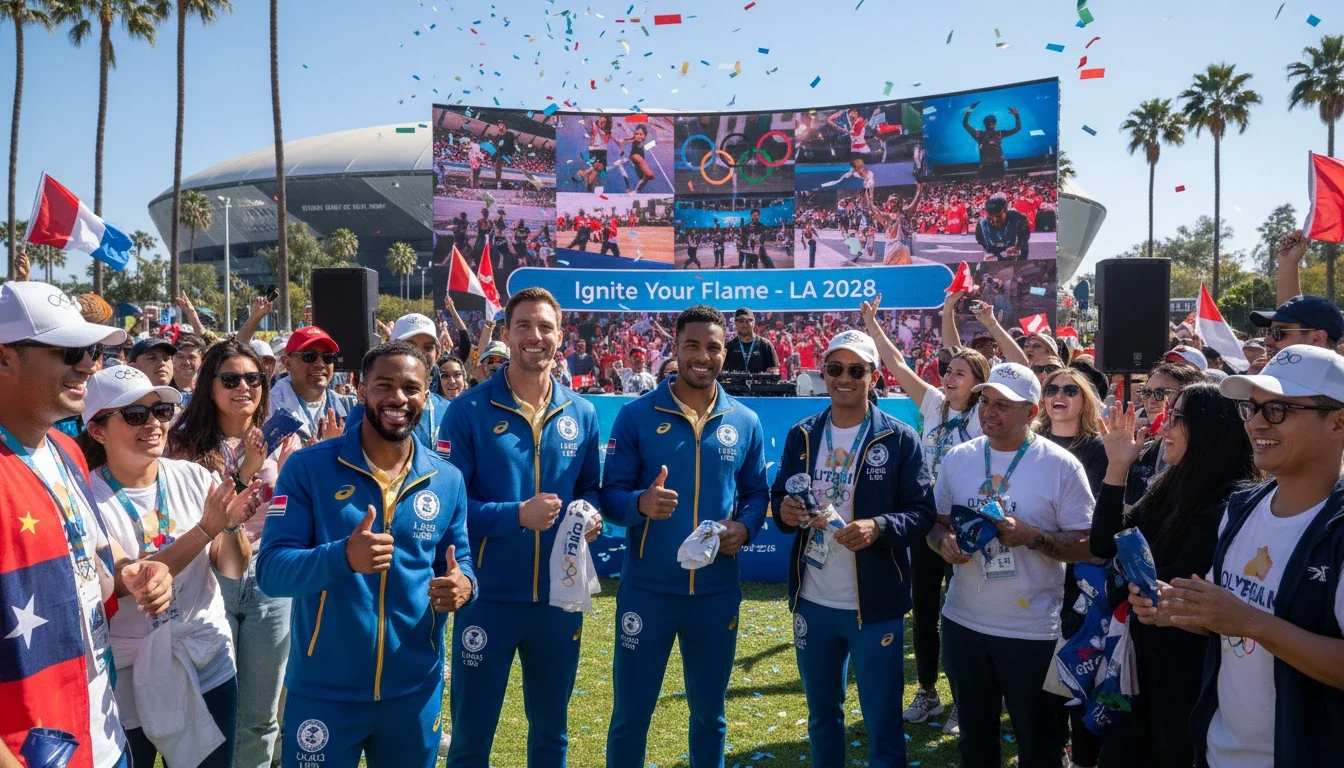
A professional brand ambassador team engaging Olympic fans at a high-energy Los Angeles activation.
The Los Angeles 2028 Olympic Games are not just a sporting event. It is the most concentrated moment of global attention your brand may ever get the chance to operate within — two weeks where billions of people worldwide have their eyes locked on a single city.
But here is what separates the brands that capitalize on the Olympics from the ones that throw money at it and come up empty: execution. Strategy gets you to the activation. Staffing, logistics, and operational precision get you through it — and make it memorable enough to matter.
Whether your brand is an official Olympic sponsor, a category partner, or an independently activated brand leveraging the cultural gravity of the games, the checklist that follows is designed to walk you through every phase of planning and execution. No fluff. No generic advice. Just the specific, actionable steps that separate a world-class activation from a costly disappointment.
Eleven8 Event Staff is a preferred staffing partner for the LA 2028 Olympic Games, with over 30 years of experience supporting brand activations at some of the largest events in the world. This guide reflects operational frameworks developed through that hands-on experience.
Why Brand Activation Planning Starts Now — Not in 2027
Two years sounds like a long runway. In Olympic brand activation terms, it is not. The brands that succeed at the LA 2028 Games are not the ones who scramble with six months to go. They are the ones already locking in venues, building relationships with local authorities, and securing staffing partnerships while competitors are still in the ideation phase.
Los Angeles presents unique logistical challenges that other Olympic host cities simply do not. It is a sprawling, decentralized metropolitan area spanning hundreds of square miles with notoriously complex permitting, no centralized transit network, and event venue clusters spread from SoFi Stadium in Inglewood to the Coliseum in Exposition Park to Santa Monica Pier to Crypto.com Arena in Downtown LA.
Layered on top of that, Olympic activations must navigate strict IOC brand guidelines that govern how — and how close to official venues — non-sponsor brands can activate. Understanding the boundaries, both legal and geographical, early is not just advisable. It is essential.
The Olympic Activation Timeline Brands Need to Follow
The most successful Olympic activations follow a phased planning model that begins roughly 18 months before Opening Ceremonies. Think of it in five phases:
12–18 Months Out: Strategic planning, goal setting, budget allocation, location scouting
6–12 Months Out: Staffing partnerships, creative development, permit applications, vendor contracting
3–6 Months Out: Staff training and briefing, logistics finalization, tech setup, content strategy
Week of Event: Final walkthroughs, staff check-ins, real-time monitoring systems
Post-Event: Debrief, measurement, content amplification
Understanding Official vs. Non-Official Sponsorship Activation
If your brand is an official LA28 partner or sponsor — and with over $2 billion in sponsorship commitments already secured, those rosters are largely set — you have access to official activation zones, Olympic IP rights, and co-marketing opportunities through channels like the NBCUniversal partnership.
If your brand is not an official sponsor, you can still activate powerfully around the Games. "Olympic-adjacent" activations, fan zone experiences, pop-ups near transport hubs, and cultural events within the broader LA community are all viable. The key is understanding IOC Rule 40 guidelines that restrict the use of Olympic words, imagery, and athlete-specific content by non-sponsors. Smart brands work with legal counsel early to map out what is and is not permissible.
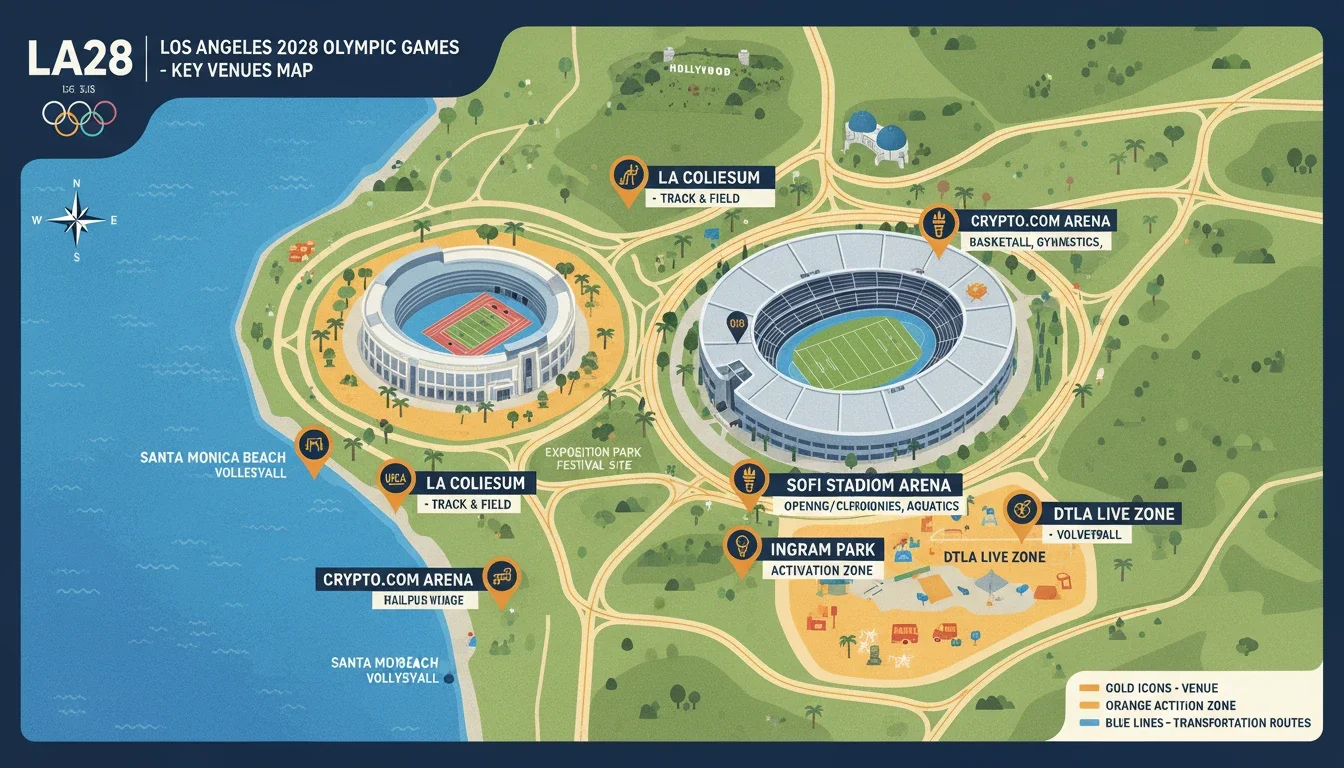
Map of key LA 2028 Olympic venues including SoFi Stadium, the Coliseum, and Crypto.com Arena with surrounding activation zones.
Phase 1 — Strategic Planning Checklist (12–18 Months Out)
This is the foundation phase. Every decision made here — or missed here — cascades through everything that follows. Rushing through strategic planning to get to the "exciting" parts of production is where most brands create problems that no amount of great staffing can fix.
Define Your Activation Goals and KPIs
Before you book a venue, hire a single person, or brief a creative team, you need clarity on what success looks like. Olympic activations are expensive and resource-intensive. They deserve real strategic rigor.
Determine your primary objective: brand awareness, lead generation, product sampling, media coverage, or social content
Define measurable KPIs: foot traffic targets, social impressions, media mentions, sampling volume, conversion rates
Establish your audience: tourists, locals, international fans, media, trade partners, or a combination
Set a clear budget envelope including contingency (minimum 15% buffer for Olympic-scale activations)
Align internally on brand messaging and activation narrative before any vendor conversations begin
Location Scouting and Venue Selection in Los Angeles
Los Angeles is vast. Where your activation lives determines everything — foot traffic, permitting complexity, staff requirements, and media opportunity. Olympic fans will concentrate around venue clusters, transit corridors, and fan zones established by LA28.
Map the primary venue clusters: Inglewood (SoFi Stadium), Exposition Park (Coliseum, BMO Stadium), Downtown LA (Crypto.com Arena, Convention Center), Santa Monica/Venice Beach
Identify high-footfall transit points: LA Metro Olympic corridors, Union Station, major hotel districts
Evaluate activation formats for each location: pop-up structures, mobile units, permanent retail activations, rooftop experiences, or street-team deployments
Research zoning regulations and special event overlay districts for each target area
Visit shortlisted locations in person during comparable large events (Super Bowl week, major concerts) to evaluate real-world foot traffic and logistics
Budgeting for an Olympic-Scale Activation
Olympic activations at LA 2028 will face premium pricing across every vendor category. Venue rentals, permits, production labor, talent, and experiential technology costs will reflect the scarcity and demand of a once-in-a-generation event. Build your budget with eyes open.
Venue costs: Factor 2–5x multipliers over standard event pricing for the Games period (July 14 – August 12, 2028)
Staffing: Budget for quality over quantity — trained, experienced staff outperform larger untrained teams at a fraction of the risk. Staffing typically represents 20–35% of a brand activation budget
Production: Set builds, technology, signage, and experiential elements
Permits and insurance: LA County and City permits for outdoor brand activations can involve multiple agencies — LA Public Works, LADOT, LA Parks & Rec — and should be budgeted with legal guidance
Contingency: 15–20% minimum for Olympic-period activations due to weather, logistical disruptions, and competitive market dynamics
Navigating Permits, Insurance, and IOC Brand Guidelines
This is the phase where brands most commonly underestimate both timeline and complexity. LA's permitting process involves multiple city and county agencies that do not always move quickly, and Olympic-period applications will face high volume.
Begin permit applications at a minimum of 6–9 months before the activation date
Obtain all required certificates of insurance before permit submissions (general liability, workers' comp, event cancellation)
Work with a local entertainment attorney to review activation creative against IOC Rule 40 requirements
If using outdoor structures, check ADA compliance and city structural review requirements
Coordinate with neighborhood councils and community stakeholders for activations in residential-adjacent areas
Phase 2 — Staffing Checklist (6–12 Months Out)
Your activation can have a stunning build, a prime location, and a perfect strategy. If the staff on the ground cannot execute it — or worse, leave attendees with a negative impression — none of it matters. At the Olympic level, staffing is your single highest-leverage execution variable.
This is also the phase where delay costs you significantly. Elite event staff agencies book up fast for signature events, and Olympic Games staffing demand will begin outpacing supply at least 12 months before the Opening Ceremony.
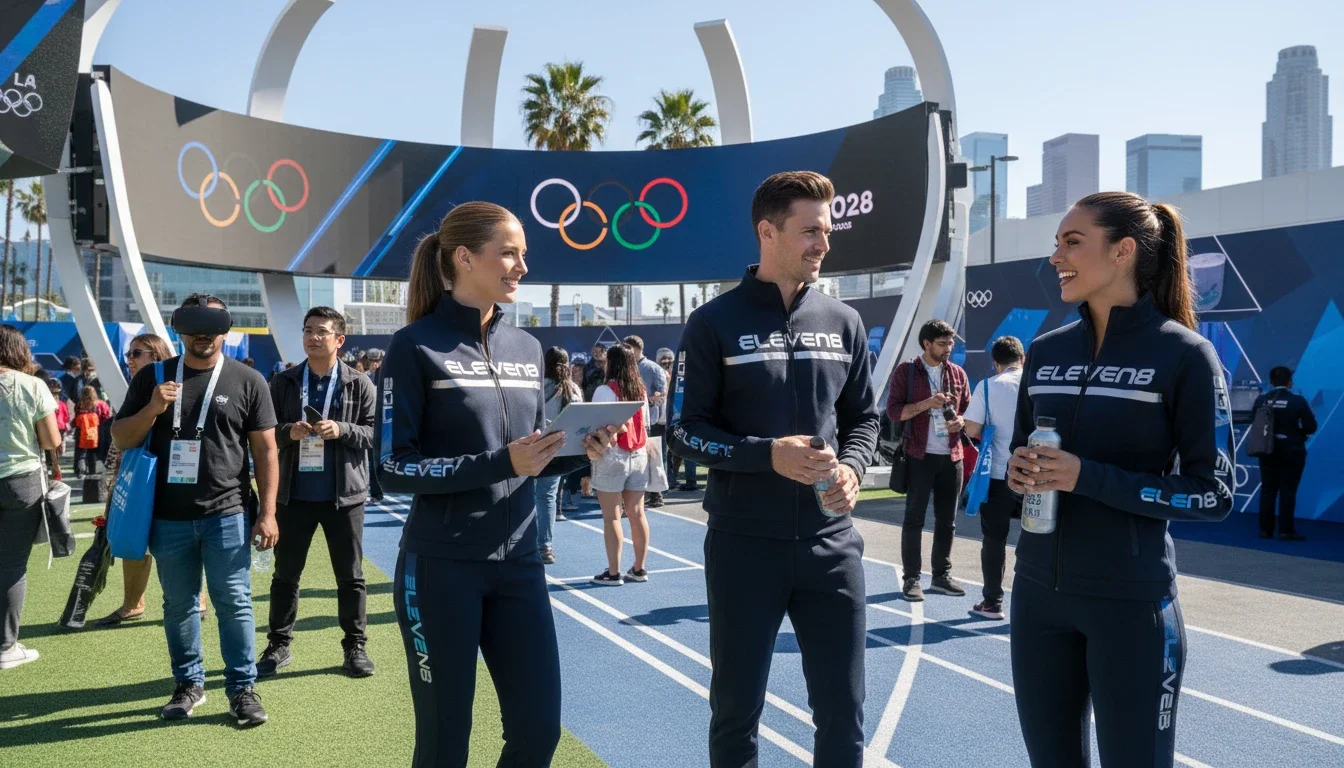
Professional Eleven8 brand ambassadors in branded uniforms engaging Olympic attendees at a Los Angeles activation event.
How Many Staff Does an Olympic Activation Need?
Staff-to-attendee ratios vary significantly by activation type, but the following benchmarks provide a starting framework for Olympic-scale brand activations:
Street team/sampling activation: 1 staff per 50–75 anticipated hourly contacts
Pop-up brand experience: 1 ambassador per activation station or interactive element, plus dedicated supervisor per 8–10 staff
Hospitality suite or lounge: 1 staff per 15–20 guests for premium experiences
Registration or check-in: 1 registration staff per 75–100 anticipated hourly arrivals
Large fan zone or multi-zone activation: Dedicated zone captains for each activation area, plus floating supervisors and a central logistics coordinator
Always add 10–15% buffer to your staffing plan for unplanned absences, volume surges, or role reassignments.
Key Roles to Hire for a Brand Activation
A well-structured Olympic brand activation team typically includes the following roles:
Brand Ambassadors: The core face-to-face engagement team — welcoming, demonstrating, sampling, photographing, and creating positive brand impressions
Event Captain / Supervisor: On-site team leader responsible for staff coordination, problem resolution, and real-time communication with your agency partner
Registration / Check-in Staff: Essential for ticketed or gated experiences — manages guest flow, data capture, and wristbanding
Hospitality Staff: For lounge, suite, or dining experiences — serving, guiding, and attending to VIP or guest needs
Logistics / Run-of-Show Coordinator: Manages scheduling, vendor arrivals, setup oversight, and operational flow
Content Staff: On-site social media managers or photographers who capture and post content in real time
Floater Staff: Flexible, experienced team members who fill gaps, relieve other staff, and address unexpected needs
What to Look for in Your Olympic Activation Staff
At the Olympic Games, your staff is your brand. International audiences, global media, and high-net-worth event goers will form lasting impressions based entirely on the human interactions your team creates. This is not the event to book on price alone.
Multilingual capability: LA 2028 will draw visitors from over 200 countries. Staffing agencies with multilingual talent rosters provide a measurable experiential advantage
High-pressure experience: Look for staff with backgrounds in major sporting events, conventions with 50,000+ attendees, or premium brand campaigns
Brand training capability: Your agency should be able to brief and train staff thoroughly on your brand narrative, product, and engagement approach — not just hand them a script
Insurance and compliance: All staff should be fully insured and legally certified for food and beverage handling, where applicable
Professional presentation and adaptability: Olympic activations move fast and change unexpectedly — experienced staff improvise gracefully under pressure
When and How to Book Your Event Staffing Agency
For the LA 2028 Olympics, the answer to "when should I book?" is: as soon as your activation concept is confirmed. Preferred staffing agencies for the Olympic Games are establishing partnerships 12–24 months in advance.
Identify 2–3 candidate agencies and evaluate their mega-event experience, LA market depth, and staff roster size
Request a detailed capabilities presentation — not just a rate card
Confirm the agency's Olympic or equivalent mega-event track record (Paris 2024, FIFA, Super Bowl, etc.)
Negotiate preferred partner terms for multi-day, multi-venue, or national-tour Olympic activations
Confirm your staffing contract includes contingency staffing provisions and prorated reimbursement for unforeseen gaps
Phase 3 — Logistics & Production Checklist (3–6 Months Out)
At this stage, your strategy is locked, your team is coming together, and the build gets real. The decisions made in this phase determine whether your activation runs smoothly on day one or spends the first 48 hours troubleshooting preventable problems.
Venue Logistics and Infrastructure Planning
Complete final venue measurements and produce accurate production drawings for all build elements
Confirm load-in, setup, and teardown schedules with venue management — Olympic-period venues will have compressed windows
Map staff arrival points, designated parking or transport stops, green rooms, and break areas
Finalize power, water, internet, and communications infrastructure requirements and confirm with venue
Establish clear emergency evacuation routes and safety protocols in coordination with venue security
Arrange dedicated waste management and cleaning protocols for multi-day activations
Technology, Signage & Brand Compliance
Finalize all signage, branded materials, and physical build elements — confirm compliance with IOC brand guidelines and venue restrictions
Install and test any interactive technology (AR experiences, QR systems, NFC integrations, projection mapping)
Set up real-time analytics systems: foot traffic counters, social listening dashboards, lead capture tools
Ensure all digital content assets are formatted for vertical video and mobile-first consumption
Test all AV equipment, microphone systems, and display screens under realistic venue conditions
Staff Training, Briefing & Brand Immersion
The most overlooked investment in brand activation staffing is training. Staff who understand your brand deeply — not just their job description — deliver exponentially better guest experiences.
Develop a comprehensive staff briefing deck covering brand story, activation narrative, key messages, FAQs, and on-brand language
Conduct in-person or video briefing sessions at a minimum of 48–72 hours before activation launch
Train all staff on activation layout, their specific role, escalation paths, and emergency procedures
Run a full activation walkthrough with staff on site the day before opening
Create role-specific reference cards or digital cheat sheets that staff can reference on-shift
Establish a clear communication chain: staff → event captain → agency coordinator → brand manager
Transportation, Accommodations, and Scheduling
Olympic-period Los Angeles will experience unprecedented transportation demand. Staff movement logistics alone can become a significant operational challenge if not planned carefully.
Map staff transport routes from common accommodation areas to activation sites, factoring in Olympic Games traffic and transit disruptions
Coordinate staff schedules around LA Metro Olympic service enhancements and temporary road closures
Build 30–45 minute transit buffers into all staff call times for Olympic-period conditions
Confirm accommodation arrangements for out-of-market staff well in advance — Olympic-period hotel inventory will be extremely constrained
Create a detailed run-of-show document covering every time block of your activation, with the responsible staff listed
Phase 4 — Execution Day Checklist (Week Of & Day Of)
Everything you have built in the prior phases now comes down to execution. The weeks and days immediately preceding your activation are where operational discipline pays off — and where small oversights become costly problems.
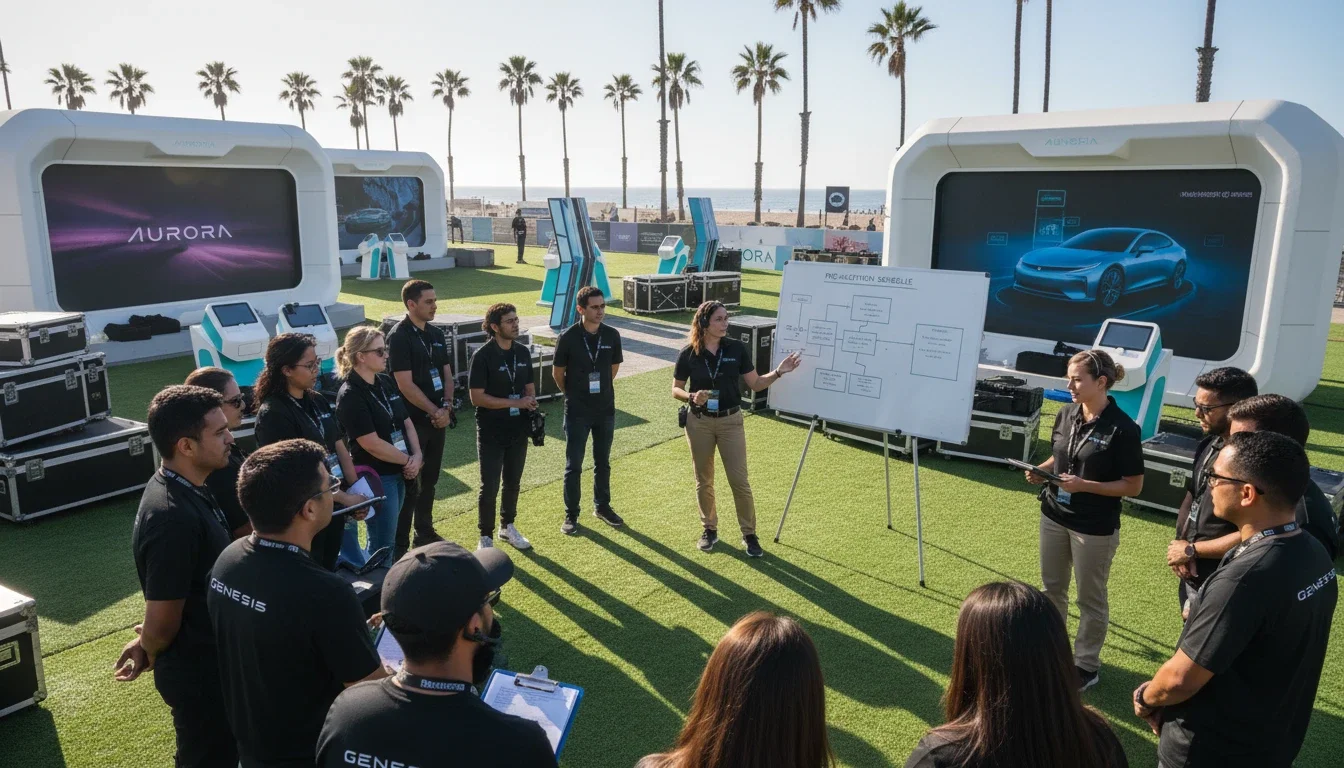
Pre-Event Day Walkthrough and Staff Briefing (48–72 Hours Before)
Conduct a full site walkthrough with the event captain, production lead, and agency coordinator
Walk every staff position and verbally confirm responsibilities, sightlines, and escalation procedures
Test all technology systems under load — check-in systems, interactive elements, and content capture equipment
Confirm all permits, certificates of insurance, and vendor documentation are on-site and organized
Verify staff schedules, confirm call times, and distribute final run-of-show documents
Identify and brief backup staff plans for potential no-shows or role gaps
Establish a dedicated communication channel for the activation team (group chat, radio, or walkie-talkie system)
Execution Day — First 2 Hours
Staff arrive at call time with a 30-minute minimum pre-opening buffer
The event captain conducts a full team check-in and confirms all positions are filled
Final technology and display system check
Briefing refresher on key messages and any day-specific updates
Confirm that crowd management entry and exit points are clearly marked
Verify all sampling, product, giveaway, or demonstration inventory is stocked and positioned
Live Event Management and Real-Time Problem Solving
No activation executes exactly as planned. The best activations are the ones where problems are caught early and resolved without attendees ever knowing they occurred.
Event captain conducts 30-minute check-ins with each zone throughout the day
Monitor crowd density and flow — redeploy staff to high-traffic areas proactively
Track and report real-time KPIs: estimated contacts, samples distributed, leads captured
Maintain a live issues log — document problems, solutions, and time of resolution
Ensure a direct line stays open between the on-site event captain and the brand manager throughout all operating hours
Do not wait for problems to escalate — early intervention is the hallmark of experienced event leadership
Content Capture and Social Amplification During the Activation
Assign a dedicated content staff member responsible solely for photography and video — do not leave this to ambassadors who are also managing guests
Post real-time content from approved branded accounts using pre-approved hashtags and messaging
Capture behind-the-scenes and staff-forward content — authentic activation content outperforms polished brand content in organic social
Script 2–3 designated "content moment" opportunities into the activation design — big reveals, interactive moments, crowd reactions
Collect user-generated content permissions for any attendee-forward content captured
Phase 5 — Post-Activation Checklist
The activation does not end when the doors close. How you close out — from staff debriefing to content amplification — determines a significant portion of the long-term ROI your brand extracts from the investment.
Staff Debrief and Performance Review
Conduct a full team debrief within 24 hours of activation close, while observations are fresh
Gather structured feedback from every team member: what worked, what did not, and what they would change
Review the agency coordinator's notes and the issues log from the event captain
Identify top-performing staff for preferred team shortlisting in future activations
Submit formal performance feedback to your staffing agency — this shapes the preferred team you build over the Olympic period
Measuring Activation Success Against KPIs
Compile all captured data: foot traffic counts, lead capture volume, social metrics, media mentions, and sampling numbers
Compare outcomes against KPIs established in Phase 1 — honest, granular assessment only
Conduct post-event surveys with a sample of attendees if possible — NPS or brief satisfaction scoring
Calculate cost per engagement, cost per lead, and earned media value against investment
Document lessons learned for any subsequent Olympic-period activations
Repurposing Content and Extending Activation Reach
A well-documented Olympic activation can continue generating brand value for weeks or months after the event itself through a smart content strategy.
Edit and publish recap content across brand social channels within 24–48 hours of activation close
Develop long-form recap content — blog posts, LinkedIn articles, case studies — that supports ongoing SEO and sales enablement
Distribute select content to media and trade press as part of a post-activation PR push
Submit activation for relevant industry awards and case study opportunities (Event Marketer EX Awards, PRWeek, ADWEEK)
LA 2028 Brand Activation Quick Reference Checklist
Use this condensed checklist as a rapid-reference planning tool across all five phases:
Phase 1: Strategic Planning (12–18 Months Out)
Define goals and KPIs
Begin location scouting across LA venue clusters
Establish an activation budget with 15–20% contingency
Begin permit and IOC brand guideline review
Phase 2: Staffing (6–12 Months Out)
Calculate staff numbers by activation type and ratio
Define all required staffing roles
Vet and contract your Olympic event staffing agency
Confirm multilingual capability and mega-event experience
Phase 3: Logistics & Production (3–6 Months Out)
Finalize venue logistics and infrastructure
Confirm technology, signage, and brand compliance
Develop and execute staff training program
Finalize transportation and scheduling
Phase 4: Execution (Week Of & Day Of)
Complete pre-event site walkthrough
Conduct full staff briefing and position walk
Activate live monitoring and communication systems
Deploy content capture staff
Phase 5: Post-Activation
Complete staff debrief within 24 hours
Measure results against KPIs
Publish recap content and amplify through PR
How Eleven8 Supports Olympic Brand Activations in Los Angeles
Eleven8 Event Staff has been designated as a preferred staffing partner for the LA 2028 Olympic Games — a distinction that reflects not just capability, but a deep understanding of what it takes to perform at the highest level of international events.
Over more than three decades in the Los Angeles event staffing market, Eleven8 has supported brand activations at some of the world's most high-profile events, including partnerships with Nike, Netflix, The Academy, Adidas, and Porsche. The team has staffed events from intimate VIP gatherings to conventions exceeding 140,000 attendees.
For Olympic brand activations specifically, Eleven8 provides:
Elite brand ambassadors with multilingual capability for international audiences
Experienced event captains and supervisors who understand large-scale, fast-moving event environments
Hospitality and VIP concierge staff for sponsor suites and premium guest experiences
Registration and crowd management staff for high-volume activations
On-call 24/7 management support throughout the Olympic period
A preferred team-building model that lets brands work with the same consistent team across multiple activations
With only the top 3.5% of applicants admitted to the roster, Eleven8's staff are vetted professionals who know how to represent global brands with precision, composure, and genuine hospitality.
Ready to staff your LA 2028 Olympic brand activation? Connect with Eleven8 at elev8.la/la-2028-olympic-staffing or reach the team directly at hello@elev8.la.
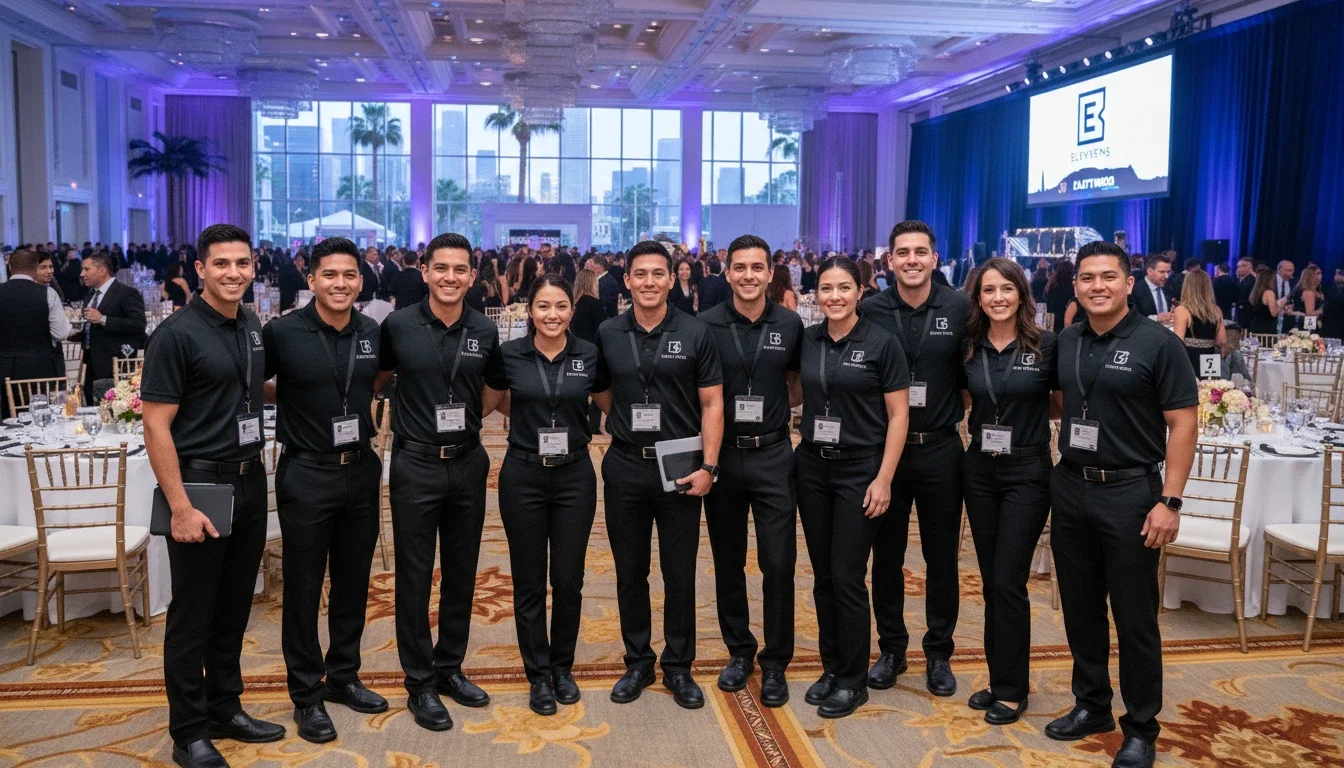
Eleven8 event staff team members in branded uniforms at a large Los Angeles corporate event.